The Asterix project Kit CB Roes UMC Utrecht On behalf of Armin - - PowerPoint PPT Presentation

the asterix project
SMART_READER_LITE
LIVE PREVIEW

The Asterix project Kit CB Roes UMC Utrecht On behalf of Armin - - PowerPoint PPT Presentation

The Asterix project Kit CB Roes UMC Utrecht On behalf of Armin Koch, Martin Posch, Ferran Torres, Hanneke vd Lee, Cor Oosterwijk, Egbert Biesheuvel, Caroline van Baal and all the researchers of the Asterix consortium Asterix Concept and


slide-1
SLIDE 1

The Asterix project

Kit CB Roes UMC Utrecht

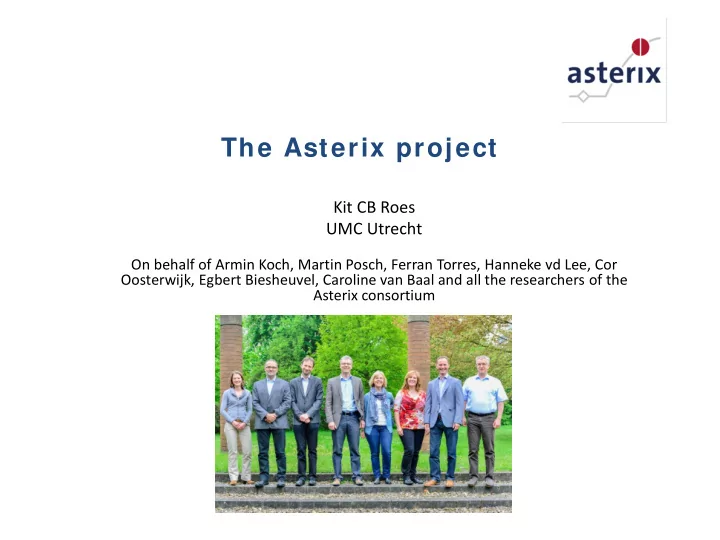
On behalf of Armin Koch, Martin Posch, Ferran Torres, Hanneke vd Lee, Cor Oosterwijk, Egbert Biesheuvel, Caroline van Baal and all the researchers of the Asterix consortium

slide-2
SLIDE 2

Asterix

  • Concept and objectives
  • Key progress and output to date
  • What is still ahead of us?
  • Towards guidance for practice
slide-3
SLIDE 3

Concept and objectives: Patients

In the meantime I passed away

slide-4
SLIDE 4

Concept and objectives: Call

slide-5
SLIDE 5

Patient Think Tank

Concept and objectives

slide-6
SLIDE 6

Collaboration

slide-7
SLIDE 7

Concept and objectives

Unique features in project execution

– Included developments beyond statistical methodology

  • Explore new clinically relevant endpoints
  • Ethical framework
  • Disease/condition framework
  • Models for patient involvement

– Regular interaction between patient representatives and researchers. – Strong focus on PhD projects: educate and train the next generation of clinical trial statisticians/methodologist.

slide-8
SLIDE 8

Key progress and output

Some highlights:

  • Stratification in small population trials
  • Goal Attainment Scaling
  • Sequential and adaptive trials in small populations
  • Multiple endpoints in small samples
  • Meta-analysis and borrowing of information (in sparse settings)
  • ………..
slide-9
SLIDE 9

Key progress and output

  • Guidance on design at disease level not practical (over 8000

rare diseases).

  • One general document may not provide sufficient guidance.
  • Framework with intermediate approach, driven by key

characteristics of medical conditions and treatment.

  • Developed based on about 100 EMA dossiers.
slide-10
SLIDE 10

Key output: Fram ew ork

Clinical course Acute Chronic

Single acute episode Repeated acute episodes Slow/ Non progressive Progressive led by

  • ne system/organ

Progressive multidimensional multiorgan Staged disease

Life threatening Fulminating Time to event If SOC, back to normal Repeated events Predictable course Clear-cut episodes Numer of events, time Single organ driven Life-long disease Predictable course, surrogates SOC generally available Adults, disabling Multidimensional single organ Patient reported outcomes, QoL Surrogates requiring validation Children, life lasting, registries Multidimensional multiorgan Patient/caregiver otucomes Poor SOC Poor prognosis Subgroups required Time to end-points Surrogates validated

Rare or very rare Frequency Ultrarare (<1/105)

slide-11
SLIDE 11

W hat is ahead of us?

Ongoing research: – In depth study of European Public Assessment Reports in

  • rphan drugs.

– Support potential of guidance for existing methodology and potential application of new methodology. – Using clustering of conditions as framework.

slide-12
SLIDE 12

W hat is ahead of us?

  • Generate information on key methodology

for patients (patient leaflets).

  • Patient perspective in recommendations.
  • About 8 PhD students to graduate.
  • Many already involved in rare disease

clinical trial projects (oncology, cystic fibrosis, ALS, transplantation medicine, Fanconi,....).

Patient Think Tank Next Gen and application

slide-13
SLIDE 13

Tow ards guidance for practice

Asterix will finish October 2017, with important results still to follow. Together with IDeAL and InSPiRe lay the ground work for renewed guidance.