The ASB's Audit Standards Clarity Project: h d d d l Prepare Now - - PowerPoint PPT Presentation

the asb s audit standards clarity project h d d d l
SMART_READER_LITE
LIVE PREVIEW

The ASB's Audit Standards Clarity Project: h d d d l Prepare Now - - PowerPoint PPT Presentation

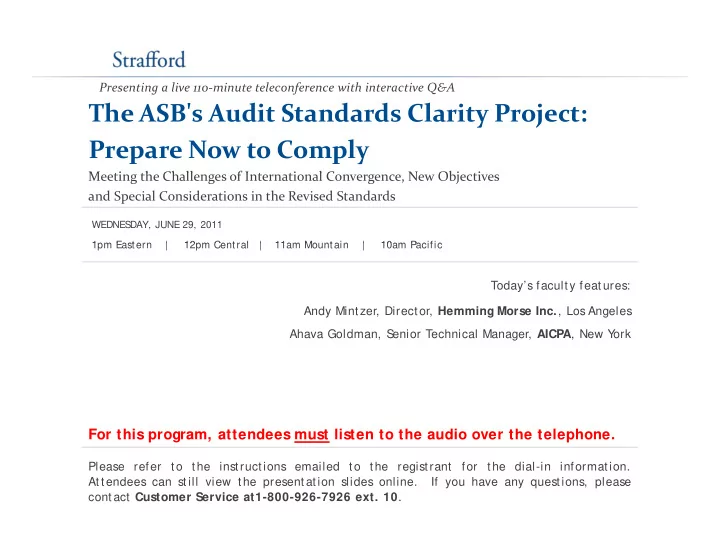
Presenting a live 110 minute teleconference with interactive Q&A The ASB's Audit Standards Clarity Project: h d d d l Prepare Now to Comply Meeting the Challenges of International Convergence, New Objectives M ti th Ch ll f I t ti l


slide-1
SLIDE 1

h d d d l

Presenting a live 110‐minute teleconference with interactive Q&A

The ASB's Audit Standards Clarity Project: Prepare Now to Comply

M ti th Ch ll f I t ti l C N Obj ti Meeting the Challenges of International Convergence, New Objectives and Special Considerations in the Revised Standards

1pm Eastern | 12pm Central | 11am Mountain | 10am Pacific WEDNES DAY, JUNE 29, 2011

Today’s faculty features:

1pm Eastern | 12pm Central | 11am Mountain | 10am Pacific

Andy Mintzer Director Hemming Morse Inc. Los Angeles Andy Mintzer, Director, Hemming Morse Inc., Los Angeles Ahava Goldman, S enior Technical Manager, AICPA, New Y

  • rk

For this program, attendees must listen to the audio over the telephone.

Please refer to the instructions emailed to the registrant for the dial-in information. Attendees can still view the presentation slides online. If you have any questions, please contact Customer Service at1-800-926-7926 ext. 10.

slide-2
SLIDE 2

Conference Materials

If you have not printed the conference materials for this program, please complete the following steps:

  • Click on the + sign next to “ Conference Materials” in the middle of the left-

hand column on your screen hand column on your screen.

  • Click on the tab labeled “ Handouts” that appears, and there you will see a

PDF of the slides for today's program.

  • Double click on the PDF and a separate page will open.

Double click on the PDF and a separate page will open.

  • Print the slides by clicking on the printer icon.
slide-3
SLIDE 3

Continuing Education Credits

FOR LIVE EVENT ONLY

Attendees must listen to the audio over the telephone. Attendees can still view the presentation slides online but there is no online audio for this program. Please refer to the instructions emailed to the registrant for additional

  • information. If you have any questions, please contact Customer Service

at 1-800-926-7926 ext. 10. at 1 800 926 7926 ext. 10.

slide-4
SLIDE 4

Tips for Optimal Quality

S d Q lit S

  • und Qualit y

For this program, you must listen via the telephone by dialing 1-866-873-1442 and entering your PIN when prompted. There will be no sound over the web connection. co ect o . If you dialed in and have any difficulties during the call, press *0 for assistance. Y

  • u may also send us a chat or e-mail sound@

straffordpub.com immediately so we can address the problem. Viewing Qualit y To maximize your screen, press the F11 key on your keyboard. To exit full screen, press the F11 key again press the F11 key again.

slide-5
SLIDE 5

The ASB Audit Standards Clarity P j t P N T C l Project: Prepare Now To Comply Seminar

June 29, 2011 Ahava Goldman, AICP A agoldman@ aicpa.org Andy Mintzer, Hemming Morse Inc. andy@ mintzercpa.com

slide-6
SLIDE 6

Today’s Program

Convergence And Timetable [Andy Mint zer] Clarity Drafting Conventions [Ah G ld S lide 7 – S lide 12 S lide 13 – S lide 20 [Ahava Goldman Impacts Of Clarity, Conventions On S pecific S tandards, Part I [Andy Mint zer] Impacts Of Clarity, Conventions On S pecific S tandards, Part II S lide 21 – S lide 26 S lide 27 – S lide 33 [Ahava Goldman] Impacts Of Clarity, Conventions On S pecific S tandards, Part III [Andy Mint zer] Planning And Training S teps S lide 39 – S lide 44 S lide 34 – S lide 38 Planning And Training S teps [Ahava Goldman] S lide 39 S lide 44

slide-7
SLIDE 7

CONVERGENCE AND

Andy Mintzer, Hemming Morse Inc.

CONVERGENCE AND TIMETABLE

slide-8
SLIDE 8

Clarity

Background

  • Discussion paper issued March 2007
  • ASB considered comments received and approved direction

pp going forward August 2007 Goals Goals

  • Address concerns over length and complexity of standards
  • Make standards easier to read, understand and implement

Will l d t h t i dit lit

  • Will lead to enhancements in audit quality

8

slide-9
SLIDE 9

Clarity And Convergence C a ty d Co e ge ce

Convergence? S S G O C O

  • IAASB, ASB, GAO, PCAOB

Convergence with ISAs

  • Harmonize, not adopt
  • Most audits performed internationally are of non-public

entities; therefore, ASB and IAASB have a similar focus.

  • Avoid unnecessary differences with PCAOB

y

  • ASB standards: More “shoulds” than ISAs, but less than

existing SASs

9

American Institute of CPAs

slide-10
SLIDE 10

Clarity Project

58 AU sections

  • Three withdrawn
  • 37 redrafted to corresponding SAS
  • 7 combined into one new SAS

7 combined into one new SAS

  • 11 combined/split into 9 SASs

Will b l d b 47 SAS Will be replaced by 47 new SASs

  • AU section numbers will be changed to converge with ISA

numbering Effective for audits of periods ending on or after 12/15/2012

10

slide-11
SLIDE 11

Current Status Of Projects (As Of 5/23/11) j ( )

Fi l E d D ft Final Exposed Draft

SASs 117‐120 F/S for Another C t Internal Auditors 117 120 SAS 122 Country Alert to SAS 122 (39 SASs) Alert to Intended Use Going Concern

11

American Institute of CPAs

slide-12
SLIDE 12

Codification

Two volumes – extant and clarified

  • Codification numbers set by SAS No. 122

“Extras”

  • Preface
  • Cross reference old AU numbers to new AU numbers
  • Cross-reference old AU numbers to new AU numbers
  • Summary of differences between SASs and ISAs
  • Glossary

12

slide-13
SLIDE 13

CLARITY DRAFTING

Ahava Goldman, AICPA

CLARITY DRAFTING CONVENTIONS

slide-14
SLIDE 14

Clarity Drafting Conventions y g

Introduction Objective D fi i i Definitions Requirements Application material

  • Integral part of standard – auditors required to read and

d t d understand Appendices and exhibits

14

slide-15
SLIDE 15

Common Misconceptions

Difference between must and should Difference between must and should

  • Must = is required to do action
  • (always do action, exactly as prescribed)

Sh ld i i d t d [ ti ]

  • Should = is required to do [action]
  • (always do action, but on rare occasions not exactly as

prescribed) Application material is integral part of standard; auditor is required to understand it

15

slide-16
SLIDE 16

Geographical Change Geog ap ca C a ge

E l f t i l d t f AU ti

Extant Clarified

Example of material moved out of an AU section

AU 329 ‐ Analytical Procedures ‐ Planning the audit AU 315 ‐ Understanding the Entity and Its Environment ‐ Planning the audit g ‐ Substantive tests g AU 520 ‐ Analytical Procedures ‐ Substantive tests

16

American Institute of CPAs

slide-17
SLIDE 17

Geographical Change (Cont.) Geog ap ca C a ge (Co t )

Understanding the entity and Its environment (new AU 315) will now contain this t i l i l f d i th AU ti

Example of additional material now found elsewhere

material previously found in other AU sections AU 326 ‐ Audit Evidence ‐ Auditor’s use of assertions in obtaining evidence AU 329 A l i l P d AU 329 ‐ Analytical Procedures ‐ Analytical procedures used in planning

17

American Institute of CPAs

slide-18
SLIDE 18

Clarity Format Clarity Format

Example of clarity changes: The Auditor’s Communication With Those Charged With

Extant New And Clarified

Communication With Those Charged With Governance

Extant New And Clarified 65 paragraphs 14 paragraphs of “requirements” 45 paragraphs of “application guidance” Auditor actions: Auditor actions: Auditor actions: One “must” 34 “shoulds” Auditor actions: 21 “shoulds”

18

American Institute of CPAs

slide-19
SLIDE 19

Changes From Extant Standards C a ges

  • ta t Sta da ds

No substantive changes to requirements for:

  • Audit documentation
  • Auditor’s communication with those charged with governance
  • Risk assessment standards
  • External confirmations
  • Analytical procedures
  • Audit sampling
  • Auditing accounting estimates
  • Auditing accounting estimates
  • Written representations
  • Subsequent events
  • Consideration of omitted procedures after the report release

date

19

American Institute of CPAs

slide-20
SLIDE 20

Changes From Extant Standards (Cont.) g ( )

Primary difference relates to group audit standard

  • More specific as to what group engagement partner is

responsible for Additional QC guidance

  • QC responsibilities for the audit more specifically described
  • Overall QC function remains “firm” responsibility, but

Overall QC function remains firm responsibility, but responsibilities are engagement partner’s and engagement team’s Some changes in audit report to more clearly describe management’s responsibility

  • New format to use report headings

20

American Institute of CPAs

  • New format to use report headings
slide-21
SLIDE 21

IMPACTS OF CLARITY,

Andy Mintzer, Hemming Morse Inc.

, CONVENTIONS ON SPECIFIC STANDARDS PART I STANDARDS, PART I

slide-22
SLIDE 22

Impact Of Selected Standards: Group Audits p p

OLD Part of the audit OLD “Principal NEW Group audit performed by

  • ther auditors

auditor” “Other auditor” Component auditor

22

American Institute of CPAs

slide-23
SLIDE 23

Impact Of Selected Standards: G A dit (C t ) Group Audits (Cont.)

  • Group and

component Materiality

  • Significant

components component

  • Make reference or

take responsibility

  • Group
  • Component

components

  • Individual significant

RMM

  • Not significant

Focus g Levels of Evidence Evidence

23

American Institute of CPAs

slide-24
SLIDE 24

Impact Of Selected Standards: Group Audits

Definitions Definitions

Group: “all the components whose financial information is included in the group financial statements A group always has more than one

  • statements. A group always has more than one

component.” Component: “an entity or business activity for which group or component management prepares financial information that should be included in the group information that should be included in the group financial statements.”

24

American Institute of CPAs

slide-25
SLIDE 25

Impact Of Selected Standards: Group Audits

Definitions (Cont ) Definitions (Cont.)

Group financial statements: “financial statements that include the financial information of more than

  • ne component.”

Principal auditor = group engagement partner group Principal auditor = group engagement partner, group engagement team, or auditor of the group financial

  • statements. “The partner or other person in the firm

h i ibl f th dit t who is responsible for the group audit engagement and its performance and for the auditor’s report on the group financial statements that is issued on g p behalf of the firm.”

25

American Institute of CPAs

slide-26
SLIDE 26

Impact Of Selected Standards: Group Audits (Cont.) p p ( )

Understanding of entity includes Extent group auditor will be able to be Decision to make entity includes components involved with component auditor reference Obtaining misstatements above Communications between group and Group auditor’s reporting of trivial noted by component auditor component auditor increased component auditor’s MW and SD

26

American Institute of CPAs

slide-27
SLIDE 27

IMPACTS OF CLARITY,

Ahava Goldman, AICPA

, CONVENTIONS ON SPECIFIC STANDARDS PART II STANDARDS, PART II

slide-28
SLIDE 28

Impact Of Selected Standards: Overall Objectives SAS Objectives SAS

No substantive changes from superseded sections

  • AU sections 110, 120, 150, 201, 210, 220 and 230

New structure

  • Overall objective of the auditor
  • Objective for each SAS
  • 10 standards superseded
  • 10 standards superseded

New terminology

  • Financial reporting framework
  • Applicable financial reporting framework
  • Fair-presentation framework

28

American Institute of CPAs

  • Regulatory and contractual-based framework
slide-29
SLIDE 29

Overall Objective Of An Auditor

In cond cting an a dit of financial statements the o erall objecti es of the In conducting an audit of financial statements, the overall objectives of the auditor are:

  • To obtain reasonable assurance about whether the financial

statements as a whole are free from material misstatement, whether due to fraud or error. Thus, the auditor can express an opinion on whether the financial statements are prepared in all material whether the financial statements are prepared, in all material respects, in accordance with an applicable financial reporting

  • framework. And:
  • To report on the financial statements and communicate as required

by GAAS, in accordance with the auditor’s findings

29

slide-30
SLIDE 30

Overall Objective Of An Auditor (Cont.)

To achieve the overall objectives of the auditor the auditor uses the To achieve the overall objectives of the auditor, the auditor uses the

  • bjectives stated in individual AU sections in planning and performing

the audit considering the interrelationships within GAAS, to:

  • Determine whether any audit procedures in addition to those
  • Determine whether any audit procedures in addition to those

required by individual AU sections are necessary in pursuance of the objectives stated in each AU section; and

  • Evaluate whether sufficient appropriate audit evidence has been
  • Evaluate whether sufficient appropriate audit evidence has been
  • btained.

30

slide-31
SLIDE 31

Principles Governing An Audit

Preserves function of the 10 standards Preserves function of the 10 standards

  • Describing what an audit is
  • Setting the structure for the codification of the SASs
  • Used in the classroom and the courtroom
  • Used in the classroom and the courtroom

31

American Institute of CPAs

slide-32
SLIDE 32

Impact Of Selected Standards: T Of E t Terms Of Engagement

Terms SAS supersedes AU 311.05–.10. and AU 315.03, .05–.10, d 14 and .14 C ’t t dit l Can’t accept audit unless:

  • Management acknowledges its responsibilities
  • Applicable financial reporting framework is acceptable

g

  • No scope limitation at outset that will result in disclaimer

32

American Institute of CPAs

slide-33
SLIDE 33

Impact Of Selected Standards: Q lit C t l Quality Control

SQCS SQCS

CPA

QC SAS

CPA firm Engagement partner Engagement partner

33

American Institute of CPAs

slide-34
SLIDE 34

IMPACTS OF CLARITY,

Andy Mintzer, Hemming Morse Inc.

, CONVENTIONS ON SPECIFIC STANDARDS PART III STANDARDS, PART III

slide-35
SLIDE 35

Impact Of Selected Standards: A dit R t Auditor Reports

Headings and subheadings Opinion Management’s responsibilities (Basis for qualified, adverse or disclaimer) Explanatory paragraphs

  • Emphasis of matter
  • Other matter

Other auditor reporting responsibilities

35

American Institute of CPAs

responsibilities

35

slide-36
SLIDE 36

Impact Of Selected Standards: A dit R t (C t ) Auditor Reports (Cont.)

These financial statements are the responsibility of t management. Management is responsible for the preparation and fair presentation of the financial statements in accordance with [the applicable financial reporting framework]; this includes the design, implementation, and maintenance of internal control rele ant to the preparation and fair presentation of financial relevant to the preparation and fair presentation of financial statements that are free from material misstatement, whether due to fraud or error.

36

American Institute of CPAs

slide-37
SLIDE 37

Impact Of Selected Standards: A dit R t (C t ) Auditor Reports (Cont.)

Emphasis-of-matter paragraph

  • Matters appropriately presented or disclosed
  • Examples
  • Going concern (required)

g ( q )

  • Uncertainty relating to a pending unusually important

litigation matter (elective) Other-matter paragraph Other matter paragraph

  • To understand audit matters
  • Examples

Material inconsistency in other information in documents

  • Material inconsistency in other information in documents

containing audited financial statements (required)

  • Going concern (elective)

37

American Institute of CPAs

slide-38
SLIDE 38

Examples Of Impact Of Selected Standards: S i l P F k Special Purpose Frameworks

Cash Basis Tax Basis Contractual Regulatory Restricted General Opinion Single Single Single Single Dual Use EOM? Yes Yes Yes Yes No Use EOM? Yes Yes Yes Yes No Describe purpose No No Yes Yes Yes Restrict No No Yes Yes No Restrict use? No No Yes Yes No

38

American Institute of CPAs

slide-39
SLIDE 39

PLANNING AND TRAINING

Ahava Goldman, AICPA

STEPS

slide-40
SLIDE 40

Implementation Strategies p e e tat o St ateg es

Wait, hope and pray? , p p y Hitch a ride with someone else? Hitch a ride with someone else?

  • Still need to learn the content

Get on your own horse and hit the trail!

40

American Institute of CPAs

slide-41
SLIDE 41

Implementation Strategies (Cont.) p e e tat o St ateg es (Co t )

Gotta know the stuff

  • Read, read, read
  • Application guidance, appendices and exhibits

pp g pp

  • Updated AICPA audit guides
  • Risk assessment standards
  • State and local governments
  • State and local governments
  • Not-for-profit entities
  • Watch for AICPA clarity educational efforts
  • Attend this and other educational events
  • Talk with others!!!

41

American Institute of CPAs

slide-42
SLIDE 42

Implementation Strategies (Cont.) p e e tat o St ateg es (Co t )

A proactive approach

  • Begin updating for CY 2012/FY 2013 financial statement audits
  • Your policies and procedures manuals, forms, checklists

p p and audit processes

  • Arizona OAG example
  • Began with exposure drafts (i.e., small task forces)

Began with exposure drafts (i.e., small task forces)

  • Cataloguing changes (e.g., significant changes, things to

watch for, government-specific)

  • Some centralized effort but use/reinstate task forces for
  • Some centralized effort, but use/reinstate task forces for

implementation analysis

42

American Institute of CPAs

slide-43
SLIDE 43

Clarity Project Web Site Resources y j

Guide to Clarified and Converged Standards for Auditing and Q lit C t l Quality Control All finalized SASs Mapping of existing AU sections to clarified SASs Summary of differences between existing SASs and clarified SASs Clarity project FAQs

43

American Institute of CPAs

Matrices of detailed differences from ISAs

slide-44
SLIDE 44

Clarity Project Web Site C a ty

  • ject

eb S te

http://www.aicpa.org/InterestAreas/ AccountingAndAuditing/Resources/ g g AudAttest/AudAttestStndrds/ASB Clarity/Pages/ImprovingClarityASB Standards aspx Standards.aspx

44

American Institute of CPAs