The Affordable Care Act is Here: Now What? Michael S. Policar, MD, - - PowerPoint PPT Presentation
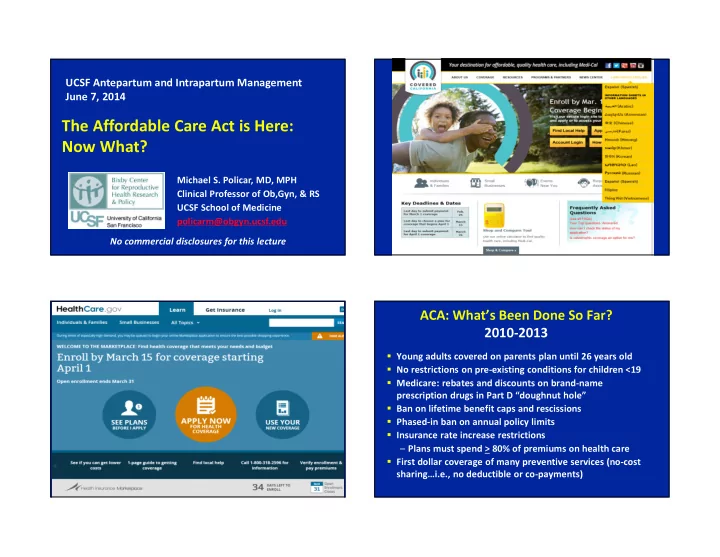
6/7/2014 UCSF Antepartum and Intrapartum Management June 7, 2014 The Affordable Care Act is Here: Now What? Michael S. Policar, MD, MPH Clinical Professor of Ob,Gyn, & RS UCSF School of Medicine policarm@obgyn.ucsf.edu No commercial
6/7/2014 2
ACA: What Started on 1/1/2014?
Individual requirement to have insurance State Medicaid expansion Go-live for health insurance benefits through state health insurance exchanges (enrollment started 10/1/13) Essential health benefit (EHB) standards Insurance market reforms; no rating on health, gender – No restrictions for adults with pre-existing conditions Employer shared responsibility penalties ‒ Delayed until 2015
The Individual Mandate
All citizens, legal immigrants 18 and older must have coverage Tax penalty if no coverage (by 2016)…higher of
– $695/person; up to 3 times for a family, or – 2.5% of household income
Exemptions granted for
– Undocumented persons – No coverage for less than 3 months – Lowest cost plan > 8% personal income (net of subsidies) – Religious objection – Individuals who are incarcerated – Members of Native American tribes – People who have incomes below the tax-filing threshold ($9,750 for single and $27,100 for a family of four)
Women and the Health Care Law in CA
National Women’s Law Center and State Partners - April 2013
- In CA, 2.8 million women (24%) women are uninsured
– 25% of black women – 35.3% of Hispanic women – Compared to 14% of white women
- Up to 856,000 women in CA will be newly insured once this
coverage is fully implemented
- This coverage expansion will reduce uninsurance in
California by 39% Insured through employer Military Veterans Admin Undocumented individuals Little or no change Medicare Medicaid Minor changes Uninsured Self employed Major changes Small business
6/7/2014 3
- Uninsured
- Self employed
- SB <50 workers
- Small business
(50-99 workers)
5 % 1 % State Health Insurance Exchanges
Medi-Cal
5 %
CA Health Benefit Exchange “Covered California” Small Business Health Options Program (SHOP)
? ?
Employer based HI <50: business can purchase <25: business tax credits fine pay October 1, 2014 October 2015
Major Changes
2 yr. extension (2016)
(19-49)
Insurance Status of Non‐elderly Women in CA
AIM
Household Size If income is less than… If income between 1 $ 15,867 $ 15, 857-45,960 2 $ 21,404 $ 21,404-62,040 3 $ 26,952 $ 26,952-78,120 4 $ 32,500 $ 32,500-94,200 5 $ 38,407 $ 38,047-110,280 You may qualify for Medi-Cal Premium assistance through Covered CA
Modified Adjusted Gross Income (MAGI) Determines Program Eligibility
6/7/2014 4
Medicaid and Women’s Health Services
- Payer for 40-50% of U.S. births
- Expansion in Medicaid eligibility to cover adults with
incomes below 138% of the federal poverty level – Previously: “Broke plus something else” – With expansion: men and women with incomes below $15,867 individual; $32,500 for a family of 4
- Federal government will cover 100% of expansion costs
until 2017, then drops to 90% by 2020 – Reason for rejection of expansion by many states…
- Creates a “coverage gap” for the poor in 25 states
Medi-Cal Expansion
- To be eligible for Medi-Cal Expansion you must be ALL of…
– A U.S. citizen, U.S. national or lawfully present in the U.S. – A resident of California – Less than 65 years old – Have a family income at, or below, 138% of the Federal Poverty Level – Children of families whose income is at, or below, 250%
- f the Federal Poverty Level
- All “new” Medi-Cal enrollments via M’cal managed care
Health Insurance Exchanges
Subsidies for families 138-400% federal poverty level
− Premium tax credit (toward purchase of insurance), and − Cost-sharing tax credit (rebate on OOP costs) − 399% FPL: $44,680 individual; $92,200 family of four Tax credit applied at enrollment; no wait till taxes filed
6/7/2014 5
Health Insurance Exchanges
Level Plan covers Platinum 90% Gold 80% Silver 70% Bronze 60% Catastrophic < 30 years old
- Premiums are higher at
each level
- Subsidy based on average
Silver plan cost
- Out of pocket max= Health
Savings Account limit
- $5,950 individual
- $11,900 family
- Lower out-of-pocket limits if
subsidized
Coveredca.com
Alameda Alliance for Health Anthem Blue Cross of California Blue Shield of California Chinese Community HP Contra Costa Health Plan Health Net Kaiser Permanente L.A. Care Health Plan Molina Healthcare Sharp Health Plan Valley Health Plan Ventura County Health Care Plan Western Health Advantage
Which Plans Were Selected for Covered CA?
6/7/2014 6
Features of Covered California
- Rates vary by region, by metal level, and age
- The following are not factored into rates
– Preexisting conditions – Gender – Smoker vs. non-smoker
- Compared to the small employer market, rates range from
2 percent above the 2013 average premium to 29 percent below the rates in California’s most populous markets
Features of Covered California
Open enrollment is October 1, 2013 thru March 31, 2014 – Next open enrollment is in Oct 2014 for 2015 – Earlier if “life-changing event”: loss of job, death of spouse, birth of child On-line premium calculator available Available in 10 languages
http://www.aim.ca.gov
Access For Infants And Mothers Program
- Low cost affordable health coverage for middle-income
pregnant women
- Cost is 1.5% of net annual income; billed over 12 months
- Coverage for pregnant women who…
– Do not have health insurance OR have private insurance with a maternity-only deductible > $500; and, – Are not eligible for no-cost Medi-Cal or Medicare and, – Have family income above no-cost Medi-Cal; and, – Are less than 30 weeks pregnant
6/7/2014 7
Access For Infants And Mothers Program
- Available plans
– SF county: Anthem Blue Cross HMO – Alameda: Anthem Blue Cross HMO – Contra Costa: CC Health Plan; Kaiser Permanente – San Mateo: Kaiser Permanente
- What are the benefits of having AIM as opposed to
pregnancy-related restrictive Medi-Cal only? – AIM offers comprehensive benefits, including pregnancy and non-pregnancy related service
Cost of the AIM Program
Adjusted Annual Household Income $39,840.00 Multiply the Adjusted Annual Household Income by 1.5% to calculate the cost to participate in the AIM program x 1.5% Total Annual AIM Contribution $597.60
- No deductibles or copayments
Specified preventive services must be covered with no
cost-sharing (no out-of-pocket costs)
Applies to private and public programs – (New) Private insurance policies 2010 – Medicare, Medicaid 2011 – State insurance exchanges 2014 Improves coverage for preventive services in many
individual and small group plans
Reproductive Health Cancer Healthy Behaviors Pregnancy related Immunizations Chronic conditions STI and HIV counseling ; all sexually active F) Breast Cancer
- Mammography
Alcohol S&C
- Alcohol
S&C
- TdaP, Td
booster,
- MMR, varicella
CV: HTN, lipids Ct, GC, Syphilis screening
- Genetic S&C
Tobacco C&I
- Tobacco
C&I Influenza T2DM screen HIV screening (adults at HR; all sexually active F)
- Preventive
medication counseling Diet counseling if CVD risk
- Folic acid
supplement
- Hepatitis A, B
- Meningococcal
Depression screen Contraception (women w/repro capacity Cervix:
- Cytology
- HPV + cytology
Interpersonal and DV S&C
- GDM
screen
- Rh screen
- Anemia
screen
- HPV
(women 19‐26) Osteo- porosis screen Colorectal:
- FOBT,
- Colonoscopy,
- Sigmoid
Well‐woman visits
- STI screen
- Bacteruria
screen
- Pneumococcal
- Zoster
Obesity screen; C&I if obese
- Lactation
Supports S&C: screening and counseling C&I: counseling and interventions
6/7/2014 8
Women's Preventive Services
HHS Guideline for Insurance Coverage Frequency Well-woman visits annually including preconception and prenatal care
- Several visits may be needed to
- btain all recommended services,
depending on health status, health needs, and other risks
Women's Preventive Services
HHS Guideline for Insurance Coverage Frequency All FDA approved contraceptive methods, sterilization procedures, and patient education & counseling for women with reproductive capacity As prescribed
- All methods must be covered, but not all products
- Limited exclusion for religious institutions (e.g., churches)
from providing contraceptive coverage for insured employees
Can Plans Limit Coverage Without Cost-Sharing?
- Plans must cover all of the FDA-approved methods
- “Reasonable medical management techniques” are allowed
– Cost-sharing for brand-name drugs – Cost-sharing for out-of-network services – Prescription for over-the-counter methods
- The “Waiver Process”
– Allows women to access medically appropriate method without cost-sharing if plan typically imposes cost-sharing – Usually done through pharmacy pre-authorization
Many Questions…Not Many Answers
If I can’t collect a co-payment, will the Plan pay it? – In the short term…yes – Over time, most contracting will be with ACOs Is there cost-sharing for global OB care? – No cost-sharing for routine prenatal, post-partum visits – Cost-sharing applies to the delivery itself If I manage other conditions at a well woman visit, should a co-pay be collected? – Yes, if separate office visit is billed with -25 modifier
6/7/2014 9
When Does the “Contraception As Prevention” Benefit Start?
Definition Cost- sharing? When is cost-sharing prohibited? New Plan Created after 8/1/2012 None Now Non- grandfathered Created 3/23/10-8/1/12 Yes* Next “new plan year”; mostly by 1/1/2013 Grandfathered plan Created before 3/23/2012 Yes* Once plan changes; mostly in 2014
* Unless plan agrees to remove cost sharing earlier than deadline
How Do You Know If You Have First Dollar Coverage for Contraceptives?
- Call “Member Services” at you health plan…the
number is on your insurance card
- If you feel you are not receiving benefits to which you
are entitled, contact the National Women’s Law Center – 1-866-PILL4US – pill4us@nwlc.org
What’s on The Horizon for Ob-Gyn?
- More activity around value-based payments (P4P)
- Currently, some health plans and Medicaid programs
incentivize reductions in inductions and C/S rates
- Other “hot topics”
– Updated HEDIS criteria for cervical cancer screening intervals – Hysterectomy indications and rates – Development of post-partum contraceptive metric
Take it Home….
- Most individuals and families are now required to have
health insurance or will pay a tax penalty
- Women’s heath services will become much more accessible
and clinicians will be paid more reliably going forward
- There is “no wrong door” to enter in order to enroll in most
new ACA-related programs
- As providers, we owe it to each patient that has no
insurance, or who receives care thru categorical programs, to offer advice regarding health insurance enrollment
6/7/2014 10
Additional Resources
- National CMS site for consumer education regarding ACA
– Healthcare.gov
- California health insurance marketplace
– Coveredca.com
- National Women’s Law Center
– Excellent advice re: accessing preventive services, especially contraception with no cost-sharing benefit – nwlc.org
- Kaiser Family Foundation