Text 1 / 24 Introduction to the PS3 Programming the SPEs - - PowerPoint PPT Presentation

text
SMART_READER_LITE
LIVE PREVIEW

Text 1 / 24 Introduction to the PS3 Programming the SPEs - - PowerPoint PPT Presentation

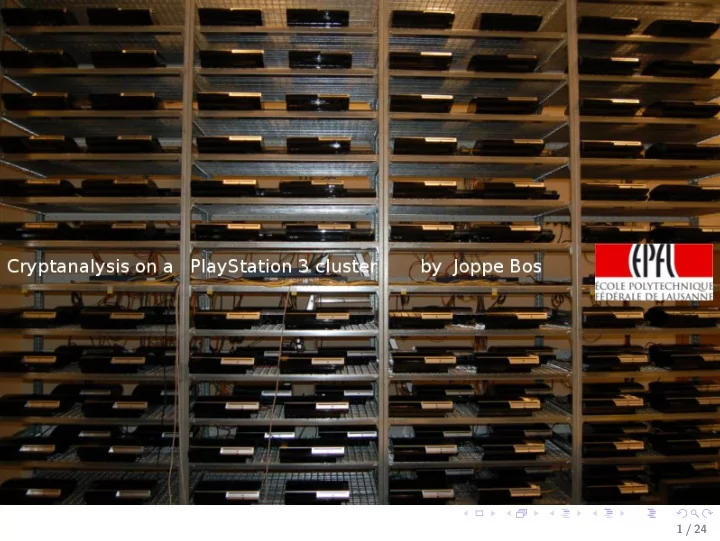
Introduction to the PS3 Programming the SPEs PS3-clusters Results Text 1 / 24 Introduction to the PS3 Programming the SPEs PS3-clusters Results Why is the PlayStation 3 (PS3) hardware of any interest? How should we implement our


slide-1
SLIDE 1

Introduction to the PS3 Programming the SPEs PS3-clusters Results

Text

1 / 24
slide-2
SLIDE 2

Introduction to the PS3 Programming the SPEs PS3-clusters Results

Why is the PlayStation 3 (PS3) hardware of any interest? How should we implement our algorithms on the PS3? Existing and new video game clusters. Projects and results obtained

  • n the PS3s at LACAL.

2 / 24

slide-3
SLIDE 3

Introduction to the PS3 Programming the SPEs PS3-clusters Results Overview Hardware

The PlayStation 3

Facts about the PS3: The third video game console by Sony Computer Entertainment Released in Japan 11 November 2006 North America 17 November 2006 Europe 23 March 2007 As of 30 June 2008 worldwide 14.41 million units sold

3 / 24

slide-4
SLIDE 4

Introduction to the PS3 Programming the SPEs PS3-clusters Results Overview Hardware

Hardware

PS3 disc drive is an all-in-one type: 2× Blu-ray, 8× DVD and 24× CD Hard disk size ∈ {20, 40, 60, 80} GB. This month the 160 GB version will be released {2, 4} USB 2.0 ports (depending on version) A graphics processing unit manufactured by Nvidia

Based on the NVIDIA G70 architecture. Makes use of 256 MB GDDR3 RAM clocked at 700 MHz Unavailable to the programmer

3.2 GHz Cell Broadband Engine (Cell) microprocessor architecture jointly developed by Sony, Toshiba, and IBM

4 / 24

slide-5
SLIDE 5

Introduction to the PS3 Programming the SPEs PS3-clusters Results Overview Hardware

Cell architecture, overview

The Cell consists of the following components external input and output structures

  • ne “Power Processor Element” (PPE)

eight Synergistic Processing Elements (SPEs) six SPEs available to the user the Element Interconnect Bus (EIB) a specialized high-bandwidth circular data bus

5 / 24

slide-6
SLIDE 6

Introduction to the PS3 Programming the SPEs PS3-clusters Results Overview Hardware

PS3 architecture, the PPE

64-bit PowerPC architecture core, can run in 32- and 64-bit mode 128-bit AltiVec/VMX SIMD unit dual-threaded processor 32 KB instruction- and a 32 KB data Level 1 cache 512 KB Level 2 cache ∼ 214 out of 256 MB of memory available to the guest OS instruct the workhorses (SPEs) what to do

6 / 24

slide-7
SLIDE 7

Introduction to the PS3 Programming the SPEs PS3-clusters Results Overview Hardware

PS3 architecture, the SPEs

Synergistic Processing Unit (SPU)

Access to an 128 × 128-bit wide register file SIMD architecture

7 / 24

slide-8
SLIDE 8

Introduction to the PS3 Programming the SPEs PS3-clusters Results Overview Hardware

PS3 architecture, the SPEs

Synergistic Processing Unit (SPU)

Access to an 128 × 128-bit wide register file SIMD architecture

256 KB of fast local memory (Local Store)

7 / 24

slide-9
SLIDE 9

Introduction to the PS3 Programming the SPEs PS3-clusters Results Overview Hardware

PS3 architecture, the SPEs

Synergistic Processing Unit (SPU)

Access to an 128 × 128-bit wide register file SIMD architecture

256 KB of fast local memory (Local Store) Memory Flow Controller (MFC)

Direct Memory Access (DMA) controller Handles synchronization operations to the other SPUs and the PPU DMA transfers are independent of the SPU program execution

7 / 24

slide-10
SLIDE 10

Introduction to the PS3 Programming the SPEs PS3-clusters Results Overview Hardware

Element Interconnect Bus

12 participants circular ring comprised of four 16 Byte-wide unidirectional channels peak instantaneous EIB bandwidth: (4 × 3) × 16 / 2 = 96 Byte per processor cycle (307.2 GB/s)

8 / 24

slide-11
SLIDE 11

Introduction to the PS3 Programming the SPEs PS3-clusters Results Limitations SIMD Special instructions SPU pipelines

Limitations

Branching

No “smart” dynamic branch prediction Instead “prepare-to-branch” instructions to redirect instruction prefetch to branch targets

9 / 24

slide-12
SLIDE 12

Introduction to the PS3 Programming the SPEs PS3-clusters Results Limitations SIMD Special instructions SPU pipelines

Limitations

Branching

No “smart” dynamic branch prediction Instead “prepare-to-branch” instructions to redirect instruction prefetch to branch targets

Memory

The binary and all the needed memory should fit in the LS Or perform manual DMA requests to the main memory (max. 214 MB)

9 / 24

slide-13
SLIDE 13

Introduction to the PS3 Programming the SPEs PS3-clusters Results Limitations SIMD Special instructions SPU pipelines

Limitations

Branching

No “smart” dynamic branch prediction Instead “prepare-to-branch” instructions to redirect instruction prefetch to branch targets

Memory

The binary and all the needed memory should fit in the LS Or perform manual DMA requests to the main memory (max. 214 MB)

Instruction set limitations

16 bit multiplier

9 / 24

slide-14
SLIDE 14

Introduction to the PS3 Programming the SPEs PS3-clusters Results Limitations SIMD Special instructions SPU pipelines

SPU registers

Byte: 16 × 8-bit SIMD Half-word: 8 × 16-bit SIMD Word: 4 × 32-bit SIMD

10 / 24

slide-15
SLIDE 15

Introduction to the PS3 Programming the SPEs PS3-clusters Results Limitations SIMD Special instructions SPU pipelines

SPU registers

Byte: 16 × 8-bit SIMD Half-word: 8 × 16-bit SIMD Word: 4 × 32-bit SIMD Theoretical performance of 16 × 3.2 · 109 = 51.2 billion 8-bit integer

  • perations per second.

10 / 24

slide-16
SLIDE 16

Introduction to the PS3 Programming the SPEs PS3-clusters Results Limitations SIMD Special instructions SPU pipelines

Special SPU instructions

All distinct binary operations f : {0, 1}2 → {0, 1} are present. shuffle bytes add/sub extended

  • r across

count leading zeros average of two vectors count ones in bytes select bits gather lsb carry/borrow generate sum bytes multiply and add multiply and subtract element-wise absolute difference

11 / 24

slide-17
SLIDE 17

Introduction to the PS3 Programming the SPEs PS3-clusters Results Limitations SIMD Special instructions SPU pipelines

Special SPU instructions

All distinct binary operations f : {0, 1}2 → {0, 1} are present. shuffle bytes add/sub extended

  • r across

count leading zeros average of two vectors count ones in bytes select bits gather lsb carry/borrow generate sum bytes multiply and add multiply and subtract element-wise absolute difference shufb Concatenate two input registers to form a 32-byte lookup table Each byte in the third register selects either a constant value (0x00/0x80/0xFF) or a location in the lookup table → 16 table lookups per cycle

11 / 24

slide-18
SLIDE 18

Introduction to the PS3 Programming the SPEs PS3-clusters Results Limitations SIMD Special instructions SPU pipelines

SPU pipelines and latencies

One odd and one even instruction can be dispatched per clock cycle. Challenge to the programmer (or compiler).

12 / 24

slide-19
SLIDE 19

Introduction to the PS3 Programming the SPEs PS3-clusters Results Small clusters Big clusters LACAL PS3 cluster

Cluster of game console

Using the compute power of video game consoles is not new 65-node PS2 cluster build by the National Center for Supercomputing Applications and the University of Illinois in 2003

13 / 24

slide-20
SLIDE 20

Introduction to the PS3 Programming the SPEs PS3-clusters Results Small clusters Big clusters LACAL PS3 cluster

Cluster of game console

Using the compute power of video game consoles is not new 65-node PS2 cluster build by the National Center for Supercomputing Applications and the University of Illinois in 2003 Other uses, besides gaming and computing, include grilling:

13 / 24

slide-21
SLIDE 21

Introduction to the PS3 Programming the SPEs PS3-clusters Results Small clusters Big clusters LACAL PS3 cluster

Small clusters

Academic clusters

An 8 PS3-cluster at the North Carolina State University An 16 PS3-cluster “Gravity Grid” at the University of Massachusetts

14 / 24

slide-22
SLIDE 22

Introduction to the PS3 Programming the SPEs PS3-clusters Results Small clusters Big clusters LACAL PS3 cluster

Small clusters

Academic clusters

An 8 PS3-cluster at the North Carolina State University An 16 PS3-cluster “Gravity Grid” at the University of Massachusetts

Commercial clusters

Pre-installed PS3 from Terra Soft solutions: 8 Node PS3 Cluster $17, 650 (≈ $2, 200 per PS3) 32 Node PS3 Cluster $42, 250 (≈ $1, 300 per PS3) (current PS3 price ≈ $400)

14 / 24

slide-23
SLIDE 23

Introduction to the PS3 Programming the SPEs PS3-clusters Results Small clusters Big clusters LACAL PS3 cluster

Warhawk mayhem

Ranked-Dedicated servers for the PS3 games called Warhawk mayhem

15 / 24

slide-24
SLIDE 24

Introduction to the PS3 Programming the SPEs PS3-clusters Results Small clusters Big clusters LACAL PS3 cluster

Warhawk mayhem

Ranked-Dedicated servers for the PS3 games called Warhawk mayhem U.S. Air Force wants to buy 300 PS3s

15 / 24

slide-25
SLIDE 25

Introduction to the PS3 Programming the SPEs PS3-clusters Results Small clusters Big clusters LACAL PS3 cluster

LACAL cluster

16 / 24

slide-26
SLIDE 26

Introduction to the PS3 Programming the SPEs PS3-clusters Results Small clusters Big clusters LACAL PS3 cluster

LACAL setup

Physically in the cluster room: 186 PS3s 6 × 4 PS3s in the PlayLaB (attached to the cluster) 9 PS3 scattered over our offices for programming purposes ⇒ 219 PS3s in total.

17 / 24

slide-27
SLIDE 27

Introduction to the PS3 Programming the SPEs PS3-clusters Results Small clusters Big clusters LACAL PS3 cluster

LACAL setup

Physically in the cluster room: 186 PS3s 6 × 4 PS3s in the PlayLaB (attached to the cluster) 9 PS3 scattered over our offices for programming purposes ⇒ 219 PS3s in total. How do we put these machines to work?

17 / 24

slide-28
SLIDE 28

Introduction to the PS3 Programming the SPEs PS3-clusters Results Hashing ECM Pollard rho Future

Finding MD5 multi-collisions

Performed by: Marc Stevens, Arjen Lenstra, Benne de Weger. Summer 2007: Single chosen-prefixes MD5 collision after half year on BOINC network (no PS3s used) Fall 2007: Previous attack in 3 hours on single PS3 (with 30-fold MD5 speed-up on PS3 over desktop) Proof of concept example: 12 PDF turned into a MD5 multi-collision: “Predicting the winner of the 2008 US Presidential Elections using a Sony PlayStation 3”

18 / 24

slide-29
SLIDE 29

Introduction to the PS3 Programming the SPEs PS3-clusters Results Hashing ECM Pollard rho Future

Multi-Stream Hashing on the PlayStation 3 Joppe Bos, Nathalie Casati and Dag Arne Osvik PARA 2008: State-of-the-Art in Scientific and Parallel Computing Idea: Using the SIMD-organization of the SPUs to hash multiple streams and hide latencies. Algorithm Gb / sec / PS3 Gb / sec / Core2Quad (*) MD5 88.17 64 SHA-1 43.60 34.8 SHA-256 18.70 13.5 (*) Upper-bound by carefully counting instructions Hashing 105 150 KB messages with the assembly version.

19 / 24

slide-30
SLIDE 30

Introduction to the PS3 Programming the SPEs PS3-clusters Results Hashing ECM Pollard rho Future

Finished student projects related to ECM at LACAL Sylvain Pelissier and Aniruddha Bhargava First attempt to port GMP to the SPU

code size versus performance

20 / 24

slide-31
SLIDE 31

Introduction to the PS3 Programming the SPEs PS3-clusters Results Hashing ECM Pollard rho Future

Finished student projects related to ECM at LACAL Sylvain Pelissier and Aniruddha Bhargava First attempt to port GMP to the SPU

code size versus performance

Thomas Kunz: GMP-ECM on the PS3

Non-trivial, code size problems Replace low-level building blocks

20 / 24

slide-32
SLIDE 32

Introduction to the PS3 Programming the SPEs PS3-clusters Results Hashing ECM Pollard rho Future

Finished student projects related to ECM at LACAL Sylvain Pelissier and Aniruddha Bhargava First attempt to port GMP to the SPU

code size versus performance

Thomas Kunz: GMP-ECM on the PS3

Non-trivial, code size problems Replace low-level building blocks

Donato Verardi: MPM-ECM based on GMP-ECM

Fast! But many improvements are still possible

20 / 24

slide-33
SLIDE 33

Introduction to the PS3 Programming the SPEs PS3-clusters Results Hashing ECM Pollard rho Future

Finished student projects related to ECM at LACAL Sylvain Pelissier and Aniruddha Bhargava First attempt to port GMP to the SPU

code size versus performance

Thomas Kunz: GMP-ECM on the PS3

Non-trivial, code size problems Replace low-level building blocks

Donato Verardi: MPM-ECM based on GMP-ECM

Fast! But many improvements are still possible

Stage 1 only Limitations: input number must be < 2048 bits

20 / 24

slide-34
SLIDE 34

Introduction to the PS3 Programming the SPEs PS3-clusters Results Hashing ECM Pollard rho Future

Time in seconds to run 12 curves on different input length with different B1-values. B1-value Donato Thomas PENTIUM-D 512-bit input 250000 26 30 22 1000000 108 68 89 3000000 322 341 274 768-bit input 250000 37 34 44 1000000 150 138 179 3000000 448 414 543 1024-bit input 250000 47 50 72 1000000 189 200 300 3000000 567 601 877

21 / 24

slide-35
SLIDE 35

Introduction to the PS3 Programming the SPEs PS3-clusters Results Hashing ECM Pollard rho Future

Pollard rho for finding ECDL

Work in progress: Pollard rho on the PS3 by Joppe Bos and Marcelo Kaihara Motivation Branch-free SIMD Pollard rho to calculate the elliptic curve discrete logarithms (over prime fields) Currently runs on SPU only; An implementation which offloads work to the PPE is in progress

22 / 24

slide-36
SLIDE 36

Introduction to the PS3 Programming the SPEs PS3-clusters Results Hashing ECM Pollard rho Future

Pollard rho for finding ECDL

Work in progress: Pollard rho on the PS3 by Joppe Bos and Marcelo Kaihara Motivation Branch-free SIMD Pollard rho to calculate the elliptic curve discrete logarithms (over prime fields) Currently runs on SPU only; An implementation which offloads work to the PPE is in progress Current speed: ECCP-109: 1.5 · 107 iterations per second per PS3 ⇒ less than 4 months on a PS3 cluster with 200 nodes. ECCP-131: 107 iterations per second per PS3 ⇒ 800 years on a PS3 cluster with 200 nodes.

22 / 24

slide-37
SLIDE 37

Introduction to the PS3 Programming the SPEs PS3-clusters Results Hashing ECM Pollard rho Future

New projects

PS3s attract {bachelor, master} students! This semester:

Implementation of ECM stage 2 on the SPE. Creating a set of script to handle all the ECM jobs on the cluster. “Monster RSA”; RSA encryption/decryption with 15k modulus Efficient arithmetic using the residue number system (RNS)

23 / 24

slide-38
SLIDE 38

Introduction to the PS3 Programming the SPEs PS3-clusters Results Hashing ECM Pollard rho Future

Conclusions

The PS3 hardware (i.e. Cell) is very interesting

Some limitations: memory, 16 bit multiplier Think SIMD, avoid branching, exploit the dual-pipeline and use the rich instruction set

The cluster attracts many students → lots of new PS3 project are on their way!

24 / 24

slide-39
SLIDE 39

Introduction to the PS3 Programming the SPEs PS3-clusters Results Hashing ECM Pollard rho Future

Conclusions

The PS3 hardware (i.e. Cell) is very interesting

Some limitations: memory, 16 bit multiplier Think SIMD, avoid branching, exploit the dual-pipeline and use the rich instruction set

The cluster attracts many students → lots of new PS3 project are on their way! In the future: PS4 (rumors say 2012)? More main memory? More SPEs?

24 / 24