
SLIDE 1
TEXAS BUSINESS LITIGATION JOURNAL
FALL 2007 • Volume 29
- Number 4
TEXAS BUSINESS LITIGATION JOURNAL Antitrust Review 2007 Energy - - PDF document
TEXAS BUSINESS LITIGATION JOURNAL Antitrust Review 2007 Energy Mergers Sweepstakes FALL 2007 Volume 29 Number 4 TABLE OF CONTENTS SECTION OFFICERS and COUNCIL MEMBERS Chair Randy D. Gordon 1601 Elm Street, Suite
FALL 2007 • Volume 29
Publication Layout - State Bar of Texas Graphics Department
Letter from the Section Chair. . . . . . . . . . . . . . . . . . . . . . . . . . . . . 2 From the Editor . . . . . . . . . . . . . . . . . . . . . . . . . . . . . . . . . . . . . . . 3
Antitrust Review 2007 by Leslie Sara Hyman . . . . . . . . . . . . . . . . . . . . . . . . . . . . . . . . . . . 4 The FTC’s 2007 Oil Industry Merger Challenges: Another Year of “Special Vigilance” by Bruce McDonald. . . . . . . . . . . . . . . . . . . . . . . . . . . . . . . . . . . . 11 Luck of the Draw: Avoiding the Traps of Running a Sweepstakes Contest by Tom Van Arsdel. . . . . . . . . . . . . . . . . . . . . . . . . . . . . . . . . . . . . 19
Monograph Alert by Gregory S.C. Huffman. . . . . . . . . . . . . . . . . . . . . . . . . . . . . . . . 21
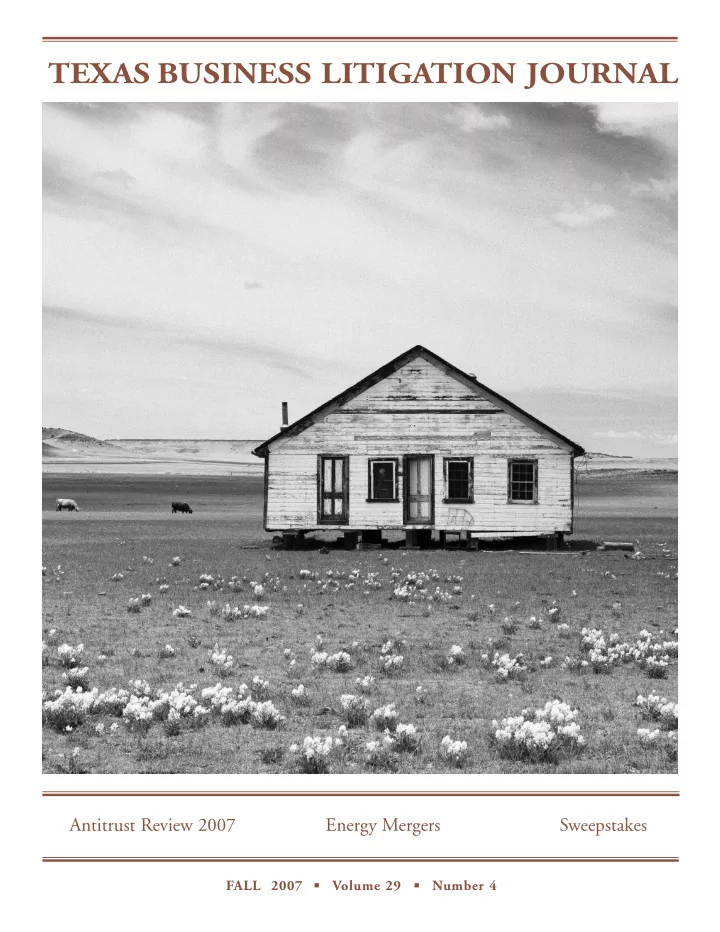
COVER: “High and Dry,” Honorable Mention, 2007 Texas Tech International Cultural Center juried competition, photograph by Larry Gustafson, Dallas.
SECTION OFFICERS and COUNCIL MEMBERS
Randy D. Gordon 1601 Elm Street, Suite 3000 Dallas, Texas 75201 (214) 999-4527 (214) 999-3527 (Fax)
William M. Katz, Jr. 1700 Pacific Avenue, Suite 3300 Dallas Texas 75201 (214) 969-1330 (214) 969-1751 (Fax)
Leslie S. Hyman 112 East Pecan Street, Suite 1800 San Antonio, Texas 78205 (210) 554-5500 (210) 226-8395 (Fax)
Charles W. Schwartz, Houston Bill Katz, Dallas Randy D. Gordon, Dallas Michael D. Rubenstein, Houston William Frank Carroll, Dallas Thomas R. Jackson, Dallas
Todd Murray, Dallas Leslie Sara Hyman, San Antonio Thomas Malone, Houston Mark K. Glasser, Houston Paul Genender, Dallas Carrie Huff, Dallas Mark Bayer, Dallas
Jim Elliott, Dallas
Michael J. Biles, Austin Rick Milvenan, Austin William R. Pakalka, Houston Wallis Hampton, Houston John Thomas Scott, Dallas
Thomas B. Carter, Dallas Duncan Currie, Dallas Mark Tobey, Austin
Stephen D. Susman - 1976-77 James E. Coleman, Jr. - 1977-78
Charles T. Newton - 1980-81 Jack N. Price - 1981-82 Robin P . Hartmann - 1982-83 Gary V. McGowan - 1983-84 Keith E. Kaiser - 1984-85 Barry F. McNeil - 1985-86 Richard N. Carrell - 1986-87
Ernest R. Higginbotham - 1988-89 Max Hendrick, III - 1989-90
Gregory S. C. Huffman - 1991-92 Layne E. Kruse - 1992-93 Allene D. Evans - 1993-94 Robert M. Cohan - 1994-95 Kenneth E. McNeil - 1995-96 Jorge C. Rangel - 1996-97 Karen B. Willcutts - 1997-98 Rufus W. Oliver, III - 1998-99 Karl S. Stern - 1999-2000
Curtis L. Frisbie, Jr. - 2001-02 James K. Spivey - 2002-03 Lin Hughes - 2003-04 Kathleen M. LaValle - 2004-05 Larry A. Gaydos - 2005-06 Justice Jim Moseley - 2006-07
Gregory S.C. Huffman, Dallas
Leslie Hyman, San Antonio Gerard G. Pecht, Houston William M. Katz, Jr., Dallas Randy Gordon, Dallas Todd Murray, Dallas Peter A. Stokes Wallis Hampton, Houston Samuel E. Joyner, Dallas Paul Genender, Dallas Matt Rinaldi, Dallas Jay Nelson, Houston Barry Golden, Dallas Nicholas Peters, Dallas
Todd Murray, Dallas
Fall • 2007 11
Petroleum markets in the U.S. are intensely competitive. You would think otherwise, reviewing the antitrust enforcement activities
merger challenges historically have been aggressive, holding these industries to a higher standard than in other markets. An effort to avoid underenforcement in a “critical” industry, or to dodge the threat of expansive legislation, may help explain this pattern. In 2007, the FTC has kept up its enthusiastic efforts against petroleum market mergers, so far with one loss, one loss with a good chance for appellate reversal, and one consent order. Western Refining / Giant Industries The leading recent example of the FTC’s intensive enforcement against energy mergers is the agency’s unsuccessful challenge to the combination of Western Refining and Giant Industries, two independent oil refiners.2 In August 2006, Western agreed to acquire Giant in a $1.4 billion transaction that would make Western the country’s fourth largest, independent, publicly-traded refiner and
as the critical overlap both refiners’ supplying gasoline to northern New Mexico, the area around Albuquerque. Headquartered in El Paso, Texas, Western refines crude oil and markets refined products in the Southwest. Western owns a refinery in El Paso, which supplies refined products to northern New Mexico and West Texas and parts of Arizona and northern Mexico. The supply to northern New Mexico travels through The Plains Pipeline from El Paso to Albuquerque. Headquartered in Scottsdale, Arizona, Giant had operations in the Southwest and mid-Atlantic. Giant owned two New Mexico refineries, from which it trucked gasoline to points in Arizona, southwest Colorado, and New Mexico, including Albuquerque. Giant also owned wholesale and retail outlets in New Mexico and elsewhere in the Southwest. Giant’s refineries had been running below capacity, because it had been unable to acquire enough of the local sweet crude that was its primary feedstock. However, Giant recently had purchased a pipeline through which it would be able to obtain more feedstock, and Giant predicted increasing its refineries’ output in 2007. In addition to Western and Giant, a number of other refiners supply gasoline to Northern New Mexico. Holly Corporation ships gasoline through several pipelines from its refinery in southeast New
Albuquerque from their refineries in the Texas Panhandle. Alon ships gasoline to Albuquerque from its Big Spring, Texas, refinery. Product from Gulf Coast refiners is delivered to Albuquerque by truck. In April 2007, the FTC filed an action in the District of New Mexico,3seeking a preliminary injunction of the merger under FTC Act § 13(b).4 The FTC alleged that the merger would lessen competi- tion in the bulk supply of gasoline to northern new Mexico. The FTC Complaint recognized that northern New Mexico had seven “signif- icant” bulk suppliers. And the FTC alleged that six (“only six”) of the refiners “are currently capable of responding” to a decrease in supply to northern New Mexico.5 The FTC even acknowledged that Holly, ConocoPhillips, and Valero had large, nearby refineries connected to pipelines with significant unused capacity running to Albuquerque.6 In most markets, a “6 to 5” merger would hardly get a second glance.7 But here the FTC identified peculiar local market facts that led it instead to challenge the merger. (1) Giant was a maverick and, with expanded refinery output, Giant would increase the supply of gasoline to Albuquerque, bringing lower prices. (2) To avoid losses caused by lower prices, Western would divert Giant’s new supply away to other markets. (3) These changes in output by Giant and Western would not be countered by other suppliers; the historical “limited supply responsiveness” of the other suppliers indicated they would not respond to Giant’s increasing supply by backing out their
away from northern New Mexico, the FTC alleged. The parties battled over the FTC’s assertions in a five-day preliminary injunction hearing in Albuquerque in May 2007. The parties presented six fact witnesses and three experts.8 Three weeks later, the court announced its decision, finding in favor of the defendants on the key issues and rejecting the FTC challenge. First, the court questioned the FTC premise that premerger Giant would have increased total supply to bring lower prices. The
By: J. Bruce McDonald
1
12 TEXAS • BUSINESS • LITIGATION
FTC alleged that Giant, consistent with being a maverick, would use its increased refinery output to increase its gasoline supply to northern New Mexico, even though this would cause prices to drop. Specifically, the FTC alleged that, with higher refinery output, and if Giant allocated that new production as it did its existing production, Giant would allocate “substantially more” gasoline to Albuquerque, causing gasoline prices “to fall significantly below where they would have been otherwise.”9 The FTC’s “maverick” story was based in large part on a single, draft Giant document, which Giant’s expert concluded reflected a Giant plan to use the new refinery output to bring 900 incremental barrels to Albuquerque. The court seemed skeptical that it could rely
if it profit-maximized, Giant would not increase its own output and still continue to purchase gasoline from third parties (like Western) to meet its obligations to customers.11 Instead, the court recognized, Giant would cut back its purchases from other refiners with which it was supplying Albuquerque, rather than lose money as prices fell: Chasing customers in Albuquerque at a deep discount – as the FTC asserts Giant will do – is inconsistent with Giant’s business practices. Giant seeks to sell its refinery production, not to resell products that others refine … Giant has no economic incentive to purchase product from Western at market prices and then resell the same barrels at a discounted price.12 Second, the court did not believe the merger would motivate Western to divert away Giant’s new supply. The FTC alleged that, with a high share of northern New Mexico gasoline sales, Western was more exposed to Albuquerque gasoline prices than Giant, giving it the incentive to limit output increases that could lower prices. Therefore, the FTC predicted, the postmerger Western could find it profitable to reduce the combined firm’s supply to northern New Mexico, causing increased prices. The FTC alleged the postmerger Western might “divert” Giant’s supply to other markets or cut the amount of gasoline Western supplied from El Paso to Albuquerque.13 The court determined that the merger would not change the incentives of the combined Western/Giant to bring Giant’s new supply to northern New Mexico.14 The court reasoned that the merged firm actually would have a relatively small market share, that customer demand was the key factor in Western’s supply decisions, and that Western’s large customers had alternatives if Western raised prices.15 Third, the court rejected as “not reasonable” the FTC assertion that other suppliers would not respond. The FTC alleged that other suppliers’ historical “limited supply responsiveness suggests they are unlikely to competitively constrain any small output reduction or price increase.”16 Therefore, the FTC predicted that the “other bulk suppliers … are unlikely to respond in a way to make Western’s
The court found it could not accept the FTC’s view of which firms competed for northern New Mexico gasoline sales, much less that these competitors would not respond to significant output changes by Giant and Western. At the preliminary injunction hearing, the FTC’s expert identified seven bulk suppliers as competitors in the relevant market: Western, Giant, ConocoPhillips, Valero, Holly, Chevron, and Shell. The combined Western/Giant would have a 19% market share or, under an “alternative market shares” calculation, just over 35%. (Calculating a market share above 35% allowed the FTC to argue that the merger would fall outside the Merger Guidelines’ “triggering thresholds.”)18 Adding to the FTC’s competitor list, the court found that the FTC should not have excluded Alon, a west Texas refiner that supplies Albuquerque through exchange agreements and gasoline purchased in El Paso.19 The court also recognized that supply by truck from Texas is playing an increasingly significant role in northern New Mexico.20 And even the possibility of supply from the Gulf Coast has an effect on price in northern New Mexico.21 Finally, the court noted that even though The Plains Pipeline, which runs from El Paso to Albuquerque, was capacity constrained, it was possible for new shippers to obtain some capacity, and a significant expansion of the pipeline is being planned.22 Ultimately the court found that the merged firm would have a market share of about 6% and that the merger would increase the HHI by 15. This gave the FTC a “weak” prima facie case, but that was as far as the agency got.23 The court otherwise could not find substantial proof of anticompetitive effect.24 The linchpin of the FTC case was its theory that these rivals would not respond to Giant output increases (rivals would not respond to lower prices by shifting their own supply to other markets) or Western supply diversions (rivals would not respond to higher prices by adding more supply to Albuquerque). The defendants argued that, if Giant were to increase its supply to Albuquerque, leading to a price increase, other suppliers would be motivated to divert their supplies away from Albuquerque and to higher netback markets.25 Likewise, if Western were to reduce supply to northern New Mexico, rivals would take the opportunity to supply more, as evidenced by “natural experiments” observed in northern New Mexico: historically suppliers actually had increased supply in response to short term shortages, and the long term decline in Giant’s production had not resulted in higher prices.26 The court agreed, concluding that [t]he FTC’s “price down” and “price up” theories are flawed because they assume that firms do not maximize
profits, profit-making opportunities.” According to [defendants’ expert] Professor Kalt, “oil companies ... have been profit-maximizing, profit-seeking” firms. The FTC’s assertions are not reasonable, because in the FTC’s framework, oil companies “do not respond when they lose money, and they can’t respond when they make money.”27
Fall • 2007 13
While it is not inconceivable that some participants in some markets would be unable to shift supply in response to price changes, the Western court seemed skeptical of the theory as applied to this market and eventually was unconvinced it was supported by the facts. Although it does not appear to have had a major effect on the analysis, the court also noted that the FTC’s 2006 report to Congress on post-Katrina price increases had found that bulk gasoline supply markets in Albuquerque and other areas were
no evidence of price manipulation.28 To obtain preliminary injunction of a merger, the FTC must show it is likely to succeed on the merits in its Clayton Act § 7 challenge to the merger and that the equities favor granting the injunction.29 The Western court accepted that the FTC had made a “weak” prima facie case, but held that the defendants had rebutted any presumption of anticompetitive effect, by showing that competitors would constrain the defendants postmerger.30 The court also held that the public and private equities did not justify requiring the parties to delay their merger by the 13-16 months it would take for the FTC to complete its administrative proceeding.31 The Commission sought to appeal the district court ruling, but the Tenth Circuit Court of Appeals denied the FTC request for an injunction pending appeal,32 which the FTC subsequently
complaint, terminating its administrative proceeding.33 Western is the most recent example of the FTC’s strenuous efforts to limit petroleum industry mergers, even where the theory is difficult and evidence is slim, where it is convinced the transaction will have an anticompetitive effect. Despite this loss, the FTC should be expected to continue to be especially demanding in its review of energy company mergers. Equitable Resources / Dominion Resources Later in 2007, the FTC brought an action to block the merger
have not been decided, the district court’s ruling that the FTC action was precluded by “state action” in the form of the Pennsylvania PUC’s authorizing the merger creates a potential obstacle to federal merger enforcement in regulated industries. Equitable Resources produces natural gas and distributes gas to residential and commercial customers in Pennsylvania and West Virginia. In 2006, Equitable agreed to purchase a subsidiary
which owns local gas distribution systems that serve customers in southwestern Pennsylvania (“Dominion”). These distribution systems have since the early 1900s overlapped in Pittsburgh and nearby counties in western Pennsylvania, although such overlapping retail service now is rare and generally disapproved by the Pennsylvania PUC. About 500 industrial and commercial customers enjoyed the benefits of this “gas on gas” distribution competition. The PUC, under its statutory authority to review and approve mergers, examined the proposed merger and approved it in April
competition between Equitable and Dominion was inefficient and that elimination of the overlap would produce overall efficiencies, benefiting about 650,000 retail customers. The FTC, disagreeing on the merits with the PUC decision, filed a challenge seeking a preliminary injunction.34 The FTC alleged that Equitable and Dominion had competed vigorously in providing gas distribution services to the overlap business customers, by offering rates below their PUC-approved maximum rates and by offering better service and other incentives.35 The FTC alleged that the merger would lessen competition and increase prices for those 500 overlap customers.36 Of most interest to practitioners is the ruling by the district court on the defendants’ motion to dismiss the FTC complaint on state action grounds. The PUC has the authority to review and approve a merger of gas distribution companies, to determine if it is likely to result in “anticompetitive or discriminatory” conduct or harm a variety of other “consumer protection” interests.37 The PUC also has the authority to determine whether a distribution company’s proposed maximum rates are just and reasonable.38 The defendants asserted that the grant of this authority to the PUC satisfied the “state action” defense, which recognizes that federal antitrust legislation should give way to decisions by state governments to allow anticompetitive activities, subject to state oversight. For the state action defense to apply, an antitrust defendant must satisfy two requirements. First, the defendant’s conduct must have been the “foreseeable result” of a “clearly articulated and affirmatively expressed … state policy” to replace competition with regulation.39 Second, the defendant must show that the state “actively supervised” its program and that state officials had the power to review the defendant’s activities and disapprove any that were inconsistent with state policy.40 The district court agreed with the defendants, holding that the PUC’s merger approval authority and ongoing regulatory authority constituted a “clearly articulated policy to displace competition” along with active supervision going forward.41 The court dismissed the FTC’s action; however, the Court of Appeals for the Third Circuit has enjoined the parties from closing the merger pending appeal.42 In the Third Circuit, the FTC has argued that the existence
legislature has authorized particular activities that are inconsistent with competition or empowered the PUC to regulate the postmerger conduct that allegedly would cause antitrust injury.43 The FTC’s appeal has been fully briefed and argued and is ready for decision.
14 TEXAS • BUSINESS • LITIGATION
Obviously the FTC reached different conclusions than did the Pennsylvania PUC on the likely anticompetitive effects of the combination, possible efficiencies, and the significance of the fact (found by the PUC) that a large category of customers would benefit even if a small group might suffer. The district court too implied its disagreement with the FTC on the merits: The FTC continually and inaccurately labels the merger as “anti-competitive,” which it is not. Further, the FTC stated that this Court “suggest[ed]” that “the PUC may permit an anti-competitive merger,” which it did not. The merger benefits 600,000 plus customers and may disadvantage approximately 500 customers – that is not an anti-competitive merger.44 There appear to be legitimate merits arguments on both sides. The FTC has not made public the full reasoning behind its challenge to this merger, although it has asserted it has evidence that Equitable projected a significant price increase and that the merging parties had begun to refrain from competing with each other premerger.45 Furthermore, the FTC may have considered whether the competitive benefits obtained by the business customers might redound to the benefit of many ultimate consumers. On the other hand, the PUC had determined that, given the Pennsylvania rate regulation scheme, the residential customers were essentially subsidizing the below cost-of-service rates that the overlap business customers had
The district court’s view on the merits of the FTC’s merger challenge may have influenced its decision on the state action
decision granting the defendants’ motion to dismiss: While this statement [the that PUC’s public interest review does not conflict with federal antitrust policy] may be true
that the FTC is attempting to stop a transaction which the PUC has found to be in the overall public interest of the citizens of the Commonwealth of Pennsylvania.47 Certainly it is not unusual for a federal antitrust agency to disagree with the conclusions of a regulatory agency on whether a particular transaction should be allowed, especially where the regulatory agency applies a “public interest” or similar standard of which the competition analysis is only one part.48 Nevertheless, this is a novel defense as applied here, and in the past there have been numerous federal challenges to mergers in regulated industries to which this argument might have applied.49 Therefore, whatever the merits of the FTC’s merger challenge, the resolution of this state action question will be
Kinder Morgan / Magellan Midstream Partners In a third matter, the FTC challenged the acquisition of a part interest in a firm that owns petroleum terminaling operations by investors that already had interests in a competing terminaling
created by partial ownership interests as lessening competition in the way a full merger could. The transaction that initiated the FTC action involved the management buyout of Kinder Morgan, Inc. (“KMI”), a midstream energy firm that owns terminaling operations for gasoline and other petroleum products, among its other diversified energy assets. KMI had agreed to sell its shares to KMI management and a set of private equity investors, including equity funds controlled by Riverstone Holdings LLC and Carlyle Partners IV, L.P ., part of The Carlyle
Before the KMI transaction, through another jointly-controlled fund, Carlyle and Riverstone already owned 50% of the general partner that controls Magellan Midstream Partners, L.P . (“Magellan”), a midstream terminal and pipeline company. The fund had the right to appoint two of the Magellan general partner’s four board members and also exercise certain management and veto rights.51 Both KMI and Magellan have terminaling operations in the southeastern U.S.52 The FTC complaint challenged the funds’ acquisitions of interests in KMI and Magellan as “combining KMI and Magellan under Carlyle and Riverstone.” As the FTC analysis for public comment put it, Although the proposed transaction will not directly merge KMI and Magellan, it will have the effect of combining the two companies through partial common ownership. Carlyle and Riverstone, through their funds, will acquire a combined 22.6% interest in KMI, in addition to their existing 50% interest in the general partner controlling Magellan.53 The FTC claimed that this “combination” would lessen competition in petroleum terminaling in eleven metropolitan markets in the southeastern U.S. The FTC alleged that Carlyle and Riverstone likely would reduce competition between KMI and Magellan through their dual board representations, by exchanging competitive information between KMI and Magellan, and by using information learned from one firm in connection with their activities at the other.54 The FTC and the parties agreed to a consent order that would make Carlyle’s and Riverstone’s interests in Magellan “passive”
serving on any of the Magellan boards and from exerting any control or influence over Magellan. The order also requires that they establish firewalls to prevent the exchange of competitively-sensitive, non-public information.55 The FTC’s resolution of its challenge may reflect lesser concern for partial ownership interests than for full
Fall • 2007 15
combinations, for which divestiture or some other structural remedy would be the standard.56 There have been other federal antitrust challenges to transactions that create partial ownership overlaps. In a recent example, the Justice Department brought an action against Dairy Farmers of America (“DFA”), which had purchased 50% of a dairy processor, when DFA already owned 50% of a nearby, competing dairy.57 Although DFA objected that a “partial, non-controlling interest” could not support a Clayton Act § 7 challenge, the Court of Appeals for the Sixth Circuit held that the common ownership by DFA, even of only a 50% interest, could motivate the two dairies to lessen their competition against each other.58 The court cited other factors, including historical business relationships among management of the parties, but rejected the argument that a particular “control mechanism” must be proved for partial ownership to be actionable.59 Neither the federal antitrust agencies nor the federal courts have provided definitive guidance on what partial common
rely heavily on all the facts to determine the transaction’s effect
The FTC’s Busy Oil Agenda These enforcement actions are part of a busy oil industry agenda at the FTC. In addition to reviewing mergers and other business activities, the Commission provides its views to Congress and other government bodies,61 prepares reports on oil industry market conditions upon request of the President or Congress,62 and has an ongoing project to monitor gasoline prices.63 This has been an FTC priority, and there is every reason to expect the agency to remain aggressive in bringing oil industry enforcement actions. The Commission’s public message emphasizes that it gives more attention to this “critical” industry than to others. As FTC Chairman Debbie Majoras recently repeated, the FTC has for a quarter century maintained a “special vigilance” in petroleum and other energy sectors.64 This is needed, the Commission has told Congress, because without its “intensive” efforts, further consolidation would bring consumer harm: Intensive, thorough FTC merger investigations and enforcement have helped prevent further increases in petroleum industry concentration and avoid potentially anticompetitive problems and higher prices for consumers.65 Of course, second to being viewed as too soft on the oil companies – and there still are critics that assert it is66 – the FTC would not want to be perceived as unjustifiably aggressive. Highlighting some
Chairman Majoras has observed that [t]he major challenge for the FTC is to continue to work to protect competition in these critical [energy] markets without folding to pressure to simply “do something,” unduly interfering in a way that will only make matters worse for consumers … This means endeavoring to get past the myth that it is the large oil mergers, approved by the FTC in the late 1990s, that have caused prices to rise in the last few years.67 This balanced message seems reassuring, but the facts show that the Commission holds oil industry mergers to a higher standard than in other markets. Although many oil sector mergers have gone untouched, recent challenges like Western provide anecdotal evidence
markets and other markets provide objective evidence that the Commission has raised the bar for energy company mergers. Looking to one the few objective benchmarks available, even the FTC itself has pointed to the fact that its petroleum industry challenges have involved markets where concentration levels were on average lower than its challenges in any other industries: A review … of horizontal merger investigations and enforcement actions from fiscal year 1996 to fiscal year 2005 shows that the Commission has brought more merger cases at lower levels of concentration in the petroleum industry than in any other industry. Unlike in other industries, the Commission has brought enforcement actions (and in many cases, obtained merger relief) in petroleum markets that are only moderately concentrated. Indeed, one comparison of postmerger concentration levels indicates that the average in challenged cases was significantly higher in the oil industry than in any other. Only in the oil industry has the FTC persistently undertaken enforcement actions at or below the 2400 postmerger HHI level. Almost all enforcement actions taken in postmerger markets with an HHI level of 1800 were in the petroleum industry. And more than 60% of the petroleum industry mergers that have been challenged were in markets with five or more significant competitors.68 The FTC alleged that Western/Giant was a “6 to 5” merger: only in oil markets has it been more likely than not that the FTC would challenge the merger of two of six competitors, according to data reported by the FTC.69 The interesting policy question asks why the FTC is more aggressive in oil industry enforcement. There is nothing in the nature of how petroleum markets work that suggests a more demanding standard is required. Oil and refined products are commodities, traded in markets where buyers and sellers have the benefit of robust information, and these markets are relatively unconcentrated, as the FTC acknowledges.70 There is nothing in the nature of how petroleum market participants behave that justifies more aggressive enforcement. Repeatedly, after careful review, the FTC and the DOJ have been unable to uncover evidence to
16 TEXAS • BUSINESS • LITIGATION
substantiate the suspicions of the politicians and the media that petroleum industry companies are engaged in widespread price gouging, withholding, or other market manipulation that might (without reference to supply and demand) explain price increases at the pump.71 Two other considerations may motivate the Commission’s ambitious approach: avoiding underenforcement and precluding overlegislation.
should be to protect competitive markets by stopping anticompetitive mergers or conduct but without overenforcing, without “unduly interfering in a way that will only make matters worse for consumers.” Underenforcement clears the way for creation or exercise of market power, but overenforcement prevents efficient transactions and may chill future, procompetitive business activities.72 Getting it just right is not easy, even in a case-by-case enforcement scheme,73 not to mention a pervasive regulatory regime. And according to the courts, the FTC and DOJ have gotten it wrong more often than right in recent merger challenges.74 U.S. antitrust policy generally acknowledges that systematic overenforcement can be as anticom- petitive as underenforcement.75 Another policy view might, given the likelihood of error in merger analysis, accept more false positives (mistaken challenges to procompetitive mergers) than false negatives (failures to challenge anticompetitive mergers). The Commission may have decided that the harms of underenforcement in “critical” markets76 will outweigh the benefits of the marginal, efficient mergers that get blocked.
and wonder if he also should be grateful – that the FTC would rather be seen as over-aggressive than watch what Congress would do if the FTC were not busy. The energy bills currently being debated in Congress includes several provisions expanding antitrust intervention in oil markets that are fundamentally misguided.77 For example, one bill includes a provision prohibiting price gouging during states of emergency, using less precise language than some state statutes use – no “unconscionably excessive price.”78 The bill sets a maximum civil fine of $5 million and maximum criminal penalties of $5 million and 5 years in jail, extraordinary punishment for a vaguely-worded prohibition involving
an ambiguous standard, can undercut markets’ responding to shortages when additional supply is needed most.80 Other pending bills would shift the burden of proof to merging competitors in Clayton Act § 7 challenges in oil and gas markets, require they prove a likely net ben- efit to consumers, and impose a one-year moratorium on mergers of petroleum companies valued over $10 million,81 despite the fact that most petroleum markets are unconcentrated and do not for inherent reasons require such unique treatment.82 If Congress believes it might be perceived as failing to motivate the federal antitrust agencies to take action in energy markets, then
that target those markets.83 The pending bills are examples of legislative changes that could do more competitive harm than good. Congress’ own eagerness to regulate petroleum industry antitrust enforcement and the threat of unsound legislation may motivate the FTC to maintain a vigorous agenda and keep a tight hold on the industry. Whatever the policy motivation, FTC enforcement efforts in petroleum markets remain aggressive. The agency’s 2007 track record fits the historical pattern. Despite the FTC loss in Western, energy companies should expect that the FTC will continue to hold
ENDNOTES
1 Bruce McDonald is a partner in Antitrust & Competition Law practice of Jones Day in its Houston and Washington, DC, offices. From 2003 to 2007 he was Deputy Assistant Attorney General in the U.S. Justice Department’s Antitrust Division, with responsibility for antitrust enforcement in energy and other industries. This article reflects his personal views and not necessarily those of Jones Day or its clients. 2 Jones Day lawyers in Washington and Houston, including the author, repre- sented Giant in this litigation. This summary is based on public information. 3 FTC v. Foster, W. Ref’g, Inc., & Giant Indus., Inc., No. 1:07-cv-00352-JB- ACT, (D.N.M., filed April 12, 2007) (“Western”). Paul L. Foster was CEO and ultimate parent entity of Western Refining. 4 The FTC Act § 13(b), 15 U.S.C. § 53(b) (1994), authorizes the Commission to bring a district court action seeking preliminary injunction of a merger that would violate the FTC Act or Clayton Act, if in the public interest, pending initiation and completion of an FTC administrative proceeding, at the conclusion of which the Commission may itself issue a cease and desist
would have allowed the FTC to maintain the status quo so that it could proceed with an FTC administrative proceeding to determine whether the merger violated FTC Act § 5 or Clayton Act § 7. The Commission filed its administrative complaint in May 2006. FTC v. Foster, FTC Docket No. 9323 (filed May 3, 2006). 5
five” could respond to a gasoline output decrease, while one might be able to shift capacity from diesel to gasoline. Admin. Compl. ¶¶ 27-28. 6
7 Federal Trade Com’n, Horizontal Merger Investigations Data, Fiscal Years 1996-2005, Table 4.3 (Jan. 25, 2007) (showing oil market enforcement actions with numbers
significant competitors), available at http://www.ftc.gov/os/2007/01/P035603horizmergerinvestigationdata1996- 2005.pdf. 8 The FTC’s expert economist was Halbert L. White of the Bates White economic consulting firm. The defendants’ economist was Joseph P . Kalt of Harvard University’s Kennedy School of Government. 9
to analyze likelihood of coordinated interaction. The Guidelines recognizes the circumstances in which a firm with excess capacity may be motivated to expand output and thereby undercut coordinated interaction in a market. U.S. Dep’t of Justice & Federal Trade Com’n, Horizontal Merger Guidelines
Fall • 2007 17
§ 2.12 (1992). The FTC’s complaint alleged both unilateral and coordinated effects would result from the merger. Am. Compl. ¶ 34. The FTC’s complaint asserted Giant was a “maverick” with “incentives to expand its supply of gasoline into northern New Mexico.” Id. These allegations were used to support both the unilateral and coordinated effects cases, but the court found no evidence of coordinated effects or that Giant had in the past acted as a “maverick.” Federal Trade Com’n v. Foster, 2007 WL 1793441, ¶¶ 455, 458 (D. N.M., May 29, 2007) (“Op.”). 10
¶ 417. 11
12
13
14
15
16
17
18
likely when merging firms market share exceeds 35% and other circumstances are present. This “alternative” calculation produced a premerger HHI of 2,339 with the merger increasing it by 500. The court found that the alternative calculation “inappropriately” attributed Chevron shares to Western. Id. ¶ 280 19
20
21
22
predicted Giant supply increase to Albuquerque). 23
24
25
26
27
28 Federal Trade Com’n, “Investigation of Gasoline Price Manipulation and Post-Katrina Gasoline Price Increases,” at vi, (May 2006) available at http://www.ftc.gov/reports/060518PublicGasolinePricesInvestigationRe- portFinal.pdf. 29
30
31
32 FTC v. Foster, 2007 WL 3023158 (10th Cir., May 31, 2007). 33 In re Foster, Western Ref’g, Inc., & Giant Indus., Inc., No. 9323, Order Returning Matter to Adjudication and Dismissing Complaint, at 1 (FTC, Oct. 2, 2007) (3-2 vote), available at http://www.ftc.gov/os/adjpro/d9323/071003order.pdf. 34 FTC v. Equitable Res. Inc., No. 07CV0490, (W.D. Pa. filed Apr. 13, 2007). 35
36 FTC v. Equitable Res. Inc., No. 07CV0490, 2007 WL 1437447, at *1 (W.D.
37
38
39 City of Columbia v. Omni Outdoor Adver., Inc., 499 U.S. 365, 373 (1991); Cal. Retail Liquor Dealers Ass’n v. Midcal Aluminum, Inc., 445 U.S. 97, 105 (1980). 40 Midcal, 445 U.S. at 105. 41 2007 WL 1437447, at *6, *8. 42 FTC v. Equitable Res. Inc., No. 07-2499, Order at 1 (3d Cir., May 21, 2007). 43 FTC v. Equitable Res. Inc., No. 07-2499, Emergency Motion of the FTC at 11, 15-16 (3d Cir., filed May 18, 2007). 44 FTC v. Equitable Res. Inc., No. 07CV0490, 2007 WL 1500046, at *8 (W.D.
45
46 Opinion and Order, Joint Application of Equitable Resources, Inc.,
63-65 (Apr. 13, 2007). 47 2007 WL 1437447, at *7. 48 Compare Press Release, DOJ, Statement by Assistant Attorney General Thomas O. Barnett Regarding the Closing of the Investigation of AT&T’s Acquisition of BellSouth (Oct. 11, 2006) (announcing closing of Antitrust Division investigation without challenge), available at http://www.usdoj.gov/atr/public/press_releases/2006/218904.pdf with In re AT&T Inc. & BellSouth Corp. Application for Transfer of Control, Memorandum Op. & Order, at 150, 10-11 (imposing special access requirements as condition for merger and contrasting FCC “public interest” review and DOJ review “limited solely to an examination of the potential competitive effects of the acquisition, without reference to national security, law enforcement, or other public interest considerations”), available at http://hraunfoss.fcc.gov/edocs_public/attachmatch/FCC-06-189A1.pdf. 49 Both federal agencies have challenged mergers that also required approval of a state or local authority that postmerger would have some ongoing regulatory authority over the merged entity. For example, the FTC and DOJ have challenged cable mergers, which may be subject to review by county and municipal authorities with responsibility for granting and overseeing cable franchise agreements. E.g., In re Am. Online, Inc. & Time Warner, Inc., No. C-3989 (FTC, filed Dec. 14, 2000), available at http://www.ftc.gov/os/2000/12/aolcomplaint.pdf. The Antitrust Division has challenged mergers of electricity generators and telecommunications companies that were subject to approval of state utility commissions with ongoing regulatory authority. E.g., United States v. Exelon Corp., No. 1:06CV01138 (D.D.C., filed June 22, 2006), available at http://www.usdoj.gov/atr/cases/f216700/216785.pdf; United States v. Verizon Commc’ns Inc., No. 1:05CV02103, (D.D.C., filed Oct. 27, 2005), available at http://www.usdoj.gov/atr/cases/f212400/212428.pdf. 50 In re TC Group, L.L.C., No. C-4183 Compl. ¶¶ 19-25, (FTC, issued Jan. 24, 2007). 51
52
53 In re TC Group, L.L.C., File No. 061-0197, Analysis of Proposed Agreement Containing Consent Orders to Aid Public Comment at 4 (FTC, dated
54
18 TEXAS • BUSINESS • LITIGATION
55 Decision & Order ¶ II.A-C (Jan. 25, 2007). 56 U.S. Dep’t of Justice, Antitrust Division, Policy Guide to Merger Remedies, at 7 (Oct. 2004) (“Structural remedies are preferred to conduct remedies in merger cases because they are relatively clean and certain, and generally avoid costly government entanglement in the market.”), available at http://www.usdoj.gov/atr/public/guidelines/205108.pdf. 57 United States v. Dairy Farmers of Am., No. 03-206-KSF, Compl. ¶¶ 7, 11 (E.D. Ky., filed Apr. 24, 2003). 58 United States v. Dairy Farmers of Am., 426 F.3d 850, 862 (6th Cir. 2005). 59
defendants’ summary judgment motion, and the case thereafter settled. 60 See United States v. E.I. du Pont de Nemours & Co., 366 U.S. 316, 331-32 (1961) (holding that even retention of nonvoting shares in du Pont by voting shareholders of General Motors could deter du Pont from doing business with GM competitors). 61 E.g., Prepared Statement of the FTC, Petroleum Industry Consolidation (May 23, 2007), Before the Joint Economic Committee of the United States Congress, available at http://www.ftc.gov/os/testimony/070523Petroleum IndustryConsolidation.pdf (“Salinger Statement”); Prepared Statement
Industry Consolidation (Feb. 1, 2006), available at www.ftc.gov/speeches/kovacic/testimonypetroleumindustryconsolidation.pdf (“Kovacic Statement”). 62 E.g., Federal Trade Com’n and U.S. Dep’t of Justice, “Report on Spring/Summer 2006 Nationwide Gasoline Price Increases,” at 2-3 (Aug. 30, 2007) (concluding that price increases were related to six market factors, not antitrust violations), available at http://www.ftc.gov/reports/gasprices06/P040101Gas06increase.pdf; Federal Trade Com’n, “Investigation of Gasoline Price Manipulation and Post-Katrina Gasoline Price Increases,” at 153-54 (May 2006) (finding no evidence of price manipulation by, e.g., running refineries below capacity or diverting to other markets; price gouging – defined as average prices higher than the previous month – found in 15 cases, but mostly explained by local market trends), avail- able at http://www.ftc.gov/reports/060518PublicGasolinePricesInvestigation- ReportFinal.pdf. 63 The Monitoring Project provides FTC staff with information on gasoline and diesel prices so that it can investigate unusual price changes. 64 “Maintaining Our Focus at the FTC: Recent Developments and Future Chal- lenges,” Speech by FTC Chairman Deborah Platt Majoras, at 8, before the ABA Section of Antitrust Law 7th Annual Fall Forum (Nov. 15, 2007), available at http://www.ftc.gov/speeches/majoras/071115fall.pdf (“Majoras Speech”) 65 Salinger Statement at 7. See also “The Cost of Filling Up: Did the FTC Approve Too Many Energy Mergers,” at 6, 11, Remarks of Luke Froeb, Director, Bureau of Economics, and John H. Seesel, Associate General Counsel for Energy, FTC, before the ABA Section of Antitrust Law, Fuel & Energy Committee (Mar. 31, 2005) (“We remain confident that the Commission has not ‘approved’ to many energy transactions.”), available at http://www.ftc.gov/speeches/froeb/050331abareport.pdf. 66 E.g., Tyson Slocum, “Standard Oil Rises Again: How Eroding Legal Protec- tions and Lax Regulatory Oversight Harm Consumers?, 2007 Loyola Con- sumer L. Rev. 1 (citing weak FTC antitrust enforcement and market manip- ulation as causes of higher petroleum prices); Energy Markets: Effects of Mergers and Market Concentration in the U.S. Petroleum Industry, at 84 (GAO-04-96) (concluding that mergers approved by the FTC led to price increases), available at http://www.gao.gov/new.items/d0496.pdf. 67 “Majoras Speech at 9. 68 Timothy J. Muris and Richard G. Parker, “A Dozen Facts You Should Know About Antitrust and the Oil Industry,” at 65-68 (U.S. Chamber
Commerce, 2007) available at http://www.uschamber.com/publications/reports/0706oil_antitrust.htm. 69 Federal Trade Com’n, Horizontal Merger Investigations Data, Fiscal Years 1996-2005, Table 4.3 (Jan. 25, 2007), available at http://www.ftc.gov/os/2007/01/P035603horizmergerinvestigationdata1996- 2005.pdf. 70
erally remain unconcentrated or moderately concentrated”). 71 See supra n. 62. 72 See Frank H. Easterbrook, “The Limits of Antitrust,” 63:1 Tex. L. Rev. 1, 2 (1984) (contrasting long run costs of overenforcement and underenforcement). 73 “[I]t is very difficult to correctly estimate the competitive effects of mergers” Froeb & Seesel, supra n. 65, at 8. 74 Besides Western and Equitable, there have been FTC v. Whole Foods Market, Inc., 502 F. Supp. 2d 1 (D.D.C. 2007) (denying preliminary injunction in grocery merger); FTC v. Arch Coal, Inc., 329 F. Supp. 2d 109 (D.D.C. 2004) (denying preliminary injunction in merger of coal companies); United States
injunction in merger of software companies). 75 See Opening Remarks of Chairman Deborah Platt Majoras, “Estimating the Price Effects of Mergers and Concentration in the Petroleum Industry: An Evaluation of Recent Learning”, at 4 (Jan. 14, 2005) (“The wrong enforcement decision, in either direction, can lead to increased prices, decreased
inferior service.”), available at http://www.ftc.gov/speeches/majoras/050114oilmergerconferenceremarks.pdf. 76 “[W]e are all energy consumers.” Majoras Speech at 8. See In re Foster, Western Ref’g, Inc., & Giant Indus., Inc., No. 9323, Statement of the Commission Concerning Dismissal of the Administrative Complaint, at 1(FTC) (“As the Commission has stated repeatedly, no other industry’s performance is more deeply felt than that of the petroleum sector.”). 77 H.R. 6, “Renewable Fuels, Consumer Protection, and Energy Efficiency Act
78
79
ed to give priority to enforcement actions against Big Oil, companies with U.S. sales exceeding $500,000,000. Id. § 607(a). The “NOPEC” provision of this bill also attempts to authorize the DOJ to bring a Sherman Act challenge against OPEC, by removing the protection of foreign sovereign immunity and act of state doctrines. Id. § 710. 80 Prepared Statement of the FTC, On Market Forces, Competitive Dynamics, and Gasoline Prices: FTC Initiatives To Protect Competitive Markets, before the
Commerce (May 22, 2007), at 16-17, available at http://www.ftc.gov/os/testimony/070522FTC_%20Initiatives_to_Protect_ Competitive_Petroleum_Markets. 81 H.R. 1500, “Gasoline Price Stabilization Act of 2007,” § 7; S. 878, “Oil Industry Merger Antitrust Enforcement Act,” §§ 3-4. 82 See supra text at nn. 68-71. 83 See Statement of The Honorable Patrick Leahy, “Crude Oil: The Source of Higher Gas Prices?,” Hearing Before the Subcommittee on Antitrust, Competition Policy and Consumer Rights (April 7, 2004) (suggesting that enforcement agencies may need new legal tools to bolster competition in petroleum markets), available at http://judiciary.senate.gov/member_ state- ment.cfm?id=1142&wit_id=103.