
SLIDE 1
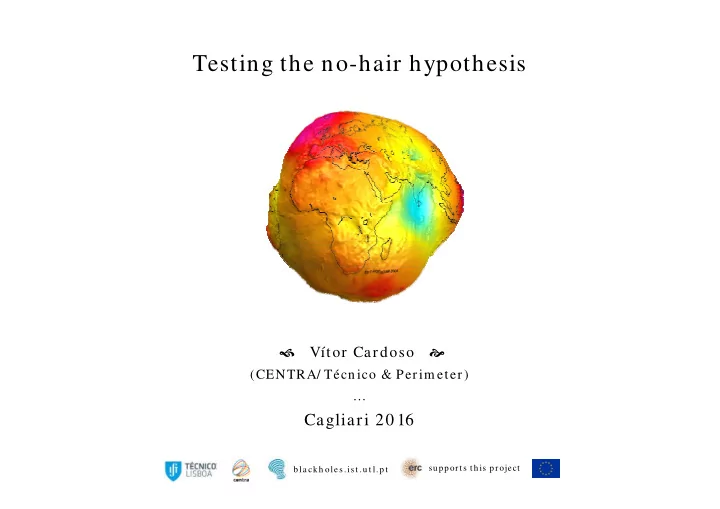
Testing the no-hair hypothesis
Vítor Cardoso
(CENTRA/ Técn ico & Perim eter) ...
Cagliari 20 16
supports this project b la ckh oles.ist .u t l.p t
Testing the no-hair hypothesis Vtor Cardoso (CENTRA/ Tcn ico - - PowerPoint PPT Presentation
Testing the no-hair hypothesis Vtor Cardoso (CENTRA/ Tcn ico & Perim eter) ... Cagliari 20 16 supports this project b la ckh oles.ist .u t l.p t Black holes have no hair Incidentally, the first mention of the theorem
Vítor Cardoso
(CENTRA/ Técn ico & Perim eter) ...
Cagliari 20 16
supports this project b la ckh oles.ist .u t l.p t
Incidentally, the first mention of the theorem was refused by PRD Editor Pasternak,
What is it Why it’s dead Why we still care
Gravitational wave ringdown Motion of stars and pulsars Accretion disks Black hole shadows
Brito, Fujita, Hopper, Nerozzi (Franzin, Okawa, Pani, Rocha, Witek, Zilhão) Barausse, Berti, Gualtieri, Herdeiro, Pretorius, Sperhake
Brito, Cardoso, Pani, Superradiance, Lect. Notes Phys. (Springer-Verlag, 2015) Cardoso, Franzin, Pani, Phys.Rev.Lett.116(2016)171101 Berti, Sesana, Barausse, Cardoso, Belczynski (2106, submitted) Cardoso, Gualtieri, Testing the no-hair hypothesis, to appear (2016)
Abbott et al, Phys.Rev.Lett.116:061102 (2016)
0.05 secs (~80 Schwarzschild radius)
Boson Stars, Fermion-boson stars
(Kaup 1968; Ruffini, Bonazzolla 1969; Colpi et al 1986; Okawa et al 2014; Brito et al 2015)
Boson Stars, Fermion-boson stars
(Kaup 1968; Ruffini, Bonazzolla 1969, Colpi et al 1986, Brito et al 2015)
Wormholes
(Morris, Thorne 1988; Visser 1996)
Gravastars
(Mazur, Mottola 2001)
Superspinars (super-extremal Kerr singularity cut-off)
(Gimon, Horava 2009)
(i) Impossible to “anchor” massless scalars (or fermions) onto Schwarzschild BHs (ii) Impossible to anchor massless multipoles l> s: no “protuberance” (hair) (iii) Possible generalization that includes electric charge and rotation
Davis et al, 1971 Anninos et al, 1993 Sperhake et al, 2008 Cardoso, Lem os, 2002
Followed by power-law decay
(Kerr 1963)
Theorem 2 (Bekenstein 1972; Graham, Jha 2014): Isolated, stationary BHs in the Einstein-Klein-Gordon or Einstein-Proca theory with a tim e-independent boson are described by Kerr family (impossible to hold the hair) Theorem 3 (Bekenstein 1972; Graham, Jha 2014): Isolated, stationary BHs in the Einstein-Klein-Gordon theory with one real scalar are described by the Kerr family (impossible not to radiate GWs)
The Kerr geometry describes all black holes in our Universe
The Kerr geometry describes all massive, compact objects
Black holes surrounded by thin shells (stability for r>3M… )
(Frauendiener, Hoenselaers, Konrad 1990; Brady, Louko, Poisson 1991)
Anisotropic fluid hair
(Brown, Hussain 1997)
Black holes in EYM theory (with SU(2) gauge group, “colored BHs”)
(Bizon 1990)
Einstein-dilaton-Gauss-Bonnet
(Mignemi, Stewart 1993; Kanti et al 1995; Kleihaus, Kunz, Radu 2011)
Dynamical-Chern-Simons
(Alexander, Yunes 2009, Pani et al 2011)
Models of mini-charged DM predict heavy, fractional “electrons”
(Rujula, Glashow, Sarid 1990; Perl, Lee 1997; Holdom 1986; Sigurdson et al 2004)
BH solutions are Reissner-Nordstrom Discharge mechanisms (mechanical, Schwinger, Hawking) suppressed
(Cardoso, Macedo, Pani, Ferrari 2016)
Hairy Kerr in minimally coupled KG theory (BS with BH at center)
(Herdeiro, Radu 2014)
Evades theorems 1-3 with complex, time-dependent scalars but time- independent stress-tensor (prevents hair from falling out) Superradiance prevents hair from falling in (Brito, Cardoso, Pani 2015)
Ribner, J. Acous. Soc. Am er.29 (1957)
Tam m , Frank, Doklady AN SSSR 14 (1937)
Pierce (& Kom pfner), Bell Lab Series (1947) Ginzburg, anomalous Doppler year
Zel’dovich, Pis’ma Zh. Eksp. Teor. Fiz. 14 (1971)
With exception of boson stars, no formation mechanism (yet) of ECOS Compact objects plagued by linear and nonlinear instabilities
(Friedman 1978; Cardoso et al 2008; Brito et al 2015; Keir 2016)
If object too compact, distinction irrelevant
(Cardoso, Franzin, Pani 2016)
Large class of theories Kerr still solution
(Psaltis et al 2008; Barausse, Sotiriou 2008)
The geodesic connection A wave analysis
Berti, Sesana, Barausse, Cardoso, Belczynski (2016)
Berti, Cardoso, Cardoso, Cavaglia, PRD76,104044(2007)
Berti, Sesana, Barausse, Cardoso, Belczynski (2016)
Cardoso, Macedo, Pani, Ferrari JCAP 1605: 054 (2016)
Brito, Cardoso, Pani, CQG32 (2015) 13, 134001; Arvanitaki et al (2016)
Barausse, Cardoso, Pani 2014
How ever, inasm uch as the goal of the gravitational w ave observatories is to obtain astrophysical inform ation of our universe (…), there is no doubt that w e w ill eventually have to face this problem of the QNM spectra of dirty black holes.
Cardoso, Franzin, Pani PRL116 (2016), 171101
Exciting tim es for gravitational-wave physics! Advances in theory and numerical methods. Advanced LIGO, network of detectors soon. Rates are under control (...) Birth and interaction of massive objects, specially BHs; central engine of violent phenomena (GRBs, etc) Demographics of very compact objects (GWs determine mass and spin better than 1%!) Gravitational wave astronomy can become a precision discipline, mapping compact objects throughout the entire visible universe.
Hundreds of ringdown observations, tests of GR and Kerr hypothesis will be done routinely. “After the advent of gravitational w ave astronom y, the observation of these resonant frequencies m ight finally provide direct evidence of BHs w ith the sam e certainty as, say, the 21 cm line identifies interstellar hydrogen” (S.Detweiler) Time-response of BH is dominated by light-ring ringdown at early times, and shared by all horizonless compact objects. These vibrations modes do not show up as poles of the corresponding Green function Can we discriminate competing gravity theories from ringdown
...?
Arvanitaki et al (2016) Brito et al, CQG (2014)
Can construct unstable states by forcing wave to bounce back
Zel’dovich, Pis’ma Zh. Eksp. Teor. Fiz. 14 (1971); Detweiler PRD22:2323 (1980) Cardoso, Dias, PRD70 (2004) ; Brito, Cardoso, Pani, arXiv:1501.06570
Massive “states” around Kerr are linearly unstable Damour et al ‘76; Detweiler PRD22:2323 (1980); see review Brito et al arXiv:1501.06570
Okaw a et al PRD89, 104032 (2014)
Herdeiro, Radu, PRL112: 221101 (2014)
Are themselves unstable in parts of the parameter space
Brito, Cardoso, Pani, arXiv:1501.06570
Mark Kac, American Mathematical Monthly, 1966
Gordon, Webb & Wolpert, Inventiones Mathematicae 1992
Brito, Cardoso, Pani arXiv:1411.0686
Pani et al PRL109, 131102 (2012) Bound on photon mass is model-dependent: details of accretion disks or intergalactic matter are important...but gravitons interact very weakly! Brito et al PRD88:023514 (2013); Review of Particle Physics 2014
Yoshino, Kodam a PTEP 2014 (043E02); Brito et al CQG32 (2015) 13, 134001
ET and NGO (Gossan S, Veitch J and Sathyaprakash 2012)