Tell me Im here A psycho-social group approach to individuals with - - PDF document

tell me i m here
SMART_READER_LITE
LIVE PREVIEW

Tell me Im here A psycho-social group approach to individuals with - - PDF document

8/7/19 Tell me Im here A psycho-social group approach to individuals with PPA and their spouses By Ffion Walker MENDERS (Mens Early oNset Dementia Engagement, Reflection and Support group) On my case list I had a cohort of men


slide-1
SLIDE 1

8/7/19 1

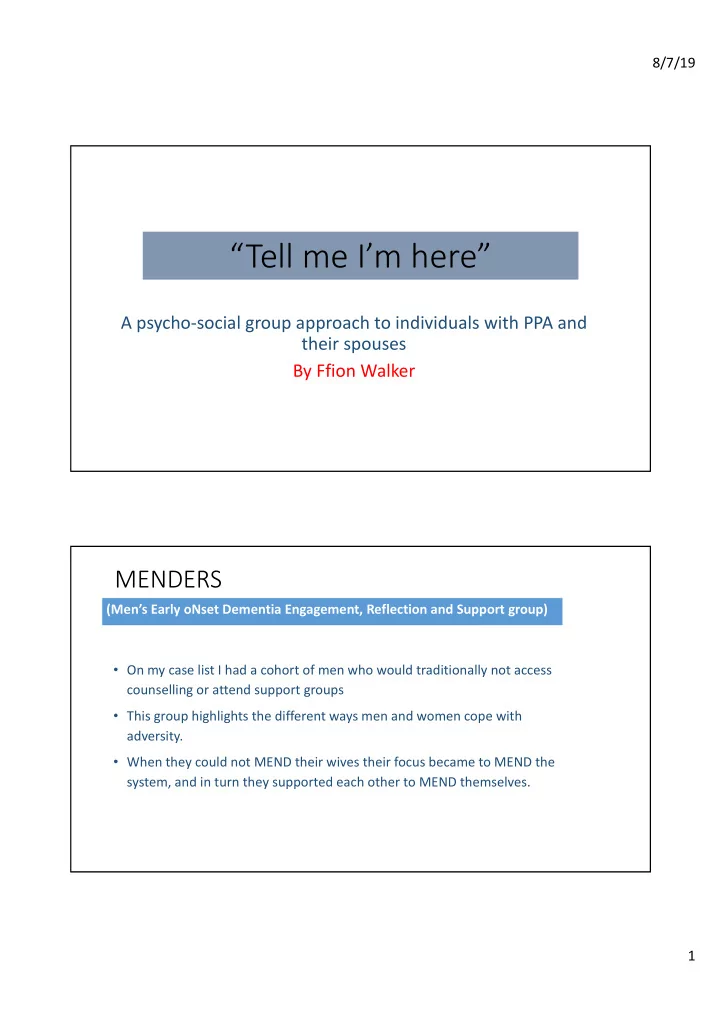
“Tell me I’m here”

A psycho-social group approach to individuals with PPA and their spouses By Ffion Walker

  • On my case list I had a cohort of men who would traditionally not access

counselling or attend support groups

  • This group highlights the different ways men and women cope with

adversity.

  • When they could not MEND their wives their focus became to MEND the

system, and in turn they supported each other to MEND themselves.

MENDERS

(Men’s Early oNset Dementia Engagement, Reflection and Support group)

slide-2
SLIDE 2

8/7/19 2

IMPACT

(Individuals Meeting with Progressive Aphasia Communicating Together)

IMPACT

Spousal stress

  • Language is the currency of our relationships. Deficiencies = distress and

dissatisfaction

  • Spouses have been dealing with deficits not just with communication but in social

cognition for a long time before diagnosis

  • Spouses feel emotionally disconnected from their partners with PPA
slide-3
SLIDE 3

8/7/19 3

IMPACT

Spousal stress- continued

  • Lack of initiation can cause significant distress.
  • Spouses also felt embarrassed as their partners withdrew socially or would act

inappropriately in group settings

  • They missed the everyday free flowing communication that was the

cornerstone of their marriages

  • Spouses also felt the increased burden over the greater role and responsibility

they have had to assume

IMPACT - Topics covered thus far include-

  • GOAL SETTING
  • MAKING CHANGES
  • PATIENCE
  • VALIDATION/AFFIRMATION
  • IDENTITY
  • GRIEF AND LOSS
  • HOPE
  • BETTER COMMUNICATION
  • STAYING CONNECTED
  • LOOKING BACK/LOOKING

FORWARD

  • HUMOUR
  • RESILIENCE
  • INDEPENDENCE
  • THE LITTLE/BIG STUFF
  • MAKING CHANGES THAT MATTER
slide-4
SLIDE 4

8/7/19 4

  • The aim of the program was to improve the groups understanding of television content through the provision of

aphasia friendly television support strategies. This was hoped to achieve:-

  • Increased recall of the story
  • Achieve higher transactional success, when relaying the story to their partner
  • Improve comprehension when viewing aphasia-friendly television episodes
  • It was also hoped that as social interaction is often about storytelling, and we could teach each couple how to

maximise information exchange in this format – so that it could also be then used in other social environments

IMPACT – Client group

Promoting strategic television viewing for individuals with PPA

slide-5
SLIDE 5

8/7/19 5

IMPACT – Client group

  • Four months (or four sessions in) I felt concerned
  • Clients were struggling to engage in the sessions
  • They were not doing the work at home
  • I have used television viewing very successfully in individual sessions
  • Considering the time constraints and in consultation with all group

members we decided to take the same psycho-social approach as we had with the spouses and work around a particular topic Promoting strategic television viewing for individuals with PPA

IMPACT – Client group

  • Pictures were introduced and modifications were made to enhance

understanding

  • AAC was introduced to help the individual with PPA’s ability to express

themselves

  • The level of engagement and enjoyment improved immediately, and

the level of social interaction improved between participants A psychosocial facilitated approach to group therapy

slide-6
SLIDE 6

8/7/19 6

IMPACT – Client group

A psychosocial facilitated approach to group therapy

What makes you more resilient?

IMPACT – Client group

A psychosocial facilitated approach to group therapy

slide-7
SLIDE 7

8/7/19 7

IMPACT- Client Group

A psychosocial facilitated approach to group therapy

IMPACT

  • Clients knew of nobody else with a language based dementia
  • Their goal was to increase their understanding and coping strategies
  • To get support from others in a similar situation
  • They felt they had very little professional support outside of Speech

Pathology

  • Concerns about attending a group like IMPACT were that they may be

confronted by people who had more advanced symptoms and that they initially would be opening up to strangers

Initial Client survey - common themes

slide-8
SLIDE 8

8/7/19 8

IMPACT

The Benefits

  • All participants now feel part of a community and

do not feel alone

  • Because we consulted with them, they feel their

goals from the start of the year have been met

  • Feeling supported and understood by others
  • Having a better understanding of the condition
  • The ability to laugh with others
  • A sense of connection
  • Increase knowledge
  • Provision of topics that were thought provoking

The Challenges

  • Most participants initially feeling vulnerable

sharing with strangers, this abated when more time was spent together as a group

  • Being confronted with difficulties experienced by
  • ther participants and wondering if that was going

to happen to them

End of year client survey - common themes

IMPACT

  • Having quarterly sessions where the spouses and partners are all

together

  • Plenty of opportunity to just have a chat
  • Chop down less trees (I like my paper handouts!)
  • Have a road map of topics at the start of the year, so that participants

knew what was coming up

Looking forward to 2019 – suggested improvements by participants

End of year client survey - common themes

slide-9
SLIDE 9

8/7/19 9

IMPACT

How to deal with group challenges

  • Expect that there will always be challenges within a group
  • Find a way to talk to people individually and get their reflections
  • Instead of just seeing the barriers, see if it can create opportunities
  • Always be willing to adapt and change to the needs of those in the group

Take home message

  • There is no one perfect way to run a group for

people with PPA

  • Don’t be afraid of change and taking things in a

new direction

  • Find ways of checking in on individuals and get

their feedback on group dynamics

  • Involve your clients in the decision making process
  • Expect challenges to occur, find the opportunities

that can come from them

  • Always have the interests of both the PWPPA and

their spouses at the centre of therapy

  • Hope and humour are just as important as

addressing the hard reality of this condition

  • Peer support is fundamental to group success
  • Lead with compassion and never minimize the

struggle a person is having

  • Find each individuals strengths and use them to

affirm the person in the group environment