Technology Maturation FERMILAB-SLIDES-18-025-DI Compact Accelerator - - PowerPoint PPT Presentation

technology maturation
SMART_READER_LITE
LIVE PREVIEW

Technology Maturation FERMILAB-SLIDES-18-025-DI Compact Accelerator - - PowerPoint PPT Presentation

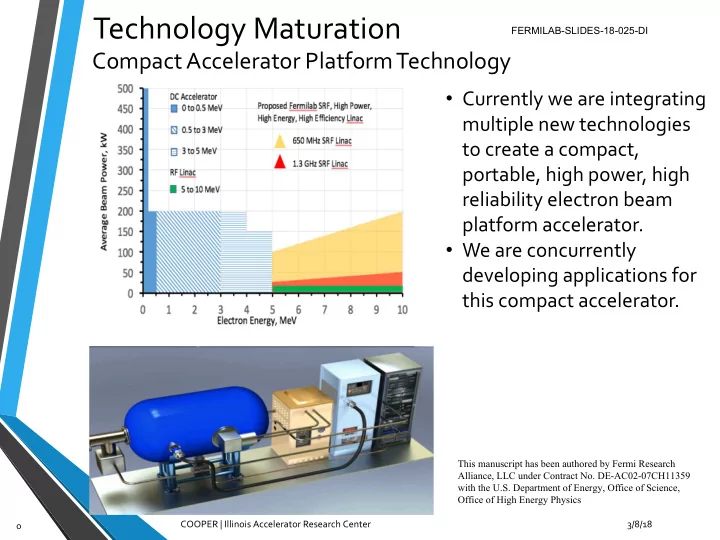
Technology Maturation FERMILAB-SLIDES-18-025-DI Compact Accelerator Platform Technology Currently we are integrating multiple new technologies to create a compact, portable, high power, high reliability electron beam platform accelerator.


slide-1
SLIDE 1

Compact Accelerator Platform Technology

  • Currently we are integrating

multiple new technologies to create a compact, portable, high power, high reliability electron beam platform accelerator.

  • We are concurrently

developing applications for this compact accelerator.

Technology Maturation

3/8/18 COOPER | Illinois Accelerator Research Center This manuscript has been authored by Fermi Research Alliance, LLC under Contract No. DE-AC02-07CH11359 with the U.S. Department of Energy, Office of Science, Office of High Energy Physics FERMILAB-SLIDES-18-025-DI

slide-2
SLIDE 2
  • Water/Biosolids
  • Cargo Scanning (DNDO)
  • Modification of Materials (like

pavement - ERDC)

  • Medical Sterilization(NNSA)
  • Driving various industrial

chemistries

  • GTL of flare gas
  • Rubber
  • Environmental remediation,

Advanced Mnfg, food treatment, surface hardening, digital electronics, mining

1

Application Areas

3/8/18 COOPER | Illinois Accelerator Research Center

slide-3
SLIDE 3

Compact Accelerator for Pavement

  • High power and good penetration depth allow for

rapid deployment of new pavement

  • Enables use of new types of pavement materials

that are more resilient to wear than asphalt

  • Can be used for applications like military runways,

specialty coatings, and normal roadways

  • Penetration depth allows for cold repairs
  • U.S. Patent #9,186,645 & 9,340,931

2

1 cm 2 cm

3/8/18 COOPER | Illinois Accelerator Research Center

slide-4
SLIDE 4

Compact Accelerator for Environmental Remediation

  • In several pilot programs electron accelerators have be proven to be

effective at destroying toxic organic contaminates in water and soil

  • Typically large volumes of material are removed from contaminated areas

creating a concern of secondary contamination

  • Key to deployment at large scale is development of high power (100’s of

KW to MW class) industrial electron accelerators that are cost effective and reliable

3

  • Compact

Accelerator could enable new in-situ environmental remediation or decontamination processes

3/8/18 COOPER | Illinois Accelerator Research Center

slide-5
SLIDE 5

Compact Accelerator for Crops

  • E-Beam treatment can improve shelf life, destroy disease

causing bacteria and be used for pest control

  • A portable high power accelerator has the potential for

saving crops in quarantined areas

4

  • Potential for large cost saving as

quarantined crops are often destroyed

3/8/18 COOPER | Illinois Accelerator Research Center

slide-6
SLIDE 6

Compact Accelerator for Driving Chemistry

  • In the U.S. Industry consumes ~32% of end use sector
  • 27% of that is used in the Chemical Sector (www.eia.gov)

5

k 50 k 100 k 150 k 200 k 250 k 300 k 350 k 400 k 100 200 300 400 500 600 700 800 900 1976 1981 1986 1991 1996 2001 2006 2011 2016 Total # US Original Catalyst Patents Total # US Original Patents patft.uspto.gov

  • Demonstrated industrial

effort to develop catalyst to increase efficiency

  • Electron Beam Driven

Chemistry largely unexplored

  • More efficient that direct

heating

  • Rubber Industry
  • Can remove need for some

toxic initiators, cross linkers

3/8/18 COOPER | Illinois Accelerator Research Center

slide-7
SLIDE 7

US E-beam Treatment of Wastewater

  • *CN Kurucz et al., “The Miami electron beam research facility:

a large scale waste water treatment application”, Radiat. Phys.

  • Chem. Vol. 45, pp299-308 (1995)
  • High Voltage Environmental Applications, Inc., Electron Beam

Technology Innovative Technology Evaluation Report - August 1997 – EPA, NRMRL

  • Workshop on Energy and Environmental Applications of

Accelerators at ANL in June of 2015 developed language that was used in 2016 Accelerator Stewardship program.

  • Design 1 MW accelerator for waste water treatment

6 3/8/18 COOPER | Illinois Accelerator Research Center

slide-8
SLIDE 8

Why Use E-Beam for Water Treatment?

  • Primarily works by generating oxidizing and reducing radicals from the water
  • But can directly decompose contaminants as well
  • Removal of toxic chemicals not removed in conventional domestic water treatment
  • Pharmaceuticals
  • Agricultural run off
  • Fuel additives (MTBE)
  • No toxic residuals (no secondary waste generation)

10 20 30 40 50 60 70 80 90 100 Experiment A

MTBE TCE PCE Benzene Toluene E-Benzene

  • -Xylene

CHCL3 EDB NDMA Atrazine Simazine

H2O

Electron Beam

OH-, H+, e-aq, H2, H2O2

*William J. Cooper, Dept. of Civil and Env. Engineering, UC, Irvine

7

  • PCBs
  • Explosives

3/8/18 COOPER | Illinois Accelerator Research Center

slide-9
SLIDE 9

Demonstration: Municipal Waste Water

  • Miami, Florida

treatment facility

  • 150 GPM
  • Effective in

disinfecting and removing organic waste from municipal waste water

  • Treatment cost

estimated at 1.5-2 cents/gal in 1995

*CN Kurucz et al., “The Miami electron beam research facility: a large scale waste water treatment application”, Radiat. Phys.

  • Chem. Vol. 45, pp299-308 (1995)

8 3/8/18 COOPER | Illinois Accelerator Research Center

slide-10
SLIDE 10

Demonstration: Textile Wastewater Treatment

  • Treatment of 1000 m3/day

(180 gpm) of water from textile dyeing process

  • Showed significant decrease

in TOC, CODCr and BOD5(30- 40% increased removal eff.)

  • Based of earlier success

10,000 m3/day plant constructed for $4M US in 2005

  • Operational cost measured to

be 0.11 cents/gal.

B Han et al., “Operation of industrial-scale electron beam wastewater treatment plant”, Rad. Phy. Chem. 81, p1475-1478 (2012)

Interaction area of water and beam (beam on to the right)

9 3/8/18 COOPER | Illinois Accelerator Research Center

slide-11
SLIDE 11

Municipal Water Treatment via Compact Accelerator

  • Currently partnered

with Metropolitan Water Reclamation District of Chicago

  • Stickney plant, largest

in the world (1.2 Billion gal/day)

  • Incoming water is a fuel

source not just waste

  • Goal of net zero energy
  • peration

10

Street
  • reclamation plant

e & Storm River Deep Tunnel Combined Sewer Systems Deep Tunnel

ARSE SCREENS

iminary treatment) Screens remove large – trash, wood,

  • etc. – that could

damage pumps.

PUMPS

3 AERATED GRIT TANKS

(Preliminary treatment) These use air bubbles keep lighter materials suspended while grit, sand and gravel sink to the bottom. Once the large material is on the bottom, a conveyor shovels it into a drain. What is collected is taken to a landfill.

4 PRIMARY SETTLING

TANKS

(Primary treatment) Here, solids settle to the

  • bottom. Fats and oils float

to the top. A revolving conveyor with slats skim off the floating fats and oils and

WASTEWATER TREATMENT PROCESS SOLIDS TREATMENT PROCESS

5 ACTIVATED SLUDGE

AERATION TANKS

Micro-organisms are returned to the activated sludge tanks to continue working Solids to solid treatment process To landfill Water returned to wastewater treatment

7

CONCENTRATION TANKS

8 CENTRIFUGES

They rapidl to extracts more liquid from the solids.

9

Solids are brok micro-organisms, producing gas in the process. The gas heats the digester to 95 degrees, for the microorganisms.

CENTRIFUGES BIOSOLIDS DRYING AREA

After the solids leave the last centrifuge they have a soil- like texture. They still have a water content of 75% and need further treatment. They are transported by train to the Lawndale Avenue Solids Management

  • Area. The biosolids are spread out so the

water can evaporate ending the process with 60%-70% solids. They are then used for farms, landfill covers, golf courses, highway shoulders, etc.

11

Biosolids Water evaporation s approximately 320 feet below the face and as wide as 33 feet diameter. SUN-TIMES GRAPHIC BY GREG GOOD

10

Sewage to plant Sewers from 125 municipalities, including their offices, homes, factories and businesses, empty into seven wastewater treatment plants in Cook County. Intercepting Intercepting

1

CENTRIFUGES

Biosolids Water evaporation

  • Biosolids can be sold as fertilizer
  • Desire to recover nitrates

and phosphates

  • Treat 2MGD with 1 MW of total power , treat at Thickened

WAS stage (5% solids before anaerobic digester)

3/8/18 COOPER | Illinois Accelerator Research Center
slide-12
SLIDE 12
  • We are integrating multiple new technologies to create a compact,

portable, high-power electron beam platform accelerator.

  • Electron-beam application development must be done because of the

new application areas that the Compact Accelerator enables

COOPER | Illinois Accelerator Research Center 11

and Demonstration (A2D2)

  • Accelerator for Application

Development

  • A2D2 allows for precise control of development work so that the beam, beam

sample interaction and analytical data taken can be changed as needed

3/8/18

slide-13
SLIDE 13

A2D2 Beam Info

Collimator (Fully Open) Position 1 Position 2 Position 3 Position 4 Position 5

Positi

  • n

Beam Diameter, cm Distance from Collimator, cm 1 4.8 63 2 5.7 75 3 7.1 93 4 10.3 135 5 12.6 165 Setting Power, kW Dose Rate, kGy/kg-s 1 0.22 0.22 2 0.43 0.43 3 0.65 0.65 4 0.87 0.87 5 1.08 1.08 6 1.3 1.3

COOPER | Illinois Accelerator Research Center 12 3/8/18

slide-14
SLIDE 14

Dose Distribution

0.00E+00 1.00E+01 2.00E+01 3.00E+01 4.00E+01 5.00E+01 6.00E+01 7.00E+01 8.00E+01 9.00E+01 1.00E+02 10 20 30 40 50 60 % Depth-Dose Distance (mm) 9MeV Electron in Water, Rock (Density 3.75) Water Greywacke Water Rock

COOPER | Illinois Accelerator Research Center 13 3/8/18

slide-15
SLIDE 15

14

Title: Workshop on Application of Electron Beam (EB) Technology on Wastewater and Biosolids Treatment Purpose:

  • Promote use of e-beam technology for wastewater treatment
  • Inform water treatment professionals about e-beam technology and opportunities
  • Provide feedback to NSF that opens future funding opportunities

Format: This two-day workshop will include expert speakers on the current state of wastewater treatment, a summary of the science of using e-beam technology for treatment of waste, the current state of e-beam accelerator technology, a tour of Fermilab National Accelerator Lab, panel discussions with water treatment experts, breakout discussions and a summary close-out session. Post conference a report will be issued with findings and recommendations. Where: Illinois Accelerator Research Center, Fermi National Accelerator Lab When: May 10-11, 2018 (Thursday-Half Day Friday) Who: By invitation only: Water treatment professionals, e-beam researchers, industrial accelerator experts, industry and utilities partners, regulatory personnel, NSF and Federal and State government officials

3/8/18 COOPER | Illinois Accelerator Research Center