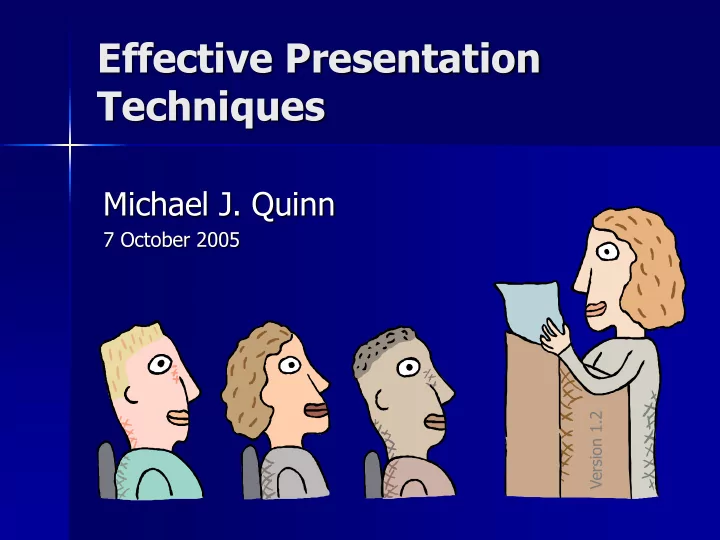
SLIDE 1 Effective Presentation Techniques
Michael J. Quinn
7 October 2005
Version 1.2
SLIDE 2
Outline
Structuring presentation Designing slides Pausing techniques Answering questions
SLIDE 3
Structuring presentation Designing slides Pausing techniques Answering questions
SLIDE 4
Structuring Presentation
Planning Delivery Sign posts
SLIDE 5
Planning
Talk: A B Consider audience Set goal Create slides
SLIDE 6
Delivery
Prepare audience Move audience Reflect on journey “Tell ’em” 3 Rehearse!
SLIDE 7
Sign Posts
Orient listener
– Current topic – Progress
Two styles
– Intermittent – Ever-present
SLIDE 8
Structuring presentation Designing slides Pausing techniques Answering questions
SLIDE 9
Designing Good Slides
Content Unveiling Color Subliminal messages
SLIDE 10
Content
Purpose
– Complement speaker – Talk ≠ technical report
Density
– 7 lines/page – 4 words/line
SLIDE 11 Speaker Reads Slides
A speaker may put his entire presentation on his
- slides. He turns his back to the audience and
reads the slides aloud. Perhaps he feels this approach guarantees all the information will get to the audience.
This may be the most annoying way to give a
- presentation. Audience members feel insulted:
they already know how to read! They wonder why the lecturer doesn’t simply hand out a copy of the slides.
The visual presentation dominates the presenter.
The presenter is not adding any value to what is
SLIDE 12 Speaker Interprets Slides
Slides dominate
– Provide all content – Hold audience’s attention
Speaker supports
– Faces slides – Helps audience understand
SLIDE 13 Complicated Derivation
) , ( ) 1 , ( ) , ( ) , ( 1 ) , ( ) 1 , ( ) 1 , ( ) , ( 1 1 ) , ( ) ( ) ( ) , ( 1 1 ) , ( ) , ( ) ( ) ( ) ( ) ( ) , ( ) , ( ) ( ) ( )) ( ) ( ( ) , ( ) , ( ) ( ) 1 ( ) ( ) ( )) ( ) ( ( ) , ( ) , ( ) ( ) ( )) ( ) ( ( ) , ( ) , ( / ) ( ) ( ) ( ) ( ) , ( p n CT n T p n T p n p n n T n T p n T p n n n p n T p n p n T n n n n p n p n T n n n n p p n p n p n p n n n n p p n p n p n n p n n p p n p n p n n n n p n
SLIDE 14
Good Illustration > Complicated Derivation
Number of processors Memory needed per processor Memory Size Scales poorly Scales well
SLIDE 15
Slides Enhance Speaker
Speaker dominates
– Faces audience – Provides content
Slides support speaker
– Reinforce message – Orient listeners
SLIDE 16
Mixing Important/ Unimportant Words
The isoefficiency and the scalability
metrics of a parallel algorithm are crucial
The typical parallel computers of the
future will have thousands of CPUs and terabytes of RAM
SLIDE 17
Important Words Only
Crucial metrics
– Isoefficiency – Scalability function
Future systems
– Thousands of CPUs – Terabytes of RAM
SLIDE 18 Unbalanced Lists
Speedup
– Sequential time – Parallel time
Parallel computations Parallel overhead
Efficiency
SLIDE 19
Balanced Lists
Speedup
– Expresses time reduction – Sequential time, parallel time, overhead
Efficiency
– Expresses processor utilization – Speedup, number of processors
SLIDE 20
“Fly In” Fails
Could you read this? How about this one? Maybe the third time is the charm!
SLIDE 21
“Wipe from Left” Works
Less distracting Reduces eye movement Increases readability
SLIDE 22
Typical Eye Movement
Upper left Upper right Lower left Lower right
SLIDE 23 Image reproduced from www.animationalley.com
SLIDE 24
Wall of White
Increases glare Causes eyestrain Distracts from speaker
SLIDE 25
Subliminal Messages
Orientation Motion
SLIDE 26
Message: Decline
SLIDE 27
Message: Improvement
SLIDE 28
Message: Bad Event
SLIDE 29
Message: Good Event
SLIDE 30
Structuring presentation Designing slides Pausing techniques Answering questions
SLIDE 31
Pauses
Useful Powerful Difficult
SLIDE 32
Silence Useful
Awaiting thought Switching gaze Reading slide Reinforcing point
SLIDE 33
Structuring presentation Designing slides Pausing techniques Answering questions
SLIDE 34
Pitfalls
Hostile gestures Wandering gaze Body language Missing point Seeking approval Excluding audience
SLIDE 35
Opportunities
Welcoming gestures Focusing gaze Body language Getting point Reinforcing message Including audience
SLIDE 36
Dangerous Responses
“Good question” “I’m glad you asked that question”
SLIDE 37
Summary
Guide audience gently Design slides carefully Use pauses effectively Answer questions inclusively