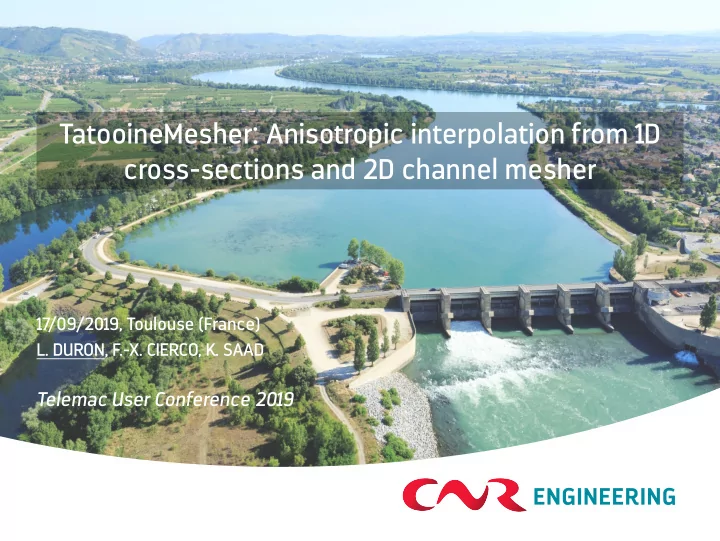
TatooineMesher: Anisotropic interpolation from 1D cross-sections and - - PowerPoint PPT Presentation

tatooinemesher anisotropic interpolation from 1d cross
SMART_READER_LITE
LIVE PREVIEW

TatooineMesher: Anisotropic interpolation from 1D cross-sections and - - PowerPoint PPT Presentation

TatooineMesher: Anisotropic interpolation from 1D cross-sections and 2D channel mesher 17/09/2019, Toulouse (France) L. DURON, F.-X. CIERCO, K. SAAD Telemac User Conference 2019 Table of contents Introduction Mesh generation Principle - Step


slide-1
SLIDE 1

TatooineMesher: Anisotropic interpolation from 1D cross-sections and 2D channel mesher

17/09/2019, Toulouse (France)

  • L. DURON, F.-X. CIERCO, K. SAAD

Telemac User Conference 2019

slide-2
SLIDE 2

Table of contents

Introduction Mesh generation Principle - Step by step Overview of main features Interpolation Applications Conclusion

1

slide-3
SLIDE 3
  • 1. Introduction
slide-4
SLIDE 4

Introduction CNR

  • 1st producer of exclusively renewable energy in France

▶ 18 hydroelectric facilities on the Rhône River (3000 MW) ▶ Solar and wind energy (1000 MW)

  • CNR Engineering Departement (for CNR and third party)

Objectives

  • 1. pre-treatment 1D models: interpolate intermediate

cross-sections

  • 2. pre-treatment 2D models: interpolate the bathymetry and/or

mesh the river bed

  • 3. post-treatment 1D models: visualize the results in 2D (in a

projected geographic coordinate system)

2

slide-5
SLIDE 5

Introduction CNR

  • 1st producer of exclusively renewable energy in France

▶ 18 hydroelectric facilities on the Rhône River (3000 MW) ▶ Solar and wind energy (1000 MW)

  • CNR Engineering Departement (for CNR and third party)

Objectives

  • 1. pre-treatment 1D models: interpolate intermediate

cross-sections

  • 2. pre-treatment 2D models: interpolate the bathymetry and/or

mesh the river bed

  • 3. post-treatment 1D models: visualize the results in 2D (in a

projected geographic coordinate system)

2

slide-6
SLIDE 6

Developed tools

  • Code : Python 3
  • Command line scripts
  • Usage:

https://github.com/CNR-Engineering/TatooineMesher/wiki

Installation and requirements

# I n s t a l l required modules pip i n s t a l l r requirements . txt # I n s t a l l i t as a module pip i n s t a l l e g i t : / / github .com/CNR Engineering / TatooineMesher . g i t#egg=TatooineMesher user

PyTelTools and Crue10_tools (contains Mascaret part of postel) are 2 packages required.

3

slide-7
SLIDE 7

Developed tools

  • Code : Python 3
  • Command line scripts
  • Usage:

https://github.com/CNR-Engineering/TatooineMesher/wiki

Installation and requirements

# I n s t a l l required modules pip i n s t a l l −r requirements . txt # I n s t a l l i t as a module pip i n s t a l l −e g i t : / / github .com/CNR − Engineering / TatooineMesher . g i t#egg=TatooineMesher − −user

PyTelTools and Crue10_tools (contains Mascaret part of postel) are 2 packages required.

3

slide-8
SLIDE 8
  • 2. Mesh generation
slide-9
SLIDE 9

Principle - Step by step

  • 1. Order cross-sections (CS)
  • 2. Intersect CS and

constraint lines

  • 3. Generate nodes for each

submesh

  • a. Linear interp. for

intermediate CS

  • b. Application of an affjne

transformation

  • c. Lateral sampling
  • 4. Triangulate over the

whole domain

  • 5. Defjnition of a

fmow-oriented coordinate system

4

slide-10
SLIDE 10

Principle - Step by step

  • 1. Order cross-sections (CS)
  • 2. Intersect CS and

constraint lines

  • 3. Generate nodes for each

submesh

  • a. Linear interp. for

intermediate CS

  • b. Application of an affjne

transformation

  • c. Lateral sampling
  • 4. Triangulate over the

whole domain

  • 5. Defjnition of a

fmow-oriented coordinate system

4

slide-11
SLIDE 11

Principle - Step by step

  • 1. Order cross-sections (CS)
  • 2. Intersect CS and

constraint lines

  • 3. Generate nodes for each

submesh

  • a. Linear interp. for

intermediate CS

  • b. Application of an affjne

transformation

  • c. Lateral sampling
  • 4. Triangulate over the

whole domain

  • 5. Defjnition of a

fmow-oriented coordinate system

4

slide-12
SLIDE 12

Principle - Step by step

  • 1. Order cross-sections (CS)
  • 2. Intersect CS and

constraint lines

  • 3. Generate nodes for each

submesh

  • a. Linear interp. for

intermediate CS

  • b. Application of an affjne

transformation

  • c. Lateral sampling
  • 4. Triangulate over the

whole domain

  • 5. Defjnition of a

fmow-oriented coordinate system

4

slide-13
SLIDE 13

Principle - Step by step

  • 1. Order cross-sections (CS)
  • 2. Intersect CS and

constraint lines

  • 3. Generate nodes for each

submesh

  • a. Linear interp. for

intermediate CS

  • b. Application of an affjne

transformation

  • c. Lateral sampling
  • 4. Triangulate over the

whole domain

  • 5. Defjnition of a

fmow-oriented coordinate system

4

slide-14
SLIDE 14

Principle - Step by step

  • 1. Order cross-sections (CS)
  • 2. Intersect CS and

constraint lines

  • 3. Generate nodes for each

submesh

  • a. Linear interp. for

intermediate CS

  • b. Application of an affjne

transformation

  • c. Lateral sampling
  • 4. Triangulate over the

whole domain

  • 5. Defjnition of a

fmow-oriented coordinate system

4

slide-15
SLIDE 15

Principle - Step by step

  • 1. Order cross-sections (CS)
  • 2. Intersect CS and

constraint lines

  • 3. Generate nodes for each

submesh

  • a. Linear interp. for

intermediate CS

  • b. Application of an affjne

transformation

  • c. Lateral sampling
  • 4. Triangulate over the

whole domain

  • 5. Defjnition of a

fmow-oriented coordinate system

4

slide-16
SLIDE 16

Principle - Step by step

  • 1. Order cross-sections (CS)
  • 2. Intersect CS and

constraint lines

  • 3. Generate nodes for each

submesh

  • a. Linear interp. for

intermediate CS

  • b. Application of an affjne

transformation

  • c. Lateral sampling
  • 4. Triangulate over the

whole domain

  • 5. Defjnition of a

fmow-oriented coordinate system

4

slide-17
SLIDE 17

Feature 1 : Spatial discretization

  • Longitudinal discretization
  • Lateral discretization : structured or not (fjgure below)

5

slide-18
SLIDE 18

Feature 2: Constraint lines

Guide the interpolation and follow topographic lines

6

slide-19
SLIDE 19

Feature 3: XY coordinates interpolation of constraint lines

7

slide-20
SLIDE 20

Feature 4: Flat projection of cross-section

This option makes the elements mesh adjacent to the cross-sections more organized.

8

slide-21
SLIDE 21
  • 3. Interpolation
slide-22
SLIDE 22

Isotropic interpolation methods

Bathymetry measured (left) compared to interpolated bathymetry from elevation along cross-sections (3 interpolation methods: Linear, IDW (In- verse distance weighting) and Kriging)

9

slide-23
SLIDE 23

Interpolation (of values at mesh nodes) Consecutive 1D interpolators (lateral then longitudinal)

Lateral interpolation methods:

  • Linear
  • Akima spline
  • Cubic spline
  • PCHIP

Longitudinal interpolation method: Linear

Global 2D interpolators

  • Bilinear
  • Bicubic

Consecutive 1D interpolations to have values at node P

10

slide-24
SLIDE 24

Validation test cases

Study area: Vaugris (Rhône, France) Criteria on difgerence in elevation (calculated - measured)

11

slide-25
SLIDE 25
  • 4. Applications
slide-26
SLIDE 26

Channel mesher and intepolator

Leysse river example

12

slide-27
SLIDE 27

Generate 2D surfaces from 1D model results

  • Mesh over multiple branches
  • Interpolation multiple frames and multiple variables:

▶ 1D variables: free surface elevation, Froude number... ▶ 2D variables: bottom elevation, friction coeffjcient, water

depth, bed shear stress...

Froude Number (1D) Water depth (2D)

13

slide-28
SLIDE 28
  • 5. Conclusion
slide-29
SLIDE 29

Conclusion and perspectives

  • Open-source Python package
  • Multiple aims
  • Usefull for Mascaret-T2D coupling?
  • Use in combinaison with BlueKenue or GMSH?

14

slide-30
SLIDE 30

Thank you for your attention ! Any questions?

slide-31
SLIDE 31

L'énergie au cœur des territoires

cnr.tm.fr

slide-32
SLIDE 32

Appendix

slide-33
SLIDE 33

Comparison of linear, cubic spline, Akima and PCHIP interpolation at single cross section

Cubic spline is not robust. In the case of upsampling or non-equally spaced data, it creates over shooting at locations of abrupt changes in the slope.

1

slide-34
SLIDE 34

Mesh generation on L'Étournel site (1/2)

A limited domain on the Upper Rhône River (upstream Génissiat dam) called L’Étournel is chosen to compare meshes generated with TatooineMesher with difgerent space discretization options. This simple data set, presented in Figure below, includes 25 cross-sections intersected by at most 5 constraint lines.

Geometrical data used to mesh “L’Étournel” site

2

slide-35
SLIDE 35

Mesh generation on L'Étournel site (2/2)

Statistics on generated meshes

3

slide-36
SLIDE 36

References I

4

slide-37
SLIDE 37

The End...