Table of contents 1. Introduction: You are already an - - PowerPoint PPT Presentation

table of contents
SMART_READER_LITE
LIVE PREVIEW

Table of contents 1. Introduction: You are already an - - PowerPoint PPT Presentation

Table of contents 1. Introduction: You are already an experimentalist 2. Conditions 3. Items Section 1: 4. Ordering items for presentation Design 5. Judgment Tasks 6. Recruiting participants 7. Pre-processing data (if necessary) 8.


slide-1
SLIDE 1

Table of contents

28
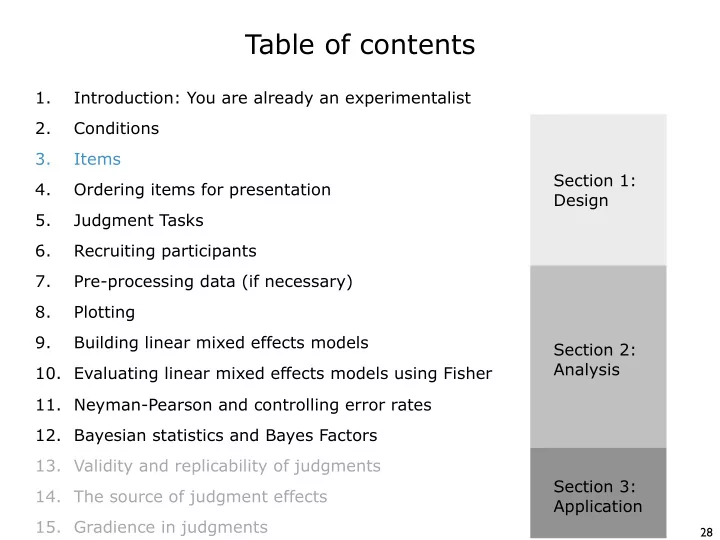
Conditions Items Ordering items for presentation Judgment Tasks Recruiting participants Pre-processing data (if necessary) Introduction: You are already an experimentalist 1. 2. 3. 4. 5. 6. 7. Plotting 8. Building linear mixed effects models 9. Evaluating linear mixed effects models using Fisher 10. Bayesian statistics and Bayes Factors 12. Validity and replicability of judgments 13. The source of judgment effects 14. Gradience in judgments 15. Section 1: Design Section 2: Analysis Section 3: Application Neyman-Pearson and controlling error rates 11.

slide-2
SLIDE 2

Linguistics tends to use repeated measures

29

condition 1 condition 2 condition 1 condition 2 Repeated Measures: If each participants sees every condition, we call it repeated

  • measures. It is also called a within-subjects design.

Independent Measures: If each participants sees only one condition, we call it independent measures. It is also called a between-subjects design. Repeated Measures Independent Measures

slide-3
SLIDE 3

Linguistics tends to use repeated measures

30

Requires fewer participants Requires more participants Individual differences between participants is not a confound Individual differences between participants is a possible confound Increased statistical power Decreased statistical power Interaction of two conditions is a potential confound Interaction of two conditions is impossible Repeated Measures Independent Measures

slide-4
SLIDE 4

There are four types of items to create

31

Instruction items: Practice items: Experimental items: Filler items: After you have designed your conditions, the next step is to actually make the items that will go in your experiment. The are four types of items that you will need to construct: These are the items that appear in your instructions. The goal there is to illustrate the task, and if necessary, anchor the response scale. These are items that occur at the beginning of the

  • experiment. They help to familiarize the participant

with the task. They are typically not analyzed in any

  • way. They can be marked as separate (announced)
  • r just part of the experiment (unannounced).

These are your treatment and control conditions. These are items that you add to the experiment for various reasons: filling out the scale, hiding the experiment’s purpose, and balancing types of items.

slide-5
SLIDE 5

Instruction items

32

The number and type of instruction items depends on your task. If the task is a scale task with an odd number of points (e.g, 7-point scale), I recommend three instruction items: one at the bottom of the scale, one at the top, and one in middle. Here are three that I use. They were pre-tested in my massive LI replication study: The was insulted waitress frequently. Tanya danced with as handsome a boy as her father. This is a pen. LI-Mode LI-Mean 1 4 7 1 4 7 If the scale has an even number of points, you would probably just use two: the bottom and top of the scale. If the task is yes/no, you might use three: a clear yes, a clear no, and one in between. If the task is forced-choice, you might use 3 pairs: a pair with a large difference, a pair with a medium difference, and one with a small difference.

slide-6
SLIDE 6

Practice items

33

Practice items give participants a chance to work out any bugs before they respond to items that you actually care about (the experimental items). For scale tasks, practice items give participants a chance to see the full range

  • f variability in acceptability, so that they can use the scale appropriately. So in

scale tasks, it is important to have practice items that span the range of

  • acceptability. Here are 9 that I have pre-tested in the LI study. One for each

point on a 7-point scale, plus one more for each endpoint. She was the winner. Promise to wash, Neal did the car. The brother and sister that were playing all the time had to be sent to bed LI-Mode LI-Mean 7 1 4 7.00 1.31 3.91 The children were cared for by the adults and the teenagers Ben is hopeful for everyone you do to attend. All the men seem to have all eaten supper They consider a teacher of Chris geeky. It seems to me that Robert can’t be trusted. There might mice seem to be in the cupboard. 6 2 5 6.08 2.00 4.92 3 7 1 3.09 6.92 1.25

slide-7
SLIDE 7

Practice items

34

For non-scale tasks, the rationale behind the practice items might be different. For yes/no tasks, you may want to give a mix of clear yes’s, clear no’s, and intermediate sentences, so that participants can sharpen their own internal boundary. For forced-choice tasks, you may want to include a mix of large differences, small differences, and medium differences, so that participants can practice identifying each size of difference. Announced practice is when you clearly indicate in the experiment that the items are practice items. This signals to the participants that it is ok to make

  • mistakes. Announced practice is typical in psycholinguistic experiments,

because it gives participants a chance to ask questions of the experimenter. Unannounced practice is when the practice items simply appear as part of the main experiment. This is appropriate if the task is relatively intuitive, such that participants won’t have questions. This is what I do with all of my judgment studies. I typically present the (unannounced) practice items in the same order for all

  • participants. You could also counterbalance the order (more on this later).
slide-8
SLIDE 8

Experimental items

35

Here is a starting set of experimental items for the whether island experiment we started to construct in the previous section. Let’s use these to see the issues that arise in creating experimental items.

Who __ thinks that Jack stole the car? 1. non-island short Condition 1: Who __ thinks that Amy chased the bus? 2. Who __ thinks that Dale sold the TV? 3. Who __ thinks that Stacey wrote the letter? 4. What do you think that Jack stole __? 1. non-island long Condition 2: What do you think that Amy chased __? 2. What do you think that Dale sold __? 3. What do you think that Stacey wrote __? 4. Who __ wonders whether Jack stole the car? 1. island short Condition 3: Who __ wonders whether Amy chased the bus? 2. Who __ wonders whether Dale sold the TV? 3. Who __ wonders whether Stacey wrote the letter? 4. What do you wonder whether Jack stole __? 1. island long Condition 4: What do you wonder whether Amy chased __? 2. What do you wonder whether Dale sold __? 3. What do you wonder whether Stacey wrote __? 4.

slide-9
SLIDE 9

Experimental items - Lexically matched sets

36

The first thing to note is that the items are created in lexically matched sets. The idea here is that the only thing you want varying between conditions is the syntactic manipulation. So, to the extent possible, you use the same lexical items in all 4 conditions. This helps minimize confounds in the experiment. The only lexical confound left is if the syntactic manipulation interacts with the lexical items.

Who __ thinks that Jack stole the car? 1. non-island short Condition 1: Who __ thinks that Amy chased the bus? 2. Who __ thinks that Dale sold the TV? 3. Who __ thinks that Stacey wrote the letter? 4. What do you think that Jack stole __? 1. non-island long Condition 2: What do you think that Amy chased __? 2. What do you think that Dale sold __? 3. What do you think that Stacey wrote __? 4. Who __ wonders whether Jack stole the car? 1. island short Condition 3: Who __ wonders whether Amy chased the bus? 2. Who __ wonders whether Dale sold the TV? 3. Who __ wonders whether Stacey wrote the letter? 4. What do you wonder whether Jack stole __? 1. island long Condition 4: What do you wonder whether Amy chased __? 2. What do you wonder whether Dale sold __? 3. What do you wonder whether Stacey wrote __? 4.

slide-10
SLIDE 10

Experimental items - variability

37

The second thing to note is that the variability in the items is tightly controlled. In this case, I primarily varied content items, keeping functional items the

  • same. There is a tension between variability and control. I tend to err on the

side of control so that there are fewer chances for confounds. However, variability is also important. When items vary, you can begin to see how well the effect generalizes across lexical items.

Who __ thinks that Jack stole the car? 1. non-island short Condition 1: Who __ thinks that Amy chased the bus? 2. Who __ thinks that Dale sold the TV? 3. Who __ thinks that Stacey wrote the letter? 4. What do you think that Jack stole __? 1. non-island long Condition 2: What do you think that Amy chased __? 2. What do you think that Dale sold __? 3. What do you think that Stacey wrote __? 4. Who __ wonders whether Jack stole the car? 1. island short Condition 3: Who __ wonders whether Amy chased the bus? 2. Who __ wonders whether Dale sold the TV? 3. Who __ wonders whether Stacey wrote the letter? 4. What do you wonder whether Jack stole __? 1. island long Condition 4: What do you wonder whether Amy chased __? 2. What do you wonder whether Dale sold __? 3. What do you wonder whether Stacey wrote __? 4.

slide-11
SLIDE 11

How much variability do you want?

38

There is no set principle for how much variability you need. It will depend on the number of viable lexical items for the constructions you are testing, the likelihood that lexical items are driving your effect, and the potential confounds that could be introduced by lexical items. What I can tell you is my approach to this: I try to make every item in a single condition the same length. This means there are no extra PPs or clauses between items. Longer sentences often lead to lower ratings, so length is a potential confound. 1. It is often the case that some of the lexical items cannot vary because of the nature of the conditions. For example, in whether-islands you will always have whether in the embedded clause. 2. I try to be consistent about the use and position of pronouns versus nouns. The reason for this is that pronouns and nouns are processed differently; in fact, different pronouns are processed differently. 3. Everything else is a potential point of variation, as long as the lexical items have the relevant properties (e.g., subcategorization frames). 4.

slide-12
SLIDE 12

Lexical matching and repeated measures

39

In repeated measures designs (each participant sees every condition), lexical matching can be a problem. You don’t want one participant to see the same lexical material in each condition, because then they might overlook the syntactic manipulation: This leads to a straightforward relationship between (i) the number of conditions, (ii) the number of judgments per condition each participant will give, and (iii) the number of items that you need to make per condition.

Who __ thinks that Jack stole the car? What do you think that Jack stole __? Who __ wonders whether Jack stole the car? What do you wonder whether Jack stole __? Who __ thinks that Jack stole the car? What do you think that Amy stole __? Who __ wonders whether Dale stole the pie? What do you wonder whether Pat stole __?

slide-13
SLIDE 13

Experimental items - number

40

If C is the number of conditions in your experiment, and O is the number of judgments (observations) each participant will give per condition, and I is the number of items per condition that you need to construct, then I = C x O.

Who __ thinks that Jack stole the car? 1. non-island short Condition 1: Who __ thinks that Amy stole the gold? 2. Who __ thinks that Dale stole the pie? 3. Who __ thinks that Pat stole the pen? 4. What do you think that Jack stole __? 1. non-island long Condition 2: What do you think that Amy stole __? 2. What do you think that Dale stole __? 3. What do you think that Pat stole __? 4. Who __ wonders whether Jack stole the car? 1. island short Condition 3: Who __ wonders whether Amy stole the gold? 2. Who __ wonders whether Dale stole the pie? 3. Who __ wonders whether Pat stole the pen? 4. What do you wonder whether Jack stole __? 1. island long Condition 4: What do you wonder whether Amy stole __? 2. What do you wonder whether Dale stole __? 3. What do you wonder whether Pat stole __? 4.

Here I’ve created 4 items per condition, so it must be the case that I only want 1 judgment per participant per condition. If I wanted 2, I’d need 8 items…

slide-14
SLIDE 14

Filler items

41

Filler items are not strictly necessary. But there are three reasons to add filler items to your experiment. If you are worried about any of these issues, then you need fillers items. (As a practical matter, most reviewers expect filler items, so it is easier to include them if you can.) Fill out the response scale: Participants tend to keep track of how often they use each response option. If some options aren’t being used, they may try to use them even if they aren’t appropriate. Well- designed fillers can make sure that every response option is used an equal number of times. Balancing other properties: Some properties of your experimental items might be particularly salient, especially if you are studying a particular construction (wh-movement, ellipsis, etc). Fillers allow you to include other constructions, so that participants are less likely to be impacted by the salience

  • f those features.

Hiding your intent: Relatedly, some experimenters worry that participants might respond differently if they know the purpose of the

  • experiment. Fillers can help disguise that purpose, by

hiding the experimental items among other items.

slide-15
SLIDE 15

Filler items

42

There is no easy formula for calculating the number of filler items that you

  • need. The answer is that you need as many as you need to achieve your goals.

What I can tell you is that there are “rules of thumb” in the field that reviewers

  • ften look for. These can be violated if the science requires it, but in general, if

you can follow these rules, it will make your reviewing experience easier. The ideal ratio of filler items to experimental items is 2:1 or higher. That means that 2/3 of the items that a participant sees are filler items, and 1/3 are experimental items. 1. The minimum ratio is 1:1. This means that half of the items that a participant sees are filler items. 2. Experimental items from a one experiment can serve as fillers for the experimental items from another experiment. So you can kill multiple birds with one stone. But the items need to be sufficiently distinct, and they still need to satisfy general filler properties (balancing responses, etc). 3.

slide-16
SLIDE 16

43

Fillers: With that announcement were many citizens denied the

  • pportunity to protest.

There is likely a river to run down the mountain. Richard may have been hiding, but Blake may have done so too. LI-Mode LI-Mean 1 1 2 1.17 2.17 1.17 The ball perfectly rolled down the hill. Lloyd Weber musicals are easy to condemn without even watching. There are firemen injured. Someone better sing the national anthem. Laura is more excited than nervous. I hate eating sushi. 3 5 5 2.00 3.08 3.08 6 6 7 4.15 4.17 5.00 Mike prefers tennis because Jon baseball. Jenny cleaned her sister the table. There had all hung over the fireplace the portraits by Picasso. Lilly will dance who the king chooses. The specimen thawed to study it more closely. 2 3 4 4 7 4.93 6.00 6.00 6.92 6.92 Here is a set of filler items that I have constructed for an experiment with 8 experimental items (2 each of 4 conditions).

slide-17
SLIDE 17

instruction items practice items filler items

What have we been controlling?

44

The construction of experimental items is primarily about controlling for grammar confounds and other cognitive confounds.

Acceptability

+

Grammar

+

memory parsing world thought

Noise Task Effects

The construction of instruction items, practice items, and filler items is primarily about controlling for task effects. experimental items

slide-18
SLIDE 18

Hands on practice

45

The file exercise.2.xlsx contains the 2x2 designs for the four island effects from exercise 1. Your job is to create four items for each condition (a total of 64 sentences). Be sure to create variability where you can, while still keeping the items tightly controlled. Exercise 2: 2x2 item practice The file anchor.practice.instruction.items.xlsx includes the instruction, practice, and filler items that we discussed here. There is nothing you need to do. These just exist for you to use in your future experiments if you want. Anchor, practice, filler items (not an exercise)