
SLIDE 1
Page # Title Name Department
2-11 Arctic Research Team John Hedengren Multiple 12-20 C-UAS Center for Unmanned Aircraft Systems John Hedengren Multiple
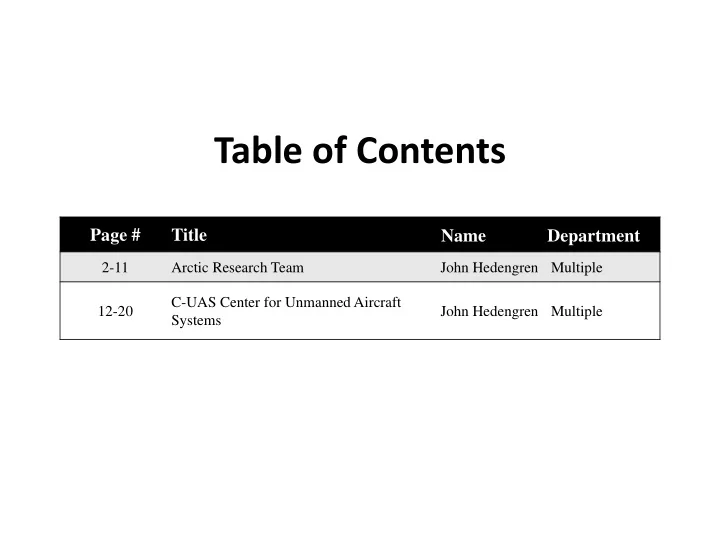
Table of Contents Page # Title Name Department 2-11 Arctic - - PowerPoint PPT Presentation
Table of Contents Page # Title Name Department 2-11 Arctic Research Team John Hedengren Multiple C-UAS Center for Unmanned Aircraft 12-20 John Hedengren Multiple Systems Proposed Arctic Research Center John Hedengren Conrad Monson
Page # Title Name Department
2-11 Arctic Research Team John Hedengren Multiple 12-20 C-UAS Center for Unmanned Aircraft Systems John Hedengren Multiple
John Hedengren Chemical Engineering john_hedengren@byu.edu (801) 422‐2590
software and analytics to find oil and gas
Conrad Monson Research Development conrad_monson@byu.edu (801) 422‐2674
John Hedengren and Conrad Monson Ira A. Fulton College of Engineering and Technology Brigham Young University 26 August 2013
undiscovered oil and 30% of its undiscovered natural gas1
barrels of recoverable oil and about 76 trillion cubic feet of recoverable natural gas2
1Unger, David. “White House Arctic strategy: What's next for oil, gas drilling?” Christian Science Monitor,
May 13, 2013
“We seek an Arctic region that is stable and free of
conflict, where nations act responsibly in a spirit of trust and cooperation, and where economic and energy resources are developed in a sustainable manner that also respects the fragile environment and the interests and cultures of indigenous peoples (National Strategy for the Arctic Region, May 2013)”
research budget to $43.9 million in 2013 from some $14 million last year
to drill up to six exploration wells beginning in the summer of 2014
exploratory drilling efforts
leases, the company is delaying and may abandon plans to drill
until at least 2015; needs to address safety and other concerns raised by the Federal Government
drilling efforts were plagued with technical problems and environmental and safety violations; shell has to provide a plan to address concerns before it can drill again
The damaged Royal Shell Dutch drilling barge Kulluk is loaded onto the transport ship XRK in Unalaska,
exploratory oil and gas drilling in the Arctic last summer (Jim Paulin/AP/File)
Better oil spill preparedness
Emergency preparedness cooperation among multiple operators that minimizes environmental impacts
Length of time to get oil market after it is discovered (a decade or more)
Potential environmental impacts to drilling
Impacts from ice flow and overall freezing temperatures
Short drilling season (July to October) in Chukchi and Beaufort Seas
Strict government and tribal regulations
Maintain infrastructure such as roads for drilling rigs
Exxon Valdez Oil Spill
Composite materials to reduce
riser weight and efficiency
High-performance computing
and advancements in software and analytics to find oil and gas
Better imaging to find resources
in deepwater
Better understanding of
environmental impacts
Greater reliability of subsea
equipment
ScanEagle UAV
Math and Statistics Model/simulate operations in harsh conditions Calculate probability of ice occurrence Chemistry Research pollutants Develop enhanced measurement techniques for cold
environments
Geology Map and research the drilling impact of boulders and other sea
floor features
Mechanical engineering Analyze the behavior of structures (containment covers, tow
lines, oil rigs, etc.) challenged by the harsh environment
1from Shell report
Chemical Engineering Model vessels and/or oil rig usage Do research to help oil companies avoid permit
violations
Find better ways to provide propulsive power for oil
and gas development with lower pollutions loads
Business Address resource (including human) management
issues
Civil Engineering Measure salinity, temperature, etc. in the arctic ocean
cold water column
Anthropology Determine how to better work with the native tribes
Tim McLain Mechanical Engineering mclain@byu.edu (801) 422‐6537
collaborate on research having industrial significance
Randy Beard Electrical and Computer Engineering beard@ee.byu.edu (801) 422‐8392
Brigham Young University
Autonomous Vehicles Path Planning Trajectory Generation
Cooperative Control Image Directed Control
Kestrel Autopilot
2004 2012 Technology Transition Path Following
efficient Applications
Sensor Based Flight
Applications
small light low cost