Table of Contents Review of Two Step Equations Click on a topic to - - PDF document

table of contents
SMART_READER_LITE
LIVE PREVIEW

Table of Contents Review of Two Step Equations Click on a topic to - - PDF document

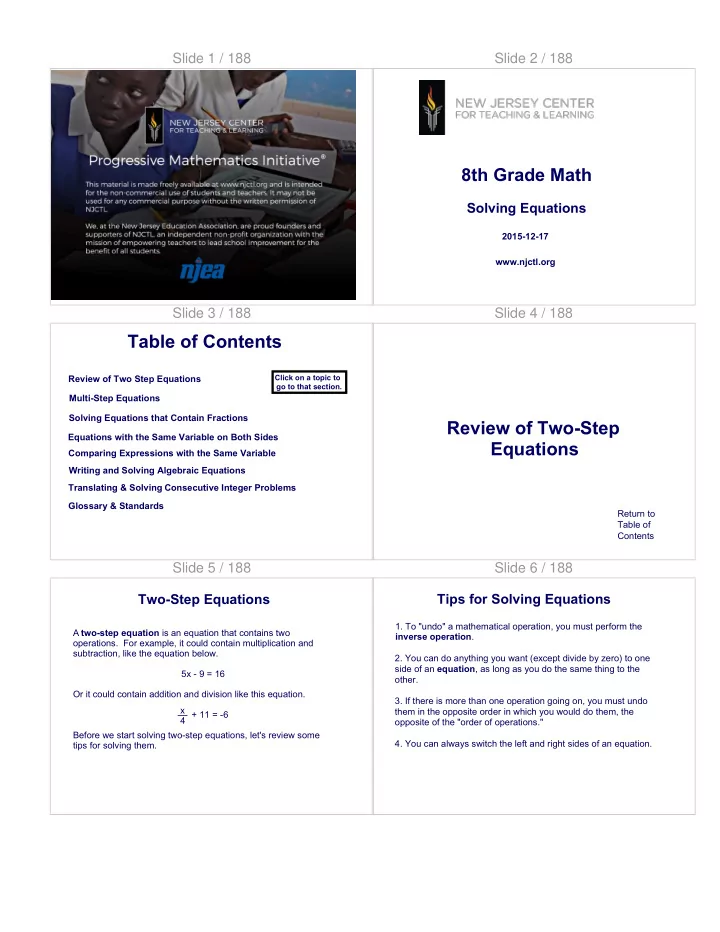
Slide 1 / 188 Slide 2 / 188 8th Grade Math Solving Equations 2015-12-17 www.njctl.org Slide 3 / 188 Slide 4 / 188 Table of Contents Review of Two Step Equations Click on a topic to go to that section. Multi-Step Equations Solving


slide-1
SLIDE 1

Slide 1 / 188 Slide 2 / 188

8th Grade Math

Solving Equations

2015-12-17 www.njctl.org

Slide 3 / 188

Table of Contents

Review of Two Step Equations Multi-Step Equations

Click on a topic to go to that section.

Glossary & Standards Translating & Solving Consecutive Integer Problems Solving Equations that Contain Fractions Writing and Solving Algebraic Equations Equations with the Same Variable on Both Sides Comparing Expressions with the Same Variable

Slide 4 / 188

Review of Two-Step Equations

Return to Table of Contents

Slide 5 / 188 Two-Step Equations

A two-step equation is an equation that contains two

  • perations. For example, it could contain multiplication and

subtraction, like the equation below. 5x - 9 = 16 Or it could contain addition and division like this equation. + 11 = -6 Before we start solving two-step equations, let's review some tips for solving them. x 4

Slide 6 / 188

  • 2. You can do anything you want (except divide by zero) to one

side of an equation, as long as you do the same thing to the

  • ther.
  • 3. If there is more than one operation going on, you must undo

them in the opposite order in which you would do them, the

  • pposite of the "order of operations."
  • 4. You can always switch the left and right sides of an equation.

Tips for Solving Equations

  • 1. To "undo" a mathematical operation, you must perform the

inverse operation.

slide-2
SLIDE 2

Slide 7 / 188

  • 1. To "undo" a mathematical operation, you must do the opposite.

We learned earlier that for every mathematics operation, there is an inverse operation which undoes it: when you do both

  • perations, you get back to where you started.

When the variable for which we are solving is connected to something else by a mathematical operation, we can eliminate that connection by using the inverse of that operation.

Tips Explained Slide 8 / 188

  • 2. You can do anything you want (except divide by zero) to one

side of an equation, as long as you do the same to the other side. If the two expressions on the opposite sides of the equal sign are equal to begin with, they will continue to be equal if you do the same mathematical operation to both of them. This allows you to use an inverse operation on one side, to undo an operation, as long as you also do it on the other side. You can just never divide by zero (or by something which turns out to be zero) since the result of that is always undefined.

Tips Explained Slide 9 / 188

  • 3. If there is more than one operation going on, you must undo

them in the opposite order in which you would do them, the

  • pposite of the "order of operations."

The operations which are connected to a variable must be "undone" in the reverse order from the Order of Operations. So, when solving for a variable, you: first have to undo addition/subtraction, then multiplication/division, then exponents/roots, finally parentheses. The order of the steps you take to untie a knot are the reverse of the order used to tie it.

Tips Explained Slide 10 / 188

  • 4. You can always switch the left and right sides of an equation.

Once an equation has been solved for a variable, it is typically easier to use if that variable is moved to the left side. Mathematically, this has no effect since the both sides are equal.

Tips Explained Slide 11 / 188

Let's solve this equation for "y"

Solving for y

That means that when we're done we'll have y alone

  • n the left side of the equation.
  • 4y - 11 = -27

Slide 12 / 188

1 Is y already alone? If not, what is with it? Select all that apply. A -4 B y C -11 D -27 E it is already alone

  • 4y - 11 = -27
slide-3
SLIDE 3

Slide 13 / 188

  • 4y - 11 = -27

2 Which math operations connect the numbers to y? Select all that apply. A Addition B Subtraction C Multiplication D Division

Slide 14 / 188

  • 4y - 11 = -27

3 Which math operation gets undone first? A Addition B Subtraction C Multiplication D Division

Slide 15 / 188

  • 4y - 11 = -27

4 What must we do if we add 11 to the left side? A Subtract 11 from the left side B Subtract 11 from the right side C Add 11 to the left side D Add 11 to the right side

Slide 16 / 188 Solving for y

  • 4y - 11 = -27

Are we done?

  • 1. To "undo" a mathematical operation, you must do the opposite.
  • 2. You can do anything you want (except divide by zero) to one

side of an equation, as long as you do the same thing to the other. So we undo 9 being subtracted from -2y by adding 9 to both sides.

  • 4y = -16
  • 4y - 11 = -27

+ 11 +11

Slide 17 / 188

5 What math operation connects -4 and y? A -4 is being added to y B -4 is being subtracted by y C -4 is being multiplied by y D -4 is being divided by y

  • 4y = -16

Slide 18 / 188

  • 4y = -16

6 What is the opposite of multiplying y by -4? A Dividing y by 4 B Dividing y by -4 C Multiplying y by 4 D Multiplying y by -4

slide-4
SLIDE 4

Slide 19 / 188

  • 4y = -16
  • 4 -4
  • 1. To "undo" a mathematical operation, you must do the opposite.

y = 4

Solving for y

  • 2. You can do anything you want (except divide by zero) to one

side of an equation, as long as you do the same thing to the

  • ther.
  • 4y = -16

Slide 20 / 188

7 Is y alone on the left? If not, what is with it? A

  • 11

B

  • 4

C y D it is alone y = 4

Slide 21 / 188

Let's solve this equation for "t"

Solving for t

15

t

5 = That means that when we're done we'll have t alone

  • n the left side of the equation.

Slide 22 / 188

8 Is t already alone? If not, what is with it? A 5 B 15 C t D it is already alone 15 t 5 =

Slide 23 / 188

9 What mathematical operation connects d to t? A t is being divided by 15 B 15 is being divided by t C 15 is being multiplied by t D t is being subtracted from 15 15 t 5 =

Slide 24 / 188

10 What is the opposite of dividing 15 by t? A dividing 15 by t B dividing 5 by t C multiplying 15 by t D multiplying t by 15

Rule 1. To "undo" a mathematical operation, you must do the

  • pposite.

15 t 5 =

slide-5
SLIDE 5

Slide 25 / 188

11 What must we do if we multiply the right side by t? A divide the left side by t B multiply the left side by t C divide the left side by 15 D divide the left side by 5

Rule 2. You can do anything you want (except divide by zero) to

  • ne side of an equation, as long as you do the same thing to the
  • ther.

15 t 5 =

Slide 26 / 188

12 Is there more than one mathematical operation acting

  • n "t"?

Yes No

Rule 3. If there is more than one operation going on, you must undo them in the opposite order in which you would do them, the opposite

  • f the "order of operations."

15 t 5 =

Slide 27 / 188

Are we done?

Solving for t

  • 1. To "undo" a mathematical operation, you must do the opposite.
  • 2. You can do anything you want (except divide by zero) to one

side of an equation, as long as you do the same thing to the other. So we undo d being divided by t, by multiplying both sides by t. 15 t 5 = (t) (t) 5t = 15 15 t 5 =

Slide 28 / 188

13 What mathematical operation connects 5 to t? A t is being divided by 15 B t is being divided into 5 C t is being multiplied by 5 D t is being subtracted from 5 5t = 15

Slide 29 / 188

14 What is the opposite of multiplying t by 5? A dividing t by 5 B dividing t by t C multiplying t by t D multiplying t by 5 5t = 15

Slide 30 / 188

5

  • 1. To "undo" a mathematical operation, you must do the opposite.

5 t = 3

Solving for t

  • 2. You can do anything you want (except divide by zero) to one

side of an equation, as long as you do the same thing to the

  • ther.

5t = 15 5t 15 5 =

slide-6
SLIDE 6

Slide 31 / 188

15 Is t alone on the left? If not, what is with it? A 5 B 15 C t D it is alone t = 3

Slide 32 / 188 Review of Solving Two-Step Equations

The following formative assessment questions are review from 7th grade. If further instruction is need, see the presentation at: https://www.njctl.org/courses/math/7th-grade/ equations-inequalities-7th-grade/

Slide 33 / 188

16 Solve the equation. 5x - 6 = -56

Slide 34 / 188

17 Solve the equation. 14 = 3c + 2

Slide 35 / 188

18 Solve the equation. x 5

  • 4 = 24

Slide 36 / 188

19 Solve the equation. 5r - 2 = -12

slide-7
SLIDE 7

Slide 37 / 188

20 Solve the equation. 14 = -2n - 6

Slide 38 / 188

21 Solve the equation. + 7 = 13 x 5

Slide 39 / 188

22 Solve the equation. + 2 = -10 x 3

  • Slide 40 / 188

23 Solve the equation.

  • 2.5x - 4 = 3.5

Slide 41 / 188

24 Solve the equation. 3.3x - 4 = -13.9

Slide 42 / 188

25 Solve the equation. + (-5.1) = -2.3

  • x

6

slide-8
SLIDE 8

Slide 43 / 188

26 Solve the equation. 2.8x - 7 = -1.4

Slide 44 / 188

Multi-Step Equations

Return to Table of Contents

Slide 45 / 188 Steps for Solving Multiple Step Equations

As equations become more complex, you should:

  • 1. Simplify each side of the equation.
  • 2. Use inverse operations to solve the equation.

Remember, whatever you do to one side of an equation, you MUST do to the other side! (Combine like terms and use the distributive property.)

Slide 46 / 188

Example: 12h - 10h + 7 = 25

Multiple Step Equations Slide 47 / 188

Example: 17 - 9f + 6 = 140

Multiple Step Equations Slide 48 / 188

Always check to see that both sides of the equation are simplified before you begin solving the equation. When an equation is simplified there should be at most one term for each variable and one constant term.

Hint

slide-9
SLIDE 9

Slide 49 / 188

In order to solve for a variable, it can't be in parentheses with other variables or numbers. If that is how the equation is given, you have to use the distributive property to get it on its own. For example: You need to use the distributive property as shown below as a first step in solving for x. 5(x - 6) - 3x = 8 Distributive Property 5x - 30 - 3x = 8 Now we can combine like terms and solve

Distributive Property Slide 50 / 188

Examples: 5(20 + 6) = 5(20) + 5(6) 9(30 - 2) = 9(30) - 9(2) 3(5 + 2x) = 3(5) + 3(2x)

  • 2(4x - 7) = -2(4x) - (-2)(7)

Remember: The distributive property is a(b + c) = ab + ac

Distributive Property Slide 51 / 188

Example: 3(w - 2) = 9

Distributive Property Slide 52 / 188

Example: 6m + 2(2m + 7) = 54

Distributive Property Slide 53 / 188

27 Solve. 3 + 2t + 4t = -63

Slide 54 / 188

28 What is the value of n in the equation 0.6(n + 10) = 3.6?

From the New York State Education Department. Office of Assessment Policy, Development and

  • Administration. Internet. Available from www.nysedregents.org/IntegratedAlgebra; accessed 17, June, 2011

A

  • 0.4

B 5 C

  • 4

D 4

slide-10
SLIDE 10

Slide 55 / 188

29 Solve. 19 = 1 + 4 - x

Slide 56 / 188

30 Solve. 8x - 4 - 2x - 11 = -27

Slide 57 / 188

31 Solve.

  • 4 = -27y + 7 - (-15y) + 13

Slide 58 / 188

32 Solve. 9 - 4y + 16 + 11y = 4

Slide 59 / 188

33 Solve. 6(-8 + 3b) = 78

Slide 60 / 188

34 Solve. 18 = -6(1 - 1k)

slide-11
SLIDE 11

Slide 61 / 188

35 Solve. 2w + 8(w + 3) = 34

Slide 62 / 188

36 Solve. 4 = 4x - 2(x + 6)

Slide 63 / 188

37 Solve. 3r - r + 2(r + 4) = 24

Slide 64 / 188

38 What is the value of p in the equation 2(3p - 4) = 10?

From the New York State Education Department. Office of Assessment Policy, Development and

  • Administration. Internet. Available from www.nysedregents.org/IntegratedAlgebra; accessed 17, June, 2011.

A 1 B 2 1/3 C 3 D 1/3

Slide 65 / 188

Solving Equations that Contain Fractions

Return to Table

  • f Contents

Slide 66 / 188

You always need to have the variable for which you are solving end up in the numerator. Also, it's often easier to just get rid of fractions as a first step.

Distributing Fractions

slide-12
SLIDE 12

Slide 67 / 188

(-3 + 3x) = 3 5 72 5 3(-3 + 3x) = 72 Distribute

  • 9 + 9x = 72

Add 9 to both sides 9x = 81 Divide both sides by 9 x = 9

Distributing Fractions

Multiply both sides of this equation by the least common denominator (LCD) of both sides to eliminate the fractions. Then this just becomes like all the equations we've been solving. In this case, the LCD is 5...so just multiply both sides by 5 to get:

Slide 68 / 188

Example: Multiply both sides by 21 Simplify fractions 12(x + 9) = 14 Distribute the 12 12x + 108 = 14 Subtract 108 from both sides 12x = -94 Divide both sides by 12 x = -7 10/12 Simplify fraction x = -7 5/6 4 7 (x + 9) = 2 3 (21)(4) 7 (x + 9) = (2)(21) 3

Distributing Fractions Slide 69 / 188

Example: 3 5 (x + 2) = 9

Distributing Fractions Slide 70 / 188

Example: 1 8 (x + ) = 7 16 1 2

Distributing Fractions Slide 71 / 188

39 Solve the equation. 2x - 3 = 9 5

Slide 72 / 188

40 Solve the equation. 2x + 3 = 4 3

slide-13
SLIDE 13

Slide 73 / 188

41 Which value of x is the solution of the equation ?

From the New York State Education Department. Office of Assessment Policy, Development and Administration. Internet. Available from www.nysedregents.org/IntegratedAlgebra; accessed 17, June, 2011

A B C D

Slide 74 / 188

42 Solve: 2 3 x + 5 6 = 7 12

Slide 75 / 188

43 Solve

Slide 76 / 188 Slide 77 / 188

45 Solve

Slide 78 / 188

slide-14
SLIDE 14

Slide 79 / 188

Equations with the Same Variable on Both Sides

Return to Table

  • f Contents

Slide 80 / 188

Now, we will be given an equation with the same variable on both

  • sides. These equations will look similar to the following:

These require one additional step to get all the terms with that variable to one side or the other. It doesn't matter which side you choose to move the variables to, but it’s typically most helpful to choose the side in which the coefficient of the variable will remain positive.

Variables on Both Sides

Previously, you solved equations with variables on one side, similar to the following:

Slide 81 / 188

When you have finished solving, discuss the meaning of your answer with your neighbor.

Meaning of Solutions

Before we encounter the new equations, let's practice how to solve an equation with the variable on only one side. Solve for x:

Slide 82 / 188 Meaning of Solutions

Remember that you always have the ability to check your answers by substituting the value you solved for back in to the original equation. It isn't necessary to show on each problem, but is encouraged if you feel unsure about your answer.

Slide 83 / 188

Which side do you think would be easiest to move the variables to?

Variables on Both Sides Slide 84 / 188

Now, solve the equation.

Variables on Both Sides

slide-15
SLIDE 15

Slide 85 / 188 Variables on Both Sides

Which side do you think would be easiest to move the variables to?

Slide 86 / 188 Variables on Both Sides

Now, solve the equation.

Slide 87 / 188

Example: What do you think about this equation? What is the value of x?

Variables on Both Sides Slide 88 / 188

Example: What do you think about this equation? What is the value of x?

Variables on Both Sides Slide 89 / 188

47 Solve for f:

Slide 90 / 188

48 Solve for h:

slide-16
SLIDE 16

Slide 91 / 188

49 Solve for x:

Slide 92 / 188

Sometimes, you get an interesting answer. What do you think about this? What is the value of x? 3x - 1 = 3x + 1

  • 3x
  • 3x
  • 1 = +1

Since the equation is false, there is no solution! No value will make this equation true.

No Solution Slide 93 / 188

How about this one? What do you think about this? What is the value of x? 3(x - 1) = 3x - 3 3x - 3 = 3x - 3

  • 3x
  • 3x
  • 3 = -3

Since the equation is true, there are infinitely many solutions! The equation is called an identity. Any value will make this equation true.

Identity Slide 94 / 188

50 Solve for r: A r = 0 B r = 2 C infinitely many solutions (identity) D no solution

Slide 95 / 188

51 Solve for w: A w = -8 B w = -1 C infinitely many solutions (identity) D no solution

Slide 96 / 188

52 Solve for x: A x = 0 B x = 24 C infinitely many solutions (identity) D no solution

slide-17
SLIDE 17

Slide 97 / 188 Slide 98 / 188

54 In the equation n is equal to?

From the New York State Education Department. Office of Assessment Policy, Development and

  • Administration. Internet. Available from www.nysedregents.org/IntegratedAlgebra; accessed 17, June, 2011.

A B C D

Slide 99 / 188

55 In the accompanying diagram, the perimeter of ∆MNO is equal to the perimeter of square ABCD. If the sides of the triangle are represented by 4x + 4, 5x - 3, and 17, and one side of the square is represented by 3x, find the length of a side of the square.

5x – 3 4x + 4 17 O M N 3x A B C D

From the New York State Education Department. Office of Assessment Policy, Development and

  • Administration. Internet. Available from www.nysedregents.org/IntegratedAlgebra; accessed 17, June, 2011.

Slide 100 / 188

56 Solve this equation for x. 0.5(5 - 7x) = 8 - (4x + 6)

From PARCC sample test - PBA non calc #2

Slide 101 / 188

57 Solve for x. 9(3 - 2x) = 2(10 - 8x)

From PARCC sample test - EOY non-calc #1

Slide 102 / 188

slide-18
SLIDE 18

Slide 103 / 188

· When solving an equation with variables on both sides, choose a side to move all of them to, then continue working to isolate the variable. · When solving an equation where all variables are eliminated and the remaining equation is false, there is No Solution. · When solving an equation where all variables are eliminated and the remaining equation is true, there are Infinite Solutions.

RECAP Slide 104 / 188

Comparing Expressions with the Same Variable

Return to Table

  • f Contents

Slide 105 / 188

Recall that an expression is a mathematical phrase that contains ordinary numbers, variables and operations. Also, an equation is a statement indicating that two expressions are equal. In the last lesson, you were solving an equation that contained variables on both sides of the equation. In some cases, you were able to find a solution. In others, there was either no solution, or infinitely many solutions. What if you were given two expressions and trying to determine the relationship between them, instead. Could it be done?

Expressions with the Same Variable Slide 106 / 188

You can easily compare expressions to one another. Take this example: What is the relationship between the expressions (x + 4) and (x + 8)? Since we don't know the relationship between the expressions yet, we can write an equation, but replace the "=" sign with a question mark. x + 4 ? x + 8

Expressions with the Same Variable Slide 107 / 188

What is the relationship between the expressions (x + 4) and (x + 8)? x + 4 ? x + 8 Treat this like an equation and try to solve it by first subtracting x from both sides. Now, we have 4 ? 8 We can conclude that 4 < 8. Therefore, no matter what the value of x is, (x + 4) will always be less than (x + 8).

Expressions with the Same Variable Slide 108 / 188

Let's try another example: What is the relationship between the expressions 4x and -6x? Since we don't know the relationship between the expressions yet, we can write an equation, but replace the "=" sign with a question mark. 4x ? -6x

Expressions with the Same Variable

slide-19
SLIDE 19

Slide 109 / 188

What is the relationship between the expressions 4x and -6x? 4x ? -6x Treat this like an equation and try to solve it by first adding 6x to both sides. Then, we have 10x ? 0 We can finish solving by dividing both sides by 10. The result will be x ? 0

Expressions with the Same Variable Slide 110 / 188

What is the relationship between the expressions 4x and -6x? x ? 0 In the expression above, there is no set value for x. Can you determine the different answers and provide evidence to support them? Discuss.

Expressions with the Same Variable Slide 111 / 188

What is the relationship between the expressions 4x and -6x? x ? 0 Here are the cases that your groups should have come up with. Case 1: If x > 0, then 4x > -6x e.g. if x = 2, 4(2) > -6(2), or 8 > -12 Case 2: If x < 0, then 4x < -6x e.g. if x = -1, then 4(-1) < -6(-1), or -4 < 6 Case 3: If x = 0, 4x = -6x e.g. if x = 0, then 4(0) = -6(0), or 0 = 0

Expressions with the Same Variable Slide 112 / 188

59 What is the relationship between the expressions (x - 10) and (x - 15)? A x - 10 < x - 15 B x - 10 > x - 15 C x - 10 = x - 15 D all of the above, depending on the value of x

Slide 113 / 188

60 What is the relationship between the expressions and ? A < B > C = D all of the above, depending on the value of x x 5 x

  • 3

x

  • 3

x

  • 3

x

  • 3

x 5 x 5 x 5

Slide 114 / 188

61 What is the relationship between the expressions (4x - 3) and (4x + 3)? A 4x - 3 < 4x + 3 B 4x - 3 > 4x + 3 C 4x - 3 = 4x + 3 D all of the above, depending on the value of x

slide-20
SLIDE 20

Slide 115 / 188

62 What is the relationship between the expressions 3x - 7 and (9x - 21)? A 3x - 7 < (9x - 21) B 3x - 7 > (9x - 21) C 3x - 7 = (9x - 21) D all of the above, depending on the value of x 1 3 1 3 1 3 1 3

Slide 116 / 188

Summer is considering the expressions 2(3x + 20) and (6x - 12) + 4(x + 11) Part A She claims that the first expression is greater than the second expression for all values of x. Is Summer correct? Explain your answer. Part B Write another expression that is always less than both of these expressions.

Expressions with the Same Variable

1 3

Slide 117 / 188

Summer is considering the expressions 2(3x + 20) and (6x - 12) + 4(x + 11) Part A She claims that the first expression is greater than the second expression for all values of x. Is Summer correct? Explain your answer. If we set up our expressions with a question mark in between them, and simplify them, we would have 2(3x + 20) ? (6x - 12) + 4(x + 11) 6x + 40 ? 2x - 4 + 4x + 44 6x + 40 ? 6x + 40

Expressions with the Same Variable

1 3 1 3

Slide 118 / 188

Summer is considering the expressions 2(3x + 20) and (6x - 12) + 4(x + 11) Part A She claims that the first expression is greater than the second expression for all values of x. Is Summer correct? Explain your answer. 6x + 40 ? 6x + 40 Clearly, we can replace the "?" with an "=". Therefore, Summer is incorrect.

Expressions with the Same Variable

1 3

Slide 119 / 188

Summer is considering the expressions 2(3x + 20) and (6x - 12) + 4(x + 11) Part B Write another expression that is always less than both of these expressions. Since both of them simplified to 6x + 40, we can write any algebraic expression that simplifies to 6x and any number less than 40. Here are 2 sample answers: 6x + 20 (12x - 10) = 6x - 5

Expressions with the Same Variable

1 3 1 2

Slide 120 / 188

slide-21
SLIDE 21

Slide 121 / 188 Slide 122 / 188 Slide 123 / 188 Slide 124 / 188 Slide 125 / 188 Slide 126 / 188

slide-22
SLIDE 22

Slide 127 / 188

Writing and Solving Algebraic Equations

Return to Table

  • f Contents

Slide 128 / 188

Recall from 6th grade and 7th grade, we translated phrases/ sentences into expressions and equations. Now, we can extend this understanding to writing and solving algebraic equations, and using them to solve word problems. Let's start off by reviewing key words for our operations. What are some of them?

Writing and Solving Algebraic Equations Slide 129 / 188 Review of Writing and Solving Algebraic Equations

The following formative assessment questions are review from 7th grade. If further instruction is need, see the presentation at: https://www.njctl.org/courses/math/7th-grade/ equations-inequalities-7th-grade/

Slide 130 / 188

70 Which equation can be made from the sentence below: The difference between 15 and a number is 18. A n - 18 = 15 B 18 - n = 15 C n - 15 = 18 D 15 - n = 18

Slide 131 / 188

71 What is the solution to the equation that represents the sentence below? The difference between 15 and a number is 18.

Slide 132 / 188

72 Which equation can be made from the sentence below: Twelve more than the quotient of a number and four is -3. A - 12 = -3 B + 12 = -3 C - 12 = 4 D + 12 = 4 n 4 n 4 n

  • 3

n

  • 3
slide-23
SLIDE 23

Slide 133 / 188

73 What is the solution to the equation that represents the sentence below? Twelve more than the quotient of a number and four is -3.

Slide 134 / 188

74 Which equation can be made from the sentence below: Two fifths of a number increased by 7 is -1. A n + (-1) = 7 B n - (-1) = 7 C n + 7 = -1 D n - 7 = -1 2 5 2 5 2 5 2 5

Slide 135 / 188

75 What is the solution to the equation that represents the sentence below? Two fifths of a number increased by 7 is -1.

Slide 136 / 188

76 Translate and solve. 10 equals the sum of four and the quotient of a number n and 12.

Slide 137 / 188

77 Translate, then solve the equation. Four more than three times a number is 13.

Slide 138 / 188

78 Translate, then solve the equation. How old am I if 400 reduced by 2 times my age is 342?

slide-24
SLIDE 24

Slide 139 / 188

79 Translate and solve. Twice the quantity of x plus eight is negative 2.

Slide 140 / 188

80 Translate and solve. Negative seven times the sum of eighteen and a number s is equal to 49.

Slide 141 / 188

81 Translate and solve. 132 is equal to negative twelve times the quantity of the sum of a number x and eighteen.

Slide 142 / 188

82 Translate and solve. Negative one is the same as the quotient of the sum of four and x, and six.

Slide 143 / 188

We can use our algebraic translating skills to solve other problems. We can use a variable to show an unknown. A constant will be any fixed amount. If there are two separate unknowns, relate one to the other.

Writing and Solving Algebraic Equations Slide 144 / 188

The school cafeteria sold 225 chicken meals today. They sold twice the number of grilled chicken sandwiches than chicken

  • tenders. How many of each were sold?

2c + c = 225

chicken sandwiches chicken tenders total meals

c + 2c = 225 3c = 225 3 3 c = 75 The cafeteria sold 150 grilled chicken sandwiches and 75 tenders.

Writing and Solving Algebraic Equations

slide-25
SLIDE 25

Slide 145 / 188

Many times with equations there will be one number that will be the same no matter what (constant) and one that can be changed based on the problem (variable and coefficient). Example: George is buying video games online. The cost of the video is $30.00 per game and shipping is a flat fee of $7.00. He spent a total of $127.00. How many games did he buy in all?

Writing and Solving Algebraic Equations Slide 146 / 188

George is buying video games online. The cost of the video is $30.00 per game and shipping is a flat fee of $7.00. He spent a total of $127.00. How many games did he buy in all? Notice that the video games are "per game" so that means there could be many different amounts of games and therefore many different prices. This is shown by writing the amount for one game next to a variable to indicate any number of games. 30g

cost of

  • ne video

game number

  • f games

Writing and Solving Algebraic Equations Slide 147 / 188

George is buying video games online. The cost of the video is $30.00 per game and shipping is a flat fee of $7.00. He spent a total of $127.00. How many games did he buy in all? Notice also that there is a specific amount that is charged no matter what, the flat fee. This will not change so it is the constant and it will be added (or subtracted) from the other part of the problem. 30g + 7

cost of

  • ne video

game number

  • f games

the cost

  • f the

shipping

Writing and Solving Algebraic Equations Slide 148 / 188

George is buying video games online. The cost of the video is $30.00 per game and shipping is a flat fee of $7.00. He spent a total of $127.00. How many games did he buy in all? "Total" means equal so here is how to write the rest of the equation. 30g + 7 = 127

cost of

  • ne video

game number

  • f games

the total amount the cost of shipping

Writing and Solving Algebraic Equations Slide 149 / 188

George is buying video games online. The cost of the video is $30.00 per game and shipping is a flat fee of $7.00. He spent a total of $127.00. How many games did he buy in all? Now you can solve it.

Writing and Solving Algebraic Equations Slide 150 / 188

Walter is a waiter at the Towne Diner. He earns a daily wage of $50, plus tips that are equal to 15% of the total cost of the dinners he

  • serves. What was the total cost of the dinners he served if he

earned $170 on Tuesday?

From the New York State Education Department. Office of Assessment Policy, Development and Administration.

  • Internet. Available from www.nysedregents.org/IntegratedAlgebra; accessed 17, June, 2011.

Writing and Solving Algebraic Equations

slide-26
SLIDE 26

Slide 151 / 188

83 Lorena has a garden and wants to put a gate to her fence directly in the middle of one side. The whole length of the fence is 24 feet. If the gate is 4 feet, how many feet should be on either side of the fence?

1 2

Slide 152 / 188

84 Lewis wants to go to the amusement park with his

  • family. The cost is $12.00 for parking plus $27.00 per

person to enter the park. Lewis and his family spent $147. Which equation shows this problem? A 12p + 27 = 147 B 12p + 27p = 147 C 27p + 12 = 147 D 39p = 147

Slide 153 / 188

85 Lewis wants to go to the amusement park with his

  • family. The cost is $12.00 for parking plus $27.00 per

person to enter the park. Lewis and his family spent $147. How many people went to the amusement park WITH Lewis?

Slide 154 / 188

86 Mary is saving up for a new bicycle that is $239. She has $68.00 already saved. If she wants to put away $9.00 per week, how many weeks will it take to save enough for her bicycle? Which equation represents the situation? A 9 + 68 = 239 B 9d + 68 = 239 C 68d + 9 = 239 D 77d = 239

Slide 155 / 188

87 Mary is saving up for a new bicycle that is $239. She has $68.00 already saved. If she wants to put away $9.00 per week, how many weeks will it take to save enough for her bicycle?

Slide 156 / 188

88 You are selling t-shirts for $15 each as a fundraiser. You sold 17 less today then you did yesterday. Altogether you have raised $675. Write and solve an equation to determine the number of t-shirts you sold today. Be prepared to show your equation!

slide-27
SLIDE 27

Slide 157 / 188

89 Rachel bought $12.53 worth of school supplies. She still needs to buy pens which are $2.49 per pack. She has a total of $20.00 to spend on school supplies. How many packs of pens can she buy? Write and solve an equation to determine the number of packs of pens Rachel can buy. Be prepared to show your equation!

Slide 158 / 188

90 The product of -4 and the sum of 7 more than a number is -96. Write and solve an equation to determine the number. Be prepared to show your equation!

Slide 159 / 188

91 A magazine company has 2,100 more subscribers this year than last year. Their magazine sells for $182 per year. Their combined income from last year and this year is $2,566,200. Write and solve an equation to determine the number of subscribers they had each year. Be prepared to show your equation! How many subscribers last year?

Slide 160 / 188

Teachers: Use this Mathematical Practice Pull Tab for the next 2 SMART Response slides.

Slide 161 / 188

92 The length of a rectangle is 9 cm greater than its width and its perimeter is 82 cm. Write and solve an equation to determine the width

  • f the rectangle.

Be prepared to show your equation!

Slide 162 / 188

93 The perimeter of a regular hexagon is 13.2 cm. Write and solve an equation to determine the length

  • f a side of the hexagon.

Be prepared to show your equation!

slide-28
SLIDE 28

Slide 163 / 188

94 Two angles are complementary. One angle has a measure that is five times the measure of the other

  • angle. What is the measure, in degrees, of the larger

angle?

From the New York State Education Department. Office of Assessment Policy, Development and Administration. Internet. Available from www.nysedregents.org/IntegratedAlgebra; accessed 17, June, 2011.

Slide 164 / 188

95 Two angles are supplementary. One angle has a measure that is 40 degrees larger than the measure

  • f the other angle. What is the measure, in degrees,
  • f the larger angle?

From the New York State Education Department. Office of Assessment Policy, Development and Administration. Internet. Available from www.nysedregents.org/IntegratedAlgebra; accessed 17, June, 2011.

Slide 165 / 188

96 Translate, then solve the equation. Together two laptops cost $756. Laptop #1 is one third the cost of laptop #2. What is the cost of the cheaper laptop?

Slide 166 / 188

97 Filipo is building a rectangular sandbox for his younger

  • brother. The length of the sandbox is 1 foot longer than

twice the width of the sandbox. The perimeter of the sandbox is 29 feet. Part A Which equation could be used to determine w, the width, in feet, of the sandbox? A w + w + 2 = 29 B w + 2w + l = 29 C 2w + 2(w + 2) = 29 D 2w + 2(2w + l) = 29

From PARCC sample test - EOY calculator #2

Slide 167 / 188

98 Part B (Continued from previous question)

What is the width, in feet, of the sandbox?

From PARCC sample test - EOY calculator #2

Slide 168 / 188

Translating & Solving Consecutive Integer Problems

Return to Table of Contents

slide-29
SLIDE 29

Slide 169 / 188

Another type of word problem that you might encounter involve consecutive integers. Consecutive integers are integers that are in a row and have a difference of 1. For example 1, 2, 3 -6, -5, -4 99, 100, 101 If we need to solve a consecutive integer word problem, it is necessary to assign a variable to each unknown and then set them equal to the given value. Let's see an example...

Consecutive Integers Slide 170 / 188

The sum of two consecutive integers is 57. Find the two integers. Begin by assigning the 1st integer as x and the 2nd integer as x + 1. Then add both integer representations and set the expression equal to the number given. x + x + 1 = 57 solve the equation 2x + 1 = 57 2x = 56 x = 28

  • nce you solve for x, then substitute the value in to find

the value of the next integer. x + 1 = 29 The integers are 28 & 29

Consecutive Integer Problems Slide 171 / 188

Try the examples below. The sum of two consecutive integers is -33. Find the integers. 1st integer = x 2nd integer = x+1 x + x + 1 = -33 2x + 1 = -33 2x = -34 x = -17 x + 1 = -16 The sum of two consecutive integers is 205. Find the integers. 1st integer = x 2nd integer = x+1 x + x + 1 = 205 2x + 1 = 205 2x = 204 x = 102 x + 1 = 103

slide to reveal slide to reveal

Consecutive Integer Problems Slide 172 / 188

1st integer = x 2nd integer = x+2 x + x + 2 = 114 2x + 2 = 114 2x = 112 x = 56 x + 2 = 58 1st integer = x 2nd integer = x+1 3rd integer = x+2 x+x+1+x+2+93 3x + 3 = 93 3x = 90 x = 30 x + 1 = 31 x + 2 = 32 The sum of three consecutive integers is 93. Find the integers. The sum of two consecutive even integers is 114. Find the integers.

slide to reveal slide to reveal

Consecutive Integer Problems Slide 173 / 188

99 The sum of two consecutive integers is 35. Find the larger of the two.

Slide 174 / 188

100 The sum of two consecutive integers is 201. Find the smaller of the two integers.

slide-30
SLIDE 30

Slide 175 / 188

101 The sum of three consecutive integers is 615. Find the middle one.

Slide 176 / 188

102 The sum of two consecutive odd integers is 624. Find the smaller integer.

Slide 177 / 188

Glossary & Standards

Return to Table of Contents

Slide 178 / 188

Back to Instruction

Consecutive Integers

Integers that are in a row and have a difference of 1 1, 2, 3

  • 9, -8, -7

x, x + 1, x + 2

Slide 179 / 188

Back to Instruction

Distributive Property

For all real numbers a, b, c, a(b + c) = ab + ac and a(b - c) = ab - ac.

3(2 + 4) = (3)(2) + (3)(4) = 6 + 12 = 18 3(2 - 4) = (3)(2) - (3)(4) = 6 - 12 = -6 3(x + 4) = 48 (3)(x) + (3)(4) = 48 3x + 12 = 48 3x = 36 x = 12 a(b + c) = ab + ac a(b - c) = ab - ac

Slide 180 / 188

Back to Instruction

Equation

A mathematical statement, in symbols, where two things are exactly the same (or equivalent). 4 + 9 = 13 1 + 2 = 3 22 = 20 + 2 3y + 2 = 14

14 - 1 = 3z + 1

7x = 28

(where x = 4)

3x + 6 = 11 7 + 4 = 90 5 = -3 + 10

(where x = 4)

(where z = 4) (where y = 4)

slide-31
SLIDE 31

Slide 181 / 188

Back to Instruction

Expression

Numbers, symbols and operators (such as + and ×) grouped together that show the value of something. 7x 3y + 2 2 - 9b -0.5a 7 x 6 7x = 21 11 = 3y + 2

11 - 1 = 3z + 1

Remember!

7x "7 times x"

"7 divided by x"

Slide 182 / 188

Back to Instruction

Identity

An equation that has infinitely many solutions.

3(x - 1) = 3x - 3

3x - 3 = 3x - 3

  • 3x -3x
  • 3 = -3

7(2x + 1) = 14x + 7 14x + 7 = 14x + 7

  • 14x -14x

7 = 7

3x - 1 = 3x + 1

  • 3x -3x
  • 1 = +1

Slide 183 / 188

Back to Instruction

Inverse Operation

The operation that reverses the effect

  • f another operation.

Addition Subtraction Multiplication Division

+ _ x ÷

11 = 3y + 2

  • 2
  • 2

9 = 3y

÷ 3

÷ 3 3 = y

  • 5 + x = 5

x = 10 + 5 + 5 Slide 184 / 188

Back to Instruction

Like Terms

Terms whose variables (and their exponents) are the same. 3x 5x 15.7x x 1/2x

  • 2.3x

27x3

  • 2x3

x3 1/4x3

  • 5x3

2.7x3 5x3 5x 5x2 5 5x4

NOT LIKE TERMS!

Slide 185 / 188

Back to Instruction

No Solution

An equation that is false.

3x - 1 = 3x + 1

  • 3x -3x
  • 1 = +1

8x - 4 = 8x + 6

  • 8x -8x
  • 4 = 6

3(x - 1) = 3x - 3 3x - 3 = 3x - 3

  • 3x -3x
  • 3 = -3

Slide 186 / 188

Back to Instruction

Two-Step Equation

An equation that contains two operations 3x - 1 = 11 + 8 = 6

3(x - 1) + x = 25

x 3

slide-32
SLIDE 32

Slide 187 / 188

Back to Instruction

Variable

A symbol for a number that is unknown. 7x = 21 11 = 3y + 2

11 - 1 = 3z + 1

x y z u v

any letter towards end of alphabet! *Sometimes Greek!

Slide 188 / 188 Standards for Mathematical Practices

Click on each standard to bring you to an example of how to meet this standard within the unit. MP8 Look for and express regularity in repeated reasoning. MP1 Make sense of problems and persevere in solving them. MP2 Reason abstractly and quantitatively. MP3 Construct viable arguments and critique the reasoning of others. MP4 Model with mathematics. MP5 Use appropriate tools strategically. MP6 Attend to precision. MP7 Look for and make use of structure.