
SLIDE 1
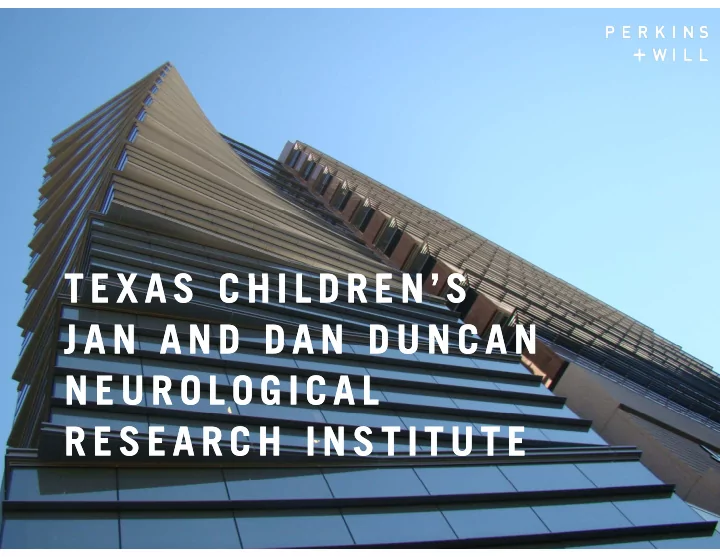
T E X A S C H I L D R E N S T E X A S C H I L D R E N S T E X A S - - PowerPoint PPT Presentation
T E X A S C H I L D R E N S T E X A S C H I L D R E N S T E X A S C H I L D R E N S T E X A S C H I L D R E N S J A N A N D D A N D U N C A N J A N A N D D A N D U N C A N J A N A N D D A N D U N C A N J A N A N D D A N
Located in the heart of Houston’s Texas Medical Center, the building exterior simultaneously stands out as an innovative design, while also blending in with the facades of the surrounding buildings. Additionally, its location facilitates collaboration with partnering research institutions in the area.
A collaborative DESIGN CHARRETTE that brings together architects, engineers, contractors, owners and users.
MASSING DIAGRAM
The building core such as chases and elevators are kept at the ends of the building, leaving the middle
collaboration spaces are located at the four corners of the building. Bridges connect to adjacent institutions, enhancing collaboration.
CORE
LABS
BASE
TOWER TOWER BRIDGES
FROM IDEA TO MATERIALIZATION
L i l i h i ll f h Leaning columns string together to visually form the double helix of a DNA strand – a design and construction challenge. Spiral stair and curvilinear pattern on the terrazzo floor adds to the theme.
BUILDING INFORMATION MODELING
The process from realistic rendering to completed project. The accuracy of design representation allows the Owner to make smart decisions and to approve the design early in the process.
Landscape Site Design
The rotation theme continues in the outdoor plaza, where retaining walls and a sloping sidewalk (handicap access) mimic the tower’s twist. (handicap access) mimic the tower s twist.
COLLABORATION WITH NEIGHBORING INSTITUTIONS
Became the catalyst for studying the building Became the catalyst for studying the building envelope as well as air quality assessments of exhausts and intakes with neighboring buildings.
CONSTRUCTION
From foundation to topping out in 9 months, an extraordinary feat with the tight site extraordinary feat with the tight site.
CONSTRUCTION
At the completion of the project, the Team was able to t ll t ti ti t th O d return all construction contingency to the Owner due to comprehensive coordination that resulted in a successful project that was completed on-time and under budget.
The building site’s location, facing a prominent intersection in the Texas Medical Center, prompted the team to seek a “worthy
From the group’s WOW initiative, a twisting tower was born, with leaning columns that string together to visually form the double helix of a DNA strand, signifying the unification of science and research.
The rotating floor plates suggest the life- altering research taking place within the facility and new directions cultivating in the
allows a look back across the medical center to the main Texas Children’s Hospital campus, five blocks away.
The NRI tower’s second floor has an internal bridge connecting to M.D. Anderson and its structure was designed for a planned future sky bridge to Baylor College of Medicine. Both bridges originate at
generates the rotation of the tower, which the design team calls a vertical “bridge” connecting the research floors.
The palette of materials takes Texas Children’s into the 21st century. Their timeless look of Texas Pink Granite was combined with a streamlined window wall system, and dark gray corrugated metal panel system. The building’s programmatic functions can be read by the material palette – the aluminum window wall occurs where collaboration and research is practiced. The corrugated metal panels denote mechanical and core spaces, and the Texas pink granite clads the spandrel zones of the research tower.
The narrowness of the site restricted both the design possibilities and presented construction challenges. Neighboring buildings on three sides, where sensitive research and education occur twenty-four hours a day, could not be interrupted, and the major traffic artery on the north side could not be utilized during the work week. The design team and Construction Manager at Risk continually sought collaboration with all groups and institutions affected, in order to make the construction of the building as seamless and friendly as possible.
By designing a concrete building using concrete moment frames, the maximum flexibility for future changes was facilitated. The concrete frame also reduced structural depth, increasing ceiling heights and plenum space, as well as increased stiffness to reduce vibration, which was critical to the type of research occurring within the building.
LABORATORY
Daylight and views permeate into the building, energizing users throughout long, strenuous days. energizing users throughout long, strenuous days.
SUSTAINABILITY DAYLIGHT AND VIEWS
A combination of exterior sunshade device, interior light shelf, sloped ceiling and daylight harvesting system contributes to energy reduction.
The “collaboratories,” as they are dubbed, are flooded with natural light while research in the labs occurs in an open, flexible environment. Light, space, and
researchers as they work together to address critical issues with neurological disease.
Each lab is adjacent to support spaces, designed by each investigator specifically for his/her unique research requirements.
The lobby’s stone terrazzo floor is a playful and colorful abstract interpretation of the DNA
building on carpets, accent walls, and laboratory flooring remind researchers that their work will brighten the outlook of millions
On the north end of the building, the twisting tower hosts collaboration spaces with panoramic views of the city.
P di i i P di i i
TESTAMENT OF SUCCESS
Pediatricians Pediatricians N N ti i t ti i t Neuro Neuro-
geneticists Behavioral Psychologists Behavioral Psychologists
Chemists Chemists Neurologists Neurologists Geneticists Geneticists
P E R K I N S + W I L L