( ) = T = = 2 + 2 A A x y A x y y Vector - - PDF document

t 2 2 a a x y a x y y vector multiplication dot scalar
SMART_READER_LITE
LIVE PREVIEW

( ) = T = = 2 + 2 A A x y A x y y Vector - - PDF document

To Do To Do Computer Graphics (Fall 2008) Computer Graphics (Fall 2008) Complete Assignment 0; e-mail by tomorrow Download and compile skeleton for assignment 1 COMS 4160, Lecture 2: Review of Basic Math Read instructions re setting


slide-1
SLIDE 1

Computer Graphics (Fall 2008) Computer Graphics (Fall 2008)

COMS 4160, Lecture 2: Review of Basic Math

http://www.cs.columbia.edu/~cs4160

To Do To Do

Complete Assignment 0; e-mail by tomorrow Download and compile skeleton for assignment 1

Read instructions re setting up your system Ask TA if any problems, need visual C++ etc. We won’t answer compilation issues after next lecture

Try to obtain textbooks, programming (using MRL lab). Let us know if there are any problems. About first few lectures

Somewhat technical: core mathematical ideas in graphics HW1 is simple (only few lines of code): Lets you see how to use some ideas discussed in lecture, create images

Motivation and Outline Motivation and Outline

Many graphics concepts need basic math like linear algebra Vectors (dot products, cross products, …) Matrices (matrix-matrix, matrix-vector mult., …) E.g: a point is a vector, and an operation like translating or rotating points on an object can be a matrix-vector multiply Chapters 2.4 (vectors) and 5.2.1,5.2.2 (matrices) Worthwhile to read all of chapters 2 and 5 Should be refresher on very basic material for most of you If not understand, talk to me (review in office hours)

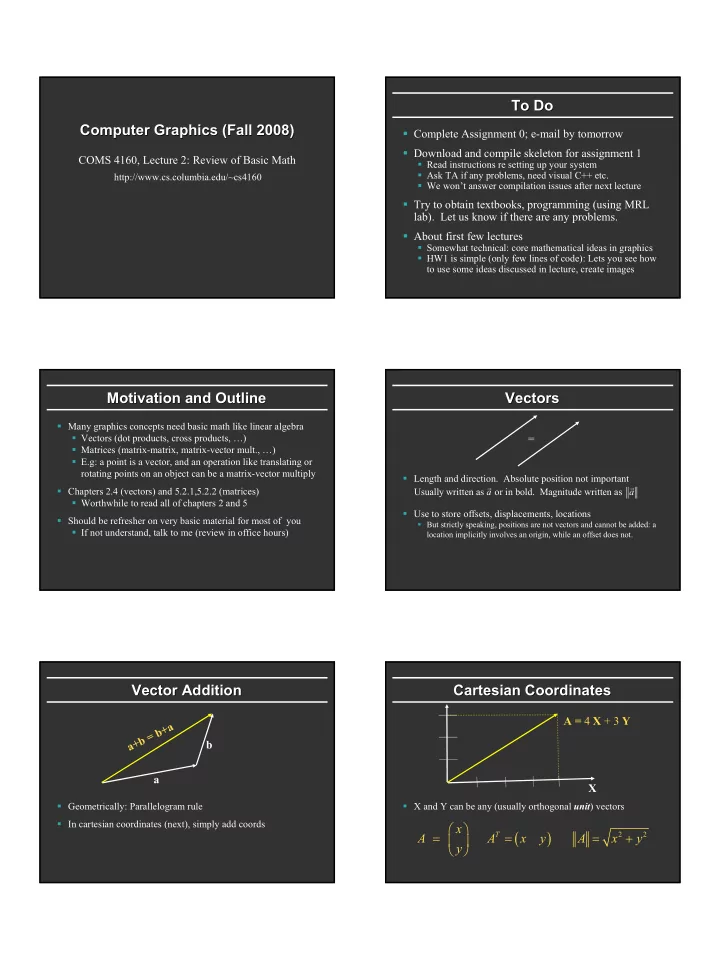
Vectors Vectors

Length and direction. Absolute position not important Use to store offsets, displacements, locations

But strictly speaking, positions are not vectors and cannot be added: a location implicitly involves an origin, while an offset does not.

=

Usually written as or in bold. Magnitude written as a a

  • Vector Addition

Vector Addition

Geometrically: Parallelogram rule In cartesian coordinates (next), simply add coords

a b a+b = b+a

Cartesian Coordinates Cartesian Coordinates

X and Y can be any (usually orthogonal unit) vectors

X A = 4 X + 3 Y

( )

2 2 T

x A A x y A x y y   = = = +    

slide-2
SLIDE 2

Vector Multiplication Vector Multiplication

Dot product (2.4.3) Cross product (2.4.4) Orthonormal bases and coordinate frames (2.4.5,6) Note: book talks about right and left-handed coordinate systems. We always use right-handed

Dot (scalar) product Dot (scalar) product

a b

φ

? a b b a = = i i

1

cos cos a b a b a b a b φ φ

=   =       i i ( ) ( ) ( ) ( ) a b c a b a c ka b a kb k a b + = + = = i i i i i i Dot product: some applications in CG Dot product: some applications in CG

Find angle between two vectors (e.g. cosine of angle between light source and surface for shading) Finding projection of one vector on another (e.g. coordinates

  • f point in arbitrary coordinate system)

Advantage: can be computed easily in cartesian components

Projections (of b on a) Projections (of b on a)

a b

φ ? ? b a b a → = → = cos a b b a b a φ → = = i

2

a a b b a b a a a a → = → = i

Dot product in Cartesian components Dot product in Cartesian components

?

a b a b

x x a b y y    

  • =
  • =

       

a b a b a b a b

x x a b x x y y y y    

  • =
  • =

+        

Vector Multiplication Vector Multiplication

Dot product (2.4.3) Cross product (2.4.4) Orthonormal bases and coordinate frames (2.4.5,6) Note: book talks about right and left-handed coordinate systems. We always use right-handed

slide-3
SLIDE 3

Cross (vector) product Cross (vector) product

Cross product orthogonal to two initial vectors Direction determined by right-hand rule Useful in constructing coordinate systems (later) a b

φ

a b b a × = − × sin a b a b φ × =

Cross product: Properties Cross product: Properties

( ) ( ) ( ) a b b a a a a b c a b a c a kb k a b × = − × × = × + = × + × × = × x y z y x z y z x z y x z x y x z y × = + × = − × = + × = − × = + × = −

Cross product: Cartesian formula? Cross product: Cartesian formula?

a b b a a a a a b a b b b b a b a b

x y z y z y z a b x y z z x x z x y z x y y x −     × = = −     −  

* a a b a a b a a b

z y x a b A b z x y y x z −       × = = −       −   

Dual matrix of vector a

Vector Multiplication Vector Multiplication

Dot product (2.4.3) Cross product (2.4.4) Orthonormal bases and coordinate frames (2.4.5,6) Note: book talks about right and left-handed coordinate systems. We always use right-handed

Orthonormal Orthonormal bases/coordinate frames bases/coordinate frames

Important for representing points, positions, locations Often, many sets of coordinate systems (not just X, Y, Z)

Global, local, world, model, parts of model (head, hands, …)

Critical issue is transforming between these systems/bases

Topic of next 3 lectures

Coordinate Frames Coordinate Frames

Any set of 3 vectors (in 3D) so that 1 ( ) ( ) ( ) u v w u v v w u w w u v p p u u p v v p w w = = = = = = = × = + + i i i i i i

slide-4
SLIDE 4

Constructing a coordinate frame Constructing a coordinate frame

Often, given a vector a (viewing direction in HW1), want to construct an orthonormal basis Need a second vector b (up direction of camera in HW1) Construct an orthonormal basis (for instance, camera coordinate frame to transform world objects into in HW1)

Constructing a coordinate frame? Constructing a coordinate frame?

a w a =

We want to associate w with a, and v with b But a and b are neither orthogonal nor unit norm And we also need to find u

b w u b w × = × v w u = ×

Matrices Matrices

Can be used to transform points (vectors)

Translation, rotation, shear, scale (more detail next lecture)

Section 5.2.1 and 5.2.2 of text

Instructive to read all of 5 but not that relevant to course

What is a matrix What is a matrix

Array of numbers (m×n = m rows, n columns) Addition, multiplication by a scalar simple: element by element

1 3 5 2 4          

Matrix Matrix-

  • matrix multiplication

matrix multiplication

Number of columns in first must = rows in second Element (i,j) in product is dot product of row i of first matrix and column j of second matrix

1 3 3 6 9 4 5 2 2 7 8 3 4             

Matrix Matrix-

  • matrix multiplication

matrix multiplication

Number of columns in first must = rows in second Element (i,j) in product is dot product of row i of first matrix and column j of second matrix

9 2 1 3 7 3 5 2 4 13 3 9 61 8 3 3 19 2 8 2 4 26 3 6 44 1 7 28 2           =                

slide-5
SLIDE 5

Matrix Matrix-

  • matrix multiplication

matrix multiplication

Number of columns in first must = rows in second Element (i,j) in product is dot product of row i of first matrix and column j of second matrix

9 2 1 3 7 3 5 2 4 13 3 9 61 8 3 3 19 2 8 2 4 26 3 6 44 1 7 28 2           =                

Matrix Matrix-

  • matrix multiplication

matrix multiplication

Number of columns in first must = rows in second Element (i,j) in product is dot product of row i of first matrix and column j of second matrix

9 2 1 3 7 3 5 2 4 13 3 9 61 8 3 3 19 2 8 2 4 26 3 6 44 1 7 28 2           =                

Matrix Matrix-

  • matrix multiplication

matrix multiplication

Number of columns in first must = rows in second

Non-commutative (AB and BA are different in general) Associative and distributive A(B+C) = AB + AC (A+B)C = AC + BC 1 3 3 6 9 4 5 2 NOT EVEN LEGAL!! 2 7 8 3 4             

Matrix Matrix-

  • Vector Multiplication

Vector Multiplication

Key for transforming points (next lecture) Treat vector as a column matrix (m×1) E.g. 2D reflection about y-axis (from textbook)

1 1 x x y y − −      =          

Transpose of a Matrix (or vector?) Transpose of a Matrix (or vector?)

1 2 1 3 5 3 4 2 4 6 5 6

T

      =          

( )T

T T

AB B A =

Identity Matrix and Inverses Identity Matrix and Inverses

1 1 1 1 1

( ) AA A A I AB B A

− − − − −

= = =

3 3

1 1 1 I ×     =      

slide-6
SLIDE 6

Vector multiplication in Matrix form Vector multiplication in Matrix form

Dot product? Cross product?

( ) ( )

T b a a a b a b a b a b b

a b a b x x y z y x x y y z z z

  • =

    = + +      

* a a b a a b a a b

z y x a b A b z x y y x z −       × = = −       −   

Dual matrix of vector a