
SLIDE 1
SYNTHESIS OF NOVEL (±)-CIS-EXO-NORBORNANE AMINO ACID CONTAINING CYCLIC HEXAPEPTIDE: ANALOGUE OF DOLASTATIN 16
Presented By Sravanthi Devi Guggilapu sciforum-006262
SYNTHESIS OF NOVEL ( )- CIS-EXO -NORBORNANE AMINO ACID CONTAINING - - PowerPoint PPT Presentation
SYNTHESIS OF NOVEL ( )- CIS-EXO -NORBORNANE AMINO ACID CONTAINING CYCLIC HEXAPEPTIDE: ANALOGUE OF DOLASTATIN 16 Presented By Sravanthi Devi Guggilapu sciforum-006262 CONTENTS INTRODUCTION LITERATURE REVIEW OBJECTIVE OF THE WORK
SYNTHESIS OF NOVEL (±)-CIS-EXO-NORBORNANE AMINO ACID CONTAINING CYCLIC HEXAPEPTIDE: ANALOGUE OF DOLASTATIN 16
Presented By Sravanthi Devi Guggilapu sciforum-006262
INTRODUCTION LITERATURE REVIEW OBJECTIVE OF THE WORK WORK DONE CONCLUSION REFERENCES
2
Plant derived agents are being used for the treatment of cancer.
anticancer agents including taxol, vinblastine, vincristine, the camptothecin derivatives, topotecan and irinotecan, and etoposide derived from epipodophyllotoxin are in clinical use all over the world.
aquaculture added to the growing recognition of the tremendous biodiversity present in the marine world, and has contributed to the growing interest of exploring the oceans as a potential source of new anticancer candidates.
and early clinical development.
3
mollusk from the Indian Ocean, the sea hare Dolabella auricularia.
class, Dolastatin 10 and Dolastatin 15, have received the greatest clinical interest.
anti-tumor activity in preclinical models.
causes cell-cycle arrest in metaphase
Dolabella auricularia - a marine shell-less mollusc
4
5
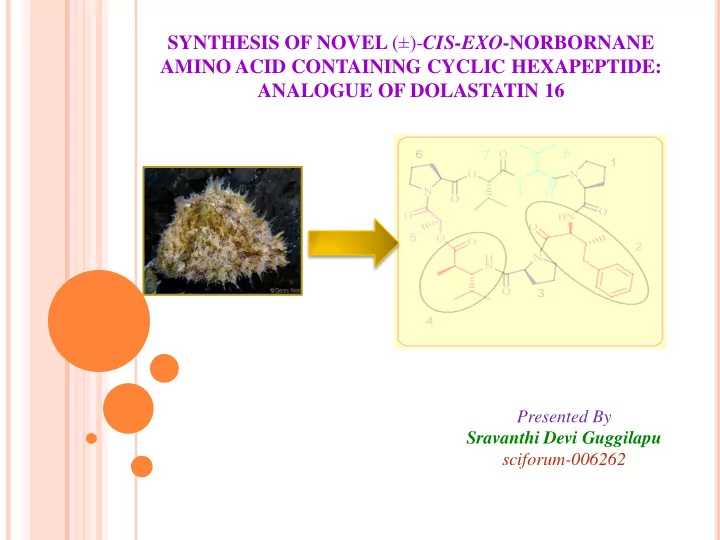
1,3,6 – Proline 2 - Dolaphenvaline 4 - Dolamethyleuine 5 - (S)- Lactic acid 7 - 2-hydroxy-3-methyl butanoic acid 8 - (3-methyl-(2-methyl amino)butanoic acid Unusual Aminoacids
6
7
8
In 1979, Yamaguchi et al. , first reported a process for mild esterification method using carboxylic 2,4,6-trichlorobenzoic anhydrides in the presence 4-N,N1dimethyl aminopyridine for the preparation of large ring lactones from the open chain hydroxyl acids. In this, the lactonization is carried out by activating the carboxylic group by an acid chloride (2,4,6, trichloro benzoyl chloride) to give its corresponding mixed anhydride, this mixed anhydride is further activated to amide nitrenium ion, which exchange with alcohol moiety to give lactone.
9
The dolastatins-16 is having high potency as anti cancer agent and presently it is in phase III clinical trials. 1.Extensive In silico SAR study of Dolastatin-16 by using MOE (Molecular Operating Environment) and Glide Docking software in Maestro 9.3 2.Design of more potent cyclic peptide analogues based on Dolastatin-16 structure by using molecular docking study. 3.Total synthesis of designed analogues 4.Biological evaluation of synthesized analogues against cancer cells.
10
dolastatin 10, dolastatin 11, dolastatin 12, dolastatin 13, dolastatin 14, dolastatin 15 and dolastatin16.
Site (PDB Codes: 1EAX, 2GV6, 2GV7, 3BZ3, 3E5A, 3HA6). The water molecules around 5Å were retained. The protein was protonated and the incomplete residues were mutated with the amino acid templates inbuilt in the software.
Energy minimised and Ligprep was performed
docked with other defaults settings. Then in ligand docking XP (extra precision) was used.
11
Proteins Dolastatins 1EAX 2GV6 2GV7 3BZ3 3E5A 3HA6 G- score HB score G- score HB score G- score HB score G- score HB score G- score HB score G- score HB score Dolastatin 10
Dolastatin 11
Dolastatin 13
Dolastatin 14
0.00
Dolastatin 15
0.00
Dolastatin 16
Molecular Docking Studies of Various Dolastatins:
Results obtained by docking series of dolastatins against proteins using glide 9.3
12
Structures were drawn in 2D sketcher Macromodel energy minimization Lig prep was performed These conformers docked into these 6 proteins.
13
RM 1(Dolaphenylvaline removed)
RM 2 (Dolamethyleuine removed)
RM 3 (Lactic acid removed)
RM 4 (1st proline removed)
RM 5 (2nd proline removed) 14
RM 6 (3rd proline removed) RM 7 (three prolines removed) RM 8 (2-hydroxy-3-methyl butanoic acid removed)
RM -9 (3-methyl-(2-methyl amino)butanoic acid removed)
15
S.NO. Analogues 1EAX 2GV6 2GV7 3BZ3 3E5A 3HA6 1 Dolastatin 16
2 RM 1(Dolaphenvaline removed)
3 RM 2(Dolamethyleuine removed)
4 RM 3 (Lactic acid removed)
5 RM 4 (1st proline removed)
6 RM 5 (2nd proline removed)
7 RM 6 (3rd proline removed)
8 RM 7 (three prolines removed)
9 RM 8 (2-hydroxy 3-methyl butanoic acid removed)
10 RM 9 (3-methyl-2-methyl amino butanoic acid removed)
Table 1: Docking scores in MOE when amino acids removed
16
S.NO. ANALOGUES 1EAX 2GV6 2GV7 3BZ3 3E5A 3HA6 1 Dolastatin 16
2 RM 1(Dolaphenvaline removed) 3.1
3 RM 2(Dolamethyleuine removed)
4 RM 3 (Lactic acid removed)
5 RM 4 (1st proline removed)
6 RM 5 (2nd proline removed) 6.62
7 RM 6 (3rd proline removed)
8 RM 7 (three prolines removed)
9 RM 8 (2-hydroxy 3-methyl butanoic acid removed)
10 RM 9 (3-methyl-2-methyl amino butanoic acid removed)
Table 2: Docking scores in glide when amino acids removed
17
The further study was carried by replacing the unusual aminoacids that are dolaphenvaline and dolamethyleuine with Exo norbornene, Endo norbornene amino acid (NBA) and Sugar Amino Acid (SAA) derived from D-glucose. The structure of these analogues are the following:
RP 1(both exo NBA) RP 2 (both endo NBA) RP 3 (dolaphenvaline replaced with exo ring and dolamethyleuine with endo NBA)
18
RP 4 (dolaphenvaline replaced with endo ring and dolamethyleuine with exo NBA) RP 5 (dolaphenvaline replaced with SAA and dolamethyleuine with exo NBA) RP 6 (dolaphenvaline replaced with SAA and dolamethyleuine with endo NBA) RP 7 (dolaphenvaline replaced with exo NBA and dolamethyleuine with SAA) RP 8 (dolaphenvaline replaced with endo NBA and dolamethyleuine with SAA) RP 9 (Both unusual amino Removed)
19
S.No Proteins 1EAX 2GV6 2GV7 3BZ3 3E5A 3HA6 ANALOGUES G SCORE HB G SCORE HB G SCORE HB G SCORE HB G SCORE HB G SCORE HB 1 DOLASTATIN 16
2 RP 1: (Both exo NBA)
3 RP 2:(Both endo NBA)
4 RP 3
5 RP 4
0.0
0.0 6 RP 5
0.0
7 RP 6
0.0
8 RP 7
9 RP 8
0.0 10 RP 9
Table 3: Results in glide (maestro 9.3) for the designed analogues:
20
21
22
S.NO. Compound Code 1EAX 2GV6 2GV7 3BZ3 3E5A 3HA6
1 DOLASTATIN 16
2 1 5.09
3 1a 7.06
4 1b 0.69
5 1c 4.2
6 2
7 2a
8 2b
9 2c
10 3 1
11 3a
12 3b 0.54
13 3c 1.2
Table 4: PROPOSED MOLECULES WITH METHYL GROUP IN MOE
23
24
S.NO. ANALOGUES 1EAX 2GV6 2GV7 3BZ3 3E5A 3HA6
G
HB G HB G HB
G
HB
G
HB G HB 1 DOLASTATIN 16
2 16 METHYL REMOVED
3 1
4 1a
5 1b
6 1c
7 2
8 2a
9 2b
10 2c
11 3
12 3a
13 3b
14 3c
Table 5: PROPOSED MOLECULES DOCKING SCORES IN GLIDE 9.3
25
26
27 S.No PROTEINS 1EAX 2GV6 2GV7 3BZ3 3E5A 3HA6 ANALOGUE G HB G HB G HB G HB G HB G HB 1 Dolastatin 16
2 4(Phenylalani ne lactone)
3 4a(Para hydroxypheny lalanine lactone)
4 4b(Tetramer)
5 4c(Hexamer)
Table 6: PROPOSED MOLECULES IN GLIDE
28
HYDROGEN BONDING INTERACTIONS WITH AMINOACIDS Figure 10: 4 in 2GV6 protein, interaction with GLY 216 and GLY 219
29
30
31
Scheme 1 Scheme 2
32
The chiral monomer 8 is confirmed by optical rotation of this compound is [α]D
25 = + 91.8 in MeOH
Scheme 3
33 (S)-1, 2-Pyrrolidinedicarboxylic acid 1-(1,1-dimethylethyl) ester Synthesis of (S)-methyl 2-amino-3-phenyl propanoate hydrochloride: Synthesis of (R)-methyl 2-amino-3-methyl butanoate hydrochloride:
34
35
36
37
38
39
The extensive SAR study of Dolastatin 16 is done by using molecular modeling softwares Glide 9.3 and MOE (Molecular Operating Environment) docking tools. It is concluded that unusual amino acids NBAA and SAA can be used to replace the amino acids dolaphenvaline and dolamethyleuine in Dolastatin 16. Furthermore, it is observed that dolaphenvaline (aromatic amino acid) can be replaced with L-phenyl alanine and dolamethyleuine can be replaced with NBAA (unusual β amino acid). Based on the computational results, designed analogue 4 was selected for the synthesis and biological evaluation. Monomers, dimers, tetramer, hexamer and lactone are synthesized by using appropriate reagents and reaction conditions to get the good yields. Spectral characterization of dimers, tetramer, hexamer and macrolide is performed using 1H NMR, mass, and IR. The synthesized analogue and its intermediates were submitted for the biological evaluation against cancer cell and results are awaited.
40
41
1949;c) Pathak S, Multani AS, Ozen M, Richardson MA, Newman RA, Oncol Res 1998, 5, 373.
2009, 72, 507; d) Chandrasekhar S.; Kiranmai N.; Udaya Kiran, M.; Sharada Devi, A.; Pavan Kumar Reddy, G.;
Bakale, Roger P.; Gingrich, Diane E. Organic Process Research and Development, 2012, 16, 148; b) Curtin, Michael L.; Robin Heyman, H.; Frey, Robin R.; Marcotte, Patrick A.; Glaser, Keith B.; Michael R. Bioorganic and Medicinal Chemistry Letters, 2012, 22(14), 4750; c) Singh, R.; Sharma, M.; Joshi, P.; Rawat, D. S. Anti-Cancer Agents Med. Chem. 2008, 8, 603.
Steglich, W.; Tamm, C., Eds.; Springer: Vienna, 1997; Vol. 70, 1,79; b) Woyke, T.; Roberson, R. W.; Pettit, G. R.; Winkelmann, G.; Pettit, R. K. Antimicrob. Agents Chemother. 2002, 46, 3802; c) Woyke, T.; Berens, M. E.; Hoelzinger, D. B.; Pettit, G. R.; Winkelmann, G.; Pettit, R. K Antimicrob. Agents Chemother. 2004, 48, 561.
42
Lisa M. Nogle and William H. Gerwick, J. Nat. Prod 2002, 65, 21; c) Michael T. Davies-Coleman, Thomas M. Dzeha,, Christopher A. Gray, J. Nat. Prod. 2003, 66, 712.
Poisonous sea hares, in poisonous and venomous marine animals of the world, Government printing office, Ishington: 1965, 1, 709; c) Petit, G. R.; Xu, J. P.; Hogan, F.; Williams, M. D.; Doubek, D.L.; schimdt, J. M.; cerny, R. L. J. Nat. Prod, 1997, 60, 752.
Valenti, M.; Bryant, A.; Rogers, P.; Pettit, G. R.; srirangam, J. K.; Kelland, L, R.Cancer chemother. Pharrmacol, 1996, 8, 225; c) Yamazaki, M.; Lijima, R.; kosuna, K. Japenese patent JP10251297, 1998.
Achmatowicz, O.; Bukowski, P.; Szechner, B.; Zwierzchowska, Z.; Zamojski, A.Tetrahedron 1971, 27, 1973; c) Ostrowski, J.; Altenbach, H. J.; Wischnat, R.; Brauer, D. J. Eur. J. Org. Chem. 2003, 1104.
43