Switch-a-roo: engineering a photoresponsive E.colight switch Team - - PowerPoint PPT Presentation

switch a roo engineering a
SMART_READER_LITE
LIVE PREVIEW

Switch-a-roo: engineering a photoresponsive E.colight switch Team - - PowerPoint PPT Presentation

Switch-a-roo: engineering a photoresponsive E.colight switch Team Macquarie University Sydney, Australia What are the elements of switch -a- roo? Phytochrome Protein that binds chromophore Chromophore PDB 1ZTU


slide-1
SLIDE 1

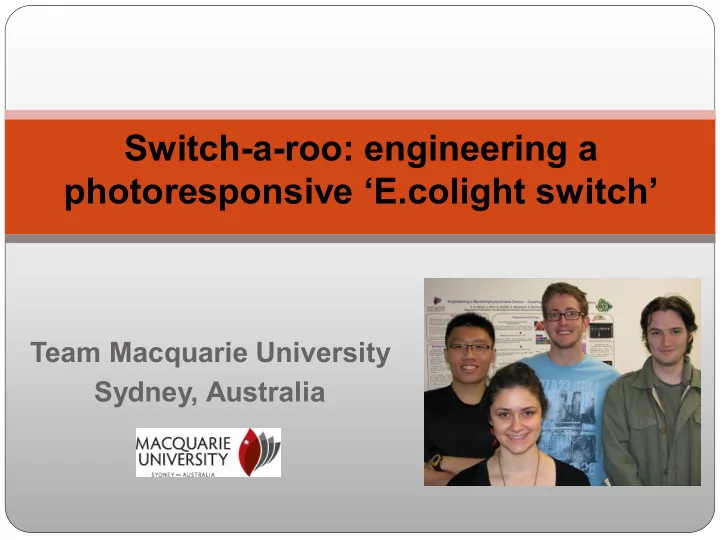
Team Macquarie University Sydney, Australia

Switch-a-roo: engineering a photoresponsive ‘E.colight switch’

slide-2
SLIDE 2

biliverdin

What are the elements

  • f ‘switch-a-roo’?

 Phytochrome

 Protein that binds

chromophore

 Chromophore

 Molecule that reacts to light

 Light

 660-800 nm range

PDB 1ZTU

slide-3
SLIDE 3

INACTIVE ACTIVE

Mechanics of the Light Switch

Biliverdin + Bacteriophytochrome

PDB 209C

HIGH ratio of light absorbed in far-red light range (730- 800nm) HIGH ratio of light absorbed in red light range (660-730nm)

slide-4
SLIDE 4

What were our bacteriophytochromes?

 Four domains  Agrobacterium tumefaciens  Able to transfer and

integrate DNA into host genome

 Deinococcus radiodurans  Extremely radiation

resistant

PDB 209C

slide-5
SLIDE 5

Heme Oxygenase makes biliverdin

 Biliverdin produced from the catabolism of heme by

Heme Oxygenase 1

 ALA (δ-aminolevulinic acid) is a precursor in the

biosynthetic pathway of heme

heme biliverdin

slide-6
SLIDE 6

What we planned to achieve

Assemble an on/off light switch

mechanism

 Consisting of a T7 promoter, HO and

bacteriophytochrome parts.

Construct BioBricks:

 Heme oxygenase

 D. radiodurans - phytochrome  A.tumefacians – phytochrome  T7 promoter

slide-7
SLIDE 7

Final construct

slide-8
SLIDE 8

Starting materials for BioBrick construction

 Used the materials from MQ 2010 effort

Gene product Template RBS + HO-1 pET3a-HO1 RBS + A.tumefacians phytochrome pGemT-easy RBS + D.Radiodurans phytochrome Amplified PCR product

slide-9
SLIDE 9

BioBrick construction using RFP BB- vector

 RFP BB (BBa_J04450)  Red colony  Successful insert  White colony  Easy visual analysis

slide-10
SLIDE 10

HO1-BB construction

 HO amplicon

 ~800bp

 Initial screen

 Digest with XbaI

0.5kb Ladder HO-PCR product

  • 1. Uncut plasmid
  • 2. RFP
  • 3. Uncut plasmid without

insert

  • 4. XbaI digest of plasmid

1 2 3 4

After BioBrick construction

slide-11
SLIDE 11

Our first BioBrick!

 Double digest of EcoRI and SpeI

 Shows correct orientation

 Sequencing

1kb 2kb

0.8kb HO fragment Plasmid backbone 2.2kb

slide-12
SLIDE 12

BioBrick Assembly of HO + T7

 T7 promoters

used:

 BBa_I712074

from 2007 Ljubljana Team.

 BBa_I719005

from 2007 Imperial Team

T7 HO

slide-13
SLIDE 13

BiIiverdin! The HO works

 Transform into BL21(DE3) E. Coli Contains T7 RNA polymerase

slide-14
SLIDE 14

How we improved a BioBrick

 Our new HO BioBrick improves part

BBa_K497005

 Their part lacks a RBS

 Added RBS & proved functional

BBa_K646000

slide-15
SLIDE 15

Successful PCR of phytochromes

 Amplicon size  2.3kbp

AT-Bph

2kbp

DR-Bph

2kbp

slide-16
SLIDE 16

Next steps for our light switch

 Construction of the phytochrome BioBricks

 Removal of internal restriction sites

 Complete assembly of the light switch

Switch-a-roo T7 HO1 Bph Next

slide-17
SLIDE 17

How is this useful?

 Switch on using red light

 Response time

 Regulation of gene expression by light  Blood detector (assuming cell free system)

slide-18
SLIDE 18

Thanks for listening!

 Add team photo