SVRK Prabhakar Presented at the Workshop on Resilience Continuum: - - PowerPoint PPT Presentation

svrk prabhakar
SMART_READER_LITE
LIVE PREVIEW

SVRK Prabhakar Presented at the Workshop on Resilience Continuum: - - PowerPoint PPT Presentation

RESILIENCE AND RISK REDUCTION Outline EVIDENCES OF FINANCIAL Finances in Resilience Continuum INNOVATIONS Current financial approaches Digging out resilience and risk reduction evidences Conclusions SVRK Prabhakar Presented at the


slide-1
SLIDE 1

SVRK Prabhakar

Presented at the Workshop on ‘Resilience Continuum: Comprehensive Risk Management in the Face of Climate Change, ‘15‐16th Sept, ISID Complex, New Delhi.

RESILIENCE AND RISK REDUCTION EVIDENCES OF FINANCIAL INNOVATIONS

Outline

  • Finances in Resilience Continuum
  • Current financial approaches
  • Digging out resilience and risk reduction evidences
  • Conclusions

2

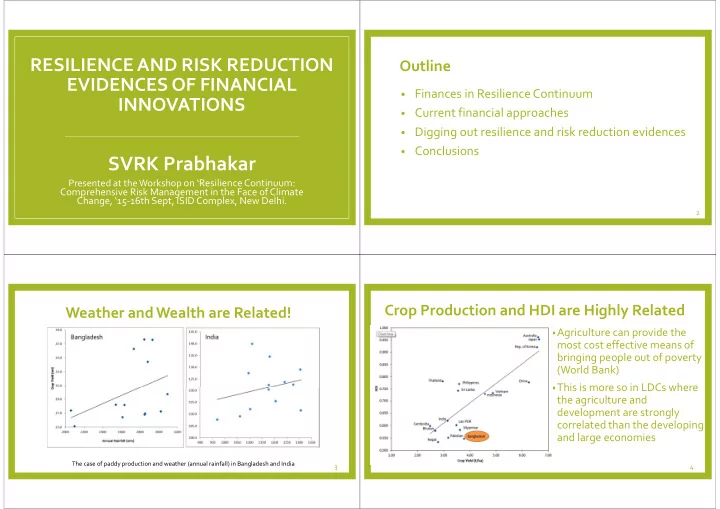
Weather and Wealth are Related!

3

The case of paddy production and weather (annual rainfall) in Bangladesh and India

Crop Production and HDI are Highly Related

4

  • Agriculture can provide the

most cost effective means of bringing people out of poverty (World Bank)

  • This is more so in LDCs where

the agriculture and development are strongly correlated than the developing and large economies

slide-2
SLIDE 2

Access to Finance is Important. Climate Impacts Crop Production: Paddy in India

FAO‐STAT, 2015

1966 drought 1967 flood 1976 drought 1979 drought 1981 dr., fl., cyc. 1987 drought 2002 drought 2004 dr. & fl. 2010 dr. & fl.

6 years lost! 32 MT lost in 1 year! (3.6 billion USD) Agriculture being primary input provider, such a shock will have rippling effects on the entire economy! Of course its an input supply problem Cant ignore the role of finance!

When Individual Loss becomes a Collective Loss: Impact of 2010 Drought on NPL of Banks in India

1 2 3 4 5 2009‐10 2011‐12

Agriculture NPAs in PSL, India

  • Increase in farm loan defaults

(figure on the right).

  • Increased burden on

government: farm loan waivers to the tune of 14.4 billion US$ in 2008 by GOI, in comparison GOI spent only ~163 million USD on insurance in 2008.

Source: RBI, 2014

What Difference Access to Finance Makes to Resilience?

7

Access to finance Path without access to finance Resilience advantage

Climate shock

Financial Tools

  • Microcredit
  • Cash transfers (including conditional cash

transfers)

  • Insurance

8

slide-3
SLIDE 3

Microcredit

  • Microcredit services are those services designed to provide financial access

to the poor and underprivileged who cant access the formal financial services such as banks.

  • Initial ideas of microcredit may have started in the 15th century but gained

momentum after 1970s and more so in 2000s. Muhammad Yunus of Bangladesh has been one of the pioneers in microcredit and received Nobel Prize for it, and networks such as CGAP.

  • They are operated by small institutions (microfinance institutions) and the

delivery mechanism is often group based lending or for individuals

  • Often accompany appropriate capacity building support to educate

borrowers to manage finances and livelihood activities (e.g. business skills, book keeping, alternative livelihoods etc)

9

Growth in Microcredit

10

Cash Transfers

  • Cash payments by governments and philanthropic organizations has long been

widely practiced however were mostly one‐off payments

  • Cash transfers as a steady stream of financial support has emerged recently

when governments realized that the developmental programs are often less efficient in cost‐benefit terms (i.e. a very small fraction of the total amount spent on most developmental programs reach and benefit the poor). On the contrary, when cash was put in the hands of the poor, the research has shown that they can do innovative investments bringing them out of poverty much faster and efficiently

  • Conditional cash transfers are even more a targeted approach where cash is

contingent upon meeting an expectation of the participant (e.g. child education, vaccination etc) and is know to increase the public program participation and poverty alleviation ‐ an effective tool for behavioural change

11

Risk Insurance

  • Acts as a financial access tool
  • Provides access to loans when made conditional for borrowing as in the case of

agricultural loan. Insurance has enabled millions of borrowers to obtain crop loans which they otherwise may not be able to

  • Soon after disaster when the communities need the finances the most
  • The Asia Pacific region ranks fifth in terms of insurance premiums and the non‐life

insurance in particular rank after life, automobile and health insurance

  • More and more governments are putting in place agriculture insurance or are

studying the possibility of putting in place agriculture insurance with subsidy on premium

  • The role of insurance in risk reduction has largely been theorized but the reality

may be different on the ground

12
slide-4
SLIDE 4

Risk Insurance

  • In agriculture sector, primarily introduced as a means of buffering economic shocks

from natural hazards

  • If designed well, insurance can provide several benefits
  • Emphasis on risk mitigation compared to response
  • Provides a cost‐effective way of coping financial impacts
  • Covers the residual risks uncovered by other risk mitigation mechanisms.
  • Provides opportunities for public‐private partnerships.
  • Helps communities and individuals to quickly renew and restore the livelihood

activity.

  • Depending on the way the insurance is designed, the insurance mechanism can

address a variety of risks of climatic and non‐climatic nature.

  • Reduced burden on government

Arnold, 2008; Siamwalla and Valdes, 1986; Swiss Re, 2010

13

Current Insurance Coverage

  • In contrast, Asia and Africa have one of the highest agricultural populations in the

world

  • The rural areas in these regions are reported to have highest poverty and seasonal

unemployment where buffering income fluctuations will have significant socio‐ economic impacts

Non‐life Insurance Premiums

Source: Global Premiums Iturrioz,2010 US$ Billions US$ Billions

Swiss Re

Why Insurance has not Scaled Up?

How to overcome these limitations?

  • High residual risks in agriculture: Only 35‐40% of agriculture is irrigated in Asia;

low expansion of drought and flood‐tolerant varieties; poor extension facilities

  • Inefficiencies attributable to adverse selection and moral hazard
  • Poor availability of data to assess risks for designing effective risk insurance

systems (e.g. weather data and data on crop loss)

  • Willingness to pay: Economic, cultural and perceptional issues with both people at

risk and policy makers

  • Lack of trust on the insurance providers
  • Poorly developed re‐insurance industry
  • And so on…
  • High insurance costs: Costs to whom and compared to what alternative risk

management strategy?

15

  • Most governments address the insurance costs

through subsidy on premium. Premium subsidies rose 250 percent over 2007 subsidy levels in the Asia Pacific region.

  • Advantages
  • Easy to implement
  • High political impact
  • Disadvantages
  • The real cost of risk is not conveyed to farmer
  • Possibility of high risk seeking behaviour
  • Disproportionately benefits rich farmers
  • Overall insurance costs remain same or even higher

Addressing High Insurance Costs

Country % Premium Subsidy China 60% Japan 49% India 30% Pakistan 70% Philippines 100%* ROK 50% *for subsistence farmers only FAO 2011

Subsidy on Premium

16

slide-5
SLIDE 5

Willingness to Pay

  • Cheaper premium
  • Poor households can have quick access to finances

(overdraft with withdrawal on premium) and hence will not feel deprived of money for long periods of time

  • Interest earned on savings can provide additional

advantage: Promotes savings

  • Help build assets in the long‐term while protection

against catastrophic risks

  • Innovations in savings‐linked insurance include

designing insurance products based on interest earned on savings could substantially reduce the premium burden on insurance holders

Savings‐Linked Insurance (Unit Linked Insurance Plan)

Monthly Payment 100 USD Risk Comp. 20 USD Savings Comp. 80 USD + int.

17

  • Combining Insurance with Payment of Ecosystem Services
  • Payment of ecosystem services and carbon capture and sequestration proceeds could

be linked to insurance premiums and or investments made on risk mitigation options that can generate substantial PES proceeds.

  • E.g. certain types of intensive row‐cropping systems and ecological farm scapes can

promote ecosystem services such as a clean and well‐regulated water supply, biodiversity, natural habitats for conservation and recreation, climate stabilization, and aesthetic and cultural amenities such as vibrant farm scapes etc. (Robertson et al. 2014).

  • Combining insurance with social security programs
  • 40% of global population is not protected and 75% are inadequately protected
  • Combining social security and insurance can help extend social protection to under‐

served populations and can reduce the overall costs of insurance for the vulnerable sections of the population while extending financial inclusion benefits

Innovations in Insurance

18

Bundling Approaches

WFP 2016

  • Bundling of risk management options can

have synergistic impact on the overall insurance costs

  • HARITA R4 Rural Resilience Initiative of

Oxfam, WFP

  • Risk reduction through water harvesting and
  • ther activities through which farmers can

earn vouchers to pay for their insurance

  • Risk transfer through insurance: Partly

subsidized and partly paid by the participating farmers

  • Provide avenues for livelihood diversification

for prudent risk taking

  • Promote savings which act as risk reserves

19

Indicators for Assessing the Effectiveness

Climate change vulnerability indicators Economic change vulnerability indicators Share of resistant crops Change in access to credit Percentage irrigated area Change in subsidies Access to infrastructure Change in market facilities % of income from non‐farm sources Change in livelihood diversity % living in hazard prone area Reduction in debt % reduction in crop yield Change in assets (focus on durable assets) Business continuity Income smoothing

20

slide-6
SLIDE 6

Evidence for Effectiveness Microcredit (RCTs)

Microcredit cases Impact of financial inclusion Increased Decreased No evidence/impact Savings and borrowings, Uganda  Borrowing  Savings Microcredit program, India  Borrowing  Investments in existing businesses  Profits of pre‐existing businesses  Business expansion  Consumption  Health  Education  Women’s empowerment  Poverty  Business profits Microcredit program, Mexico  Borrowing  Investments in existing businesses  Business expansion  Trust  Female decision making  Fire sales  Depression  Micro‐entrepreneurship,  Income  Labor supply  Expenditures  Social status  Subjective well‐being Seasonally adjusted microcredit, Bangladesh  Food consumption during lean season  Repayment frequency  Default  Food consumption (during intervention)

21

Effectiveness of Cash Transfer Programs

Cash Transfer Cases Impact of financial inclusion Increased Decreased No evidence/impact Pantawid Pamilya, Philippines  Child school enrolment  Child health Dependency Productive Safety Nets Programme, Ethiopia  Food security  Education  Farming  Livestock  Wage negotiation  Dependency  Selling of productive assets during stress periods  Vulnerability to disasters and climate change Minimum Living Standards Scheme, China  Income to poor Poverty gap reduction Bolsa Família, Brazil  School enrolment  Vaccination  Social  Entrepreneurship  Women empowerment  Social inequality  Poverty

22

Effectiveness of Insurance

23

The Notion of Insurance Effectiveness

  • Traditional understanding of

insurance effectiveness:

  • Has the insurance delivered the

contractual obligations i.e. payout as agreed in the contract.

Risks Covered Firm’s profitability Affordability

Payout to the insured

24

slide-7
SLIDE 7

Is this sufficient?

Risks Covered Firm’s profitability Affordability

  • Most literature and experiences talks insurance

effectiveness in terms of

  • How many people are insured (Economies of

scale),

  • How to avoid moral hazard and adverse

selection,

  • Minimizing basis risk
  • This gives an impression that the insurance will be

successful if the above factors are taken care of!

Payoff to the insured

  • How the payoffs are spent? Have they spent on risk

mitigation?

  • Has there been long‐term reduction in risks?

25

Loss vs Payouts, Premium paid vs Payout Received: An example from India

26

Prabhakar et al., 2017

Lack of incentive and discouraging information > mistrust?

Cost Benefit Analysis: Simple vs Comprehensive

27

2 4 6 8 10 12 India Philippines Malaysia Japan BCR Country

Prabhakar et al., 2017

Comprehensive BCR of Insurance: Benefits

Source: Prabhakar et al., 2014 28

slide-8
SLIDE 8

Costs…

Source: Prabhakar et al., 2014 29

What about non‐economic loss and damages?

30 31

Which approach satisfies which indicators

Indicators Most satisfying inclusion programs Share of resistant crops Crop insurance (Low to moderate) Percentage irrigated area Cash transfers (low) Access to infrastructure Cash transfers (moderate) % of income from non‐farm sources Microfinance (moderate to high) % living in hazard prone area None (none) % reduction in crop yield Crop insurance (low) Change in access to credit Microfinance (very high), cash transfer (low), insurance (high) Change in subsidies None (none) Change in market facilities Cash transfer (low), microfinance (low) Change in livelihood diversity Microfinance (moderate) Reduction in debt Cash transfer (high) Change in durable assets Cash transfer (moderate) Business continuity Microfinance (very high), insurance (moderate) Income smoothing Insurance (high), microfinance (low) 32

slide-9
SLIDE 9

Risk Reduction Potential of Financial Tools

Vulnerability reduction potential Economic changes Climate change 1 2 3 4 5 1 2 3 4 5 CCT Microfinance Insurance

33

Financial Institutions Themselves are Vulnerable to Shocks too!

34

Success is Conditional

  • Savings increased only when members with high

propensity to save are included. Borrowings increased

  • nly among those with less propensity to save and are

poor and vulnerable.

  • Positive effects were observed among the ultra‐poor
  • n the food intake during lean season after one year of

intervention.

  • All measures have different impacts, works differently

for climate change and economic changes.

35

Cont.…

  • No one‐size‐fits‐all strategy works!
  • Financial tools have shown positive trends in some indicators.

However, there is no evidence that these indicators have led to risk reduction though it is highly likely that they could improve the enabling conditions for risk reduction.

  • Risk reduction actually depends on more important enabling

environment such as hazard, vulnerability, and risk assessments, presence of DRR plans and policies, regulations and laws that determine how risk reduction takes place on the ground. There is a need to conduct RCTs for deeper understanding on how the financial tools will help uptake and sustainability of these risk reduction measures.

36

slide-10
SLIDE 10

THANK YOU!

Prabhakar@iges.or.jp

37