Sustainable Development Unnikrishnan Payyappallimana United Nations - - PowerPoint PPT Presentation

sustainable development
SMART_READER_LITE
LIVE PREVIEW

Sustainable Development Unnikrishnan Payyappallimana United Nations - - PowerPoint PPT Presentation

Ancestral Knowledge and Education for Sustainable Development Unnikrishnan Payyappallimana United Nations University Institute of Advanced Studies 27 th February 2013 Sequence Overview of traditional knowledge Multilateral policy


slide-1
SLIDE 1

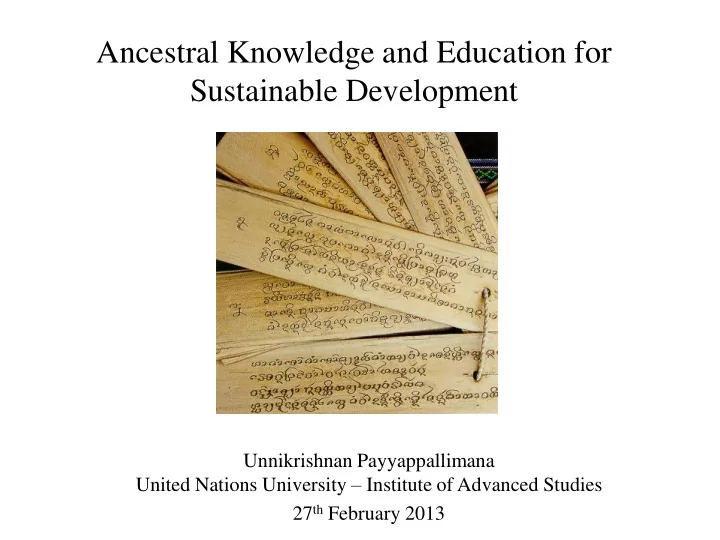
Ancestral Knowledge and Education for Sustainable Development

Unnikrishnan Payyappallimana United Nations University – Institute of Advanced Studies 27th February 2013
slide-2
SLIDE 2

Sequence

  • Overview of traditional knowledge
  • Multilateral policy perspectives
  • Traditional knowledge and ESD
  • RCE experience
slide-3
SLIDE 3

Overview

  • Different cultures around the world with

unique practices and ways of looking at life

  • Traditional knowledge refers to the

knowledge, innovations and practices of local communities around the world

  • It plays a vital role in defining the identity
  • f a community or a particular group.
slide-4
SLIDE 4
  • Traditional Knowledge - “tradition-based literary,

artistic or scientific works; performances; inventions; scientific discoveries; designs; marks, names and symbols; undisclosed information; and all other tradition-based innovations and creations resulting from intellectual activity in the industrial, scientific, literary

  • r artistic fields.” (WIPO, 2001)
  • Also known as Indigenous knowledge, Cultural

knowledge, Local knowledge, Ancestral knowledge, Traditional ecological knowledge – but any of these terms may not capture the exact nature

Traditional knowledge

slide-5
SLIDE 5

Codified and Non-codified Forms

  • Codified – Systematic epistemology, theoretical

framework, codification of traditional wisdom from an emic perspective

  • Non-codified – ecosystem and ethnic community

specific and highly diverse Though knowledge generation and transmission may vary in different cultures there are several similarities in the worldviews and value systems

slide-6
SLIDE 6

Prominent Characteristics of TK

  • Diversity, collective ownership guided by

customary laws, combined with beliefs and values

  • Largely undocumented and orally transmitted

forms- many similarities between different communities

  • Dynamic, adaptability to changing contexts
  • Differing epistemology of traditional and

contemporary knowledge

  • Not just history, but high contemporary

relevance

slide-7
SLIDE 7

Role of TK

  • Economic and social organization
  • Promotes a sense of national cohesion and

identity.

  • Impacts human wellbeing through

contributions to health, agriculture, food security, environmental and natural resource management, land use, livelihoods, disaster management, arts and culture among many others.

slide-8
SLIDE 8

Role of TK – Contd…

  • E.g. World Health Organization estimates that

traditional medical practices cater to 80% of the world population health requirements.

  • Components of local ecosystems (plants, animal and

mineral/metal derivatives)

  • Locally available, easily accessible and cost effective

and highly relevant in primary health care in health access poor regions

slide-9
SLIDE 9

Thematic Areas

TK Health Agriculture Food/nut rition Biodiversit y/Natural resources Arts Crafts Architec ture Rituals/ customs Education Ethics/value systems Technology Spirituality Region Specific knowledge

slide-10
SLIDE 10

Multilateral Instruments and Policy Perspectives

Policy

Year Position Indigenous and Tribal Peoples Convention (ILO) 1957 Due account shall be taken of the cultural and religious values and of the forms of social control existing among indigenous populations The International Covenant

  • n Economic, Social and

Cultural Rights (OHCHR) 1966 Rights of individuals and peoples to self determination and means of subsistence Indigenous and Tribal Peoples Convention (ILO) - Revised in 1989 1989 Rights of indigenous peoples to be actively involved in decisions related to their development and their right to continue with their ways of life and choose their priorities. Convention on biological diversity (CBD) 1992 Calls for the need to respect, preserve and maintain traditional cultures and encourage customary use of biological resources in line with principles of sustainable use and conservation; need to ensure equitable sharing of benefits among TK holders; and the need to obtain prior informed consent of providing parties to access biological resources and related knowledge on mutually agreed terms between the parties.

slide-11
SLIDE 11

Policy Year Position UN Convention to Combat Desertification (UNCCD) 1994 Encourages the use and protection of TK related to ecological development - Subject to their respective national legislation and/or policies, exchange information on local and traditional knowledge, ensuring adequate protection for it and providing appropriate return from the benefits derived from it,

  • n an equitable basis and on mutually agreed terms,

to the local populations concerned. International Treaty on Plant Genetic Resources (ITPGR), FAO 2001 Farmer’s rights and TK which allows for benefit sharing and participatory decision making on use of plant genetic resources UNESCO-ICSU Declaration

  • n Science and the use of

Traditional Knowledge 2002 Co-existence of knowledge systems and suitable integration for contemporary needs World Summit on Sustainable Development (WSSD) 2002 Plan for implementation WHO Traditional medicine strategy 2002-2005 2002 Integration of traditional medicine in health systems, national regulation focused on quality, safety, efficacy, access, rational use

slide-12
SLIDE 12

Policy Year Position World Intellectual Property Organization (WIPO) Sui generis model for protection of traditional cultural expressions, traditional knowledge and folklore. UNESCO Convention for the Safeguarding of Intangible Cultural Heritage (ICH) 2003 Protection of oral expressions, performing arts, social practices and rituals, knowledge and practices concerning nature and universe and traditional craftsmanship. Convention on Protection and Promotion of the Diversity of Cultural Expressions (UNESCO) 2005 Reaffirms the importance of the link between culture and development UN Declaration on Rights of Indigenous Peoples (UNPFII) 2006 Right to self determination, and to determine access to their cultures, resources and knowledge Rio + 20 2012 Reaffirms the role of traditional knowledge in sustainable development

slide-13
SLIDE 13

Views on Integration

  • These range from

– romantic (e.g., all practices are logical and sound) – Utilitarian (e.g., aspects have to be selectively studied to strengthen modern needs) – Pluralistic (should be allowed to co-exist and play a complementary role) views

slide-14
SLIDE 14

Common challenges

  • Declining social legitimacy (incl. government support)
  • Lack of recognition of practices and practitioners, lack of self

esteem

  • Erosion of knowledge, lack of successors
  • Self determination, rights to resources, traditional lands,
  • wnership of knowledge and benefits from use of resources and

knowledge, intellectual appropriation

  • Incompatibility with mainstream knowledge systems, multiple

worldviews of learners, pedagogical exclusion

  • Peaceful existence and preservation of diversity
slide-15
SLIDE 15
  • A hegemonic relationship between knowledge systems - TK in a position of

having to prove itself through a positivist epistemology – dramatically devalues traditions by universalizing norms of action

  • Over emphasis on economic growth - relevance of culture has been

examined through the lens of relevance to commercial activity

  • Prevailing view of TK as antiquated and non dynamic, relegating it to a

status of a commodity that should be documented and preserved.

  • Dominant discourse of protection of intellectual property rights while

neglecting efforts to strengthen social and cultural processes of continuity.

  • TK is considered exotic and confined to indigenous communities.
  • A contested idea of relevance in certain sections of society where benefits

from modern science and technology are not available or accessible – creating double standards in inequity especially in less developed countries.

Reasons

slide-16
SLIDE 16
  • Lack of sufficient theoretical approaches for understanding and

assessing TK

  • Institutionalization of TK - experience-based elements may not

be secured

  • A dichotomy exists between the formally trained ‘experts’ and

the informal ‘knowledge holders’

  • Shuttling between modernity and tradition - conflicts of social

identity

  • Integration into mainstream learning systems and production

processes is a challenging task.

Contd.

slide-17
SLIDE 17

TK and ESD – Key Aspects

  • Intergenerational, lifelong learning
  • Collective, social learning
  • Learning in totality
  • Appropriate integration in formal learning, building institutional

values and methods to provide choices in education

  • Constant engagement on contemporary relevance and promotion

as active social traditions in vital areas like agriculture, health etc.

  • Strengthen linkages to wellbeing and livelihoods
slide-18
SLIDE 18

Some questions relevant to ESD

  • What is an epistemologically sensitive method to identify

and integrate appropriate practices in learning?

  • What mechanisms can drive effective social as well as

institutional learning processes for ESD that integrates traditional knowledge and practices?

  • What challenges are encountered in the

institutionalization process of such knowledge systems?

  • To what extent can local experiences and models be

universalized and thus replicated?

  • What is an appropriate intercultural approach in the

current education system?

  • Can and to what extent traditional knowledge holders

participate in the formal educational systems?

slide-19
SLIDE 19

RCEs and Traditional knowledge

slide-20
SLIDE 20

UNU-Regional Centres of Expertise (RCE) Network

  • An RCE is a network of existing formal, non-formal and

informal education organisations, mobilised to deliver education for sustainable development (ESD) to local and regional communities.

  • A network of RCEs worldwide constitutes the Global

Learning Space for Sustainable Development.

  • RCEs aspire to achieve the goals of the UN Decade on

Education for Sustainable Development (DESD, 2005- 2014), by translating its global objectives into the context

  • f the local communities in which they operate.
  • There are currently 116 acknowledged RCEs worldwide.
slide-21
SLIDE 21

RCEs around the World

slide-22
SLIDE 22
  • RCE stakeholders
  • Schools
  • Higher education institutions
  • Environmental NGOs
  • Scientists, researchers
  • Museums, zoos, botanical gardens,
  • Local governments
  • Local enterprises
  • Volunteers, media, civic associations or individuals etc.
  • Functions of an RCE
  • Bring together institutions at the regional/local level to jointly promote

ESD

  • Build innovative platforms to share information and experiences
  • Promote dialogue among regional/local stakeholders through partnerships

for sustainable development

  • Create a local/regional knowledge base to support ESD actors
slide-23
SLIDE 23

Traditional Knowledge and Biodiversity: Learning Contributions

  • f The Regional Centres of Expertise (RCE) on Education for

Sustainable Development (ESD)

slide-24
SLIDE 24

Contents

  • 16 RCEs, 18 case studies under sections
  • 1. Learning for Revitalization of Natural and

Cultural Resources

  • 2. Ecosystem Services and Sustainable Use
  • 3. Co-engaged Learning Practices for Equity,

Livelihoods and Development

  • 4. Monitoring, Documentation, Protection and

Education

  • 5. Worldviews and Integration
slide-25
SLIDE 25

Contributors

Africa

  • RCE Makana and Rural

Eastern Cape Americas

  • RCE Greater Sudbury,

Canada

  • RCE Guatemala,

Guatemala Europe

  • RCE Espoo, Finland
  • RCE Porto, Portugal

Asia RCE Chandigarh, India RCE Cha-am, Thailand RCE Cebu, Philippines RCE Chubu, Japan RCE Greater Dhaka, Bangladesh RCE Greater Phnom Penh, Cambodia RCE Kodagu, India RCE Kyrgyzstan, Kyrgyzstan RCE Penang, Malaysia RCE Srinagar, India RCE Yogyakarta, Indonesia

slide-26
SLIDE 26

RCE Approaches/Methodologies of TK

  • Situated social learning processes
  • Learner led mediation processes
  • Revitalizing traditional knowledge in life situations

through a see-judge-act approach

  • Integration of mother tongue education and

reinforcing identity

  • Bridging research
  • Developing learning case modules for capacity

development based on good practices

slide-27
SLIDE 27

Case Study: ‘Developing Communication Strategy and Tools’ for Conserving Traditional Medical Knowledge and Medicinal Plants Diversity

slide-28
SLIDE 28

Indian Himalayan Region (IHR) RCEs Srinagar, Guwahati, Arunachal Pradesh

slide-29
SLIDE 29
slide-30
SLIDE 30
slide-31
SLIDE 31
slide-32
SLIDE 32
slide-33
SLIDE 33
slide-34
SLIDE 34
  • Continuous dialogue process and collective social learning with

mutual respect

  • Formal and informal educational programs have to be developed for

systematic study of local worldviews, perceptions and practices in the wider framework of ESD.

  • The formal learning could have a sectoral approach to TK in areas

such as in medicine, agriculture, veterinary sciences and so on.

  • Informal learning should also focus on means of intergenerational

transmission.

  • Issues of integration of TK to be addressed at different social levels

such as communities, civil society groups, nongovernmental

  • rganizations, formal and informal education institutions, local

administrative structures, and national and international multilateral and policy forums.

Conclusion

slide-35
SLIDE 35

Thank you !

For further information, please visit: www.ias.unu.edu/efsd

payyappalli@ias.unu.edu