sustainability in Peru Mnica Guillen (SUM, University of Oslo) Goal - - PowerPoint PPT Presentation

sustainability in peru
SMART_READER_LITE
LIVE PREVIEW

sustainability in Peru Mnica Guillen (SUM, University of Oslo) Goal - - PowerPoint PPT Presentation

Photos: Pamela Flores Discussing the role of researchers. Participatory action-research for wellbeing and sustainability in Peru Mnica Guillen (SUM, University of Oslo) Goal The context: Research suggests that ecological sustainability and


slide-1
SLIDE 1

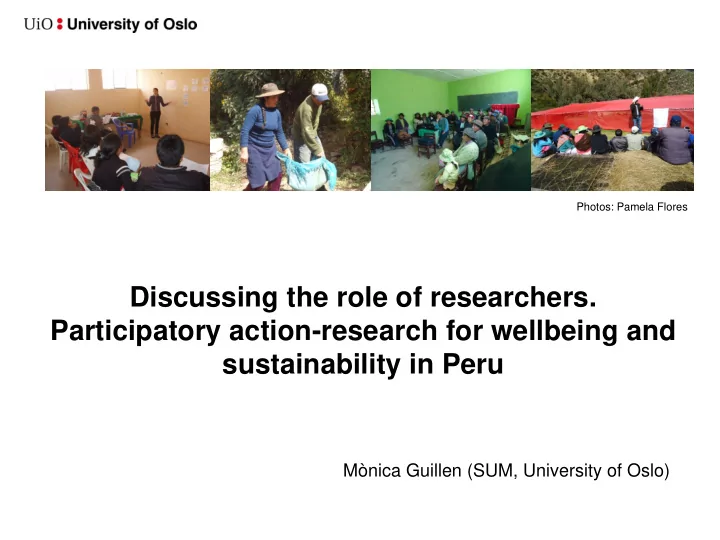
Discussing the role of researchers. Participatory action-research for wellbeing and sustainability in Peru

Mònica Guillen (SUM, University of Oslo)

Photos: Pamela Flores
slide-2
SLIDE 2

Goal

The context: Research suggests that ecological sustainability and human wellbeing are compatible. The difficulty: Finding strategies to promote both wellbeing and ecological sustainability. The current project: Using a participatory methodology researchers and participants from an Andean village engage in a process of change through strategies designed, developed and implemented by them.

2

slide-3
SLIDE 3

Overview

  • Background of the project
  • The HSD framework
  • PAR and the researcher’s position
  • PAR in Acostambo

– The problem of asistencialismo – Organic vegetable gardens

  • Reflecting on the role of researchers

3

slide-4
SLIDE 4

Background of the project (I): Peru

  • South-American middle-income country experiencing

a decade of rapid growth

  • A highly unequal society with 32% people living

under the national poverty line

  • A low ecological footprint that has doubled in the last

6 years

  • An economic growth based on mining and

hydrocarbon exploitation contributing to biodiversity loss and pollution of rivers and lakes.

4

slide-5
SLIDE 5

Background of the project (II): research on wellbeing and the environment

  • The economics of happiness: Richard Easterlin and the

Happy planet index (‘Happy lives do not have to cost the earth’]

  • Positive psychology: research on values and goals
  • Human Scale Development: Manfred Max-Neef
  • Post-doctoral project on sustainable development and

wellbeing in Peru. A mixed-methods approach.

Preliminary conclusions after quantitative analysis:

– Richer people have higher SWB but do not have more pro- environmental attitudes – People with a intrinsic goal orientation [concern for the community, self-acceptance, close relationships] have both higher SWB and pro-environmental attitudes

5

slide-6
SLIDE 6

Max-Neef’s Human Scale Development (HSD)

Participatory workshops articulated around a matrix of needs and existential categories

6

  • Results in Acostambo:

Utopian satisfiers were also described in terms of cooperation, reciprocity, respect, understanding, care for water springs and soil, patience and

  • penness, etc. which are attributes

linked to intrinsic values

BEING HAVING DOING INTERAC- TING SUBSISTENCE PROTECTION AFFECTION UNDERSTAN DING PARTICIPA- TION IDLENESS CREATION IDENTITY FREEDOM

slide-7
SLIDE 7

PAR and the researcher’s position

  • PAR: ‘Inquiry done by or with insiders to an
  • rganisation or community, but never to or on them’

(Herr and Anderson 2005:3)

  • Outsider(s) in collaboration with insiders

7

slide-8
SLIDE 8

PAR in Acostambo

8

From April 2012 to January 2013

  • Periodical participatory workshops [12]

and in-depth interviews [19]

  • Characteristics:

– Open – Flexible – Not assuming participants as oppressed – Join design, planning and implementation

  • f strategies

– Encouraging critical reflection

Photos: Pamela Flores

slide-9
SLIDE 9

PAR in Acostambo: The problem of asistencialismo

9

  • Organic farming known in

Acostambo through NGO’s and a former health worker

  • Asistencialismo or

dependence as a hurdle

‘We cannot say that Huancavelica is a poor departamento (regional unit), we have everything, but unfortunately we have been spoiled by the government that every year comes to give us presents and we have got used to that. We are not used to produce quality, to improve our economic

  • situation. People only expect presents and in my opinion this is very bad.’

(male participant, 39)

Photo: La Republica

slide-10
SLIDE 10

Organic vegetable gardens (I)

10

  • Strategy prioritised by participants as

contributing to advance towards satisfaction

  • f human needs (union, knowledge, higher

economic level)

  • Training by local vocational school teacher
  • Seeds donated by Mayor
  • Work in the seedbeds and own private

gardens organised by participants

  • Only lettuces and onions grew in the

seedbeds, carrot beetroot and radish planted directly in private gardens

  • Distribution depending on the amount of land

prepared by the households

Photos: Pamela Flores

slide-11
SLIDE 11

Organic vegetable gardens (II): contributing to wellbeing and sustainability

11

Community union

  • Participants and supporters from different institutions and

neighborhoods

  • Organic farming as collaborative work

Knowledge

  • Limited learning from training session particularly women
  • Learning from working together on seedbeds under

supervision of their own team leaders Economic level

  • Savings through own production and better health
  • Additional income through sales of surplus

Ecological sustainability

  • Reduce intensity of use of chemical fertilizers
  • Aligns with their concern for water streams and springs
slide-12
SLIDE 12

Final considerations: the role of the researcher

  • PAR encourages the researcher to become

modest, less prescriptive and in constant learning process.

  • Researcher closer to participant, personality

becomes relevant.

  • Asistencialismo as a barrier, PAR researcher

risks reproducing expert-participant division.

12

slide-13
SLIDE 13

Acostambo

13

Altitude: 3,600 m. Population: 4,537 spread in 18 annexes, 2 populated centres and 7 neighbourhoods Economy: smallholders depending on farming of barley, potatoes, wheat, peas, beans and maize Poverty (Huancavelica): 70% Illiteracy: 17% (27% women) Quechua: 41% Material of floor: 94% earth NGO’s: Caritas, Adecap Social programmes: Glass of milk, Pension 65, Juntos, Pronamaa, Wawa Wasi, Agrorural.