Surviving the Viva ! ! The role of your supervisor and examiners ! - - PDF document

surviving the viva
SMART_READER_LITE
LIVE PREVIEW

Surviving the Viva ! ! The role of your supervisor and examiners ! - - PDF document

Outline of session ! The viva in context of a PhD Surviving the Viva ! ! The role of your supervisor and examiners ! What to expect on the day Dr Keith Morgan - Typical questions / topics Dr Sara Shinton - Possible outcomes - Common


slide-1
SLIDE 1

Surviving the Viva !

Dr Keith Morgan Dr Sara Shinton Shinton Consulting Ltd

Outline of session

! The viva in context of a PhD ! The role of your supervisor and examiners ! What to expect on the day

  • Typical questions / topics
  • Possible outcomes
  • Common concerns answered

! Summary of good preparation

context: nature of research, big picture ideas, defence

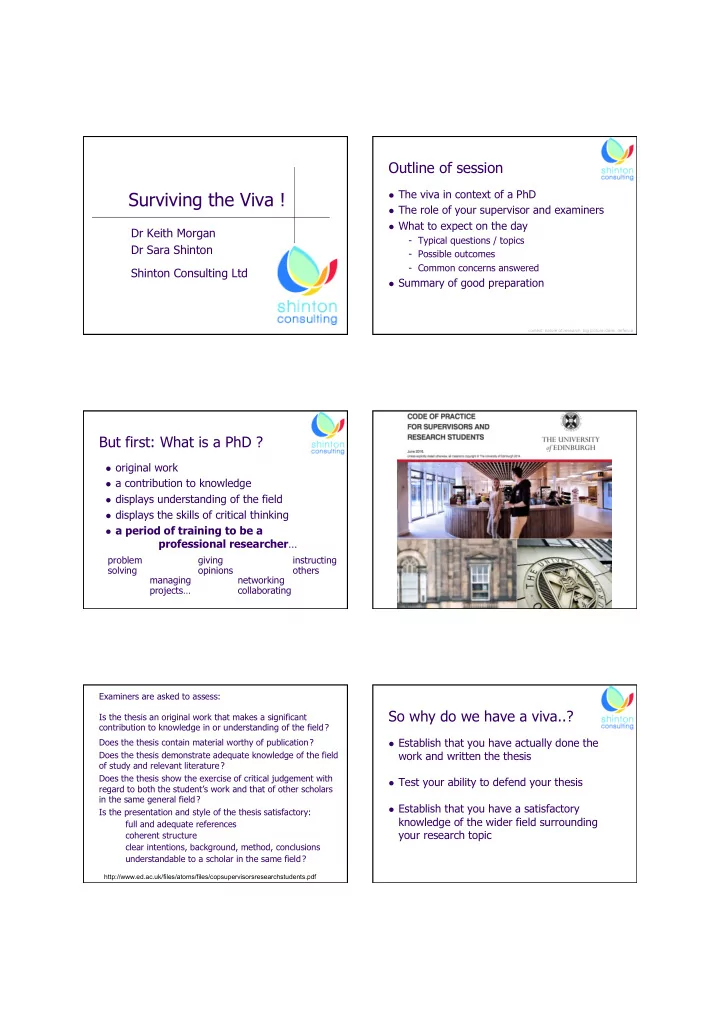
But first: What is a PhD ?

! original work ! a contribution to knowledge ! displays understanding of the field ! displays the skills of critical thinking ! a period of training to be a

professional researcher…

problem solving managing projects… giving

  • pinions

networking collaborating instructing

  • thers

Examiners are asked to assess: Is the thesis an original work that makes a significant contribution to knowledge in or understanding of the field ? Does the thesis contain material worthy of publication ? Does the thesis demonstrate adequate knowledge of the field

  • f study and relevant literature ?

Does the thesis show the exercise of critical judgement with regard to both the student’s work and that of other scholars in the same general field ? Is the presentation and style of the thesis satisfactory: full and adequate references coherent structure clear intentions, background, method, conclusions understandable to a scholar in the same field ?

http://www.ed.ac.uk/files/atoms/files/copsupervisorsresearchstudents.pdf

So why do we have a viva..?

! Establish that you have actually done the

work and written the thesis

! Test your ability to defend your thesis ! Establish that you have a satisfactory

knowledge of the wider field surrounding your research topic

slide-2
SLIDE 2

Where do we start? Think big…

! Context ! Contribution to field ! Originality ! Critical judgement and testing of ideas ! Defending results ! You need to be clear about these…

Context – your work

! You need to know WHY your project was

important / relevant at the outset…

! …so you should be able to EXPLAIN the key

work that has already been done by others in your area…

! …and how this relates to your research aim

Mini Viva - Part 1

! With a partner – someone you do NOT know ! Discuss for a few minutes how your research

project was devised, focusing on

  • problem
  • motivation
  • approach

! Both of your projects must be discussed

Context – your work

! Then you should be able to explain what you

have actually done during your research…

! …how and what this contributes to your field

key work

  • f others

the aim of your research your methods and results contribution to your field

Mini Viva - Part 2

! With the same partner ! Discuss for a few minutes what your research

contributes to your field, and where it might go in the future

  • What would you do with 10 more years?

! Both of your projects must be discussed

Originality

! New work ! New interpretation ! New application ! New way of testing knowledge ! New connections

slide-3
SLIDE 3

Mini Viva - Part 3

! Discuss with your partner

! The ways in which your work is original

! Then

! The ways in which your work is NOT original

Critical judgement

In the thesis...

! Refer to the key papers ! Demonstrate critical engagement

! Comparing approaches and conclusions of others ! Understanding academic lineage ! Recognising quality – identify value in work ! Noting potential conflicts of interest

Critical judgment in viva

! Why did you use this method / approach

! Be clear on its advantages and limitations

! Is your interpretation the only possible

explanation ?

! Support from literature ! Confirmation from further work

! What are the implications of your work ?

Potential mini viva part 4... What do you think... or What could be better...

Defending Your Results

Experiences so far...?

! Published papers ! Conference contributions ! Group meetings ! Informal discussions ! Into groups of around 4 or 5 people...

In your groups

! Reflect on your experience ! What preparation did you do ? ! What questions were you asked ? ! How was your work received ? ! What was the audiences’ perspective ? ! What new leads were suggested ?

Final thought on ‘Big Ideas’ Where will you demonstrate…

! Originality ! Significance of your contribution ! Understanding of context ! Knowledge of the field and critical thinking ! Innovative ideas ! Publishable outcomes

... and is it obvious ?

slide-4
SLIDE 4

What to Expect...

Do you have any specific concerns about the day itself ?

Frequently Asked Questions

! What format will the viva take ? ! What should I take in with me ? ! When do I find out the outcome ? ! Who will be there ? ! What are they there to do ? ! What if they disagree with each other ?

Who and what

! Chairperson

! administrative and advisory

! External Examiner

! test knowledge and understanding ! ensure thesis and candidate deserves PhD ! may advise on deficiencies

! Internal Examiner

! arranges viva and contributes to decision on award ! also tests knowledge and understanding in the viva

! Supervisor

! Should not play any part

When and where...

More on the examiner’s role

! Check that you wrote the thesis by tackling you

  • n the detail

! so may check understanding of anything you wrote

! ask questions designed to see if you really

understand your own argument

! see if you can justify a position which they have

a problem with

! point out problems with the thesis and give you

the opportunity to think through ways to rectify them

One examiner’s checklist

! Research aims clear? ! Literature adequately

reviewed/critiqued?

! Key papers included? ! Theoretical basis sound? ! Conjectures consistent

with theory?

! Appropriate methodology? ! Evidence collected

ethically?

! Sufficient evidence? ! Convinced of reliability

and validity?

! Findings assessed against

literature?

! Findings make significant

contribution to the field?

! Any inconsistencies? ! Conclusions?

IS THIS PERSON AN EXPERT?

Typical questions / topics

! what are your main findings ? ! what is original about your research ? ! describe your methodology and why you decided to use it ! can you highlight the contribution that you have made ? ! how do your findings relate to this particular literature ? ! why was this problem worth investigating ? ! what do you think of your thesis ? ! but also – anything !

slide-5
SLIDE 5

Typical examiners’ reports

The thesis:

! contains evidence of sufficient experience in methods of

research;

! demonstrates the purpose of the investigation and a critical

discussion of the results;

! represents a significant contribution to the relevant field of

learning

Recommendations including comments on:

! the scope, character and quality of the work submitted ! the performance of the candidate at the oral examination

Overall, whether the thesis and viva performance merits PhD

Possible outcomes

! PhD awarded ! PhD awarded, subject to corrections ! these could be minor editorial or more significant corrections ! checked by the internal examiner ! PhD not awarded, as candidates oral defence deficient in

specified aspects

! further examination required ! Additional research work required in thesis !

either up to 6 months work with no further oral examination

!

  • r work could be more substantial, up to 12 months, with second oral

! MPhil awarded ! for which corrections may still be required ! Degree not awarded and candidate judged to have failed

Good preparation

Planning…

During the thesis writing…

! Always remember the viva is coming ! ! Keep a file or folder of notes and references

that did not make it into your thesis

! Think of possible questions, and make a note

(especially if you don’t know the answer)

After thesis submission

! Take a short break if possible ! Read your thesis afresh, know it’s structure and

think about the BIG picture

! Look for any weak areas in your knowledge ! Then look back to your folders of related notes,

references and possible questions

After thesis submission

! Read some of your external examiners

  • utput, in order to be familiar with their

current interests

! Remember the wider field, and also basic

fundamental material

! Continue to read the relevant key literature!

slide-6
SLIDE 6

Some practical revision tips

! Take breaks ! Discuss problems with others ! Make a list of any outstanding questions to

discuss with supervisor

! Prepare condensed notes for night before ! Keep ‘in touch’ with the group / department

The night before

! Try to relax ! Avoid caffeine and alcohol ! Don’t start any new topics ! Skim those condensed notes ! Try to get a good nights sleep

On the day

! Be smart, but comfortable ! Sober (!) and pleasant – first impressions

count

! React to atmosphere and style of panel ! Be confident, you know more than think ! ! Be positive and motivated – it will come

across

! Remember the purpose of the viva…

When answering questions…

! Speak clearly, make eye contact ! Give straight but full answers ! Request clarification if a question is not

understood

! Perhaps challenge a question if you know it is

based on a poor premise

! the debate will probably come naturally… ! …so you can be assertive but not aggressive

! Don’t exaggerate or be falsely modest

Afterwards

! Wait for recommendation ! Implement corrections (often surprisingly

quick to do)

! Make sure the paperwork is all in place for

the final submission of hardbound copies

! Celebrate !

Summary of preparation

! Practice speaking and dealing with questions ! Ask people to read sections and ask questions ! Summarise your thesis and know its structure ! Ask survivors for advice... ! Understand the BIG picture of your own work –

context, aims, main findings and contribution

! Read new material as it is published