Supporting Procedure Call Supporting Procedure Call Procedures (or - - PowerPoint PPT Presentation

supporting procedure call supporting procedure call
SMART_READER_LITE
LIVE PREVIEW

Supporting Procedure Call Supporting Procedure Call Procedures (or - - PowerPoint PPT Presentation

Supporting Procedure Call Supporting Procedure Call Procedures (or functions) are a crucial program structuring mechanism. To support procedures we need to define a calling convention: a sequence of steps followed by the calling procedure


slide-1
SLIDE 1

76 CSE378 WINTER, 2001

Supporting Procedure Call

77 CSE378 WINTER, 2001

Supporting Procedure Call

  • Procedures (or functions) are a crucial program structuring

mechanism.

  • To support procedures we need to define a calling convention: a

sequence of steps followed by the calling procedure and the called procedure to assure correct passage of parameters, results, and control flow...

  • Each machine (compiler, really) uses its own calling convention
  • The convention is controlled by software and/or hardware
  • In RISC machines, the hardware performs only simple

instructions, so most of the onus is on the programmer/compiler to issue the proper sequence of instructions to assure correct implementation of procedure calls

78 CSE378 WINTER, 2001

Program Stack

  • Each executing program (process) has a stack
  • A stack is a dynamic data structure that is accessed in a LIFO

manner (you knew this already)

  • The program stack is automatically allocated by the OS when the

program starts up

  • The register $sp (register 29 on the MIPS) is automatically loaded

to point to the first empty slot on the top of the stack

  • By convention, the stack grows towards lower memory addresses
  • To allocate space on the stack, decrement $sp
  • To free old stack space, increment $sp

79 CSE378 WINTER, 2001

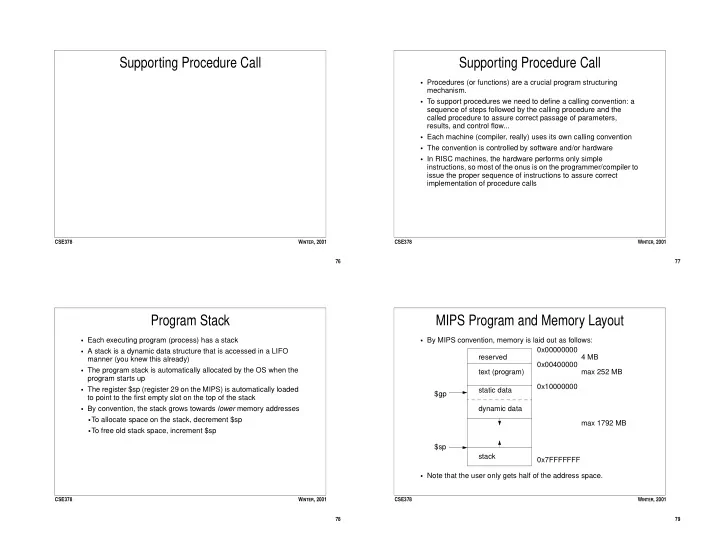
MIPS Program and Memory Layout

  • By MIPS convention, memory is laid out as follows:
  • Note that the user only gets half of the address space.

0x00000000 0x00400000 0x10000000 reserved $sp $gp text (program) static data dynamic data stack 0x7FFFFFFF 4 MB max 252 MB max 1792 MB

slide-2
SLIDE 2

80 CSE378 WINTER, 2001

Procedure Stack Frame

  • A stack frame is a block of memory on the stack that is used for:
  • Passing arguments
  • Saving registers
  • Space for local variables

Argument build area Saved regs ($ra, etc.) Local vars $sp-> low memory high memory Callee’s stack frame Caller’s frame... Used for passing additional args...

81 CSE378 WINTER, 2001

Multiple calls

  • Assume your main program calls procedure A, which in turn calls

procedure B. During the execution of B, the stack will look like: $sp-> low memory high memory

  • Proc. B

saved regs and locals

  • Proc. A

saved regs and locals main saved regs and locals

82 CSE378 WINTER, 2001

Procedure Call Sequence

  • Definitions: callee (the procedure that is called); caller (the

procedure that does the calling). Note that a given procedure can be, at different times, both caller and callee...

  • Here is a generic sequence of events surrounding a procedure
  • call. What needs to be done during the calling sequence? (And

who does it?)

  • 1. Caller must pass the return address (where to continue execution

after the call) to the callee

  • 2. Caller must pass parameters to callee
  • 3. Caller must save registers that the callee might want to use
  • 4. Jump to the first instruction of the callee
  • 5. Callee must allocate space for local variables, and possibly save

registers

  • 6. Callee executes...
  • 7. Callee has to restore registers (possibly) and return to caller
  • 8. Caller continues....

83 CSE378 WINTER, 2001

Mechanisms

  • How do we save information? Pass information? Make space for

locals? Again, this is defined mainly by convention:

  • In the MIPS convention the registers are used for:
  • 1. passing the return address (by jal target, which places the address of

the next instruction into $ra)

  • 2. passing a small number of parameters (up to 4, in $a0-$a3)
  • 3. keeping track of the stack pointer ($sp)
  • 4. returning function values (in $v0-$v1)
  • The stack is used for:
  • 1. save registers that the callee might use
  • 2. save information about the caller (its $ra, for instance: why?)
  • 3. pass additional parameters
  • 4. allocate space for a procedures local variables
slide-3
SLIDE 3

84 CSE378 WINTER, 2001

Register conventions

  • The following conventions dictate the use of registers during

procedure call:

Register Name Function $2-3 $4-7 $8-15 $16-23 $24-25 $28 $29 $30 $31 $v0-v1 $a0-a3 $t0-t7 $s0-s7 $t8-t9 $gp $sp $fp $ra return function value for passing the first 4 parameters; caller-saved (volatile) caller-saved temporaries (volatile) callee-saved temporaries caller-saved temporaries (volatile) pointer to global static memory (don’t mess) stack pointer frame pointer (used by some compilers) return address (callee-saved)

85 CSE378 WINTER, 2001

Who saves/restores the registers?

  • Caller saves. The caller saves any registers that it wants

preserved before making the call, and restores them afterwards.

  • Callee saves. The callee saves any registers it intends to use, and

restores them before it returns.

  • MIPS takes a hybrid approach, by classifying some registers as

caller-saved and some as callee-saved.

  • Caller-saved registers ($t0-$t9) are those that the caller must

save/restore (if they need the value after the call). Sometimes these registers are described as volatile, because the callee is free to change them without saving/restoring them.

  • Callee-saved registers ($s0-$s7, $ra) are those that the callee

must save/restore if they want to change them.

  • Compilers are good at deciding how to allocate the registers to
  • ptimize their use, e.g. by placing short-lived values into caller-

saved registers, and long-lived values into callee saved registers.

86 CSE378 WINTER, 2001

A Convention of My Invention

  • The trouble with conventions is that no one agrees on them. For

instance:

  • 1. The text presents two different procedure call conventions, both of

which are confusing.

  • 2. The MIPS manual presents another, which is also confusing.
  • 3. The cc compiler uses another (close to the one in the MIPS manual)
  • 4. The gcc compiler uses yet another...
  • At a minimum, our convention should agree (in principle) with the
  • nes used by typical compilers. (Ours almost does...)
  • We’re concerned primarily with 4 points in program execution:
  • 1. The entry to a called procedure.
  • 2. The exit from a called procedure.
  • 3. Just before calling a procedure.
  • 4. Just after the return from a procedure call.

87 CSE378 WINTER, 2001

Procedure Entry

  • Allocate stack space by:

subu $sp, $sp, framesize

  • Framesize is calculated by determining how many bytes are

required for

  • 1. Local variables
  • 2. Saved registers: usually at least $ra (if we intend to make a call) +

space for the callee save registers we intend to use.

  • 3. Procedure call arguments: If we intend to make a call with more than

4 parameters, we’ll need to allocate extra words at the top of our stack frame.

  • Save callee-saved registers. A callee must save $s0-$s7 before

altering them, since the caller expects to find them unchanged after the call. Register $ra need only be saved if the callee intends to make further calls.

  • It is a good habit to only grow the stack on procedure entry, and

not to mess with it again until procedure exit.

slide-4
SLIDE 4

88 CSE378 WINTER, 2001

Procedure exit

  • Return values. If the procedure is a value returning function, the

value should be placed in $v0.

  • Restore all callee-saved ($s0-$s7) registers.
  • Restore $ra, if necessary.
  • Pop the stack frame by adding framesize to $sp:

addu $sp, $sp, framesize

  • Return to the caller by jumping to the address in $ra:

jr $ra

89 CSE378 WINTER, 2001

Prior to a Call

  • Pass arguments. Place the first 4 arguments into $a0-$a3. The

remaining arguments are placed on the stack at offset($sp). The

  • ffset is 0 for the 5th argument, 4 for the 6th argument, etc. This

works because we allocated a large enough argument build area

  • n procedure entry (see above).
  • Save the caller-saved registers. The callee can modify $a0-$a3

and $t0-$t9 with impunity, so if the caller expects to use one of these registers after the call, it must save them.

  • Jump to the caller by executing the jal instruction, which will

deposit the return address into $ra.

90 CSE378 WINTER, 2001

After a call

  • Restore any caller-saved registers you saved before the call.
  • Often there will be nothing to do here, because we (or the

compiler) have been clever and have used the callee saved registers for long-lived values, and the caller-saved registers for short-lived values.

91 CSE378 WINTER, 2001

Example: Recursive Factorial

int factorial (int n) { if (n==0) return 1; else return n * factorial(n-1); }

  • How large does the stack frame for factorial need to be?
slide-5
SLIDE 5

92 CSE378 WINTER, 2001

Assembly Version

factorial: subu $sp, $sp, 8 # create stack frame sw $ra, 0($sp) # save ra beq $a0, $0, base # base case? sw $a0, 4($sp) # RECURSIVE CASE: addi $a0, $a0, -1 # save $a0 on stack, jal factorial # make recursive call lw $t0, 4($sp) # now restore $a0... mul $v0, $v0, $t0 # ...and multiply j ret # drop to bottom base: li $v0, 1 # BASE CASE, return 1 ret: lw $ra, 0($sp) # procedure exit addu $sp, $sp, 8 # restore $ra, $sp jr $ra # return to caller

93 CSE378 WINTER, 2001

Larger Example

int doubleIt (int x) { return 2*x; } int sumAndDouble (int a, int b, int c, int d, int e, int f) { int temp; temp = a+b+c+d+e+f; temp = doubleIt(temp); return temp } int main () { int x, f[6]; x = sumAndDouble(f[0], f[1], f[2], f[3], f[4], f[5]); printInt(foo); }