
SLIDE 1
Manu Linares (GAA@UPC & IEEC, Barcelona)
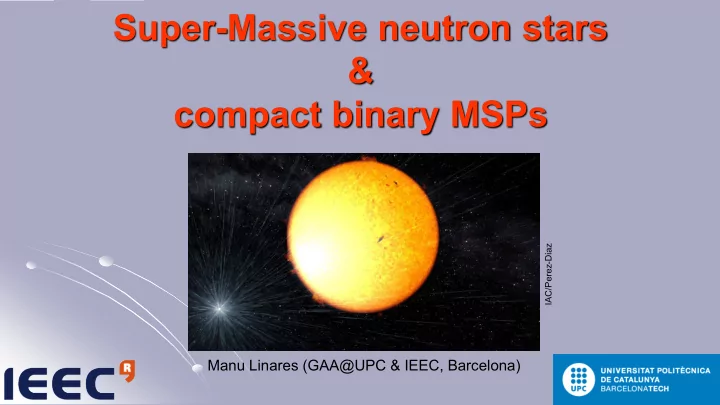
IAC/Perez-Diaz
Super-Massive neutron stars & compact binary MSPs - - PowerPoint PPT Presentation
Super-Massive neutron stars & compact binary MSPs IAC/Perez-Diaz Manu Linares (GAA@UPC & IEEC, Barcelona) WHAT IS THE MAXIMUM MASS OF A NEUTRON STAR? Astronomy: Neutron star mass measurements (binary pulsars) Astrophysics: Supernovae,
Manu Linares (GAA@UPC & IEEC, Barcelona)
IAC/Perez-Diaz
Astronomy: Neutron star mass measurements (binary pulsars) Astrophysics: Supernovae, NS birth mass, binary evolution, BH vs NS Gravitational waves: Outcome of NS+NS mergers (supra-massive NS?) Nuclear physics: Set by EoS in the core, where ρcore > ρnuc (~2 x 10¹⁴ g/cm3)
Thorsett & Chakrabarty (1999, ApJ) 21+5 radio PSRs: 1.35 +/- 0.04 Msun Özel & Freire (2016, ARAA) 35-68 NSs in the 1.2-2.0 Msun range Mass Distribution
Demorest/Fonseca 2010-16: 1.93+/-0.02 Msun
(J1614-2230, WD, Porb=8.7 d)
Antoniadis+ 2013:
2.01+/-0.04 Msun
(J0348+0432, WD, Porb=2.46 hr)
van Kerkwijk+ 2011:
2.40+/-0.12 Msun
(B1957+20, BW, Porb=9.2 hr)
COMPANION
“Spiders” (blackwidows, BWs; redbacks, RBs):
Millisecond pulsar
(wind, γ-rays, spin-down luminosity: 1034-1035 erg/s)
Binary, compact orbit (Porb ≤ 1 day; a ~ RSun) Non/semi-degenerate companion star
(low/very-low mass, RBs / BWs: ~0.1 / 0.01 MSun)
(van Kerkwijk+11, Linares+18)
(Archibald+09, Papitto+13)
(Chen+13, Benvenuto+12)
(Bogdanov+11, Venter+15) A growing, nearby population of millisecond pulsars
Bogdanov
A booming field thanks to Fermi-LAT driven discoveries
[BWs/RBs: 3/1 29+1/14+10]
43 (20% MSPs) 4 (5% MSPs)
d ~ 0.5-4 kpc; Lsd ~ 1034-1035 erg/s
(Hessels, Roberts, Ray, Ransom+ PSC; Kong, Romani, Salvetti, …)
Fermi-LAT: driving force and discovery space
Acero et al. (2015, 3FGL) Successful LAT-driven searches in: RADIO / OPTICAL* / X-RAY / GAMMA-RAY *COBIPULSE: robotic optical multi-band photometric survey (N: 13/24, S:?/17)
Gran Telescopio CANARIAS (10.4 m) +WHT, IAC80
IAC/Rosenberg
PSR J2215+5135: 4.14 hr orbit Irradiated MS companion Massive NS? Breton+’13 Schroeder&Halpern’14 Romani+’15,16
Dynamical Studies with Irradiation: PSR J2215+5135 1) Extreme heating by pulsar wind: from G5 (cold/night side) to A5 (hot/day side)! 2) Trace the velocity of both sides using different absorption lines (H vs Mg) 3) Physical model to find inclination and masses (incl. constr. on TD, TN and q = M2/M1 = K2 Porb / 2πx1 c) KBalmer = 382.8 +/- 4.7 km/s KMg = 420.2 +/- 6.2 km/s
K2 = 412.3 +/- 5.0 km/s
TN=5660 +/- 320 K TD =8080 +/- 375 K
MNS = 2.27 +/- 0.16 MSun
M2 = 0.33 +/- 0.03 MSun i = 63.9º +/- 2.5º
K K
Thorset&Chakrabarty’99 Ozel&Freire’16 M < 2.15 MSun R = 9.9 – 12 km Cromartie+19 (WD, P=4.8 d, Shap-del): MNS = 2.14 +/- 0.10 MSun vKeerkwijk+11 Romani+15,16 Linares+18 Strader+19 Mmax > 2.3-2.4 MSun!!
Compact Binary MSPs (Spiders): Key to find the most massive neutron stars!
Mass Distribution
Impact on nuclear physics
EQUATION OF STATE P(dens) + TOV M-R Only a ‘stiff’ EoS can support 2.3 MSun (need enough pressure at the central densities) Hyperons don’t seem able to provide that pressure
Özel & Freire (2016)
Margalit & Metzger (2017)
Impact on GW astronomy NEUTRON STAR MERGERS Can they lead to super-massive neutron stars? Remnant & e.m. emission sensitive to Mtotal / Mmax
GW 170817: Mtotal = 2.74 MSun
Mmax < 2.17 MSun (Margalit & Metzger‘17); Mmax < 2.16-2.28 MSun (Ruiz et al.’18)
GW 190425: Mtotal = 3.4 Msun
Low-mass BHs vs. massive NSs (Chen et al.‘20)
Impact on GW astronomy COMPACT OBJECT MERGERS Putting together EM and GW
Is there a “mass gap” between NSs and BHs?
LIGO-Virgo/Frank Elavsky/Northwestern University