9/15/2020 1
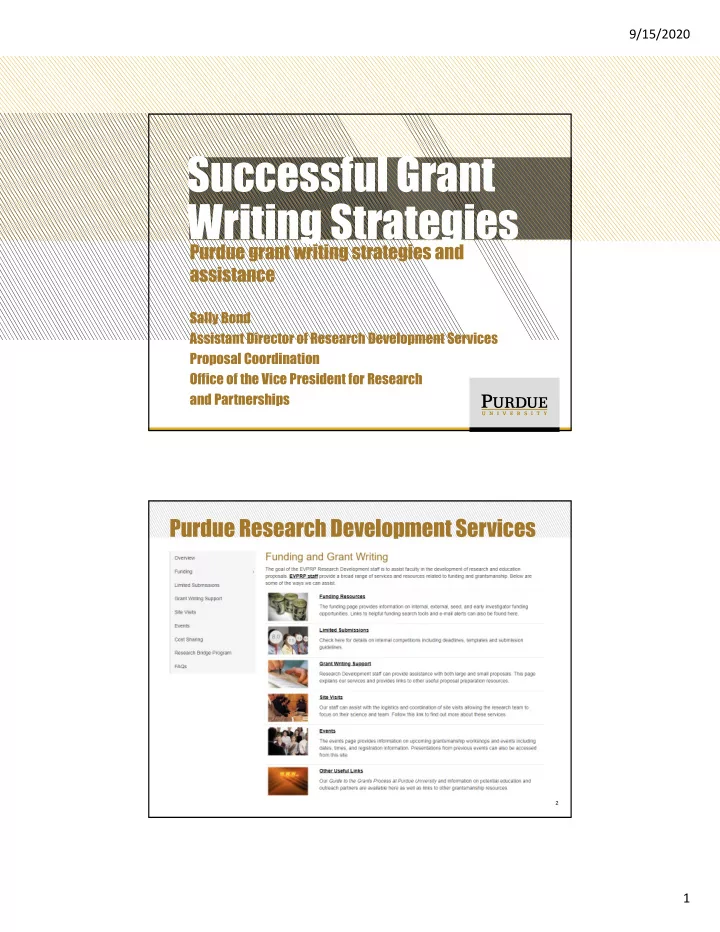
Successful Grant Writing Strategies
Purdue grant writing strategies and assistance
Sally Bond Assistant Director of Research Development Services Proposal Coordination Office of the Vice President for Research and Partnerships
2
Successful Grant Writing Strategies Purdue grant writing strategies - - PDF document
9/15/2020 Successful Grant Writing Strategies Purdue grant writing strategies and assistance Sally Bond Assistant Director of Research Development Services Proposal Coordination Office of the Vice President for Research and Partnerships
9/15/2020 1
Purdue grant writing strategies and assistance
Sally Bond Assistant Director of Research Development Services Proposal Coordination Office of the Vice President for Research and Partnerships
2
9/15/2020 2
3
4
9/15/2020 3
5
6
9/15/2020 4
7
8
9/15/2020 5
9
10
9/15/2020 6
11
12
Tailored and intentional plan
9/15/2020 7
13
Strategies for the strongest proposal submission
14
Strategies for the strongest proposal submission
9/15/2020 8
15
Storyline first!
16
9/15/2020 9
17
Provides your logical rationale in a short intro
18
Jon Lorsch, director of the National Institute of General Medical Sciences at NIH, quoting Francis Collins, director of NIH
9/15/2020 10
19
Gap analysis
Good science is a story that…
narrative
weaknesses are not fatal
20
Four key questions
address the problem?
address this gap?
9/15/2020 11
21
Funnel of logic flow
address the problem?
address this gap?
22
Start with phrase answers (Example from Brenda Capobianco NSF IUSE) What is the problem?
science education
engineering in their classroom. Particularly a problem at elementary level where teachers have less preparation in science and no formal exposure to engineering What has been done to address this problem?
Learning through Engineering Design
What is the gap that remains?
science teachers How do you propose to address this gap?
9/15/2020 12
23
Turn phrases into narrative
24
Carolina Wählby of the Broad Institute
http://www.niaid.nih.go v/researchfunding/grant /pages/appsamples.aspx
9/15/2020 13
25
Where do you put it?
– In background, rationale, or vision and goals
– in significance section and condensed version at start of specific aims page
26
Create a one-page brief
One-page project description sent to program
9/15/2020 14
27
One-page…taste of your entire grant in a single, bite-sized piece
It forces you to distill all aspects down to their essences and to find a way of piecing things together that is economical, coherent, logical, and compelling […] is totally unforgiving, revealing problems in the clarity of your thinking and presentation, weaknesses in the logic of your research, vagueness in your methods, and failures in the all-important ‘so what?’
has a way of camouflaging weaknesses (at least from the writer but not so often from the reviewer).
—Robert Levenson, UC-Berkeley
28
9/15/2020 15
29
30
Addressing common trouble spots
9/15/2020 16
31
Do not be returned without review!!
locations
rationale
32
Know the agency guidelines as well as solicitation
9/15/2020 17
33
Know general guidelines but solicitation overrides.
34
Sleuth what was funded previously to identify trends
compare to yours?
9/15/2020 18
35
Agency websites often show what was previously funded.
www.nsf.gov
36
9/15/2020 19
37
Review related abstracts.
38
Review related abstracts.
9/15/2020 20
39
NIH RePORTer http://projectreporter.nih.gov/reporter.cfm.
40
NIH RePORTer http://projectreporter.nih.gov/reporter.cfm.
9/15/2020 21
41
42
Always outline!
9/15/2020 22
43
Outline before you write. Be consistent with formatting.
44
Parallel Structure
9/15/2020 23
45
Parallel Structure and Page Allocation
46
Addressing common trouble spots
expertise, facilities, prior work, campus environment
9/15/2020 24
47
Addressing common trouble spots
expert
read your proposal
48
9/15/2020 25
49
Be kind…you are not writing for yourself.
50
Parallel formatting provides a roadmap to help your reviewer
9/15/2020 26
51
Parallel formatting provides a roadmap to help your reviewer
52
Avoid dense text by adding white space
Format 1 Format 2
9/15/2020 27
53
Avoid dense text by adding graphics
Format 1 Format 2
54
Be concise. Less is better.
There are a growing number of scientists who believe the system is capable of addressing user demands. (17 words) A growing number of scientists believe the system can address user demands. (12 words)
9/15/2020 28
55
Avoid long, dense sentences.
There are several innovations of this proposed research, including: a) analysis of air contaminant mixtures and health, particularly with extremely high spatiotemporal resolution; b) consideration of climate change impacts; and c) incorporation of novel risk assessment
Our key innovations include: a) analyzing air contaminant mixtures and health with extremely high spatiotemporal resolution; b) considering climate change impacts; and c) incorporating novel risk assessment methodology. (28 words)
56
Get rid of passive voice
Elemental mapping of animal tissues has been investigated, and results have been documented. We investigated elemental mapping of animal tissues and documented results.
9/15/2020 29
57
Get rid of passive voice
More detailed evaluations of different policy scenarios will also be developed with input from key decision makers and local communities in each state. We will also develop more detailed evaluations
decision makers and local communities in each state.
58
Delete words that do not add anything
The development of a process to screen new high- throughput products for further evaluation is certainly one of the most important features.
9/15/2020 30
59
Remove ambiguity particularly with reference words.
When Nature published research that explored gene editing of embryos using CRISPR–Cas9 to correct a specific genetic mutation, it did not include embryos from IVF clinics. What is “it”? The paper? The research? The gene editing? CRISPR-Cas9?
60
Sloppy writing = sloppy science
9/15/2020 31
61
Use high-quality, easy-to-read graphics for conceptual and organizational info
62
Use visuals to summarize narrative when possible.
Program Initiatives Year 1 Year 2 Year 3 Year 4 Year 5
Indiana administration Membership approved by Executive Council for working committees Partner retreat Create I-hub Create Passport tracking External Advisory Board meetings Annual Alliance-wide conference Goal 1: Alliance-wide practices Campus director monthly centralized training Augmented training sets Faculty/students training on I-hub Cross-Alliance recruiting, including veterans Goal 2: Effective community college partnership facilitating transfer to four-year STEM programs Co-mentored domestic research experience at partner campuses Co-mentored international research experience Industry guest speakers Cross-Alliance teaching symposia and workshops with community college faculty Goal 3: Aligning experiences with Tinto’s principles of iteration Map activities and identify gaps Pair scholars with mentors Create individualized portfolios Map incentives to Passport Badges Cross-Alliance international research cohort Disseminate model-based best practices Goal 4: Research longitudinal model of Scholar development Compile a list of Scholar attributes Test and validate Scholar attributes Collect Scholar data Analyze Scholar data and portfolios Conduct interviews with Scholars Evaluation and Assessment Formative site visits Formative focus groups/interviews Formative web-based surveys Formative analysis and reporting Summative data plan development Summative quantitative data gathering Summative analysis and final reporting9/15/2020 32
63
Addressing common trouble spots
64
New eyes on your draft before submission
9/15/2020 33
65
Because sometimes what is obvious to you is not obvious to others
66
compliance matrices
9/15/2020 34
67
68
9/15/2020 35
69
70
9/15/2020 36
71
72
9/15/2020 37
73