SUBSTANCE ABUSE Source Warning signs for abusing drugs Drug tests - - PDF document

substance abuse
SMART_READER_LITE
LIVE PREVIEW

SUBSTANCE ABUSE Source Warning signs for abusing drugs Drug tests - - PDF document

4/15/2019 Objectives Risk factors for drug abuse Statistics Trafficking flows SUBSTANCE ABUSE Source Warning signs for abusing drugs Drug tests Dr. Basim A. Baragaba, MD, MPH, AME Substance Abuse Prevention Program


slide-1
SLIDE 1

4/15/2019 1

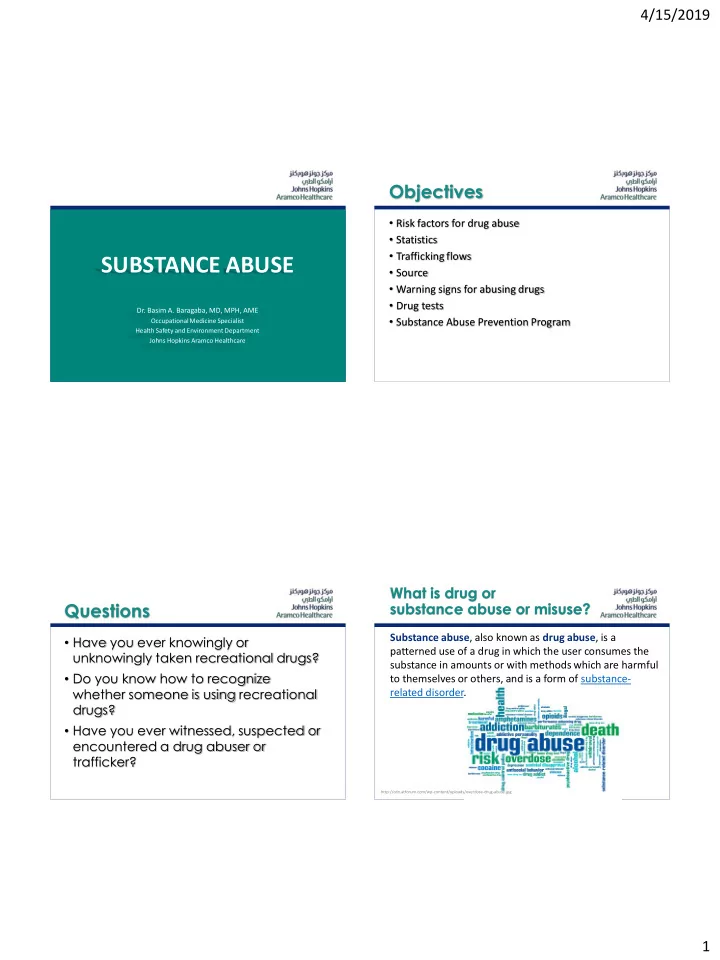
SUBSTANCE ABUSE

  • Dr. Basim A. Baragaba, MD, MPH, AME

Occupational Medicine Specialist Health Safety and Environment Department Johns Hopkins Aramco Healthcare

Objectives

  • Risk factors for drug abuse
  • Statistics
  • Trafficking flows
  • Source
  • Warning signs for abusing drugs
  • Drug tests
  • Substance Abuse Prevention Program
  • Have you ever knowingly or

unknowingly taken recreational drugs?

  • Do you know how to recognize

whether someone is using recreational drugs?

  • Have you ever witnessed, suspected or

encountered a drug abuser or trafficker?

Questions

What is drug or substance abuse or misuse?

Substance abuse, also known as drug abuse, is a patterned use of a drug in which the user consumes the substance in amounts or with methods which are harmful to themselves or others, and is a form of substance- related disorder.

http://cdn.atforum.com/wp-content/uploads/overdose-drug-abuse.jpg

slide-2
SLIDE 2

4/15/2019 2

Why is Addiction a Problem?

  • Rates of alcohol, tobacco and drug use is increasing!
  • Consequences of alcohol, tobacco and drug use are

countless!

  • Addiction affects all strata of society!
  • Cost of addiction is high including death, lost

productivity, cost to employers, society and families!

Substance use may cause issues at work

  • Impacts judgment, alertness, perception, motor

coordination, emotional state

  • Impacts working safely or making safety sensitive decisions
  • Affects job performance
  • Pre-occupation with obtaining and using substances while

at work

  • Can lead to illegal activities at work including selling illicit

drugs to other employees

  • Has psychological or stress-related effects.

The Impact of Substance Abuse

2007 Cosco Busan oil spill - largest in San Francisco bay since 1988. The Hong Kong owners of Regal Stone Ltd and Fleet Management Ltd agreed to a $44 million settlement.

  • Capt. John Coto tried to get his Mariner’s license back.

The Coast Guard denied renewal and found Cota "did not meet the medical standards and professional qualifications requirements for renewal’.

What are the Risk Factors for drug abuse?

  • Environmental factors
  • Individual factors
  • Genetic factors
  • Occupational factors
  • All the above
slide-3
SLIDE 3

4/15/2019 3 Risk Factors for Drug Abuse

Availability!

Conflict and stress!

Risk Factors for Drug Abuse

Ref: Google images

Risk Factors for Drug Abuse

Genetic predisposition

Risk Factors for Drug Abuse

https://anaheimlighthouse.com/wp-content/uploads/2018/03/anaheimlighthouse-how-drug-addiction-affects-children-article-photo-parents-sit-on-sofa-with- children-taking-drugs-and-drinking-193822439.jpg

slide-4
SLIDE 4

4/15/2019 4 Risk Factors for Drug Abuse

Poverty neighborhoods

Risk Factors for Drug Abuse

  • High demand/low control situations
  • Working in remote areas
  • low job satisfaction
  • long hours or shift work
  • Lack of career development

Other occupational risk factors for drug abuse

Substance dependence: A strong desire to take

drugs, difficulties in controlling its use, persisting in its use, despite harmful consequences

Withdrawal: A group of symptoms which occur on

cessation or reduction of use of a psychoactive substance that has been taken repeatedly, usually for a prolonged period and/ or in high doses.

Tolerance: Diminished response to a drug that is the

result of repeated use

Substance Use Disorders

slide-5
SLIDE 5

4/15/2019 5

A: 9.4% B: 8.6% C: 5.5% D: 4.1% E: 3.9%

The Substance Abuse and Mental Health Services Administration (SAMHSA): https://www.drugabuse.gov/publications/drugfacts/nationwide-trends

Population of current illicit drug users in the US World Health Organization (WHO) 2010

ATLAS of Substance Use Disorders Resources for the Prevention and Treatment of substance Use Disorders (SUD)

Country Profile: SAUDI ARABIA

  • There was an increase in the use of cannabis

and amphetamines

  • Decrease in the use of heroin and volatile

substances

  • Peer pressure and psychosocial stresses were

risk factors for initiation

Bassiony, M. (2013). Substance use disorders in Saudi Arabia. Journal of Substance use, 18(6), 450-466.

Substance Abuse Statistics in Saudi Arabia

  • Study published in 2016 showed the

prevalence of substance abuse among male secondary school students in Abha City is high!

  • 8.8% male secondary school students were

substance abusers

  • Prevalence of substance abuse increases with

students' age

http://www.alliedacademies.org/articles/substance-abuse-among-male-secondary-school-students-in-abha-city-saudi-arabia-prevalence-and-associated-factors.html

slide-6
SLIDE 6

4/15/2019 6

Global trends in estimated prevalence of drug use and prevalence of people with drug use problems (2006-2015)

Ref: ” World Drug Report 2017, UNDOC “United Nation Office of Drug and Crime”, Reponses to annual report questionnaire.

What is the most common abused substance

  • A. Marijuana
  • B. Amphetamine
  • C. Cocaine
  • D. Hallucinogen
  • E. Inhalant

ILLICIT DRUG USE IMPACTS MILLIONS: MARIJUANA MOST WIDELY USED DRUG

Reports and Detailed Tables From the 2016 National Survey on Drug Use and Health (NSDUH) https://www.samhsa.gov/sites/default/files/topics/data_outcomes_quality/nsduh-ppt-09-2017.pdf

Why is marijuana the most commonly used drug?

  • Jokes
  • No social stigma
  • Relieves stress, anxiety, fear, pain or anger-related

to personal, psychological or family issues

  • Marijuana, as medicine
  • Availability
  • Popular culture endorses marijuana use
  • Low perception of harm
  • Legalized in other countries
slide-7
SLIDE 7

4/15/2019 7

Marijuana use among people aged 12 years or older by % (2002-2016)

Key Substance Use and Mental Health Indicators in the United States:Results from the 2016 National Survey on Drug Use and Health (https://www.samhsa.gov/data/sites/default/files/NSDUH-FFR1-2016/NSDUH-FFR1-2016.htm#fig15)

Drug Related Deaths

Reports and Detailed Tables From the 2016 National Survey on Drug Use and Health (NSDUH) https://www.samhsa.gov/sites/default/files/topics/data_outcomes_quality/nsduh-ppt-09-2017.pdf

Heroin use among people aged 12 or older, by age group/by percentage % (2002-2016)

Drug Related Deaths

Main Opiate trafficking flows (2011-2015)

source: UNDOC elaboration, based on responses to annually report questionnaire and individual drug database

slide-8
SLIDE 8

4/15/2019 8

Main Cocaine trafficking flows (2011-2015)

source: UNDOC elaboration, based on responses to annually report questionnaire and individual drug database

Main Methamphetamine trafficking flows (2011-2015)

source: UNDOC elaboration, based on responses to annually report questionnaire and individual drug database

Amphetamines seized worldwide

source: UNDOC elaboration, based on responses to annually report questionnaire and individual drug database

Source of Marijuana

* among 12th

Graders (2012-2015) by State Policy

20 40 60 80 100 Medical Marijuana States Non-Medical Marijuana States

SOURCE: University of Michigan, 2015 Monitoring the Future Study

slide-9
SLIDE 9

4/15/2019 9

Drug Abuse: Physical Warning Signs

  • Red eyes, pupils larger or smaller than usual
  • Changes in appetite or sleep patterns
  • Sudden weight loss or weight gain
  • Deterioration of physical appearance, personal

grooming habits

  • Unusual smells on breath, body, or clothing
  • Tremors, slurred speech, or impaired coordination
  • Drop in attendance/performance at work or school
  • Unexplained financial problems; borrowing or stealing
  • Engaging in secretive or suspicious behaviors
  • Sudden change in friends, favorite hangouts, and/or

hobbies

  • Frequently getting into trouble (fights, accidents, illegal

activities, etc)

Drug Abuse: Behavioral Warning Signs

  • Unexplained change in personality or attitude
  • Sudden mood swings, irritability or angry outbursts
  • Periods of unusual hyperactivity, agitation or giddiness
  • Lack of motivation; appears lethargic or ‘spaced out’
  • Appears fearful, anxious, or paranoid

Drug Abuse: Psychological Warning Signs

Source: Blume, S.B., Alcohol and Drug Abuse in the Encyclopedia of Occupational Health and Safety 4th edition, International Labor Office, 1998

slide-10
SLIDE 10

4/15/2019 10 Does your company have a Drug Policy?

☑ Yes ☑ No ☑ I don’t know

Components of a Comprehensive Substance Abuse Prevention Program

RISK ASSESSMENT

Employee Education Supervisor Training Drug Screening Employee Assistance

DOCUMENTED POLICY AND PROCEDURES

TYPES OF DRUG TESTS

  • Urine sample: the most commonly used
  • Breath alcohol: the most common test for impairment by

alcohol

  • Other types of tests are blood, saliva, and hair

Are Drug Tests Accurate?

slide-11
SLIDE 11

4/15/2019 11 Are Drug Tests Accurate?

  • Chain of custody
  • Initial test
  • Confirmation test
  • Medical Review Officer (MRO)

Indications for Drug Testing

  • Pre-Employment testing
  • Pre-shift testing
  • Periodic testing
  • Reasonable suspicion testing (for cause)
  • Random testing
  • Post-incident testing
  • Post-treatment testing

http://i.huffpost.com/gen/1321171/images/o-WELFARE-DRUG-TEST-facebook.jpg

DESPITE CONSEQUENCES AND DISEASE BURDEN, MANY DO NOT GET TREATMENT

Reports and Detailed Tables From the 2016 National Survey on Drug Use and Health (NSDUH) https://www.samhsa.gov/sites/default/files/topics/data_outcomes_quality/nsduh-ppt-09-2017.pdf

slide-12
SLIDE 12

4/15/2019 12 QUESTIONS???