Subproject 2: Improving low input Sheep production systems Herv - - PDF document

subproject 2 improving low input sheep production systems
SMART_READER_LITE
LIVE PREVIEW

Subproject 2: Improving low input Sheep production systems Herv - - PDF document

Low Input Breeds - ECO AB Symposium, 28.03.2011 Wageningen (The Netherlands) March 15-16, 2011 Development of integrated livestock breeding and management strategies to improve animal health, product quality and performance in European organic


slide-1
SLIDE 1

Low Input Breeds - ECO AB Symposium, Wageningen (The Netherlands) March 15-16, 2011 28.03.2011 1

Development of integrated livestock breeding and management strategies to improve animal health, product quality and performance in European organic and ‘low input’ milk, meat and egg production

Subproject 2: Improving low input Sheep production systems

Hervé Hoste, UMR 1225 INRA/ENVT, Toulouse, FRANCE

Wageningen, 15th March 2011

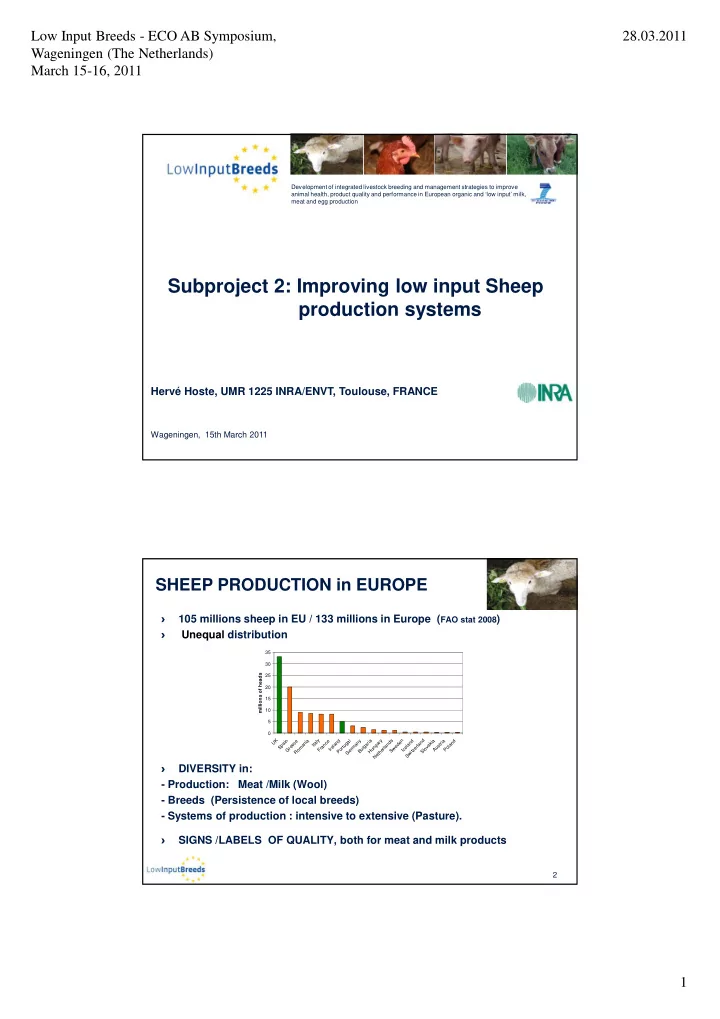
SHEEP PRODUCTION in EUROPE

  • 105 millions sheep in EU / 133 millions in Europe (FAO stat 2008)
  • Unequal distribution
  • DIVERSITY in:
  • Production: Meat /Milk (Wool)
  • Breeds (Persistence of local breeds)
  • Systems of production : intensive to extensive (Pasture).
  • SIGNS /LABELS OF QUALITY, both for meat and milk products

2

5 10 15 20 25 30 35 U K S p a i n G r e e c e R

  • m

a n i a I t a l y F r a n c e I r e l a n d P

  • r

t u g a l G e r m a n y B u l g a r i a H u n g a r y N e t h e r l a n d s S w e d e n I c e l a n d S w i t z e r l a n d S l

  • v

a k i a A u s t r i a P

  • l

a n d millions of heads

slide-2
SLIDE 2

Low Input Breeds - ECO AB Symposium, Wageningen (The Netherlands) March 15-16, 2011 28.03.2011 2

Subproject 2: Objectives

Genetic factors

(Local breeds)

Nutrition (Grazing regimes) Environment (Stress)

(Grazing management) (Abiotic and biotic factors) (Tannin rich forages)

3

Production Mediterranean and Mountainous regions Sheep SubProject

  • 1. FIBL (Switzerland)
  • 2. INRA (France)
  • 3. NAGREF (Greece)
  • 4. Univ Catania (Italy)
  • 5. Univ. Lincoln (NZ)

1 2 3 4 2 3

Subproject 2: Teams

slide-3
SLIDE 3

Low Input Breeds - ECO AB Symposium, Wageningen (The Netherlands) March 15-16, 2011 28.03.2011 3

Subproject 2: Objectives

1.To examine the genetics of sheep resistance to abiotic and biotic factors

  • 2. To develop integrated methods of control of GI Nematodes
  • 3. To examine feeding and breed factors affecting the meat

quality

5

Subproject 2 : Objectives

2.1 Development of WITHIN BREED SELECTION systems to improve abiotic and biotic stress resistance and performance traits; comparing marker assisted and traditional quantitative genetic selection systems for functional traits.

2.1.1. Phenotyping of Sfakiano sheep for biotic (nematodes, mastitis) and abiotic (heat) stress resistance. Dr S. Sotiraki (NAGREF) / Collaboration with stakeholders in Creta 2.1.2. Genotyping of sheep breeds used in different macro-climatic zones

  • f Europe (Greece, Switzerland, France, and NZ)

Dr S. Sotiraki (NAGREF), Dr V Maurer, F Heckendorn and S. Werne (FiBL), Dr H. Hoste and S. Prache (INRA); Pr J. Hickford (Lincoln Univ.)

6

slide-4
SLIDE 4

Low Input Breeds - ECO AB Symposium, Wageningen (The Netherlands) March 15-16, 2011 28.03.2011 4

Subproject 2: Objectives

2.2 Development of improved ENDOPARASITE MANAGEMENT STRATEGIES based on integrating: (a) feed supplementation with tannin rich (TR) forages; (b) strategic use of clean pastures and/or (c) the use of parasite tolerant breeds.

2.2.1 CONTROLLED STUDIES:

Quantification of (a) condensed tannin profiles in TR-forages and concentrate feeds, (b) ‘in vitro’ and ‘in vivo’ anthelmintic (AH) activity and (c) the potential contribution of non-tannin compounds to AH activity.

2.2.2 FIELD TRIALS (Mediterranean production systems):

Effects of (and interaction between) (a) different TR feeding regimes and (b) Sfakiano sheep genotypes on animal health, yield and product quality.

2.2.3 FIELD TRIALS (Mountainous/Alpine production systems) :

Effects of (and interaction between) (a) different TR feeding regimes (b) grazing regimes and (c) different sheep genotypes on animal health, yield and product quality

7

Subproject 2: Objectives

2.3 Development of strategies to improve LAMB MEAT QUALITY in sheep production systems based on optimising (a) TF feed supplements (b) grazing regimes and/or (c) the use of stress tolerant breed

8

2.3.1 FIELD TRIALS and LABORATORY STUDIES

Effects of (and interaction between) using (a) robust breeds/genotypes (b) TF-feed supplementation and (c) different grazing regimes on carcass and meat quality (including samples from trials under WP2.2.).

  • Two studies in mountainous conditions (INRA Clermont Ferrand) S. Prache, J. Ballet)

(FiBL V. Maurer , F Heckendorn and S Werne)

  • One study in Mediterranean conditions (Univ Catania) A Priollo, V. Vasta
slide-5
SLIDE 5

Low Input Breeds - ECO AB Symposium, Wageningen (The Netherlands) March 15-16, 2011 28.03.2011 5

The authors gratefully acknowledge co-funding from the European Commission, under the Seventh Framework Programme for Research and Technological Development, for the Collaborative Project LowInputBreeds (Grant agreement No 222623)

9