Strong-coupling properties of a superfuid Fermi gas and application - - PowerPoint PPT Presentation

strong coupling properties of a superfuid fermi
SMART_READER_LITE
LIVE PREVIEW

Strong-coupling properties of a superfuid Fermi gas and application - - PowerPoint PPT Presentation

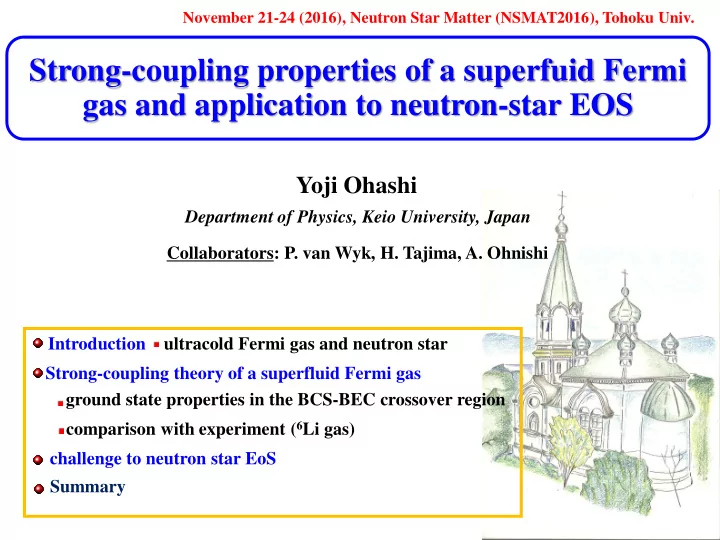
November 21-24 (2016), Neutron Star Matter (NSMAT2016), Tohoku Univ. Strong-coupling properties of a superfuid Fermi gas and application to neutron-star EOS Yoji Ohashi Department of Physics, Keio University, Japan Collaborators: P. van Wyk, H.


slide-1
SLIDE 1

Introduction ultracold Fermi gas and neutron star Department of Physics, Keio University, Japan

November 21-24 (2016), Neutron Star Matter (NSMAT2016), Tohoku Univ.

Strong-coupling properties of a superfuid Fermi gas and application to neutron-star EOS

Yoji Ohashi

Summary challenge to neutron star EoS Strong-coupling theory of a superfluid Fermi gas ground state properties in the BCS-BEC crossover region comparison with experiment (6Li gas) Collaborators: P. van Wyk, H. Tajima, A. Ohnishi

slide-2
SLIDE 2

nucleus electron neutron proton quark

地球

neutron liquid

Earth + neutron star = complete condensed matter physics atom gas crystal

quark liquid

pressure Importance of neutron star in “material science”

slide-3
SLIDE 3

Current possible approach by human beings Equation of state (EoS)

internal structure

+ TOV eq.

“Mass-radius (MR)” relation

Obserbavle! Obserbavle! theorists on the earth experimentalists on the earth

slide-4
SLIDE 4

Standard approach to “Neutron star EoS”

B.Friedman et al, Nucl. Phys, A 361 (1981) 502

  • A. Akmal et al, Phys. Rev. C 58 (1998)
  • S. Gandolfi et al, Eur. Phys. J. A 50 (2014)

FP(`81) : APR(`98, AV18) : GCRSW(`13, AV8) :

High Density Low Density Unitarity Weak Coupling

  • Phase shift data of NN interaction

effective interaction potential with “32” fitting parameters (AV18) QMC, variational calculation, ….

  • S. Gandolfi et al, Eur. Phys. J. A 50 (2014)

EoS in the intermediate density region

slide-5
SLIDE 5

Approach to neutron star interior from the earth

few-body physics many-body physics Experimental support (phase shift data→AV18) Theoretical challenge No experimental support!

neutron superfluid

1

( ) ~ 0.0 1! 5

NN F s

k a



unitary regime

Experimental support Theoretical challenge

Ultracold Fermi gas

slide-6
SLIDE 6
  • C. A. Regal, et al. PRL 92 (2004) 040403.

9/ 2, 7 / 2 9/ 2, 9/ 2   

0.35

F

T K  

5

10 N 

1S0 pairing state

9/ 2, 7 / 2  9/ 2, 9/ 2 

40K superfluid Fermi gas

Fermi atom molecule Feshbach-induced tunable pairing interaction Ultracold Fermi gas as a testing ground for neutron star physics

slide-7
SLIDE 7

s-wave scattering length Fermi wave-length

“BCS-BEC crossover”

weak-coupling (BCS) strong-coupling (BEC)

Phase diagram of an ultracold Fermi gas

slide-8
SLIDE 8

Phase diagram of an ultracold Fermi gas

s-wave scattering length Fermi wave-length

Fermi gas neutron star 18.5 fm

NN s

a   

tunable tunable

neutron star

~ 0 T

“BCS-BEC crossover”

BEC BCS

slide-9
SLIDE 9

EoS observed in a superfluid 6Li Fermi gas (Horikoshi 2015)

T 

6Li (experiment)

FG

3 5

F

E N 

internal energy

BCS-Leggett (mean field theory)

!

Usually, it is believed that the mean-field-based BCS-Leggett theory is valid for the BCS-BEC crossover at T=0. However, even at T=0 (where thermal fluctuations are absent), strong-coupling corrections are actually important.

slide-10
SLIDE 10

Crucial difference between cold Fermi gas and neutron star The magnitude of effective range re is VERY different between the two systems.

~ 0

F e

p r

( 2.7fm)

e

r  ~ neutron star

ultracold Fermi gas

3

e F

p r 

We need to theoretically include a finite effective range re, to approach neutron star EoS starting from cold Fermi gas physics.

slide-11
SLIDE 11

Today’s talk: our strategy

e

r 

2.7fm

e

r 

Ultracold Fermi gas

+

theory Neutron star EoS

We first construct a reliable strong-coupling theory which can quantitatively explain the observed EoS in a superfluid 6Li Fermi gas. We then extend this theory to include a finite effective range (re=2.7fm), to see to what extent we can discuss the neutron star EoS in the low density region by this approach.

6Li experiment

Strong-coupling theory with re=0

① ② ③

slide-12
SLIDE 12

Ground state properties of a superfluid Fermi gas in the unitary regime

Effective range

e

r 

slide-13
SLIDE 13

Model superfluid Fermi gas

 

† 3 1 1 1 2 2

( ) ( ) ( ) ( ) ( ) 2 U H                      

 

p p p p q

q q q q

c c

  

         

p p p

: Nambu field

: superfluid order parameter BCS Hamiltonian under the Nambu representation

,  

( : pseudospins describing atomic hyperfine states)

U

: tunable s-wave pairing interaction

† /2 /2

( )

j j

  

 

  

p p q p q p

q

: generalized density operator

2

1 1 ( / )

c

p p   

p

2

c e c

p r p     

2

4 1 /(2 )

s

U m U a       

p p p

slide-14
SLIDE 14

Inclusion of strong coupling corrections beyond mean-field BCS theory

normal phase (T >Tc): “pairing” fluctuations

  • U

superfluid phase (T <Tc): fluctuations of “Δ”

i

e  

(2) phase fluctuations (1) amplitude fluctuations (1)-(2) coupling

 

† 3 1 1 1 2 2

( ) ( ) ( ) ( ) ( ) 2 U H                      

 

p p p p q

q q q q

amplitude fluc. phase fluc.

1 1 1 2 2 1 2 2

ˆ                

=

  • U

ˆ  ˆ  ˆ 

slide-15
SLIDE 15

Construction of Gaussian fluctuation (NSR) theory below Tc

Ωfluc

Π𝑗𝑘

Thermodynamic potential: W  WMFWfluc

1 ˆ ˆ Tr ( ) ( ) 2 2

ij i j p

q q G p G p               

p p

3 1

1 ˆ( ) ( )

n

G p i         

p

Gap Equation

𝐹 = 𝐹𝑁𝐺 + Ωfluc − 𝑈 𝜖Ωfluc 𝜖𝑈

𝑊,𝜈

− 𝜈 𝜖Ωfluc 𝜖𝜈

𝑊,𝑈

Internal Energy Solve Δ and 𝜈

𝑂 = 𝑂MF − 𝜖Ωfluc 𝜖𝜈

𝑊,𝑈

Number Equation

2 tanh(

/ 2 ) 4 1 1 2 2

s

E T a m E              

p p p p p

2 2

E    

p

slide-16
SLIDE 16

Self-consistent solutions for Δ and μ in the crossover region

F

T T

1

) (

 S Fa

k

F

 

F

 

F

T T /

1

) (

 s Fa

k

c

T superfluid order parameter Fermi chemical potential

BCS BCS BEC BEC BCS BEC

c

T

0(coldatom)

e

r  0(coldatom)

e

r 

slide-17
SLIDE 17

EoS: Superfluid Fermi gas

Internal energy

unitarity weak coupling

BCS-Leggett

  • ur result: NSR

Exp.: 6Li (Horikoshi)

T 

Inclusion of superfluid fluctuations is crucial for the quantitavive evaluation of the internal energy in the unirary regime ((kFas)-1<<0), even at T=0.

slide-18
SLIDE 18

G

Diagrammatic representation of NSR theory and its extension

NSR

G G G G   

Green’s function to reproduce the NSR results (T >Tc)

1

n

G i   

p

self-energy describing pairing fluctuations

TMA 1

... 1 G G G G G G G G          

T-matrix approximation (TMA)

ETMA

 

G

=

  • U

1

n

G i     

p

Extended T-matrix approximation (ETMA)

G

 

G

slide-19
SLIDE 19

EoS: Superfluid Fermi gas

Exp.: 6Li (Horikoshi)

Internal energy

T 

unitarity weak coupling

BCS-Leggett

  • ur result: NSR
  • ur result: ETMA

Inclusion of superfluid fluctuations is crucial for internal energy E in the unirary regime ((kFas)-1<<0), even at T=0.

slide-20
SLIDE 20

Compressibility k in a superfluid Fermi gas at T=0

Exp.: 6Li (Horikoshi) BCS-Leggett

  • ur result: ETMA

weak coupling unitarity

Superfluid fluctuations enhances the compressibility at T=0.

Isothermal compressibility

T 

slide-21
SLIDE 21

Strong-coupling effects: quantum depletion

q q

Some Cooper pairs are kicked out from the condensate, because of this repulsive interaction between them.

Eq

The BCS theory The binding energy of non- condensed pairs lowers the internal energy. Non-condensed Cooper- pair molecules enhance the bosonic character

  • f

the system, leading to k ↑.

slide-22
SLIDE 22

Application to neutron star EoS in the low density region

Finite effective range

2.7fm

e

r 

slide-23
SLIDE 23

(1) interaction “window”

2

1 1 ( / )

c

p p   

p

1

2 2 0.74fm 2.7

c e

p r

  

† † int /2, /2, ' /2, ' /2, ', ' ,

H U c c c c  

         

  

p q p q p q p q p q p p p

p p

F

p

F

p

Low density high density S-wave pairing interaction The s-wave superfluid phase is suppressed when kF>1 fm-1. ~

Two key effects of effective range re

slide-24
SLIDE 24

(2) Hartree energy EHatree

4 1 1 2

c

s p

a U m U      p

p

1 2 1 4

c

s p

U m a       

p

p

Hartree

E Un n

 

 

† † int ' , ', , , , ',

H U c c c c

     

  

p q p p q p p p q

The Hartree term actually vanishes identically, when re=0 (pc=∞), because This is, however, not the case when re>0, because then -U becomes finite. divergence when pc=∞ Including these two keys within the framework of NSR, we evaluate the neutron star EoS in the low density region (where the s-wave interaction is dominant) .

Two key effects of effective range re

slide-25
SLIDE 25

S-wave is dominant

18.5fm

s

a  

  • ur result (re=2.7 fm)

Our approach well reproduces the previous EoS results in the low density region, using the effective interactions being based on the phase shift data.

Comparison with previous neutron star EoS

slide-26
SLIDE 26

Summary

We have discussed ground state properties of a superfluid Fermi gas in the BCS-BEC crossover region, as well as a possible application to neutron star EoS.

2.7fm

e

r  cold Fermi gas

+

theory Neutron star Strong-coupling theory with re=0

EoS