STRH 5 th Annual Life Sciences Summit 1 Disclaimer This - - PowerPoint PPT Presentation

strh 5 th annual life sciences summit
SMART_READER_LITE
LIVE PREVIEW

STRH 5 th Annual Life Sciences Summit 1 Disclaimer This - - PowerPoint PPT Presentation

May 2019 STRH 5 th Annual Life Sciences Summit 1 Disclaimer This presentation contains for ward-looking statemen ts, as that term is defined under the Private Securities Litigation Reform Act of 1995 (PSLRA), which statements may be


slide-1
SLIDE 1

STRH 5th Annual Life Sciences Summit

1
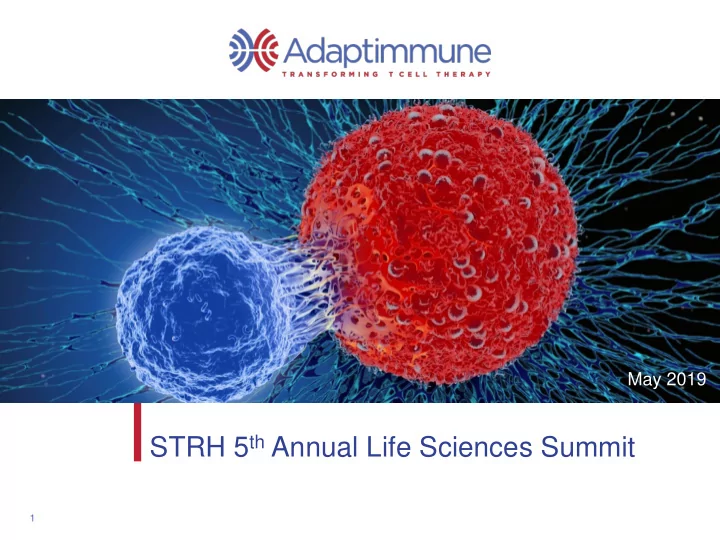
May 2019

slide-2
SLIDE 2

Disclaimer

This presentation contains “forward-looking statements,” as that term is defined under the Private Securities Litigation Reform Act of 1995 (PSLRA), which statements may be identified by words such as “believe,” “may ,” “will,” “estimate,” “continue,” “anticipate,” “intend,” “expect” and other words of similar meaning. These forward-looking statements involve certain risks and uncertainties. Such risks and uncertainties could cause

  • ur actual results to differ materially from those indicated by such forward-looking statements, and include,

without limitation: the success, cost and timing of our product development activities and clinical trials; our ability to submit an IND and successfully advance our technology platform to improve the safety and effectiveness of our existing TCR therapeutic candidates; the rate and degree of market acceptance of T-cell therapy generally and of our TCR therapeutic candidates; government regulation and approval, including, but not limited to, the expected regulatory approval timelines for TCR therapeutic candidates; and our ability to protect our proprietary technology and enforce our intellectual property rights; amongst others. For a further description of the risks and uncertainties that could cause our actual results to differ materially from those expressed in these forward-looking statements, as well as risks relating to our business in general, we refer you to our Quarterly Report on Form 10-Q filed with the Securities and Exchange Commission (SEC) on May 6, 2019 and our other SEC filings. We urge you to consider these factors carefully in evaluating the forward-looking statements herein and you are cautioned not to place undue reliance on such forward-looking statements, which are qualified in their entirety by this cautionary statement. The forward-looking statements contained in this presentation speak

  • nly as of the date the statements were made and we do not undertake any obligation to update such

forward-looking statements to reflect subsequent events or circumstances. We intend that all forward-looking statements be subject to the safe-harbor provisions of the PSLRA.

2

slide-3
SLIDE 3

Adaptimmune - The Leader in TCR T-cell Therapy

  • Compelling data with ADP-A2M4 in synovial sarcoma

– Partial responses in 4 out of 5 synovial sarcoma patients treated with ~10 billion cells – Tumor shrinkage in nearly all assessed synovial sarcoma patients

  • Initiating SPEARHEAD-1 trial in synovial sarcoma and MRCLS with ADP-A2M4
  • Aim to launch first TCR T-cell therapy in 2022
  • Tumor shrinkage in other solid tumors with ADP-A2M4, ADP-A2M10 & ADP-A2AFP
  • Initiating SURPASS study for ADP-A2M4CD8 next generation SPEAR T-cells

– Aim to transform activity in epithelial tumors into durable responses

  • Strong momentum with stem cell derived T-cells in allogeneic program
  • $168 million total liquidity taking us into Q3 2020*

3 *Represents updated guidance. Total liquidity is the total of cash and cash equivalents, and marketable securities

slide-4
SLIDE 4

Our evolving pipeline in multiple solid tumor indications

4

Initiating late stage development with SPEARHEAD-1 (ADP-A2M4 in sarcomas)

Study Indications Pilot studies Phase 2/3 Dose Escalation Expansion MAGE-A4 ADP-A2M4 Multiple solid tumors** ADP-A2M4 Radiation sub-study* Multiple solid tumors**

2H 2019

SPEARHEAD-1 Sarcomas Not applicable

2H 2019

SURPASS (ADP-A2M4CD8) Multiple solid tumors**

2H 2019

IND APRIL 2019 MAGE-A10 ADP-A2M10 NSCLC Bladder Melanoma Head & neck AFP ADP-A2AFP Hepatocellular carcinoma

*Site specific protocol amendment with MD Anderson Cancer Center ** Bladder, Melanoma, Head & Neck, Ovarian, NSCLC, Esophageal, Gastric, Synovial sarcoma, MRCLS

Strong momentum with stem cell derived T-cells in allogeneic (“off-the-shelf”) program Range of other targets and candidates in preclinical stage

slide-5
SLIDE 5

ADP-A2M4 in synovial sarcoma

5

slide-6
SLIDE 6

Responses in synovial sarcoma ADP-A2M4 Cohort 3 and Expansion

6

Tumor shrinkage in nearly all assessed synovial sarcoma patients

Data cut off 30 Apr 2019

Patient # (Gender; Age [y]) Baseline SLD (mm) MAGE-A4 expression (%) Peak Persistence a Dose b Best response c Maximum change in SLD (%) d 1+ 2+ 3+ 1 (M, 53) 240 100 220 9.9 cPR

  • 86 (Wk 12)

2 (M, 59) 35 100 101 10.0 cPR

  • 54 (Wk 10)

3 (M, 42) 204 10 35 50 238 9.9 cPR

  • 44 (Wk 11)

4 (F, 54) 32 5 15 65 325 9.7 ucPR

  • 31 (Wk 6)

5 (M, 46) 60 100 27 4.5 SD

  • 27 (Wk 12)

6 (F, 57) 60 10 90 284 9.7 SD

  • 15 (Wk 6)

7 (M, 31) 66 10 20 10 45 6.0 SD +12 (Wk12) 8 (M, 49) 118 10 20 60 19 5.1 PD +24 (Wk 6) 9 (F, 34) 110 100 Pending 10.0 Pending Pending 10 (F, 76) 174 15 85 Pending 8.4 Pending Pending

SLD=sum of lesion(s) diameter(s) in target lesions (a) (Vector copies per µg/DNA) x 103 (b) Dose (109 transduced cells) (c) cPR=confirmed partial response; ucPR=unconfirmed partial response; SD=stable disease; PD=progressive disease (d) Maximum (%) change in target lesions (SLD) by week of scan (to date); numbers rounded to nearest whole number

slide-7
SLIDE 7

ADP-A2M4 synovial sarcoma

7

Partial responses in 4 out of 5 synovial sarcoma patients treated with ~10 billion cells

PR=partial response (confirmed); SD=stable disease; PD=progressive disease Data cut off 30 Apr 2019

Maximum Change from Baseline in SLD through Progression or Prior to Surgical Resection 60 40 20

  • 20
  • 40
  • 60
  • 80
  • 100

Change from Baseline (%) Time from SPEAR T-cell infusion (weeks) Change from Baseline in SLD through Progression or Prior to Surgical Resection 8 7 6 5 4 3 2 1 Change from Baseline (%) 8 7 6 5 4 3 2 1 Patient number

slide-8
SLIDE 8

ADP-A2M4 synovial sarcoma Patient #1

8

Confirmed PR with significant tumor burden reduction (-86% max. change in 24 cm SLD)

Max.=maximum; SLD=sum of lesion(s) diameter(s)

Baseline Week 6 Lung Pleura Pleura

slide-9
SLIDE 9

ADP-A2M4 synovial sarcoma Patient #3

9

Confirmed PR with bulky tumor almost completely resolved (-44% max. change in 20 cm SLD)

Max.=maximum; SLD=sum of lesion(s) diameter(s)

Baseline Week 6 Week 12

slide-10
SLIDE 10

SPEARHEAD-1 study starting in 2H 2019 (ADP-A2M4)

  • Single-arm, Phase 2 study in more than 20 centers (North America & EU)
  • Sample size of 60 treated subjects with:

– Advanced (metastatic or inoperable) synovial sarcoma or MRCLS, who have received prior chemotherapy – HLA-A*02 & MAGE-A4 antigen positive – MAGE-A4 expression 30% (2+, 3+)

  • Primary endpoint

– Overall Response Rate by RECIST v1.1 by independent review – Interim futility: 3+ responses in first 15 subjects for study continuation (1H/2020)

  • Safety endpoints with Independent Data Safety Monitoring Board
  • Exploratory endpoints: translational and patient-reported outcomes
  • Treatment

– Lymphodepletion: Flu: (30 mg/m2/day) x 4 days; Cy (1800 mg/m2/day) x 2 days – Dose: up to 10 billion transduced SPEAR T-cells

10

Well positioned to execute based on years of engagement with sarcoma community

MRCLS=myxoid/round cell liposarcoma

slide-11
SLIDE 11

ADP-A2M4 potential to be first & best in class - with 2022 launch plan

11

Significant commercial opportunity for Adaptimmune’s first therapy

* Data from primary and secondary market research MRCLS=myxoid/round cell liposarcoma

  • Similar population profile in EU
  • Limited options for metastatic/unresectable disease

– Localized disease initially treated by resection (surgery) – Preferred therapy for metastatic/unresectable disease is chemotherapy

› Almost all patients progress over time

– Second line therapy options are limited

› Low response rates › Unsuccessful converting unresectable tumors into resectable ones

Synovial Sarcoma MRCLS US incidence (patients annually) Up to 1400 Up to 1000 Median age of diagnosis c.30 35 - 50 5 year survival ~ 50 – 60% ~ 30 – 50% MAGE-A4 expression ~ 70% ~ 50% HLA A-2 40 – 50% 40 – 50%

slide-12
SLIDE 12

Tumor shrinkage in other solid tumors with:

  • ADP-A2M4
  • ADP-A2M10
  • ADP-A2AFP

12

slide-13
SLIDE 13

ADP-A2M4 melanoma Patient #11 with high MAGE-A4 expression

13

Decrease in target lesion (-40% max. change in 6 cm SLD) with PD due to new lesions

* Patient #11 had a -40% maximum change in SLD; best overall response is PD due to new lesions

Baseline Week 10

slide-14
SLIDE 14

ADP-A2M10 NSCLC Patient #1 with high MAGE-A10 expression

14

Stable disease with decrease in target lesion and disappearance of non-target lesion

Patient #1 received second infusion at Week 16; post-baseline scans presented are after second infusion

Baseline Nov 2018 ~5 months Apr 2019 Supraclavicular Lymph Node Right lower lobe Lung Left upper lobe Lung

slide-15
SLIDE 15

ADP-A2AFP first patient treated in Cohort 2 with 1 billion cells

15

Tumor shrinkage at first scan and strong transient decrease in serum AFP

aCTLA-4 + aPD-L1 sorafenib FGFR4 inh

CTX Cells FDB

Baseline Week 4

slide-16
SLIDE 16

Safety with SPEAR T-cells

  • Most adverse events are consistent with those typically experienced by cancer

patients undergoing cytotoxic chemotherapy or other cancer immunotherapies

  • There were two reports of CRS ≥ Grade 3 for an incidence of ~4.5%
  • Incidence rate for all CRS (any grade) is ~39%
  • Tolerability in patients treated has been acceptable, to date, and will allow for

continued treatment in dose escalation (AFP) and Expansion Phases (ADP-A2M4, ADP-A2M10)

  • One serious adverse event report of grade 2 encephalopathy

– Reported at ESMO 2018 – Considered related to SPEAR T-cells by the investigator (resolved after 2 days)

16

Patients treated with ADP-A2M4, ADP-A2M10, and ADP-A2AFP (n=44)*

* As of April 5, 2019 for ADP-A2AFP and April 15, 2019 for ADP-A2M4 and ADP-A2M10

Favorable benefit:risk profile in synovial sarcoma Good tolerability overall

slide-17
SLIDE 17

Learnings and next steps Improving SPEAR T-cells

17

slide-18
SLIDE 18

Preclinical data AACR 2019:

– No evidence of off-target reactivity – Improved cytokine release of both dendritic cells (DCs) and T-cells in co-culture with MAGE-A4+ cells – Improved killing of MAGE-A4+ cells (shown below)

Next-generation ADP-A2M4CD8 SPEAR T-cells

18

SPEAR T-cells targeting MAGE-A4 co-expressing CD8α

COMBINE DC cell

(-) Control ADP-A2M4 ADP-A2M4CD8 CD4+ SPEAR T-cells

0h 143h 404h

CD4+ ADP-A2M4CD8 SPEAR T-cell

CD4+

ADP-A2M4 SPEAR TCR CD8α co-receptor Stabilizes interaction when binding to target cell to enable killing CD4 co-receptor Does not stabilize the TCR target interaction, so no killing – but does bind to DCs

slide-19
SLIDE 19

SURPASS Study (ADP-A2M4CD8) next-gen

  • Up to 30 subjects (HLA-A*02 with MAGE-A4+) with:
  • Locally advanced inoperable or metastatic cancer

– Same indications as ADP-A2M4

  • Primary endpoint: safety and tolerability
  • Secondary endpoints: antitumor activity
  • Lymphodepletion:

– Flu: (30 mg/m2/day) x 4 days; Cy (1800 mg/m2/day) x 2 days

  • Dose escalation (3 patients per cohort expand to 6 if DLT)
  • Shorter stagger between patients – anticipate faster dose escalation
  • Starting doses of ~1 billion cells

› Cohort 1 (0.8 to 1.2 billion) › Cohort 2 (1.2 to 3.0 billion) › Cohort 3 (3.0 to 6.0 billion)

  • Expansion Phase dose up to 10 billion transduced cells
  • IND submitted
  • Data expected in 2020

19

Study start planned for 2H 2019 – IND submitted and initial data in 2020

slide-20
SLIDE 20

Radiation sub-study ADP-A2M4 with MD Anderson Cancer Center

  • SPEAR T-cells could be more effective if tumor infiltration increased

– Preclinical data shows low dose radiation may improve T-cell penetration into tumors*

  • Radiation sub-study of ADP-A2M4 to be conducted at

MD Anderson Cancer Center

  • Up to 10 subjects to be treated
  • Primary endpoint: safety
  • Secondary endpoint: response
  • Radiation

– 7Gy (low dose) per lesion or isocenter – Maximum of 5 lesions or isocenters – Administered prior to lymphodepletion

20

Improve tumor trafficking

*Barsoumian, 2018; DeSelm, 2018

slide-21
SLIDE 21

Significant progress with our allogeneic program

21

We can produce T-cells from stem cells that respond to cancer targets (ASGCT 2019)

Significant progress with stem-cell-derived T-cells

  • T-cell marker expression mimics mature T-cells
  • Tumor antigen-specific activation via SPEAR TCR
  • On stimulation, T cells:

– Produce cytokines – Produce and release lytic granules

  • Adaptimmune process does not use human serum or stromal cell lines

– Enabling scale-up and GMP manufacture of edited off-the-shelf lines

Can be used with any engineered T-cell (TCR and CAR-T)

This source of T-cells, combined with our engineering expertise, enables a new generation of off-the-shelf T-cell therapies

slide-22
SLIDE 22

Looking forward

22

Data from all programs over next 12 months

2H 2019

  • SPEARHEAD-1 study start
  • SURPASS study start
  • Radiation study start
  • Further data from ADP-A2M10 trials
  • Further data from ADP-A2M4 trials outside sarcoma

1H 2020

  • Durability of sarcoma responses
  • ADP-A2AFP data update
  • Safety and response data from SURPASS study
  • SPEARHEAD-1 interim futility

Beyond 1H 2020

  • Allogeneic program data update
  • Next targets into clinic
  • Data from SPEARHEAD-1
  • Data from other programs
slide-23
SLIDE 23

Adaptimmune - The Leader in TCR T-cell Therapy

  • Compelling data with ADP-A2M4 in synovial sarcoma

– Partial responses in 4 out of 5 synovial sarcoma patients treated with ~10 billion cells – Tumor shrinkage in nearly all assessed synovial sarcoma patients

  • Initiating SPEARHEAD-1 trial in synovial sarcoma and MRCLS with ADP-A2M4
  • Tumor shrinkage in other solid tumors with ADP-A2M4, ADP-A2M10

and ADP-A2AFP

  • Initiating SURPASS study for ADP-A2M4CD8 next generation SPEAR T-cells

– Aim to transform currently observed activity in epithelial tumors into durable responses

  • Strong momentum with stem cell derived T-cells in allogenic (“off-the-shelf”)

program

  • $168 million total liquidity taking us into Q3 2020*

23

Aim to launch first TCR T-cell therapy in 2022

*Represents updated guidance. Total liquidity is the total of cash and cash equivalents, and marketable securities

slide-24
SLIDE 24

Appendix

24

slide-25
SLIDE 25

Summary of ADP-A2M4 in non-sarcoma patients

25

Tumor shrinkage seen in melanoma (-40%) and ovarian (-9%)

* Patient #11 had a -40% maximum change in SLD; best overall response is PD due to new lesions Data cut off 30 Apr 2019

Patient # (Gender; Age [y]) Indication Baseline SLD (mm) MAGE-A4 expression (%) Peak Persistence a Dose b Best response c Maximum change in SLD (%) d 1+ 2+ 3+ 11 (M, 51) Melanoma 62 100 161 10.0 PD

  • 40 (WK 10)*

12 (F, 74) Ovarian 34 5 5 1 130 5.7 SD

  • 9 (Wk 12)

13 (F, 62) Ovarian 42 25 15 55 316 9.4 SD +17 (Wk 6) 14 (M, 61) Lung 37 15 206 9.9 SD 0 (Wk 6) 15 (M, 60) Head & neck 57 100 60 4.8 PD +26 (Wk 6) 16 (F, 49) Gastric 92 25 30 5 206 10.0 PD + 52 (Wk 4) 17 (M, 76) Esophageal 54 10 90 35 3.0 Expired before first scan

SLD=sum of lesion(s) diameter(s) in target lesions (a) (Vector copies per µg/DNA) x 103 (b) Dose (109 transduced cells) (c) cPR=confirmed partial response; ucPR=unconfirmed partial response; SD=stable disease; PD=progressive disease (d) Maximum (%) change in target lesions (SLD) by week of scan (to date); numbers rounded to nearest whole number

slide-26
SLIDE 26

Summary of ADP-A2M10 patients

26

Evidence of antitumor activity in two NSCLC patients

* Patient received second infusion at Week 16 Data cut off 26 Apr 2019

Patient # (Gender; Age [y]) Indication Baseline SLD (mm) MAGE-A10 expression (%) Peak Persistence a Dose b Best response c Maximum change in SLD (%) d 1+ 2+ 3+ 1 (M, 65) * Lung 104 5 5 90 44 6.0 SD

  • 25 (Wk 14)

105 5.2 SD

  • 28 (Wk 21)

2 (M, 63) Lung 188 25 71 5.2 SD

  • 6 (Wk 8)

3 (M, 58) Bladder 106 40 20 5 77 5.3 SD +4 (Wk 10) 4 (M, 66) Bladder 130 30 30 20 134 5.5 SD +12 (Wk 18) 5 (F, 47) Melanoma 199 5 5 30 13 4.9 PD +6 (Wk 4) 6 (F, 46) Head & neck 101 5 70 20 83 6.0 PD +9 (Wk 4) 7 (M, 76) Head & neck 70 20 80 35 4.0 PD +21 (Wk 6)

SLD=sum of lesion(s) diameter(s) in target lesions (a) (Vector copies per µg/DNA) x 103 (b) Dose (109 transduced cells) (c) cPR=confirmed partial response; ucPR=unconfirmed partial response; SD=stable disease; PD=progressive disease (d) Maximum (%) change in target lesions (SLD) by week of scan (to date); numbers rounded to nearest whole number

slide-27
SLIDE 27

ADP-A2M10 - evidence of antitumor activity in Cohort 3 and Expansion

27

Two lung patients with decreases in SLD

ucPR=unconfirmed partial response; cPR=confirmed partial response PD=progressive disease; SD=stable disease; Data cut off 26 Apr 2019

Post-infusion 1 Post-infusion 2 1 (lung; 2 infusions) 2 (lung) 4 (bladder) 3 (bladder) 7 (H&N) 5 (melanoma) 6 (H&N) Change from Baseline in SLD through Progression or Prior to Surgical Resection

slide-28
SLIDE 28

Persistence of ADP-A2M4 SPEAR-T cells in blood (synovial sarcoma)

28

Response trending with persistence

cPR=confirmed partial response; ucPR=unconfirmed partial response; PD=progressive disease; SD=stable disease;

B a s e lin e D a y 2 D a y 4 D a y 8 W e e k 2 W e e k 4 W e e k 6 W e e k 1 2 11 0 1 11 0 2 11 0 3 11 0 4 11 0 5 11 0 6

V is it V e c to r c o p ie s /  g g e n o m ic D N A S D # 7 P D # 8 c P R # 3 S D # 5 c P R # 1 c P R # 2 u c P R # 4 S D # 6 #9 # 1 0

slide-29
SLIDE 29

Killing activity ex vivo correlates with patient response

29

ADP-A2M4 SPEAR T-cells isolated from patients (in vitro killing assay)

Stable disease (Patient #7)

Poor killing by patient's cells vs. manufactured product (SPEAR T-cells from blood at Week 2)

Confirmed PR (Patient #3)

Strong killing by patient's cells (SPEAR T-cells from malignant pleural effusion at Day 4)

Non-transduced normal donor & patient T-cells (negative controls) Transduced healthy donor cells (positive controls)

  • +

Manufactured product Patient’s cells

+

  • Hours

120 Hours 150 Patient’s cells

  • +

Increased target cell survival

slide-30
SLIDE 30

Building an integrated cell therapy company

30

Clinical, translational, cell manufacturing, and vector production

In-house cell manufacturing

  • Navy Yard from first ever product to

10 patients per month capacity

  • Scalable to ~100s of patients per year
  • Routinely making >5 billion cell doses
  • >90% success rate across a broad range of

solid tumors

Clinical infrastructure

Clinical network established

  • >20 active sites at leading cancer

centers in US, Canada, and EU

  • Expanded collaboration with

MD Anderson Cancer Center

  • European infrastructure in place
  • First patients enrolled in UK and

Spain

CMC infrastructure

Secured vector supply

  • Agreement for commercial vector

supply from 3rd party vendor

  • Dedicated vector facility in place
  • First production planned for 2019

Translational capabilities

  • Extensive translational program
  • Convert translational learnings into

product improvements with aim to transform activity into durable responses

slide-31
SLIDE 31

STRH 5th Annual Life Sciences Summit

31

May 2019