STRANGER IN A STRANGE LAND: Ethics and Multijurisdictional Practice - - PowerPoint PPT Presentation

stranger in a strange land ethics and multijurisdictional
SMART_READER_LITE
LIVE PREVIEW

STRANGER IN A STRANGE LAND: Ethics and Multijurisdictional Practice - - PowerPoint PPT Presentation

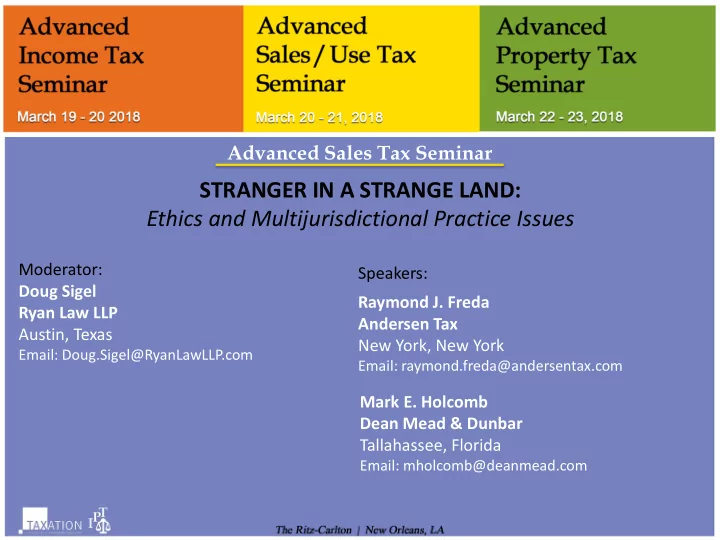
Advanced Sales Tax Seminar STRANGER IN A STRANGE LAND: Ethics and Multijurisdictional Practice Issues Moderator: Speakers: Doug Sigel Raymond J. Freda Ryan Law LLP Andersen Tax Austin, Texas New York, New York Email:


slide-1
SLIDE 1

Advanced Sales Tax Seminar

STRANGER IN A STRANGE LAND: Ethics and Multijurisdictional Practice Issues

Moderator: Doug Sigel Ryan Law LLP Austin, Texas

Email: Doug.Sigel@RyanLawLLP.com

Speakers: Raymond J. Freda Andersen Tax New York, New York

Email: raymond.freda@andersentax.com

Mark E. Holcomb Dean Mead & Dunbar Tallahassee, Florida

Email: mholcomb@deanmead.com

slide-2
SLIDE 2

2018 Advanced Sales/Use Tax Seminar

2

AGENDA

  • Review ethical obligations of SALT

practitioners in multijurisdictional practice (MJP) environment

  • Consider admission-to-practice requirements

for SALT accountants & lawyers

  • Focus on IPT Code of Ethics, Uniform

Accountancy Act and ABA Model Rules (and select state laws)

  • Contrast federal practice requirements and

challenges

slide-3
SLIDE 3

2018 Advanced Sales/Use Tax Seminar

3

HISTORY

  • Territorial practice
  • Emergence of MJP
  • Trans-border practice
  • Uniform Accountancy Act (1998): “substantial

equivalency” fosters interstate practice by eliminating “artificial barriers”

  • ABA MJP report (2002): Client Representation in the

21st Century

  • ABA SALT Committee Multistate Tax Practice Task Force
slide-4
SLIDE 4

ETHICS RULES

2018 Advanced Sales/Use Tax Seminar

4

  • Institute for Professionals in Taxation Code of Ethics

http://www.ipt.org/learncenter.asp?id=178410&page=29

  • American Institute of CPAs Statements on Standards

for Tax Services

http://www.aicpa.org/Research/Standards/Tax/Pages/default.aspx

  • American Bar Association Model Rules of

Professional Conduct

http://www.americanbar.org/groups/professional_responsibility/publi cations/model_rules_of_professional_conduct/model_rules_of_ professional conduct_table_of_contents.html

slide-5
SLIDE 5

2018 Advanced Sales/Use Tax Seminar

5

DUTY OF COMPETENCY

  • Always applies
  • IPT Code of Ethics Preamble – obligation for competence of work
  • Accountants – UAA: assure public of reasonable competence
  • Attorneys – ABA MR 1.1: Duty to provide competent

representation – legal knowledge, skill, thoroughness and preparation necessary for the representation – May have duty to inform client that attorney not licensed in foreign jurisdiction if representation occurs primarily there and requires knowledge of that law: ABA MR 5.5, comment 20 + MR 1.4(b)

slide-6
SLIDE 6

2018 Advanced Sales/Use Tax Seminar

6

CERTIFIED PUBLIC ACCOUNTANTS

  • State law regulation of practice of public

accountancy

– Assure “minimum competence of practitioners”

  • UAA: Joint model act of AICPA + NASBA

– Substantial majority of states follow key terms – Enhance interstate reciprocity and practice across state lines – Remove artificial barriers to interstate practice and mobility of CPAs

slide-7
SLIDE 7

CERTIFIED PUBLIC ACCOUNTANTS

2018 Advanced Sales/Use Tax Seminar

7

  • UAA (cont’d)

– “Substantial Equivalency” – education, examination & experience requirements are comparable on a state or individual CPA level – Reciprocity & practice privileges w/o addt’l licensure, except principal place of business – Freely practice across state lines – “No notice, no fee and no escape”

  • Subject to regulation for professional conduct, even if

performing services that non-licensee may perform

slide-8
SLIDE 8

LAWYERS

2018 Advanced Sales/Use Tax Seminar

8

  • Each state regulates ‘practice of law’ within its

borders

– Definition varies by state – Admitted vs. authorized practice

  • ABA Model Rule 5.5

– 44± states have adopted in some form since 2002:

  • Verbatim; or
  • Jurisdiction-specific modifications
slide-9
SLIDE 9

MODEL RULE 5.5 – General Rule

2018 Advanced Sales/Use Tax Seminar

9

  • Lawyer shall not practice law in another

jurisdiction in violation of that jurisdiction’s regulation of legal profession

  • Unless admitted to practice here, shall not:

– Establish office “or other systematic and continuous presence” for practice of law; or – Hold out to public or otherwise represent that lawyer admitted to practice here

slide-10
SLIDE 10

MODEL RULE 5.5 – 4 Exceptions

2018 Advanced Sales/Use Tax Seminar

10

  • Lawyer in good standing in another jurisdiction

may provide legal services on temporary basis here if:

– Associate local lawyer who actively participates in matter; – Services reasonably related to pending or potential proceeding in this or another jurisdiction if authorized by law or order to appear; – Services reasonably related to alternative dispute resolution proceeding arising out of practice in admitted jurisdiction and not requiring pro hac vice admission; or

slide-11
SLIDE 11

MODEL RULE 5.5 – 4 Exceptions (cont’d)

2018 Advanced Sales/Use Tax Seminar

11

– Arise out of or reasonably related to lawyer’s practice in jurisdiction where admitted

  • These four exceptions do not create

unreasonable risk to clients, courts or public

  • Exceptions form safe harbor

– Fact that conduct not identified in MR does not imply that conduct is/is not authorized

slide-12
SLIDE 12

MODEL RULE 5.5 (cont’d)

2018 Advanced Sales/Use Tax Seminar

12

  • Lawyer in good standing in another jurisdiction may

provide legal services through an office or “other systematic and continuous presence” here if: – Services provided to lawyer’s employer or affiliates and do not require pro hac vice admission; or – Services authorized by federal or other law or rule

  • If employee-lawyer establishes office or other systematic

presence for purposes of rendering legal services to employer, may be subject to registration and other requirements (e.g., client security fund assessments, mandatory CLE, etc.)

slide-13
SLIDE 13

MODEL RULE 5.5 COMMENTS

2018 Advanced Sales/Use Tax Seminar

13

  • Lawyer may only practice law where

authorized:

– Admitted to practice on regular basis; or – Authorized by court rule, order or law to practice for limited purpose/restricted basis

  • Other than as authorized by law or rule, non-

admitted lawyer violates MR 5.5 if establishes

  • ffice or other systematic and continuous

presence here for practice of law

slide-14
SLIDE 14

MODEL RULE 5.5 COMMENTS (cont’d)

2018 Advanced Sales/Use Tax Seminar

14

– Presence may be systematic and continuous even if lawyer not physically present here

  • No single test to determine whether lawyer’s

services are provided on a “temporary basis”

– Services may be “temporary” even though provided on a recurring basis or for an extended period of time (e.g., single lengthy negotiation or litigation)

slide-15
SLIDE 15

MODEL RULE 5.5 COMMENTS (cont’d)

2018 Advanced Sales/Use Tax Seminar

15

  • ‘Reasonably related to lawyer’s practice in

jurisdiction where admitted’:

– Client previously represented by lawyer – Client resides in or has substantial contacts with jurisdiction where lawyer admitted – Matter has significant connection with jurisdiction where lawyer admitted – Significant aspects of lawyer’s work conducted in jurisdiction where admitted

slide-16
SLIDE 16

MODEL RULE 5.5 COMMENTS (cont’d)

2018 Advanced Sales/Use Tax Seminar

16

– Significant aspect of matter involves law of jurisdiction where lawyer admitted – Client’s business or legal issues involve multiple jurisdictions – Services draw on lawyer’s “recognized expertise developed through the regular practice of law on behalf of clients in matters involving a particular body of federal, nationally-uniform, foreign, or international law”

slide-17
SLIDE 17

MODEL RULE 5.5 COMMENTS (cont’d)

2018 Advanced Sales/Use Tax Seminar

17

  • Lawyer subject to discipline both where

practices law (authorized or otherwise) and where admitted to practice

  • Authorization to practice in foreign jurisdiction

does not authorize advertising legal services there

slide-18
SLIDE 18

PRE-LITIGATION REPRESENTATION

2018 Advanced Sales/Use Tax Seminar

18

  • Audits, refunds, informal protests, ruling requests

– Qualified Representatives – capable of representing taxpayer’s interests – CPAs – “move freely between states” – Attorneys - allowed per MR 5.5(c), comments 9 & 18

  • Authorized by law or informal practice of tribunal or agency
  • However, out-of-state attorney may need pro hac

vice admission – even if accountants and qualified representatives do not

slide-19
SLIDE 19

PRE-LITIGATION – Attorney Exceptions

2018 Advanced Sales/Use Tax Seminar

19

  • Pro hac vice admission required for out-of-

state attorney to appear before state revenue department:

– IA, MS, SD – KS (maybe) – NE (contested hearings) – OH (UPL to negotiate with ODT if out-of-state attorney?) – OR (for informal conference appeals)

slide-20
SLIDE 20

LITIGATION

2018 Advanced Sales/Use Tax Seminar

20

  • 40 states & D.C. allow admission by motion, following adoption of ABA MR

5.5 in 2002 – Not in: CA, FL, DE, HI, LA, MD, MT, NV, NJ, RI, SC

  • Pro Hac Vice Admission

– Requirements vary by jurisdiction

  • Associate with local counsel
  • Limited number of appearances
  • Fees to Bar and/or trial court
  • Trial court’s discretion
  • When to file:

– BTA has jurisdiction over appeal filed by attorney not authorized to practice law in OH: NASCAR Holdings (2017)

slide-21
SLIDE 21

LITIGATION

2018 Advanced Sales/Use Tax Seminar

21

  • Pro hac vice admission may be required for out-of-state

attorney before tax tribunal or board

– AL, GA (exc Small Claims Division), IL, KS, KY, LA, MA, MN, MO, MT (maybe), NV, NC, OH (NASCAR?), OK, OR, SC, WA (if reciprocity by home state)

  • Pro hac vice admission required for judicial

proceedings

  • Accountants and other qualified representatives may

handle formal administrative (APA) litigation

slide-22
SLIDE 22

OTHER CONSIDERATIONS

2018 Advanced Sales/Use Tax Seminar

22

  • Lawyers working in Accounting or Tax Services

Firms –Which rules apply?

  • Malpractice insurance coverage for attorneys

– Are you covered if engaged in unauthorized practice?

slide-23
SLIDE 23

IRS - REPRESENTATION

2018 Advanced Sales/Use Tax Seminar

23

  • BEFORE THE INTERNAL REVENUE SERVICE

– Any attorney; certified public accountant; enrolled agent; and (with certain restrictions) any enrolled actuary, retirement plan agent, or registered tax return preparer, not currently under suspension or disbarment from practice before the IRS. 31 CFR 10.3. – Government (including State) officers and

  • employees. Id; 31 CFR 10.5.

– Pro se. Id.; 31 CFR 10.7.

slide-24
SLIDE 24

TAX COURT & U.S. DIST. COURT

2018 Advanced Sales/Use Tax Seminar

24

  • Before the U.S. TAX COURT

– Practitioners admitted to the Tax Court bar, including attorneys and nonattorney applicants for admission to practice before the Court. Tax Ct. XX R.P.P. 200. – Pro se. Id.

  • Before the U.S. DISTRICT COURTS

– An attorney that is an active member in good standing

  • f the highest court of any state or the District of

Columbia (reciprocity rules), and Law students (see, e.g. USDC LCrR 44.1).

slide-25
SLIDE 25

CHALLENGES TO STATE ADMISSION TO PRACTICE RULES IN FED. COURTS

2018 Advanced Sales/Use Tax Seminar

25

  • National Association For the Advancement of

Multijurisdictional Practice – NAAMJP

– Challenging U.S. District Court Rules which incorporate State Admission to Practice Rules. – Suing State Supreme Court Justices, Federal District Court Judges and the Attorney General in Official Capacity as Promulgators/Administrators

  • f Admission Rules
slide-26
SLIDE 26

CHALLENGES TO STATE ADMISSION TO PRACTICE RULES IN FED. COURTS

2018 Advanced Sales/Use Tax Seminar

26

  • Third Circuit – 799 F.3d 216 (2015)

– Maryland Attorney denied admission to practice in Pennsylvania because Maryland did not have reciprocity agreement with PA which would allow a non-PA bar member to practice.

  • U.S. Dist. Court for District of Columbia – 180 F. Supp. 3d 46 (2015)

– Attorney with principal law office in Switzerland barred from practicing under D.C. admission rules.

  • Fourth Circuit – 826 F.3d 191 (2016)

– Attorneys challenging Maryland’s rule requiring reciprocity from District Courts in other states before allowing non-MD attorneys to practice in Maryland District Courts.

slide-27
SLIDE 27

CHALLENGES TO STATE ADMISSION TO PRACTICE RULES IN FED. COURTS

2018 Advanced Sales/Use Tax Seminar

27

  • NAAMJP challenges under the following:

– Fourteenth Amendment – Equal Protection – First Amendment – Freedom of Speech – Freedom of Association – Right to Petition – Privileges and Immunities Clause – Dormant Commerce Clause – Supremacy Clause – Due Process – Rules Enabling Act

slide-28
SLIDE 28

CHALLENGES TO STATE ADMISSION TO PRACTICE RULES IN FED. COURTS

2018 Advanced Sales/Use Tax Seminar

28

  • Federal courts reject all of NAAMJP’s challenges:

– No Strict Scrutiny; only rational basis required – States have compelling state interest to regulate the practice of law within their borders – Regulation of profession, not regulation of speech based on content – No elevation of state law over federal law as nothing prohibits federal law from incorporating state law – Right to association not denied as remedy is to take bar exam in state where attorney wants to practice – Privileges of one state not guaranteed to be respected by another state – Discriminatory result of admission rules serves legitimate local purpose

slide-29
SLIDE 29

QUESTIONS

2018 Advanced Sales/Use Tax Seminar

29

slide-30
SLIDE 30

CONTACT INFORMATION

2018 Advanced Sales/Use Tax Seminar

30

Raymond J. Freda Managing Director Andersen Tax New York, NY raymond.freda@andersentax.c

  • m

(646)213-5114 Mark E. Holcomb Shareholder Dean Mead & Dunbar Tallahassee, FL mholcomb@deanmead.com (850) 270-5519