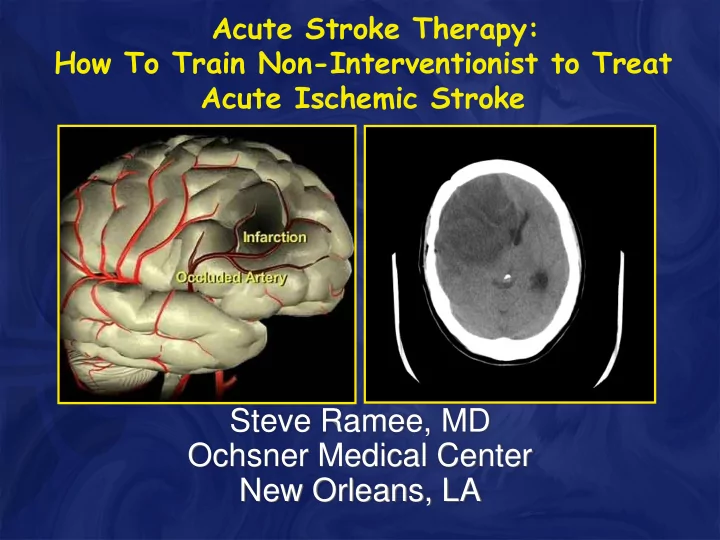
Steve Ramee, MD Ochsner Medical Center New Orleans, LA Disclosure - - PowerPoint PPT Presentation

steve ramee md
SMART_READER_LITE
LIVE PREVIEW

Steve Ramee, MD Ochsner Medical Center New Orleans, LA Disclosure - - PowerPoint PPT Presentation

Acute Stroke Therapy: How To Train Non-Interventionist to Treat Acute Ischemic Stroke Steve Ramee, MD Ochsner Medical Center New Orleans, LA Disclosure Consultant: Neurointerventions 2 Time is BRAIN! The typical (stroke) patient loses


slide-1
SLIDE 1

Acute Stroke Therapy: How To Train Non-Interventionist to Treat Acute Ischemic Stroke

Steve Ramee, MD Ochsner Medical Center New Orleans, LA

slide-2
SLIDE 2

Disclosure Consultant: Neurointerventions

2

slide-3
SLIDE 3

Time is BRAIN!

“The typical (stroke) patient loses 1.9 MILLION neurons each minute in which stroke is untreated.”

slide-4
SLIDE 4

Ischemic Penumbra

slide-5
SLIDE 5

So....we want to SAFELY restore brain perfusion as quickly as possible “Get the Damn Artery Open”

  • Treatment options
  • Intra-arterial thromboysis
  • Balloon angioplasty
  • Clot retrieval
  • Stenting
slide-6
SLIDE 6

Stroke Treatment

❖Less than 5% get

treated at all

❖Doesn’t get to the

clot in major stroke

❖Success rate is low

PS: Didn’t work for STEMI either!

slide-7
SLIDE 7

Mechanical Approach

  • Why is it our first choice?
  • Higher recanalization rates
  • Low SICH rates
  • 17% re-occlusion rates after IAT
slide-8
SLIDE 8

Catheter Based Options

❖Penumbra* ❖Merci* ❖Solitaire* ❖Thrombus disruption ❖Wire manipulation ❖Balloon angioplasty ❖Intracranial Stents

slide-9
SLIDE 9

NeuroSpecific Devices

Clot Retrieval

slide-10
SLIDE 10

Concentric Retrieval System

slide-11
SLIDE 11
  • 15 yo A+ athlete
  • Had a stroke before

practice and couldn’t see

  • well. Coach told mom.
  • Mom took him to a

neurologist who confirmed the stroke and recommended he see a stroke specialist.

  • First appointment: 2

weeks.

Doctors don’t know where to send stroke patients!

slide-12
SLIDE 12

3 days later...

 Brother found him on floor.  Mother brought him to ER #1 with

locked-in syndrome. MRA confirmed the problem.

 Transferred to Hospital #2 after 3 hours.  Called us (hospital #3) 42 hours after

stroke.

 When he arrived, all he could move

were his eyes.

slide-13
SLIDE 13

R vertebral artery

slide-14
SLIDE 14

Thombus Snared on Third Attempt

slide-15
SLIDE 15

Stephen Ramee, MD

slide-16
SLIDE 16

What Does This Patient Teach Us?

 Stroke is a 911 Emergency!  There is a real need Comprehensive Regional Stroke

Centers.

 Telemedicine, Neuro-ICU, Stroke Neurology, 24/7 MRI and

CT Perfusion, Angioplasty, Rehab.

 MOST hospitals offer only very limited stroke treatment.

 Every ER, hospital, EMS service and physician’s

  • ffice should have a plan if they diagnose acute

stroke.

 Interventional Cardiologists can assist in this effort.

slide-17
SLIDE 17

Henkes H, Miloslavski E, Lowens S, et al. Neuroradiology. 2005;47:222–228.

Self-Expanding Neuro Stents

  • More flexibility with open cell design
  • Low radial force during deployment…no post dilitation
  • Increased safety profile …No vessel rupture
  • Designed specifically for the cerebrovasculature
  • Delivered to target area - success rate of > 95%

Wingspan- open cell Enterprise- closed cell

slide-18
SLIDE 18

Hospital Course

Dense hemiparesis persisted for 48 hrs,

followed by a rapid resolution.

At one month, had complete recovery of

language and only mild fine motor deficit.

At two years back in school with his

  • classmates. Wears a brace on his L leg

because of mild foot drop.

slide-19
SLIDE 19

Solitaire Temporary Stent

Stephen Ramee, MD

slide-20
SLIDE 20

TREVO device

Radiopaque proximal marker

Proximal tapered section – for smooth withdrawal and easy re-sheathing Cell geometry – for integration of clot in curved vessels

Distal tapered transition

Soft radiopaque tip

slide-21
SLIDE 21

Cryotherapy: Can we prolong the window for stroke Rx?

Level 2b indication for OOH arrest

slide-22
SLIDE 22

SUMMARY: Stroke Technique

Stroke is a medical emergency

  • Time is Brain!

If CT/CT perfusion shows brain

viability, open the artery as quickly and safely as possible.

  • Lysis, balloon, clot retrieval, stenting

Avoid guidewire perforation and

vessel rupture.

slide-23
SLIDE 23

Conclusion: How can we make stroke treatment more effective?

  • Educate our citizens about the signs and

symptoms of stroke: TIME IS BRAIN!!!

  • Develop regional stroke centers and

educate EMS and health care providers how to access this network emergently: BRAIN ATTACK/911!

  • Now that Stentrievers are available in the

USA, Interventional Cardiology Manpower can assist in getting Rapid Door to Patency.

slide-24
SLIDE 24

STROKE