STATUS OF METHYL BROMIDE PHASE-OUT IN THE TEMPERATE AUSTRALIAN - - PDF document

status of methyl bromide phase out in the temperate
SMART_READER_LITE
LIVE PREVIEW

STATUS OF METHYL BROMIDE PHASE-OUT IN THE TEMPERATE AUSTRALIAN - - PDF document

STATUS OF METHYL BROMIDE PHASE-OUT IN THE TEMPERATE AUSTRALIAN STRAWBERRY INDUSTRY Donohoe, H., Mattner, S.*, Brett, R., Bianco, V., Shanks, A., Gounder, R., & Porter, I. Dept. of Nat. Res. & Env., PMB 15, Scoresby Business Centre, 3176,


slide-1
SLIDE 1

44-1

STATUS OF METHYL BROMIDE PHASE-OUT IN THE TEMPERATE AUSTRALIAN STRAWBERRY INDUSTRY

Donohoe, H., Mattner, S.*, Brett, R., Bianco, V., Shanks, A., Gounder, R., & Porter, I.

  • Dept. of Nat. Res. & Env., PMB 15, Scoresby Business Centre, 3176, Vic., Australia

Currently in Australia, 75% of the strawberry fruit and 98% of the strawberry nursery industry rely on soil disinfestation with methyl bromide (MB) to control soil-borne diseases, weeds and to increase yields. Without a suitable replacement for MB, these industries will suffer up to 35% in lost production and up to AUS$42 million annually (US$23 million). To date, these industries have largely met MB reduction schedules by lowering the concentration of MB in products rather than changing to alternative fumigants. Following the most recent reduction in MB use (50% in Jan 2001), virtually all the nursery industry switched to MB:Pic 50:50 formulations, while increasing prices for MB are beginning to force the fruit industry to consider MB:Pic 30:70. Several factors have prevented strawberry growers from adopting alternative

  • fumigants. These include reduced weed control, increased plant-back times

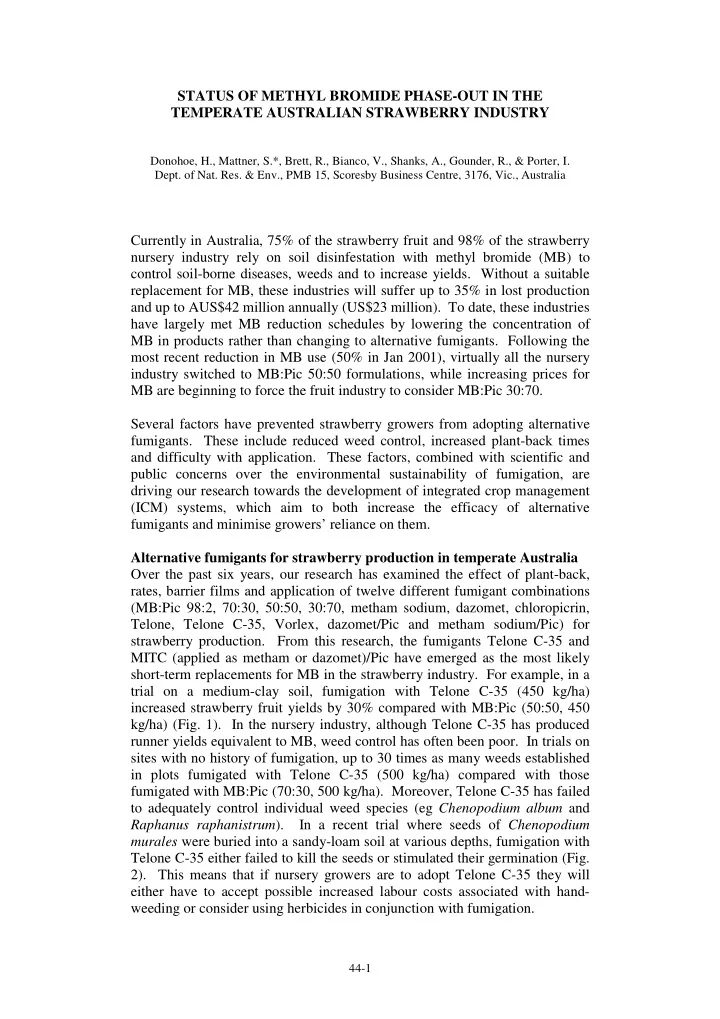
and difficulty with application. These factors, combined with scientific and public concerns over the environmental sustainability of fumigation, are driving our research towards the development of integrated crop management (ICM) systems, which aim to both increase the efficacy of alternative fumigants and minimise growers’ reliance on them. Alternative fumigants for strawberry production in temperate Australia Over the past six years, our research has examined the effect of plant-back, rates, barrier films and application of twelve different fumigant combinations (MB:Pic 98:2, 70:30, 50:50, 30:70, metham sodium, dazomet, chloropicrin, Telone, Telone C-35, Vorlex, dazomet/Pic and metham sodium/Pic) for strawberry production. From this research, the fumigants Telone C-35 and MITC (applied as metham or dazomet)/Pic have emerged as the most likely short-term replacements for MB in the strawberry industry. For example, in a trial on a medium-clay soil, fumigation with Telone C-35 (450 kg/ha) increased strawberry fruit yields by 30% compared with MB:Pic (50:50, 450 kg/ha) (Fig. 1). In the nursery industry, although Telone C-35 has produced runner yields equivalent to MB, weed control has often been poor. In trials on sites with no history of fumigation, up to 30 times as many weeds established in plots fumigated with Telone C-35 (500 kg/ha) compared with those fumigated with MB:Pic (70:30, 500 kg/ha). Moreover, Telone C-35 has failed to adequately control individual weed species (eg Chenopodium album and Raphanus raphanistrum). In a recent trial where seeds of Chenopodium murales were buried into a sandy-loam soil at various depths, fumigation with Telone C-35 either failed to kill the seeds or stimulated their germination (Fig. 2). This means that if nursery growers are to adopt Telone C-35 they will either have to accept possible increased labour costs associated with hand- weeding or consider using herbicides in conjunction with fumigation.

slide-2
SLIDE 2

44-2

In comparison with Telone C-35, the fumigant combination metham/Pic has provided improved weed control. In the past, the use of metham/Pic was impractical because the two products are reactive and cannot be mixed. This meant that growers had to apply the combination in two separate operations. To address this, we designed and constructed a strip-fumigation rig for strawberry fruit production that can apply metham and chloropicrin in a single

  • pass. The rig injects chloropicrin at depth (20 cm), and sprays metham onto

the soil surface and incorporates it to a depth of 10 cm with a slotted plate stirrer (Fig. 3). Trials with this rig have shown that metham/Pic (500 L/ha/ 250 kg/ha) can produce strawberry fruit yields and weed control equivalent to that obtained with MB:Pic (50:50, 500 kg/ha) and at a similar application cost. Currently, we are attempting to design and construct a broad-acre fumigation rig to apply dazomet/Pic for use in the nursery industry as this combination should give better control of weeds than Telone C-35. Impact of fumigation on rhizoplane organisms of strawberry In order to gain a greater understanding of how fumigation influences strawberry yields, we examined the rhizoplane (root surface) ecology of strawberries using SEM. Soil disinfestation with a range of fumigants reduced bacterial and fungal colonization on the rhizoplane compared with plants in untreated soils (eg Fig. 4). Lower colonization of the rhizoplane was expected because fumigation also reduced populations of fungi and bacteria in the bulk soil (determined by dilution plating). Although there was no difference in strawberry fruit yields between different fumigant treatments in this trial, regression analysis indicated a significant relationship whereby strawberry root dry weight increased as rhizoplane colonization by bacteria decreased (r =

  • 0.55). This association might partially be explained by a reduction in

competition for resources in conjunction with an increase in soil nutrients following fumigation. However, new trials are also investigating the influence

  • f fumigation on the ratio of plant growth promoting rhizobacteria (PGPR)

and deleterious rhizosphere microorganisms (DRMO) in the rhizosphere. In the long-term, it might be possible to manipulate the ecology of the rhizoplane by using biocidal runner dips (eg BCDMH) and/or artificial inoculation with PGPR to simulate the effect of fumigation on strawberry growth. Development of ICM systems to reduce reliance on fumigation Although research has often identified a potential for individual forms of non- fumigant soil disinfestation, researchers have rarely attempted to combine these treatments into ICM systems. To address this, we investigated a system aimed at replacing the individual effects of soil fumigation with MB in strawberry fruit production. Treatments consisted of: (a) Application of a slow release NH4

+-fertilizer (N:P:K 40:0:0 at 200 kg/ha),

to replace the effects MB has in increasing soil NH4

+;

(b) Application of pre-emergent herbicides (napropamide at 6.7 kg/ha and metolachlor at 2 L/ha) following planting, to replace the herbicidal effect

  • f MB;

(c) Application

  • f

the biocide BCDMH (1, bromo-3-chloro-5, 5dimethylhydantoin) as a pre-plant runner dip (10 ppm) and soil amendment (10% dust at 2000 kg/ha), to replace the fungicidal effect of MB; and

slide-3
SLIDE 3

44-3

(d) Fumigation – MB:Pic (50:50, 500 kg/ha) and untreated. The trial was conducted as a randomised split-plot design (fumigant treatments formed the main-plots) on a medium-clay site which was naturally infested with Phytophthora cactorum. Overall, fumigation with MB had the largest effect of all the treatments, increasing strawberry yields by 25%. Herbicide application had no significant phytotoxic effect on strawberries, although it also did not increase strawberry yields as weed pressure in the trial was light. Similarly, application of supplementary NH4

+-fertilizer had no effect on strawberry yield. In contrast,

BCDMH increased strawberry yields by 10%, which was largely due to its effect in significantly reducing the incidence of plant death and wilting from crown rot from 6% to 2%. Conclusion In the short-term, it is likely that strawberry growers will adopt the next best fumigant to MB following phase-out. Grower’s concerns over the uncertain future of fumigation and the need to increase the efficacy of existing alternative fumigants are stimulating research into ICM systems for soil

  • disinfestation. These systems will require a greater knowledge of the chemical

and biological factors (eg rhizosphere ecology) that maximise strawberry

  • yields. The challenge for researchers is to integrate these systems in a manner

that both promotes soil health and enhances crop production.

Figure 1. Fruit yield of strawberries grown in beds treated with different fumigants. All fumigants were applied by shank injection at 450 kg/ha, except Vorlex (680 L/ha) and chloropicrin (250 kg/ha).

0.2 0.4 0.6 0.8 1.0 V

  • r

l e x T e l

  • n

e C

  • 3

5 C h l

  • r
  • p

i c r i n T e l

  • n

e M B : P i c ( 5 : 5 ) M B : P i c ( 3 : 7 ) U n t r e a t e d Marketable Fruit Yield (kg/plant) LSD = 0.122

slide-4
SLIDE 4

44-4 Figure 2. Inhibition of seed germination of wheat and Chenopodium murales buried at 10 cm in soil fumigated with Telone C-35 (500 kg/ha), compared with seed buried in untreated soil. Following fumigant application, seeds were buried for various lengths of time (fumigant exposure), then retrieved and germinated in incubators set at 20º and 30ºC for wheat and Chenopodium respectively. Fumigation with Telone C-35 inhibited wheat germination after just 2 hours, but actually stimulated (negative inhibition) Chenopodium germination at longer exposure times. Plant species were statistically analysed separately, as were different exposure times. The germination of seed in fumigated plots was significantly different from seed buried in untreated plots for all bars except (*). Figure 3. Schematic of a prototype strip-fumigation rig for strawberry fruit production that applies the fumigant combination of metham/chloropicrin in a single operation. Figure 4. Bacterial colonization of the rhizoplane of strawberries grown under different fumigant regimes. All fumigants were applied by shank injection at a rate of 500 kg/ha except dazomet 250 (250 kg/ha) and chloropicrin (150 kg/ha).

Metham sodium is sprayed

  • nto the soil surface

Chloropicrin is injected through chisel tynes at a depth of 20 cm Slotted plate strirrer incorporates metham sodium into the top 10 cm

  • f soil

Direction of travel

20 cm 10 cm

Plastic mulch applied Chloropicrin treated soil Metham sodium treated soil Soil surface Shield to reduce spray drift

1

2 3 4 5 6 U n tre a te d D a z o m e t

2 5 0

D a z o m e t

5 0 0 C h lo ro p ic rin

M B :P ic (5 0 :5 0 ) T e lo n e C -3 5 L S D = 0 .9 7 1 SA Bacteria × 10

  • 2/µm

2

  • 80
  • 60
  • 40
  • 20

20 40 60 80 1 00 2 21 23 25 W h ea t C h en opo dium

Inhibition of Germination (%) F u m igant E xp osu re (hrs)

*