Status of direct neutrino mass measurements Florian Frnkle, - - PowerPoint PPT Presentation

status of direct neutrino mass measurements
SMART_READER_LITE
LIVE PREVIEW

Status of direct neutrino mass measurements Florian Frnkle, - - PowerPoint PPT Presentation

Status of direct neutrino mass measurements Florian Frnkle, Institute for Nuclear Physics (IKP) , Karlsruhe Institute of Technology (KIT) KIT University of the State of Baden-Wuerttemberg and www.kit.edu National Research Center of


slide-1
SLIDE 1

KIT – University of the State of Baden-Wuerttemberg and National Research Center of the Helmholtz Association

Florian Fränkle, Institute for Nuclear Physics (IKP) , Karlsruhe Institute of Technology (KIT)
www.kit.edu

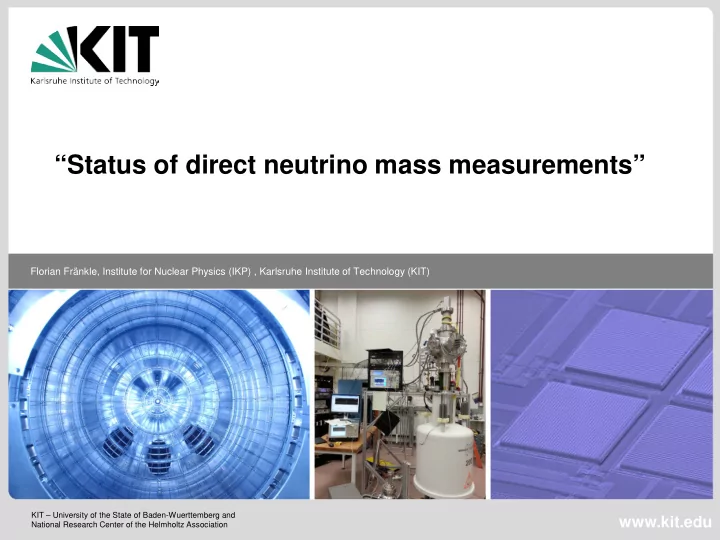
“Status of direct neutrino mass measurements”

slide-2
SLIDE 2

Institute for Nuclear Physics (IKP) 2

Outline

Introduction Neutrino masses Single β-decay experiments

163Ho electron capture experiments

Status and outlook Summary

Florian Fränkle, “Status of direct neutrino mass measurements” XIIth International Conference on Heavy Quarks & Leptons 2014, Mainz, Germany 26.08.2014

slide-3
SLIDE 3

Institute for Nuclear Physics (IKP) 3

Introduction

Neutrinos are massive particles, but so far there are only upper (< 2 eV)* and lower limits ( > 0.01 eV) Absolute neutrino mass scale is one of the big open questions in particle physics, astrophysics and cosmology Different approaches to determine neutrino mass:

Florian Fränkle, “Status of direct neutrino mass measurements” XIIth International Conference on Heavy Quarks & Leptons 2014, Mainz, Germany 26.08.2014

neutrino mass direct measurements 0νββ decay cosmology

* J. Beringer et al. (Particle Data Group), Phys. Rev. D86, 010001 (2012) and 2013 partial update for the 2014 edition

slide-4
SLIDE 4

Institute for Nuclear Physics (IKP) 4

Neutrino masses

Neutrino flavour eigenstates are related to neutrino mass eigenstates by the lepton mixing matrix (PMNS) Neutrino oscillations are sensitive to the differences between the squares

  • f neutrino masses:

Florian Fränkle, “Status of direct neutrino mass measurements” XIIth International Conference on Heavy Quarks & Leptons 2014, Mainz, Germany 26.08.2014

νe νµ ντ m1 m2 m3 Ue1 Uµ1 Uτ1 Ue2 Uµ2 Uτ2 Ue3 Uµ3 Uτ3 = normal inverted m3 2 2 m2 2 m1 2 m2 2 m1 m3 2 2 m ? 2 ∆matm. νe νµ ντ 2 ∆msol. ? 2 ∆msol. 2 ∆matm. mass ordering

+0.12

  • 0.08

∆matm. = (2.32 ) × 10-3 eV2 * ∆msol. = (7.5 ± 0.2) × 10-5 eV2 * Two mass ordering scenarios possible The value of the lightest neutrino mass is unknown

* J. Beringer et al. (Particle Data Group), Phys. Rev. D86, 010001 (2012) and 2013 partial update for the 2014 edition

2 2

slide-5
SLIDE 5

Institute for Nuclear Physics (IKP) 5

Neutrino mass and single β-decay

β-decay: n → p + e- + νe Neutrino mass influences energy spectrum of β-decay electrons Neutrino mass determination via precise measurement of the spectral shape close to the endpoint Model independent method

Florian Fränkle, “Status of direct neutrino mass measurements” XIIth International Conference on Heavy Quarks & Leptons 2014, Mainz, Germany 26.08.2014

  • bservable:

Fermi theory of β-decay: β-spectrum for tritium:

slide-6
SLIDE 6

Institute for Nuclear Physics (IKP) 6

MAC-E filter

Magnetic Adiabatic Collimation combined with an Electrostatic Filter Combines high luminosity with high energy resolution

Florian Fränkle, “Status of direct neutrino mass measurements” XIIth International Conference on Heavy Quarks & Leptons 2014, Mainz, Germany 26.08.2014

MAC-E filter: E0 E0+∆E 1 energy transmission energy ideal filter: 1 E0 transmission

t max A E

B B E = ∆

energy resolution:

const B Et = = µ

magnetic moment: B pe θ

slide-7
SLIDE 7

Institute for Nuclear Physics (IKP) 7

The KATRIN experiment

Florian Fränkle, “Status of direct neutrino mass measurements” XIIth International Conference on Heavy Quarks & Leptons 2014, Mainz, Germany 26.08.2014

KArlsruhe TRItium Neutrino experiment goal: measure neutrino mass with a sensitivity of 200 meV

Windowless Gaseous Tritium Source Differential and Cryogenic Pumping sections Pre-Spectro- meter Main Spectrometer Detector tritium β-decay decay rate: 1011 1/s T2 pressure: 10-3 to 10-6 mbar β-electron transport tritium retention (factor > 1012) energy analysis of β-electrons resolution 0.93 eV @ 18.6 keV pressure < 10-10 mbar counting

  • f trans-

mitted β-electrons ~ 70 m

slide-8
SLIDE 8

Institute for Nuclear Physics (IKP) 8

KATRIN – Windowless Gaseous Tritium Source

Stability of T2 density profile of 10-3 (function of T2 injection rate, purity, beamtube temperature TB stability and homogeneity, pump rate) TB stability in prototype experiment 10× better than specified* Tritium loop processes 1.4 × 10¹⁶ Bq tritium / day (same scale as ITER) WGTS currently under construction, delivery to KIT next year (summer)

Florian Fränkle, “Status of direct neutrino mass measurements” XIIth International Conference on Heavy Quarks & Leptons 2014, Mainz, Germany 26.08.2014

T2 pumping T2 pumping T2 injection longitudinal source profile 3.6 Tesla

* S. Grohmann et al. “The thermal behaviour of the tritium source in KATRIN”, Cryogenics, V. 55–56, 2013, p. 5–11, DOI: 10.1016/j.cryogenics.2013.01.001

August 19th, 2014

slide-9
SLIDE 9

Institute for Nuclear Physics (IKP) 9

KATRIN – pumping sections

T2 partial pressure reduction (105) via differential pumping Magnetic guiding of β-electrons Removal of positive ions Commissioning end of this year

Florian Fränkle, “Status of direct neutrino mass measurements” XIIth International Conference on Heavy Quarks & Leptons 2014, Mainz, Germany 26.08.2014

Differential pumping T2 partial pressure reduction (107) via cryosorption of T2 on argon frost Concept successfully tested* Currently under construction, delivery beginning of next year

T2

Ar frost stainless steel

* F. Eichelhardt et al. "First Tritium Results of the KATRIN Test Experiment Trap" Fusion Science and Technology 54 (2008), Nr. 2, p. 615-618

Cryogenic pumping

slide-10
SLIDE 10

Institute for Nuclear Physics (IKP) 10

KATRIN – Spectrometer & Detector Section (SDS)

First SDS commissioning measurements in autumn 2013 Main spectrometer successfully operated at -18.6 kV Spectrometer pressure ~ 10-10 mbar Transmission characteristics of main spectrometer as expected Initial background rate ~ 1 cps (benchmark 0.01 cps) 2nd commissioning phase: test active & passive background reduction

Florian Fränkle, “Status of direct neutrino mass measurements” XIIth International Conference on Heavy Quarks & Leptons 2014, Mainz, Germany 26.08.2014

Angular selective electron source detector Main spectrometer

slide-11
SLIDE 11

Institute for Nuclear Physics (IKP) 11

Project 8

Idea: Measure β-spectrum via coherent cyclotron radiation emitted by an energetic electron in a magnetic field Frequency of emitted radiation independent of electron pitch angle Θ New form of nondestructive spectroscopy

Florian Fränkle, “Status of direct neutrino mass measurements” XIIth International Conference on Heavy Quarks & Leptons 2014, Mainz, Germany 26.08.2014

T2 B electron antenna array

e

m E eB + = = γ ω γ ω ) ( Simulated spectrum (105 T2 decays)*

* B. Monreal, J.A. Formaggio, PHYSICAL REVIEW D 80, 051301(R) (2009), DOI: 10.1103/PhysRevD.80.051301

slide-12
SLIDE 12

Institute for Nuclear Physics (IKP) 12

Project 8 – phase I

Prototype system for “proof of principle” test Goal: detect single electrons from 83mKr Measurement phase finished, data analysis ongoing

Florian Fränkle, “Status of direct neutrino mass measurements” XIIth International Conference on Heavy Quarks & Leptons 2014, Mainz, Germany 26.08.2014

magnet (~ 1T) electron trapping waveguide gas lines (83mKr) expected signal (simulation) *

* Noah Oblath, „The Project 8 Experiment“, KATRIN Analysis Workshop 2014

* *

slide-13
SLIDE 13

Institute for Nuclear Physics (IKP) 13

Project 8 – phase I results

Florian Fränkle, “Status of direct neutrino mass measurements” XIIth International Conference on Heavy Quarks & Leptons 2014, Mainz, Germany 26.08.2014

* D.M. Asner et al. „Single electron detection and spectroscopy via relativistic cyclotron radiation “ http://arxiv.org/abs/1408.5362

cyclotron radiation emission from single, mildly relativistic electrons has been observed experimentally for the first time! *

slide-14
SLIDE 14

Institute for Nuclear Physics (IKP) 14

MARE – (Microcalorimeter Arrays for a Rhenium Experiment)

Florian Fränkle, “Status of direct neutrino mass measurements” XIIth International Conference on Heavy Quarks & Leptons 2014, Mainz, Germany 26.08.2014

Calorimeter ideally measures all the energy released in the decay (except neutrino energy), source = detector 187Re: T1/2 = 4.3 ×10¹⁰ yr, Q-value = 2.47 keV Investigate different techniques: Si thermistors, transition edge sensor, magnetic microcalorimeter, microwave kinetic inductance detector MARE also investigates the possibility to use 163Ho electron capture

neutrino calorimeter β-decay thermometer AgReO4 crystal (0.5 mg) MARE-1 @ Milano-Bicocca* ∆E = 28 eV @ 1.5 keV‡

* A. Nucciotti, Meudon Workshop 2011, 8-10 JUNE 2011, ‡ E. Ferri, “The status of the MARE experiment with 187Re and 163Ho isotopes” TAUP 2013

0.5 1.0 1.5 2.0 2.5 3.0 energy [keV] counts 100 200 ‡ Al Kα Si Kα Cl Kα

thermal link, readout heat sink (< 1 K)

slide-15
SLIDE 15

Institute for Nuclear Physics (IKP) 15

Neutrino mass and electron capture

Florian Fränkle, “Status of direct neutrino mass measurements” XIIth International Conference on Heavy Quarks & Leptons 2014, Mainz, Germany 26.08.2014

Electron capture: p + e- → n + νe Neutrino mass affects the de-excitation energy spectrum Calorimetric measurement of atomic de-excitation (x-rays, Auger electrons, Coster-Kronig transitions)

* Loredana Gastaldo, “Status of Holmium-based Neutrino Mass Measurements” Neutrino 2014, Boston

* *

163Ho

T1/2: 4570 yr Q(EC): 2.56 keV

slide-16
SLIDE 16

Institute for Nuclear Physics (IKP) 16

ECHo (Electron Capture 163Holmium)

Goal: investigate the electron neutrino mass in the energy range < 1eV by calorimetric measurement of 163Ho electron capture using low temperature metallic magnetic colorimeters (MMCs)

Florian Fränkle, “Status of direct neutrino mass measurements” XIIth International Conference on Heavy Quarks & Leptons 2014, Mainz, Germany 26.08.2014

* P.C.-O. Ranitzsch et al., J Low Temp Phys (2012) 167:1004–1014 DOI: 10.1007/s10909-012-0556-0 ‡L. Gastaldo et al., J Low Temp Phys (2014) 176:876–884 DOI: 10.1007/s10909-014-1187-4 http://www.kip.uni-heidelberg.de/echo

First detector prototype was tested successfully (∆E = 7.6 eV @ 6 keV) Measurements with 64 detector pixel to prove scalability

absorber

163Ho implanted

area Au:Er sensor pick-up coil *

‡ 163Ho spectrum

slide-17
SLIDE 17

Institute for Nuclear Physics (IKP) 17

HOLMES / LANL

measurement of 163Ho electron capture using transition edge sensors

Florian Fränkle, “Status of direct neutrino mass measurements” XIIth International Conference on Heavy Quarks & Leptons 2014, Mainz, Germany 26.08.2014

HOLMES LANL

* Loredana Gastaldo, “Status of Holmium-based Neutrino Mass Measurements” Neutrino 2014, Boston

* *

Testing different methods for

163Ho isotope production

funding received for 1000 channel Ho detector experiment Recent experiments show ∆E ~ 7.5 eV Testing different methods of incorporating Ho into absorber

slide-18
SLIDE 18

Institute for Nuclear Physics (IKP) 18

Status and outlook

KATRIN is in construction and commissioning phase Project 8 phase 1: prototype with 83mKr, proof of principle successful

Florian Fränkle, “Status of direct neutrino mass measurements” XIIth International Conference on Heavy Quarks & Leptons 2014, Mainz, Germany 26.08.2014

“tritium β-decay” “163Ho electron capture” status:

  • utlook:

KATRIN will start neutrino mass measurements 2016 Project 8 phase 2: measure tritium spectrum

163Ho spectra with more

than 1010 counts m(νe) < 10 eV Different experiments with R&D on detector performance, scalability and high purity 163Ho source production

slide-19
SLIDE 19

Institute for Nuclear Physics (IKP) 19

summary

The absolute neutrino mass scale is one of the big open questions in particle physics, astrophysics and cosmology Neutrinos are massive particles, but so far there are only upper < 2 eV and lower limits > 0.01 eV The KATRIN experiment aims to measure the neutrino mass with a sensitivity of 0.2 eV. It is currently in a construction and commissioning phase and neutrino mass data taking is expected to start 2016 Novel techniques to determine the neutrino mass, such as measuring the β-spectrum from coherent cyclotron radiation or measuring the

163Ho electron capture with low temperature microcalorimeters are in

development

Florian Fränkle, “Status of direct neutrino mass measurements” XIIth International Conference on Heavy Quarks & Leptons 2014, Mainz, Germany 26.08.2014

slide-20
SLIDE 20

Institute for Nuclear Physics (IKP) 20 Florian Fränkle, “Status of direct neutrino mass measurements” XIIth International Conference on Heavy Quarks & Leptons 2014, Mainz, Germany 26.08.2014

slide-21
SLIDE 21

Institute for Nuclear Physics (IKP) 21

KATRIN sensitivity

Florian Fränkle, “Status of direct neutrino mass measurements” XIIth International Conference on Heavy Quarks & Leptons 2014, Mainz, Germany 26.08.2014

MC energy spectrum (1 year)

slide-22
SLIDE 22

Institute for Nuclear Physics (IKP) 22

Tritium source: molecular vs. atomic

Florian Fränkle, “Status of direct neutrino mass measurements” XIIth International Conference on Heavy Quarks & Leptons 2014, Mainz, Germany 26.08.2014

* J.A. Formaggio, “Project 8 & alternative paths in beta decay experiments” LNGS, May 14th, 2014, https://agenda.infn.it/conferenceDisplay.py?confId=8004

slide-23
SLIDE 23

Institute for Nuclear Physics (IKP) 23

KATRIN background from stored electrons

Florian Fränkle, “Status of direct neutrino mass measurements” XIIth International Conference on Heavy Quarks & Leptons 2014, Mainz, Germany 26.08.2014

  • MAC-E filter works as a magnetic bottle
  • high-energy (~10 keV) electrons created in the volume
  • f the spectrometer can be stored for several hours
  • stored electrons can create a large number of

background electrons via ionization of residual gas molecules methods to avoid or eliminate stored electrons: magnetic pulse electric dipole field mechanical elimination LN2 cooled baffle