Statistics in medicine One group is measured one time: Lecture 3: - - PDF document

β–Ά
statistics in medicine
SMART_READER_LITE
LIVE PREVIEW

Statistics in medicine One group is measured one time: Lecture 3: - - PDF document

11/2/2016 Proportion in one group Statistics in medicine One group is measured one time: Lecture 3: Bivariate association : Categorical variables z test Use the z distribution as an approximation to the binomial distribution Fatma


slide-1
SLIDE 1

11/2/2016 1

S L I D E 0

Statistics in medicine

Lecture 3: Bivariate association : Categorical variables

Fatma Shebl, MD, MS, MPH, PhD Assistant Professor Chronic Disease Epidemiology Department Yale School of Public Health Fatma.shebl@yale.edu

S L I D E 1

Proportion in one group

  • One group is measured one time:

–z test

  • Use the z distribution as an approximation

to the binomial distribution

S L I D E 2

Steps of the statistical significance testing, z test

  • 1- Calculate the test statistic
  • 2- Determine the critical value of

significance

  • 3-Compare the test statistic with the

critical value

  • 4- Calculate the p value
  • 5- Draw a conclusion

S L I D E 3

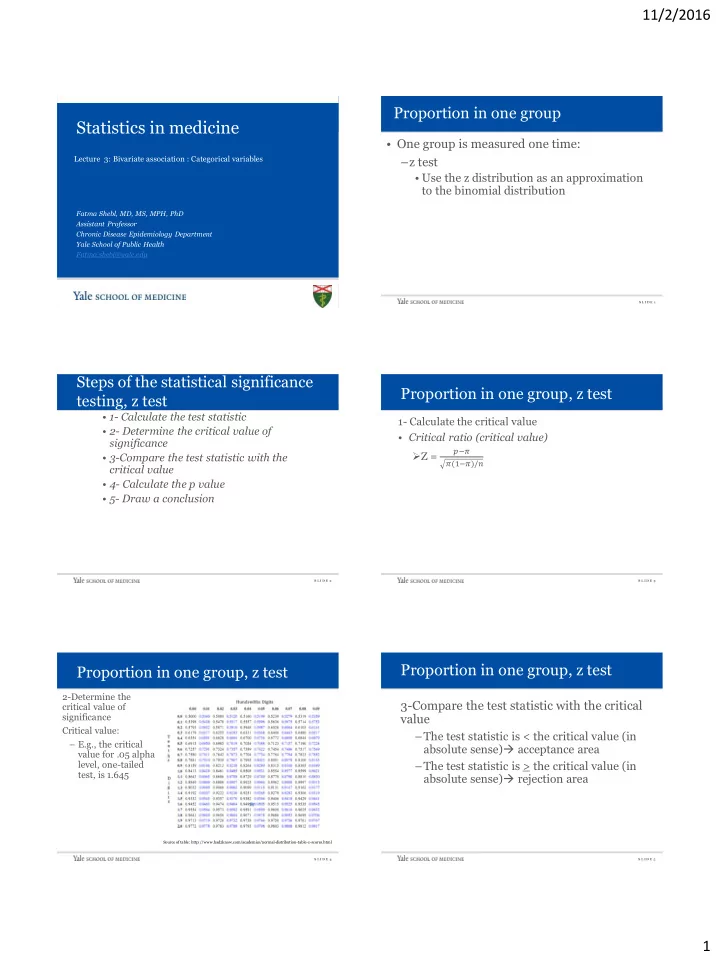
Proportion in one group, z test

1- Calculate the critical value

  • Critical ratio (critical value)
  • Z =

π‘žβˆ’πœŒ 𝜌(1βˆ’πœŒ)/π‘œ

S L I D E 4

Source of table: http://www.had2know.com/academics/normal-distribution-table-z-scores.html

Proportion in one group, z test

2-Determine the critical value of significance Critical value: – E.g., the critical value for .05 alpha level, one-tailed test, is 1.645

S L I D E 5

Proportion in one group, z test

3-Compare the test statistic with the critical value

–The test statistic is < the critical value (in absolute sense)οƒ  acceptance area –The test statistic is > the critical value (in absolute sense)οƒ  rejection area

slide-2
SLIDE 2

11/2/2016 2

S L I D E 6

Proportion in one group, z test

4- Calculate the p value

  • Using the z-table

–Find the z value that is =test statistic by scrolling down the z column then scrolling to the right in the row –The entries of the tables are used to calculate the p values

  • For negative z values
  • One-tailed, the p value is the entry of the z table
  • Two-tailed, the p value is the entry of the z table multiplied by

2

  • For positive z values
  • One-tailed, the p value = 1- the entry of the z table
  • Two-tailed,: p value = (1- the entry of the z table )multiplied

by 2

S L I D E 7

Proportion in one group, z test

4- Calculate the p value – E.g., for a z=3.1

  • one-tailed test, p=(1-.999)

=.001

  • two-tailed test, p=(1-.999)

*2=.002

Source of table: http://www.had2know.com/academics/normal-distribution-table-z-scores.html

S L I D E 8

Proportion in one group, z test

5- Calculate the confidence interval

  • CI of proportion:

– π‘ž Β± 𝑨 Γ—

π‘ž(1βˆ’π‘ž) π‘œ

  • E.g.

–95% CI=π‘ž Β± 1.96 Γ—

π‘ž(1βˆ’π‘ž) π‘œ

The value that defines the central 95% of the area

S L I D E 9

Proportion in one group, z test

6- Draw a conclusion

  • Reject or fail to reject the null hypothesis

– Fail to reject the null

  • If the p value > alpha level
  • If the confidence interval crosses the 1

– Reject the null

  • If the p value < alpha level
  • If the confidence interval does not cross

the 1

S L I D E 10

Proportion in one group, z test example

  • A study of success of

vaccination revealed that 97.1% responded to the

  • vaccine. The investigators

would like to examine whether this proportion is significantly higher than 95%. If the calculated z value was 1.75. Using a .05 alpha level, what is the critical value and the corresponding p value?

  • Answer:

– Critical value=1.645 (one tail) – p=(1-.9599)=.0401 – Conclusion: we reject the null hypothesis

Source: http://www.had2know.com/academics/normal-distribution-table-z-scores.html

S L I D E 11

Proportion in one group, paired/matched

  • One group is measured twice (or matched

design): –McNemar Chi-square

  • Is a chi-square test for comparing

proportions from two DEPENDENT or paired groups.

  • Use the chi-square distribution
slide-3
SLIDE 3

11/2/2016 3

S L I D E 12

Proportion in one group, paired/matched

  • One group is measured twice (or matched

design): –McNemar Chi-square

  • E.g., E.g., Is there a change in bowel

functions after cholecystectomy?

S L I D E 13

Steps of the statistical significance testing, McNemar Chi-square

  • 1- Calculate the test statistic (critical

ratio)

  • 2- Calculate degrees of freedom
  • 3- Determine the critical value of

significance

  • 4-Compare the test statistic with the

critical value

  • 5- Calculate the p value
  • 6- Calculate the confidence interval
  • 7- Draw a conclusion

S L I D E 14

Proportion in one group, paired/matched, McNemar test

1- Calculate the critical value

  • Critical ratio

(critical value)

  • McNemar X2=

π‘βˆ’π‘‘

2

𝑐+𝑑

2- Calculate degrees

  • f freedom
  • df= (R-1)(C-1)=1

Paired design Before intervention After intervention Total Positive Negative Positive a b a+b Negative c d c+d Total a+c b+d a+b+c+d Matched design Cases Control Total Positive risk Negative risk Positive risk a b a+b Negative risk c d c+d Total a+c b+d a+b+c+d

S L I D E 15

Proportion in one group, paired/matched, McNemar test

3-Determine the critical value of significance Critical value: – Depends on:

  • Alpha level
  • Degrees of freedom

– E.g., for an alpha of .05, 1 df, the value of the critical x2 is 3.841

df Probability (p value) 0.10 0.05 0.025 0.01 0.005 1 2.706 3.841 5.024 6.635 7.879 2 4.605 5.991 7.378 9.210 10.597 3 6.251 7.815 9.348 11.345 12.838 4 7.779 9.488 11.143 13.277 14.860 5 9.236 11.070 12.833 15.086 16.750 6 10.645 12.592 14.449 16.812 18.548 7 12.017 14.067 16.013 18.475 20.278 8 13.362 15.507 17.535 20.090 21.955 9 14.684 16.919 19.023 21.666 23.589 10 15.987 18.307 20.483 23.209 25.188 11 17.275 19.675 21.920 24.725 26.757 12 18.549 21.026 23.337 26.217 28.300 13 19.812 22.362 24.736 27.688 29.819

S L I D E 16

Proportion in one group, paired/matched, McNemar test

4-Compare the test statistic with the critical value

–The test statistic is < the critical value (in absolute sense)οƒ  acceptance area –The test statistic is > the critical value (in absolute sense)οƒ  rejection area

S L I D E 17

Proportion in one group, paired/matched, McNemar test

5- Calculate the p value

  • From the x2 table

– Locate the row of the relevant df – Find the x2 value that is < test statistic – Find the p value at the top of the column – E.g., for a, 1 df, x2 =4 – οƒ  .05 > p value > .025

df Probability (p value) 0.10 0.05 0.025 0.01 0.005 1 2.706 3.841 5.024 6.635 7.879 2 4.605 5.991 7.378 9.210 10.597 3 6.251 7.815 9.348 11.345 12.838 4 7.779 9.488 11.143 13.277 14.860 5 9.236 11.070 12.833 15.086 16.750 6 10.645 12.592 14.449 16.812 18.548 7 12.017 14.067 16.013 18.475 20.278 8 13.362 15.507 17.535 20.090 21.955 9 14.684 16.919 19.023 21.666 23.589 10 15.987 18.307 20.483 23.209 25.188 11 17.275 19.675 21.920 24.725 26.757 12 18.549 21.026 23.337 26.217 28.300 13 19.812 22.362 24.736 27.688 29.819

slide-4
SLIDE 4

11/2/2016 4

S L I D E 18

Proportion in one group, paired/matched, McNemar test

6- Draw a conclusion

  • Reject or fail to reject the null hypothesis

– Fail to reject the null

  • If the p value > alpha level

– Reject the null

  • If the p value < alpha level

S L I D E 19

Proportion in one group, paired/matched, McNemar test example

Researcher examined whether bowel movement changed postoperative. If the calculated McNemar statistic is 15, what is: the df and the p value?

  • df=1
  • 0.005 > p value

df Probability (p value) 0.10 0.05 0.025 0.01 0.005 1 2.706 3.841 5.024 6.635 7.879 2 4.605 5.991 7.378 9.210 10.597 3 6.251 7.815 9.348 11.345 12.838 4 7.779 9.488 11.143 13.277 14.860 5 9.236 11.070 12.833 15.086 16.750 6 10.645 12.592 14.449 16.812 18.548 7 12.017 14.067 16.013 18.475 20.278 8 13.362 15.507 17.535 20.090 21.955 9 14.684 16.919 19.023 21.666 23.589 10 15.987 18.307 20.483 23.209 25.188 11 17.275 19.675 21.920 24.725 26.757 12 18.549 21.026 23.337 26.217 28.300 13 19.812 22.362 24.736 27.688 29.819

S L I D E 20

Readings and resources

  • Chapter 5, p93-133: Dawson, B. and

Trapp, R. G. (2004). Basic and Clinical Biostatistics (4th edition). New York: McGraw-Hill.

  • Chapter 11, p134-146: Jekel's

epidemiology, biostatistics, preventive medicine, and public health by David L. Katz et al (4th edition).

S L I D E 21

Proportions in two groups, z approximation test

  • Z test:

–Definition: Test of the equality of two independent proportions –Is an approximation of the binomial distribution when p*n>5 –Requires at least 5 observed frequencies in each group –Parametric test

S L I D E 22

Steps of the statistical significance testing, z test

  • 1- Calculate the test statistic
  • 2- Determine the critical value of

significance

  • 3-Compare the test statistic with the

critical value

  • 4- Calculate the p value
  • 5- Draw a conclusion

S L I D E 23

Proportions in two groups, z test

1- Calculate the critical value critical value Z =

π‘ž1βˆ’π‘ž2 π‘ž 1βˆ’π‘ž [ 1/π‘œ1 + 1/π‘œ2 ]

Where,

  • π‘ž1, π‘π‘œπ‘’ π‘ž2 are proportions in each group
  • P is the pooled proportion
  • p =

π‘œ1π‘ž1+π‘œ2π‘ž2 π‘œ1+π‘œ2

slide-5
SLIDE 5

11/2/2016 5

S L I D E 24

Proportions in two groups, z test

2-Determine the critical value of significance 3-Compare the test statistic with the critical value 4-Calculate the p value Calculate the confidence interval

  • CI of proportion difference

= (π‘ž1βˆ’π‘ž2) Β± 𝑨 Γ— π‘‡πΉπ‘ž1βˆ’π‘ž2

  • where., π‘‡πΉπ‘ž1βˆ’π‘ž2 =

π‘ž(1 βˆ’ π‘ž) (1/π‘œ1) + (1/π‘œ2) 5- Draw a conclusion

S L I D E 25

Proportions in two groups, z test example

  • A study of the physicians’ screening practices of

domestic violence (DV), revealed that 86.6% of 202 physicians who were trained for DV detection versus 58.3% of 266 physicians who were not trained for DV detection screened their patients for DV. The investigators would like to examine whether the proportion among trained physicians is the same as proportion among non trained physicians. If the calculated z value was 6.6, and the SE(p1-p2)=.043. Using a .05 alpha level, what are: the critical value, the corresponding p value, and the 95% CI?

S L I D E 26

Proportions in two groups, z test example

  • Answer:

–Critical value=1.96 (two tail) –P<(1-.999)*2 <.0002 –95% CI= (.866-.583)+1.96*.043= (.201, .367) –Conclusion: we reject the null hypothesis

S L I D E 27

Proportions in two groups, Chi-square test

  • Chi-square test:

– Definition: the test of the null hypothesis that proportions are equal, or equivalently, that factors

  • r characteristics are independent or not

associated – Nonparametric test – Could be used for two or more groups – Use the X2 distribution – Could be used if n*p>5 – Should not be used if expected frequencies <2

S L I D E 28

Chi-square distribution (X2)

  • The distribution used to analyze

counts in frequency tables.

  • A nonsymmetrical distribution with

mean (Β΅) and variance (Οƒ2)

  • Used for categorical (nominal) data
  • Properties:

– Degrees of freedom = Ο… – Β΅ = Ο… – Οƒ2 = Ο…*2 – Approaches normal distribution with the increase in df

Graph generated by R

S L I D E 29

Steps of the statistical significance testing, Chi-square test for independence

  • 1- Calculate the test statistic
  • 2- Calculate degrees of freedom
  • 3- Determine the critical value of

significance

  • 4-Compare the test statistic with the

critical value

  • 5- Calculate the p value
  • 6- Draw a conclusion
slide-6
SLIDE 6

11/2/2016 6

S L I D E 30

Proportions in two groups, chi- square test of independence

1- Calculate the critical value

  • X2=βˆ‘

π‘ƒβˆ’πΉ 2 𝐹

  • Short cut formula for 2x2 table
  • X2=

π‘œ π‘π‘’βˆ’π‘π‘‘ 2 (𝑏+𝑑)(𝑐+𝑒)(𝑏+𝑐)(𝑑+𝑒)

Where,

  • O=observed frequencies
  • E=expected frequencies=

𝑠𝑝π‘₯ π‘’π‘π‘’π‘π‘š 𝑦 π‘‘π‘π‘šπ‘£π‘›π‘œ π‘’π‘π‘’π‘π‘š π‘•π‘ π‘π‘œπ‘’ π‘’π‘π‘’π‘π‘š

2- Calculate degrees of freedom

  • df= (R-1)(C-1)

Chi-square test Exposure

  • utcome

Total Disease Un- diseased Exposed a b a+b Unexposed c d c+d Total a+c b+d a+b+c+d

S L I D E 31

Proportions in two groups, chi- square test of independence

3-Determine the critical value of significance from the x2 table 4-Compare the test statistic with the critical value 5-Calculate the p value 6-Draw a conclusion

df Probability (p value) 0.10 0.05 0.025 0.01 0.005 1 2.706 3.841 5.024 6.635 7.879 2 4.605 5.991 7.378 9.210 10.597 3 6.251 7.815 9.348 11.345 12.838 4 7.779 9.488 11.143 13.277 14.860 5 9.236 11.070 12.833 15.086 16.750 6 10.645 12.592 14.449 16.812 18.548 7 12.017 14.067 16.013 18.475 20.278 8 13.362 15.507 17.535 20.090 21.955 9 14.684 16.919 19.023 21.666 23.589 10 15.987 18.307 20.483 23.209 25.188 11 17.275 19.675 21.920 24.725 26.757 12 18.549 21.026 23.337 26.217 28.300 13 19.812 22.362 24.736 27.688 29.819

S L I D E 32

Proportions in two groups, chi-square test

  • f independence, example

Researcher examined whether there is an association between DV training and screening for DM by physicians. If the calculated x2 statistic is 44.4, what are: the df and the p value, and your conclusion?

  • df=(2-1)(2-1)=1
  • p value < 0.005
  • Conclusion: there is a

significant association between training and screening.

df Probability (p value) 0.10 0.05 0.025 0.01 0.005 1 2.706 3.841 5.024 6.635 7.879 2 4.605 5.991 7.378 9.210 10.597 3 6.251 7.815 9.348 11.345 12.838 4 7.779 9.488 11.143 13.277 14.860 5 9.236 11.070 12.833 15.086 16.750 6 10.645 12.592 14.449 16.812 18.548 7 12.017 14.067 16.013 18.475 20.278 8 13.362 15.507 17.535 20.090 21.955 9 14.684 16.919 19.023 21.666 23.589 10 15.987 18.307 20.483 23.209 25.188 11 17.275 19.675 21.920 24.725 26.757 12 18.549 21.026 23.337 26.217 28.300 13 19.812 22.362 24.736 27.688 29.819

S L I D E 33

Proportions in two groups, Fisher’s exact test

  • Fisher’s exact test:

–Definition: An exact test for 2x2 contingency table. It is used when the sample size is too small to use a chi-square test –Should be used if expected frequencies <2 –Fisher p=

(𝑏+𝑐)!(𝑑+𝑒)!(𝑏+𝑑)!(𝑐+𝑒)! 𝑂!𝑏!𝑐!𝑑!𝑒!

S L I D E 34

Proportions in two groups, Risk ratios

  • Allows examining associations between two

nominal measures

  • Allows estimating confidence intervals as a

significance test

S L I D E 35

Proportions in two groups, Relative risk

  • Relative risk:

–The ratio of the incidence of a given disease in exposed to the incidence of the disease in the unexposed

slide-7
SLIDE 7

11/2/2016 7

S L I D E 36

Proportions in two groups, Relative risk

1- Calculate the relative risk (RR)

  • RR=

𝑏/(𝑏+𝑐) 𝑑/(𝑑+𝑒)

2- Calculate the confidence interval

  • exp ln

(𝑆𝑆) Β± 𝑨𝛽/2

1βˆ’[ 𝑏

𝑏+𝑐]

𝑏

+

1βˆ’[ 𝑑

𝑑+𝑒]

𝑑

Chi-square test Exposure

  • utcome

Total Disease Un- diseased Exposed a b a+b Unexposed c d c+d Total a+c b+d a+b+c+d

S L I D E 37

Proportions in two groups, Odds ratio

  • Odds ratio

–An estimate of relative risk in case-control

  • studies. It is the odds that a patient was

exposed to a given risk factor divided by the

  • dds that a control was exposed to a given

risk factor

S L I D E 38

Proportions in two groups, Odds ratio

1- Calculate the odds ratio (OR)

  • OR=

𝑏 𝑏+𝑑 /[ 𝑑 𝑏+𝑑] 𝑐 𝑐+𝑒 /[ 𝑒 𝑐+𝑒]= 𝑏𝑒 𝑐𝑑

2- Calculate the confidence interval

  • exp ln

(𝑃𝑆) Β± 𝑨𝛽/2

1 𝑏 + 1 𝑐 + 1 𝑑 + 1 𝑒

Chi-square test Exposure

  • utcome

Total Disease Un- diseased Exposed a b a+b Unexposed c d c+d Total a+c b+d a+b+c+d

S L I D E 39

Readings and resources

  • Chapter 6, p134-154: Dawson, B. and

Trapp, R. G. (2004). Basic and Clinical Biostatistics (4th edition). New York: McGraw-Hill.

  • Chapter 11, p134-146: Jekel's

epidemiology, biostatistics, preventive medicine, and public health by David L. Katz et al (4th edition).

S L I D E 40

Proportions in three or more groups, Chi-square test

  • Chi-square test:

– Definition: the test of the null hypothesis that proportions are equal, or equivalently, that factors

  • r characteristics are independent or not

associated – Nonparametric test – Could be used for two or more groups – Use the X2 distribution – Could be used if n*p>5 – Should not be used if expected frequencies <2

S L I D E 41

Steps of the statistical significance testing, Chi-square test for independence

  • 1- Calculate the test statistic
  • 2- Calculate degrees of freedom
  • 3- Determine the critical value of

significance

  • 4-Compare the test statistic with the

critical value

  • 5- Calculate the p value
  • 6- Draw a conclusion
slide-8
SLIDE 8

11/2/2016 8

S L I D E 42

Proportions in three or more groups, Chi-square test

1- Calculate the test statistic

  • X2=βˆ‘

π‘ƒβˆ’πΉ 2 𝐹

Where,

  • O=observed frequencies
  • E=expected frequencies=

𝑠𝑝π‘₯ π‘’π‘π‘’π‘π‘š 𝑦 π‘‘π‘π‘šπ‘£π‘›π‘œ π‘’π‘π‘’π‘π‘š π‘•π‘ π‘π‘œπ‘’ π‘’π‘π‘’π‘π‘š

2- Calculate degrees of freedom

  • df= (R-1)(C-1)

Chi-square test Exposure

  • utcome

Total Sever disease Mild disease Control Exposed y11 y12 y13 y11+y12+y13 Unexposed y21 y22 y23 y21+y22+y23 Total y11+y21 y12+y22 y13+y32 y11+y12+y13 +y21+y22+y23

S L I D E 43

Proportions in three or more groups, Chi-square test

3-Determine the critical value of significance from the x2 table 4-Compare the test statistic with the critical value 5-Calculate the p value 6-Draw a conclusion

df Probability (p value) 0.10 0.05 0.025 0.01 0.005 1 2.706 3.841 5.024 6.635 7.879 2 4.605 5.991 7.378 9.210 10.597 3 6.251 7.815 9.348 11.345 12.838 4 7.779 9.488 11.143 13.277 14.860 5 9.236 11.070 12.833 15.086 16.750 6 10.645 12.592 14.449 16.812 18.548 7 12.017 14.067 16.013 18.475 20.278 8 13.362 15.507 17.535 20.090 21.955 9 14.684 16.919 19.023 21.666 23.589 10 15.987 18.307 20.483 23.209 25.188 11 17.275 19.675 21.920 24.725 26.757 12 18.549 21.026 23.337 26.217 28.300 13 19.812 22.362 24.736 27.688 29.819

S L I D E 44

Proportions in three or more groups, Chi- square test, example

Researchers examined the response to three vaccine’s dilutions. Subjects were classified as responders or non-

  • responders. Researchers would like to

determine whether there is an association between vaccine’s dilutions and the response to the vaccine. If the calculated x2 statistic is 2.589, and for an alpha of .05, what are: the df, critical value of significance and the p value, and your conclusion?

  • df=(3-1)(2-1)=2
  • Critical value=5.991
  • p value >.1
  • Conclusion: there is no significant

association between vaccine’s dilutions and the response

df Probability (p value) 0.10 0.05 0.025 0.01 0.005 1 2.706 3.841 5.024 6.635 7.879 2 4.605 5.991 7.378 9.210 10.597 3 6.251 7.815 9.348 11.345 12.838 4 7.779 9.488 11.143 13.277 14.860 5 9.236 11.070 12.833 15.086 16.750 6 10.645 12.592 14.449 16.812 18.548 7 12.017 14.067 16.013 18.475 20.278 8 13.362 15.507 17.535 20.090 21.955 9 14.684 16.919 19.023 21.666 23.589 10 15.987 18.307 20.483 23.209 25.188 11 17.275 19.675 21.920 24.725 26.757 12 18.549 21.026 23.337 26.217 28.300 13 19.812 22.362 24.736 27.688 29.819

S L I D E 45

Proportions in three or more groups, Chi- square test, example

Researchers examined the association between eyes’ color and hair color. Eyes’ color was classified into three groups, and hair’s color was classified into 5

  • groups. If the calculated x2 statistic is

20.92, and for an alpha of .05, what are: the df, critical value of significance and the p value, and your conclusion?

  • df=(3-1)(5-1)=2x4=8
  • Critical 15.507
  • .005 < p value <.01
  • Conclusion: there is significant

association between eyes' color and hair’s color

df Probability (p value) 0.10 0.05 0.025 0.01 0.005 1 2.706 3.841 5.024 6.635 7.879 2 4.605 5.991 7.378 9.210 10.597 3 6.251 7.815 9.348 11.345 12.838 4 7.779 9.488 11.143 13.277 14.860 5 9.236 11.070 12.833 15.086 16.750 6 10.645 12.592 14.449 16.812 18.548 7 12.017 14.067 16.013 18.475 20.278 8 13.362 15.507 17.535 20.090 21.955 9 14.684 16.919 19.023 21.666 23.589 10 15.987 18.307 20.483 23.209 25.188 11 17.275 19.675 21.920 24.725 26.757 12 18.549 21.026 23.337 26.217 28.300 13 19.812 22.362 24.736 27.688 29.819

S L I D E 46

Proportions in three or more groups, odds ratio

1. Pick exposure reference category

  • 2. Calculate OR for each exposure level

Chi-square test Outcome Exposure level Total High Middle Low Diseased y11 y12 y13 y11+y12+y13 Not diseased y21 y22 y23 y21+y22+y23 Total y11+y21 y12+y22 y13+y32 y11+y12+y13 +y21+y22+y23 P (𝑧11) (𝑧11 + 𝑧21) (𝑧12) (𝑧12 + 𝑧22) (𝑧13) (𝑧13 + 𝑧23) OR (𝑧11)(𝑧23) (𝑧13)(𝑧21) (𝑧12)(𝑧23) (𝑧13)(𝑧22) 1

S L I D E 47

Proportions in three or more groups, risk ratio

1. Pick exposure reference category

  • 2. Calculate RR for each exposure level

Chi-square test Outcome Exposure level Total High Middle Low Diseased y11 y12 y13 y11+y12+y13 Not diseased y21 y22 y23 y21+y22+y23 Total y11+y21 y12+y22 y13+y23 y11+y12+y13 +y21+y22+y23 P (𝑧11) (𝑧11 + 𝑧21) (𝑧12) (𝑧12 + 𝑧22) (𝑧13) (𝑧13 + 𝑧23) RR (𝑧11)/(𝑧11 + 𝑧21) (𝑧13)/(y13+y23 ) (𝑧12)/(𝑧12 + 𝑧22) (𝑧13)/(𝑧13 + 𝑧23) 1
slide-9
SLIDE 9

11/2/2016 9

S L I D E 48

Proportions in three or more groups, Cochran-Armitage Trend Test

  • Is a test of linear trend in proportions
  • Used if one variable is dichotomous and the other variable is
  • rdinal
  • A test of trend of ordinal categories has higher power than the

chi-square test of the nominal categories

  • Ordinal levels values will depend on the type of the variable, ex.:

– Cancer stage: levels 1, 2, 3, 4 are reasonable – Number of cigarettes smoked: median values of the intervals such as 5, 15, 25, 35 could be used

S L I D E 49

Proportions in three or more groups, Cochran-Armitage Trend Test

  • A clinical trial investigated whether larger drug doses

increase adverse response. Patients were randomized to receive placebo, or one of the four drug doses.

Cochran-Armitage Trend Test Statistic (Z)

  • 4.7918

One-sided Pr < Z <.0001 Two-sided Pr > |Z| <.0001

Table of Adverse by Dose Adverse Dose 1 2 3 4 Total No 26 26 23 18 9 102 Yes 6 7 9 14 23 59 Total 32 33 32 32 32 161

Source: SAS examples

S L I D E 50

Readings and resources

  • Chapter 7, p162-185: Dawson, B. and

Trapp, R. G. (2004). Basic and Clinical Biostatistics (4th edition). New York: McGraw-Hill.

  • Chapter 11, p134-146: Jekel's

epidemiology, biostatistics, preventive medicine, and public health by David L. Katz et al (4th edition).