Statistics and the Emerging Discipline of Data Science Adam - - PowerPoint PPT Presentation

statistics and the emerging discipline of data science
SMART_READER_LITE
LIVE PREVIEW

Statistics and the Emerging Discipline of Data Science Adam - - PowerPoint PPT Presentation

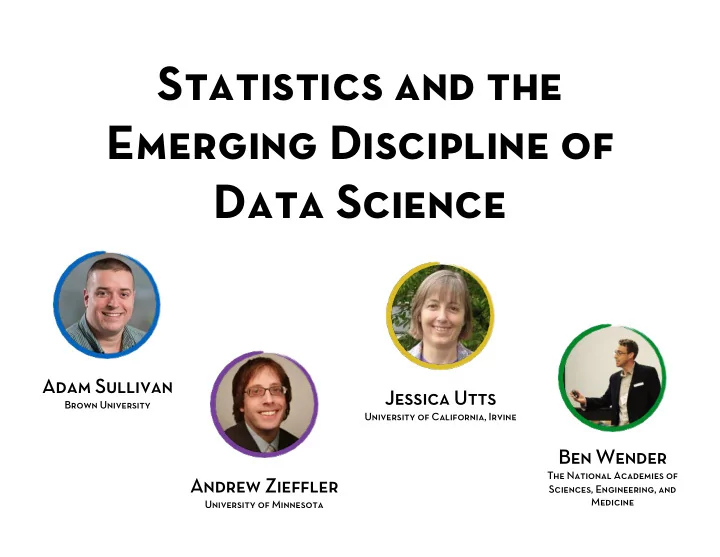
Statistics and the Emerging Discipline of Data Science Adam Sullivan Jessica Utts Brown University University of California, Irvine Ben Wender The National Academies of Andrew Zieffler Sciences, Engineering, and Medicine University of


slide-1
SLIDE 1

Statistics and the Emerging Discipline of Data Science

Ben Wender

The National Academies of Sciences, Engineering, and Medicine

Andrew Zieffler

University of Minnesota

Adam Sullivan

Brown University

Jessica Utts

University of California, Irvine

slide-2
SLIDE 2

Data Science Education Roundtable

Project statement of task: The Roundtable on Data Science Post-Secondary Education will convene critical stakeholders from data science training programs, funding agencies, societies, foundations, and industry to discuss data science education and practice, needs of the community and employers, and ways to move forward. The Roundtable will convene 4 times per year and create a venue for exchange of ideas and a mechanism for joint strategic planning among key stakeholders and experts in data science and education.

slide-3
SLIDE 3

Data Science Education Roundtable

Engaging through structured meetings and targeted dissemination Each Roundtable meeting has a theme and targets slightly different audiences. Core audience: Industry, government, foundations, and academic groups doing work related to data science post- secondary education. Goal: Improve coordination among stakeholder and increase awareness of current and future efforts in the broader data science community.

slide-4
SLIDE 4

Foundations of Data Science and the Needs of Diverse Communities December 14, 2016 Examining the Intersection of Domain Expertise and Data Science March 20, 2017 Tailoring courses and training to diverse data communities May 1, 2017 Data science education mechanisms: Matching educational approaches for the audience October 20, 2017 (Chicago, IL) Integrating societal and ethical concerns into data science education December 8, 2017 (Washington, DC) You are here! Videos, materials, and summary available online http://www.nas.edu/statistics
slide-5
SLIDE 5

Envisioning the Data Science Discipline: The Undergraduate Perspective

Carry out a consensus study to

  • Identify core underlying principles, intellectual content, and

pedagogical issues specific to data science, including core concepts that distinguish it from neighboring disciplines.

  • Focus on undergraduate level, but address topics related to

middle and high schools, community colleges, and draw on experiences of Master's-level programs.

  • Consider opportunities to engage underrepresented student

populations.

slide-6
SLIDE 6

Convened: Sept. 2016 Pre-workshop meeting: Dec. 2016 Webinar: April 25, 2017 1st workshop: May 2–3, 2017 Interim report: Summer 2017 2nd workshop: Dec. 7 –8, 2017 Final report: Early 2018 You are here!

slide-7
SLIDE 7

Ultimate Goal Today

Hear about each others’ opinions and experiences Identify common themes and differences across different groups Explore and inform development of data science syllabi/courses and curriculum.

slide-8
SLIDE 8

Small-Group Activity

In your small-groups from the warm-up, take 10 minutes to discuss the questions on the next slide. Have one person volunteer to take notes and send these to Ben after your discussion.

slide-9
SLIDE 9

Thought-Provoking Discussion Questions

  • What is data science?
  • Is data science a "stand alone" discipline that should

have its own undergraduate major?

  • How should data science be taught in data-intensive

domain fields such as astronomy, humanities, and biology?

  • Does statistics education need to change in the

context of data science and how?

slide-10
SLIDE 10

Data Science Content

Discussion Questions

20 minutes

  • What topics are essential to include from statistics? Not just specific content, but what

principles? How should this material be structured?

  • Which Computer Science principles are essential to include in data science?
  • Which (fill-in-the-blank) principles are essential to include in data science?
  • What order should content be introduced (e.g., sequencing) and in what context?
  • What infrastructure is necessary? (Not just hardware, but also which people and expertise?)
  • Where should data science programs be housed?
  • How do we keep data science from having the same gender and racial gaps as other STEM

disciplines?

  • How do we maintain a system of collaboration within the curriculum and design of the

program?

slide-11
SLIDE 11

How to Participate

Data Science Roundtable To receive updates, please join the Committee on Applied and Theoretical Statistics (CATS) mailing list at: http://www.nas.edu/statistics Envisioning the Data Science Discipline Contact Ben Wender at: bwender@nas.edu

slide-12
SLIDE 12

References and Attributions

  • building by Yo! Baba from the Noun Project
  • retro computer by Tinashe Mugayi from the

Noun Project

  • Eric Kolaczyk for the Data Science Roundtable

slides

  • Laura Haas for the Envisioning the Data

Science Discipline slides