Statistical Parsing NP, S N, V, VP ? S ? VP ? ? V, VP S ? - - PDF document

statistical parsing
SMART_READER_LITE
LIVE PREVIEW

Statistical Parsing NP, S N, V, VP ? S ? VP ? ? V, VP S ? - - PDF document

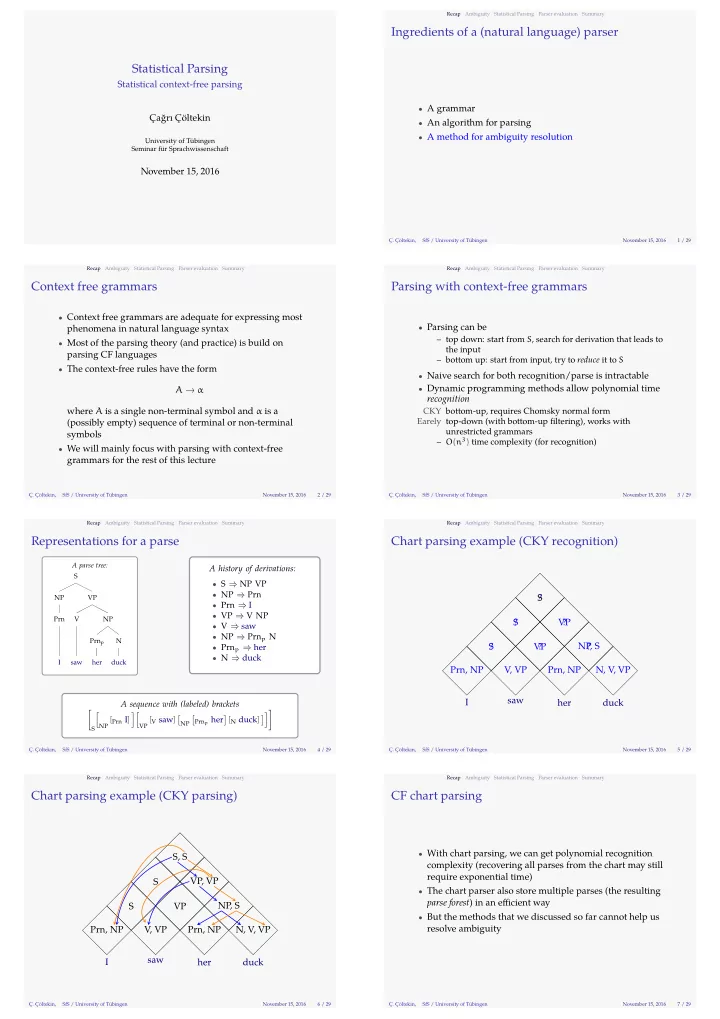
Statistical Parsing NP, S N, V, VP ? S ? VP ? ? V, VP S ? VP ? S . ltekin, SfS / University of Tbingen Prn, NP Prn, NP 5 / 29 Recap Statistical context-free parsing S NP . ltekin, SfS / University of Tbingen


slide-1
SLIDE 1

Statistical Parsing

Statistical context-free parsing Çağrı Çöltekin

University of Tübingen Seminar für Sprachwissenschaft

November 15, 2016

Recap Ambiguity Statistical Parsing Parser evaluation Summary

Ingredients of a (natural language) parser

  • A grammar
  • An algorithm for parsing
  • A method for ambiguity resolution

Ç. Çöltekin, SfS / University of Tübingen November 15, 2016 1 / 29 Recap Ambiguity Statistical Parsing Parser evaluation Summary

Context free grammars

  • Context free grammars are adequate for expressing most

phenomena in natural language syntax

  • Most of the parsing theory (and practice) is build on

parsing CF languages

  • The context-free rules have the form

A → α where A is a single non-terminal symbol and α is a (possibly empty) sequence of terminal or non-terminal symbols

  • We will mainly focus with parsing with context-free

grammars for the rest of this lecture

Ç. Çöltekin, SfS / University of Tübingen November 15, 2016 2 / 29 Recap Ambiguity Statistical Parsing Parser evaluation Summary

Parsing with context-free grammars

  • Parsing can be

– top down: start from S, search for derivation that leads to the input – bottom up: start from input, try to reduce it to S

  • Naive search for both recognition/parse is intractable
  • Dynamic programming methods allow polynomial time

recognition

CKY bottom-up, requires Chomsky normal form Earely top-down (with bottom-up fjltering), works with unrestricted grammars – O(n3) time complexity (for recognition)

Ç. Çöltekin, SfS / University of Tübingen November 15, 2016 3 / 29 Recap Ambiguity Statistical Parsing Parser evaluation Summary

Representations for a parse

A parse tree: S NP Prn I VP V saw NP Prnp her N duck

A history of derivations:

  • S ⇒ NP VP
  • NP ⇒ Prn
  • Prn ⇒ I
  • VP ⇒ V NP
  • V ⇒ saw
  • NP ⇒ Prnp N
  • Prnp ⇒ her
  • N ⇒ duck

A sequence with (labeled) brackets [

S

[

NP [Prn I]

][

VP [V saw]

[

NP

[

Prnp her

] [N duck] ]]]

Ç. Çöltekin, SfS / University of Tübingen November 15, 2016 4 / 29 Recap Ambiguity Statistical Parsing Parser evaluation Summary

Chart parsing example (CKY recognition)

I saw her duck Prn, NP V, VP Prn, NP N, V, VP ? S ? VP ? NP, S ? S ? VP ? S

Ç. Çöltekin, SfS / University of Tübingen November 15, 2016 5 / 29 Recap Ambiguity Statistical Parsing Parser evaluation Summary

Chart parsing example (CKY parsing)

I saw her duck Prn, NP V, VP Prn, NP N, V, VP S VP NP, S S VP, VP S, S

Ç. Çöltekin, SfS / University of Tübingen November 15, 2016 6 / 29 Recap Ambiguity Statistical Parsing Parser evaluation Summary

CF chart parsing

  • With chart parsing, we can get polynomial recognition

complexity (recovering all parses from the chart may still require exponential time)

  • The chart parser also store multiple parses (the resulting

parse forest) in an effjcient way

  • But the methods that we discussed so far cannot help us

resolve ambiguity

Ç. Çöltekin, SfS / University of Tübingen November 15, 2016 7 / 29

slide-2
SLIDE 2

Recap Ambiguity Statistical Parsing Parser evaluation Summary

Pretty little girl’s school (again)

Cartoon Theories of Linguistics, SpecGram Vol CLIII, No 4, 2008. http://specgram.com/CLIII.4/school.gif Ç. Çöltekin, SfS / University of Tübingen November 15, 2016 8 / 29 Recap Ambiguity Statistical Parsing Parser evaluation Summary

Some more examples

  • Lexical ambiguity

– She is looking for a match – We saw her duck

  • Attachment ambiguity

– I saw the man with a telescope – Panda eats bamboo shoots and leaves

  • Local ambiguity (garden path sentences)

– The horse raced past the barn fell – The old man the boats – Fat people eat accumulates

  • Anaphora resolution

– Every farmer who owns a donkey beats it.

Ç. Çöltekin, SfS / University of Tübingen November 15, 2016 9 / 29 Recap Ambiguity Statistical Parsing Parser evaluation Summary

Even more examples

(newspaper headlines)

  • FARMER BILL DIES IN HOUSE
  • TEACHER STRIKES IDLE KIDS
  • SQUAD HELPS DOG BITE VICTIM
  • BAN ON NUDE DANCING ON GOVERNOR’S DESK
  • PROSTITUTES APPEAL TO POPE
  • KIDS MAKE NUTRITIOUS SNACKS
  • DRUNK GETS NINE MONTHS IN VIOLIN CASE
  • MINERS REFUSE TO WORK AFTER DEATH

Ç. Çöltekin, SfS / University of Tübingen November 15, 2016 10 / 29 Recap Ambiguity Statistical Parsing Parser evaluation Summary

But humans do not recognize many ambiguities

  • Time fmies like an arrow; fruit fmies like a banana
  • Outside of a dog, a book is a man’s best friend; inside it’s

too hard to read

  • One morning I shot an elephant in my pajamas. How he

got in my pajamas, I don’t know.

  • Don’t eat the pizza with a knife and fork

Ç. Çöltekin, SfS / University of Tübingen November 15, 2016 11 / 29 Recap Ambiguity Statistical Parsing Parser evaluation Summary

The task: choosing the most plausible parse

S NP We VP V saw NP NP D the N man PP P with NP D a N hat S NP We VP VP V saw NP D the N man PP P with NP D a N hat

Ç. Çöltekin, SfS / University of Tübingen November 15, 2016 12 / 29 Recap Ambiguity Statistical Parsing Parser evaluation Summary

Statistical parsing

  • Find the most plausible parse of an input string given all

possible parses

  • We need a scoring function, for each parse, given the input
  • We typically use probabilities for scoring, task becomes

fjnding the parse (or tree), t, given the input string x tbest = arg max

t

P(t|x)

  • Note that some ambiguities need a larger context than the

sentence to be resolved correctly

Ç. Çöltekin, SfS / University of Tübingen November 15, 2016 13 / 29 Recap Ambiguity Statistical Parsing Parser evaluation Summary

Probability refresher (1)

  • Probability is a measure of (un)certainty of an event
  • We quantify the probability of an event with a number

between 0 and 1

0 the event is impossible 0.5 the event is as likely to happen (or happened) as it is not 1 the event is certain

  • All possible outcomes of a trial (experiment or
  • bservation) is called the sample space (Ω)

Axioms of probability states that

  • 1. P(E) ∈ R, P(E) ≥ 0
  • 2. P(Ω) = 1
  • 3. For disjoint events E1 and E2, P(E1 ∪ E2) = P(E1) + P(E2)

Ç. Çöltekin, SfS / University of Tübingen November 15, 2016 14 / 29 Recap Ambiguity Statistical Parsing Parser evaluation Summary

Probability refresher (2)

Joint and conditional probabilities, chain rule

  • Joint probability of two events is noted as P(x, y)
  • The conditional probability is defjned as

P(x|y) = P(x,y)

P(y) or P(x, y) = P(x|y)P(y)

  • If the events x and x are independent,

P(x|y) = P(x), P(y|x) = p(y), P(x, y) = P(x)P(y)

  • For more than two variables (chain rule):

P(x, y, z) = P(z|x, y)P(y|x)P(x) = P(x|y, z)P(y|z)P(z) = . . .

  • If all are independent

P(x, y, z) = P(x)P(y)P(z)

Ç. Çöltekin, SfS / University of Tübingen November 15, 2016 15 / 29

slide-3
SLIDE 3

Recap Ambiguity Statistical Parsing Parser evaluation Summary

Probabilistic context free grammars (PCFG)

A probabilistic context free grammar is specifjed by, Σ is a set of terminal symbols N is a set of non-terminal symbols S ∈ N is a distinguished start symbol R is a set of rules of the form A → α [p] where A is a non-terminal, α is string of terminals and non-terminals, and p is the probability associated with the rule

  • The grammar accepts a sentence if it can be derived from S

with rules R1 . . . Rk

  • The probability of a parse t of input string x, P(t|x),

corresponding to the derivation R1 . . . Rk is P(t|x) = ∏k

1 pi

where pi is the probability of the rule Ri

Ç. Çöltekin, SfS / University of Tübingen November 15, 2016 16 / 29 Recap Ambiguity Statistical Parsing Parser evaluation Summary

PCFG example (1)

S NP We VP V saw NP NP D the N man PP P with NP D a N hat

S → NP VP 1.0 NP → D N 0.7 NP → NP PP 0.2 NP → We 0.1 VP → V NP 0.9 VP → VP PP 0.1 PP → P NP 1.0 N → hat 0.2 N → man 0.8 V → saw 1.0 P → with 1.0 D → a 0.6 D → the 0.4

P(t) = 1.0 × 0.1 × 0.9 × 1.0 × 0.2 × 0.7 × 0.4 × 0.8 × 1.0 × 1.0 × 0.7 × 0.6 × 0.2 = 0.000263424

Ç. Çöltekin, SfS / University of Tübingen November 15, 2016 17 / 29 Recap Ambiguity Statistical Parsing Parser evaluation Summary

PCFG example (2)

S NP We VP VP V saw NP D the N man PP P with NP D a N hat S → NP VP 1.0 NP → D N 0.7 NP → NP PP 0.2 NP → We 0.1 VP → V NP 0.9 VP → VP PP 0.1 PP → P NP 1.0 N → hat 0.2 N → man 0.8 V → saw 1.0 P → with 1.0 D → a 0.6 D → the 0.4 P(t) = 1.0 × 0.1 × 0.3 × 0.7 × 1.0 × 0.1 × 0.8 × 0.4 × 0.8 × 1.0 × 1.0 × 0.7 × 0.6 × 0.2 = 0.0001317120

Ç. Çöltekin, SfS / University of Tübingen November 15, 2016 18 / 29 Recap Ambiguity Statistical Parsing Parser evaluation Summary

Where does the rule probabilities come from?

  • Supervised: estimate from a treebank, e.g., using

maximum likelihood estimation

  • Unsupervised: expectation-maximization (EM)

Ç. Çöltekin, SfS / University of Tübingen November 15, 2016 19 / 29 Recap Ambiguity Statistical Parsing Parser evaluation Summary

PCFGs - an interim summary

  • PCFGs assign probabilities to parses based on CFG rules

used during the parse

  • PCFGs assume that the rules are independent
  • PCFGs are generative models, they assign probabilities to

P(t, x), we can calcuate the probability of a sentence by P(x) = ∑

t

P(t, x) = ∑

t

P(t)

Ç. Çöltekin, SfS / University of Tübingen November 15, 2016 20 / 29 Recap Ambiguity Statistical Parsing Parser evaluation Summary

What makes the difgerence in PCFG probabilities?

S ⇒ NP VP 1.0 NP ⇒ We 0.1 VP ⇒ VP PP 0.1 VP ⇒ V NP 0.8 V ⇒ saw 1.0 NP ⇒ D N 0.7 D ⇒ the 0.4 N ⇒ man 0.8 PP ⇒ P NP 1.0 P ⇒ with 1.0 NP ⇒ D N 0.7 D ⇒ a 0.6 N ⇒ hat 0.2 S ⇒ NP VP 1.0 NP ⇒ We 0.1 VP ⇒ V NP 0.7 V ⇒ saw 1.0 NP ⇒ NP PP 0.2 NP ⇒ D N 0.7 D ⇒ the 0.4 N ⇒ man 0.8 PP ⇒ P NP 1.0 P ⇒ with 1.0 NP ⇒ D N 0.7 D ⇒ a 0.6 N ⇒ hat 0.2 The parser’s choice would not be afgected by lexical items!

Ç. Çöltekin, SfS / University of Tübingen November 15, 2016 21 / 29 Recap Ambiguity Statistical Parsing Parser evaluation Summary

What is wrong with PCFGs?

  • In general: the assumption of independence
  • The parents afgect the correct choice for children, for

example, in English NP → Prn is more likely in the subject position

  • The lexical units afgect the correct choice decision, for

example:

– We eat the pizza with hands – We eat the pizza with mushrooms

  • Additionally: PCFGs use local context, diffjcult to

incorporate arbitrary/global features for disambiguation

Ç. Çöltekin, SfS / University of Tübingen November 15, 2016 22 / 29 Recap Ambiguity Statistical Parsing Parser evaluation Summary

Solutions to PCFG problems

  • Independence assumptions can be relaxed by either

– Parent annotation – Lexicalization - Collins (1999)

  • To condition on arbitrary/global information:

disciriminative models - Charniak and Johnson (2005)

Ç. Çöltekin, SfS / University of Tübingen November 15, 2016 23 / 29

slide-4
SLIDE 4

Recap Ambiguity Statistical Parsing Parser evaluation Summary

Evaluating the parser output

  • A parser can be evaluated

extrinsically based on it’s efgect on a task (e.g., machine translation) where it is used intrinsically based on the match with ideal parsing

  • The typically evaluation (intrinsic) based on a gold standard

(GS)

  • Exact match is often

– very diffjcult to achieve (think about a 50-word newspaper sentence) – not strictly necessary (recovering parts of the parse can be useful for many purposes)

Ç. Çöltekin, SfS / University of Tübingen November 15, 2016 24 / 29 Recap Ambiguity Statistical Parsing Parser evaluation Summary

Parser evaluation metrics

  • Common evaluation metrics are (PARSEVAL):

precision the ratio of correctly predicted nodes recall the nodes (in GS) that are predicted correctly f-measure harmonic mean of precision and recall (

2×precision×recall precision+recall

)

  • The measures can be

unlabled the spans of the nodes are expected to match recall the node label should also match

  • Crossing brackets (or average non-crossing brackets)

( We ( saw ( them ( with binoculars )))) ( We (( saw them ) ( with binoculars )))

  • Measures can be averaged per constituent (micro average),
  • r over sentences (macro average)

Ç. Çöltekin, SfS / University of Tübingen November 15, 2016 25 / 29 Recap Ambiguity Statistical Parsing Parser evaluation Summary

Training, test, development sets

You already know it, but to be sure …

  • Testing a statistical (machine learning) model on the

training set is cheating (or fooling yourself)

  • The systems has to be tested on a separate test set
  • We often need to fjne-tune the model, adjust parameters

based on its performance on a development set

  • Actual training is carried over on a training set
  • One should also follow the same ideas when using

cross-validation

Ç. Çöltekin, SfS / University of Tübingen November 15, 2016 26 / 29 Recap Ambiguity Statistical Parsing Parser evaluation Summary

PARSEVAL example

Gold standard:

S NP N We VP V saw NP NP D the N man PP P with NP D a N hat

Parser output:

S NP N We VP VP V saw NP D the N man PP P with NP D a N hat

precision = 6 7 recall = 6 7 f-measure = 6 7

Ç. Çöltekin, SfS / University of Tübingen November 15, 2016 27 / 29 Recap Ambiguity Statistical Parsing Parser evaluation Summary

Problems with PARSEVAL metrics

  • PARSEVAL metrics favor certain type of structures

– You can surprisingly do well for fmat tree structures (e.g., Penn treebank) – Results of some mistakes are catastrophic (e.g., low attachment)

  • Not all mistakes are equally important for semantic

distinctions

  • Some alternatives:

– Extrinsic evaluation – Evaluation based on extracted dependencies

Ç. Çöltekin, SfS / University of Tübingen November 15, 2016 28 / 29 Recap Ambiguity Statistical Parsing Parser evaluation Summary

Summary

  • PCFGs are a good fjrst start for statistical parsing
  • But they are limited (mainly due to independence

assumption) Next week: (statistical) dependency parsing Please read: Joakim Nivre (n.d.). Dependency grammar and dependency parsing. Unpublished notes. url: http://stp.lingfil.uu.se/~nivre/docs/05133.pdf

Ç. Çöltekin, SfS / University of Tübingen November 15, 2016 29 / 29

Bibliography

Charniak, Eugene and Mark Johnson (2005). “Coarse-to-fjne N-best Parsing and MaxEnt Discriminative Reranking”. In: Proceedings of the 43rd Annual Meeting on Association for Computational Linguistics. ACL ’05. Ann Arbor, Michigan: Association for Computational Linguistics, pp. 173–180. doi: 10.3115/1219840.1219862. url: http://dx.doi.org/10.3115/1219840.1219862. Collins, Michael (1999). “Head-Driven Statistical Models for Natural Language Parsing”. PhD thesis. University of Pennsylvania. Nivre, Joakim (n.d.). Dependency grammar and dependency parsing. Unpublished notes. url: http://stp.lingfil.uu.se/~nivre/docs/05133.pdf. Ç. Çöltekin, SfS / University of Tübingen November 15, 2016 A.1