Statistical NLP Spring 2011 Lecture 2: Language Models Dan Klein - - PDF document

statistical nlp
SMART_READER_LITE
LIVE PREVIEW

Statistical NLP Spring 2011 Lecture 2: Language Models Dan Klein - - PDF document

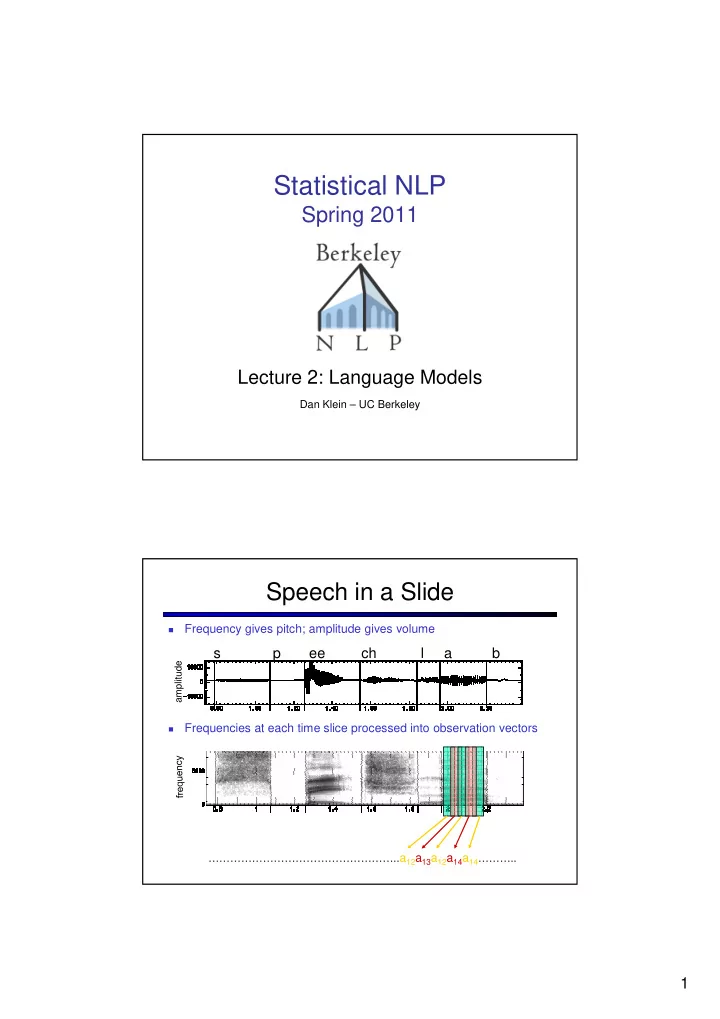
Statistical NLP Spring 2011 Lecture 2: Language Models Dan Klein UC Berkeley Speech in a Slide Frequency gives pitch; amplitude gives volume s p ee ch l a b amplitude Frequencies at


slide-1
SLIDE 1

1

Statistical NLP

Spring 2011

Lecture 2: Language Models

Dan Klein – UC Berkeley

  • Frequency gives pitch; amplitude gives volume
  • Frequencies at each time slice processed into observation vectors

s p ee ch l a b

amplitude

Speech in a Slide

……………………………………………..a12a13a12a14a14………..

slide-2
SLIDE 2

2

The Noisy-Channel Model

We want to predict a sentence given acoustics: The noisy channel approach:

Acoustic model: HMMs over word positions with mixtures

  • f Gaussians as emissions

Language model: Distributions over sequences

  • f words (sentences)

Acoustically Scored Hypotheses

the station signs are in deep in english

  • 14732

the stations signs are in deep in english

  • 14735

the station signs are in deep into english

  • 14739

the station 's signs are in deep in english

  • 14740

the station signs are in deep in the english

  • 14741

the station signs are indeed in english

  • 14757

the station 's signs are indeed in english

  • 14760

the station signs are indians in english

  • 14790

the station signs are indian in english

  • 14799

the stations signs are indians in english

  • 14807

the stations signs are indians and english

  • 14815
slide-3
SLIDE 3

3

ASR System Components

  • Translation: Codebreaking?

“Also knowing nothing official about, but having guessed and inferred considerable about, the powerful new mechanized methods in cryptography—methods which I believe succeed even when one does not know what language has been coded—one naturally wonders if the problem

  • f translation could conceivably be treated as a

problem in cryptography. When I look at an article in Russian, I say: ‘This is really written in English, but it has been coded in some strange symbols. I will now proceed to decode.’ ”

Warren Weaver (1955:18, quoting a letter he wrote in 1947)

slide-4
SLIDE 4

4

MT System Components

  • N-Gram Model Decomposition

Break sentence probability down (w/o deeper variables) Impractical to condition on everything before

P(??? | Turn to page 134 and look at the picture of the) ?

N-gram models: assume each word depends only on a short linear history Example:

slide-5
SLIDE 5

5

N-Gram Model Parameters

  • The parameters of an n-gram model:

The actual conditional probability estimates, we’ll call them θ Obvious estimate: relative frequency (maximum likelihood) estimate

  • General approach

Take a training set X and a test set X’ Compute an estimate θ from X Use it to assign probabilities to other sentences, such as those in X’ 198015222 the first 194623024 the same 168504105 the following 158562063 the world … 14112454 the door

  • 23135851162 the *

Training Counts

Higher Order N-grams?

3380 please close the door 1601 please close the window 1164 please close the new 1159 please close the gate … 0 please close the first

  • 13951 please close the *

198015222 the first 194623024 the same 168504105 the following 158562063 the world … 14112454 the door

  • 23135851162 the *

197302 close the window 191125 close the door 152500 close the gap 116451 close the thread 87298 close the deal

  • 3785230 close the *

Please close the door Please close the first window on the left

slide-6
SLIDE 6

6

Unigram Models

  • Simplest case: unigrams
  • Generative process: pick a word, pick a word, … until you pick STOP
  • As a graphical model:
  • Examples:
  • [fifth, an, of, futures, the, an, incorporated, a, a, the, inflation, most, dollars, quarter, in, is, mass.]
  • [thrift, did, eighty, said, hard, 'm, july, bullish]
  • [that, or, limited, the]
  • []
  • [after, any, on, consistently, hospital, lake, of, of, other, and, factors, raised, analyst, too, allowed,

mexico, never, consider, fall, bungled, davison, that, obtain, price, lines, the, to, sass, the, the, further, board, a, details, machinists, the, companies, which, rivals, an, because, longer, oakes, percent, a, they, three, edward, it, currier, an, within, in, three, wrote, is, you, s., longer, institute, dentistry, pay, however, said, possible, to, rooms, hiding, eggs, approximate, financial, canada, the, so, workers, advancers, half, between, nasdaq]

w1 w2 wn-1 STOP ………….

Bigram Models

  • Big problem with unigrams: P(the the the the) >> P(I like ice cream)!
  • Condition on previous single word:
  • Obvious that this should help – in probabilistic terms, we’re using weaker

conditional independence assumptions (what’s the cost?)

  • Any better?
  • [texaco, rose, one, in, this, issue, is, pursuing, growth, in, a, boiler, house, said, mr.,

gurria, mexico, 's, motion, control, proposal, without, permission, from, five, hundred, fifty, five, yen]

  • [outside, new, car, parking, lot, of, the, agreement, reached]
  • [although, common, shares, rose, forty, six, point, four, hundred, dollars, from, thirty,

seconds, at, the, greatest, play, disingenuous, to, be, reset, annually, the, buy, out, of, american, brands, vying, for, mr., womack, currently, sharedata, incorporated, believe, chemical, prices, undoubtedly, will, be, as, much, is, scheduled, to, conscientious, teaching]

  • [this, would, be, a, record, november]

w1 w2 wn-1 STOP

START
slide-7
SLIDE 7

7

Regular Languages?

N-gram models are (weighted) regular languages

Many linguistic arguments that language isn’t regular.

Long-distance effects: “The computer which I had just put into the machine room on the fifth floor ___.” Recursive structure

Why CAN we often get away with n-gram models?

PCFG LM (later):

[This, quarter, ‘s, surprisingly, independent, attack, paid, off, the, risk, involving, IRS, leaders, and, transportation, prices, .] [It, could, be, announced, sometime, .] [Mr., Toseland, believes, the, average, defense, economy, is, drafted, from, slightly, more, than, 12, stocks, .]

More N-Gram Examples

slide-8
SLIDE 8

8

Measuring Model Quality

The game isn’t to pound out fake sentences!

Obviously, generated sentences get “better” as we increase the model order More precisely: using ML estimators, higher order is always better likelihood on train, but not test

What we really want to know is:

Will our model prefer good sentences to bad ones? Bad ≠ ungrammatical! Bad ≈ unlikely Bad = sentences that our acoustic model really likes but aren’t the correct answer

Measuring Model Quality

The Shannon Game:

How well can we predict the next word? Unigrams are terrible at this game. (Why?)

“Entropy”: per-word test log likelihood (misnamed)

When I eat pizza, I wipe off the ____ Many children are allergic to ____ I saw a ____

grease 0.5 sauce 0.4 dust 0.05 …. mice 0.0001 …. the 1e-100 3516 wipe off the excess 1034 wipe off the dust 547 wipe off the sweat 518 wipe off the mouthpiece … 120 wipe off the grease 0 wipe off the sauce 0 wipe off the mice

  • 28048 wipe off the *
slide-9
SLIDE 9

9

Measuring Model Quality

Problem with “entropy”:

0.1 bits of improvement doesn’t sound so good “Solution”: perplexity Interpretation: average branching factor in model

Important notes:

It’s easy to get bogus perplexities by having bogus probabilities that sum to more than one over their event spaces. 30% of you will do this on HW1. Even though our models require a stop step, averages are per actual word, not per derivation step.

Measuring Model Quality (Speech)

Word Error Rate (WER) The “right” measure:

Task error driven For speech recognition For a specific recognizer!

Common issue: intrinsic measures like perplexity are easier to use, but extrinsic ones are more credible

Correct answer: Andy saw a part of the movie Recognizer output: And he saw apart of the movie

insertions + deletions + substitutions true sentence size

WER: 4/7 = 57%

slide-10
SLIDE 10

10

0.2 0.4 0.6 0.8 1 200000 400000 600000 800000 1000000 Number of Words Fraction Seen Unigrams Bigrams Rules

Sparsity

Problems with n-gram models:

New words appear all the time:

Synaptitute 132,701.03 multidisciplinarization

New bigrams: even more often Trigrams or more – still worse!

Zipf’s Law

Types (words) vs. tokens (word occurences) Broadly: most word types are rare ones Specifically:

Rank word types by token frequency Frequency inversely proportional to rank

Not special to language: randomly generated character strings have this property (try it!)

Parameter Estimation

  • Maximum likelihood estimates won’t get us very far
  • Need to smooth these estimates
  • General method (procedurally)

Take your empirical counts Modify them in various ways to improve estimates

  • General method (mathematically)

Often can give estimators a formal statistical interpretation … but not always Approaches that are mathematically obvious aren’t always what works

3516 wipe off the excess 1034 wipe off the dust 547 wipe off the sweat 518 wipe off the mouthpiece … 120 wipe off the grease 0 wipe off the sauce 0 wipe off the mice

  • 28048 wipe off the *
slide-11
SLIDE 11

11

Smoothing

  • We often want to make estimates from sparse statistics:
  • Smoothing flattens spiky distributions so they generalize better
  • Very important all over NLP, but easy to do badly!
  • We’ll illustrate with bigrams today (h = previous word, could be anything).

P(w | denied the) 3 allegations 2 reports 1 claims 1 request 7 total

allegations

charges motion benefits

allegations reports claims

charges

request

motion benefits

allegations reports

claims

request

P(w | denied the) 2.5 allegations 1.5 reports 0.5 claims 0.5 request 2 other 7 total

Smoothing: Add-One, Etc.

  • Classic solution: add counts (Laplace smoothing / Dirichlet prior)

Add-one smoothing especially often talked about

  • For a bigram distribution, can add counts shaped like the unigram:
  • Can consider hierarchical formulations: trigram is recursively

centered on smoothed bigram estimate, etc [MacKay and Peto, 94]

  • Can be derived from Dirichlet / multinomial conjugacy: prior shape

shows up as pseudo-counts

  • Problem: works quite poorly!
slide-12
SLIDE 12

12

Held-Out Data

  • Important tool for optimizing how models generalize:

Set a small number of hyperparameters that control the degree of smoothing by maximizing the (log-)likelihood of held-out data Can use any optimization technique (line search or EM usually easiest)

  • Examples:

Training Data Held-Out Data Test Data k L

Held-Out Reweighting

  • What’s wrong with add-d smoothing?
  • Let’s look at some real bigram counts [Church and Gale 91]:
  • Big things to notice:

Add-one vastly overestimates the fraction of new bigrams Add-0.0000027 vastly underestimates the ratio 2*/1*

  • One solution: use held-out data to predict the map of c to c*

Count in 22M Words Actual c* (Next 22M) Add-one’s c* Add-0.0000027’s c* 1 0.448 2/7e-10 ~1 2 1.25 3/7e-10 ~2 3 2.24 4/7e-10 ~3 4 3.23 5/7e-10 ~4 5 4.21 6/7e-10 ~5 Mass on New 9.2% ~100% 9.2% Ratio of 2/1 2.8 1.5 ~2

slide-13
SLIDE 13

13

  • Kneser-Ney smoothing: very successful estimator using two ideas
  • Idea 1: observed n-grams occur more in training than they will later:
  • Absolute Discounting

No need to actually have held-out data; just subtract 0.75 (or some d) Maybe have a separate value of d for very low counts

Kneser-Ney: Discounting

Count in 22M Words Future c* (Next 22M) 1 0.448 2 1.25 3 2.24 4 3.23

Kneser-Ney: Continuation

  • Idea 2: Type-based fertility

Shannon game: There was an unexpected ____?

delay? Francisco?

“Francisco” is more common than “delay” … but “Francisco” always follows “San” … so it’s less “fertile”

  • Solution: type-continuation probabilities

In the back-off model, we don’t want the probability of w as a unigram Instead, want the probability that w is allowed in a novel context For each word, count the number of bigram types it completes

slide-14
SLIDE 14

14

Kneser-Ney

Kneser-Ney smoothing combines these two ideas

Absolute discounting Lower order continuation probabilities

KN smoothing repeatedly proven effective [Teh, 2006] shows KN smoothing is a kind of approximate inference in a hierarchical Pitman-Yor process (and better approximations are superior to basic KN)

Predictive Distributions

Parameter estimation: With parameter variable: Predictive distribution:

a b c a

θ = P(w) = [a:0.5, b:0.25, c:0.25]

a b c a Θ a b c a Θ

W

slide-15
SLIDE 15

15

Hierarchical Models

a b c c c b b c

Θ0 Θb Θc Θa

a b a

Θd [MacKay and Peto, 94]

“Chinese Restaurant Process”

Pitman-Yor Processes

[Teh, 06, diagrams from Teh]

P k ∝ c P ∝ α P w θw /V P k ∝ c − d P ∝ α dK Dirichlet Process Pitman-Yor Process

slide-16
SLIDE 16

16

What Actually Works?

  • Trigrams and beyond:
  • Unigrams, bigrams

generally useless

  • Trigrams much better (when

there’s enough data)

  • 4-, 5-grams really useful in

MT, but not so much for speech

  • Discounting
  • Absolute discounting, Good-

Turing, held-out estimation, Witten-Bell, etc…

  • Context counting
  • Kneser-Ney construction
  • flower-order models
  • See [Chen+Goodman]

reading for tons of graphs…

[Graphs from Joshua Goodman]

Data >> Method?

  • Having more data is better…
  • … but so is using a better estimator
  • Another issue: N > 3 has huge costs in speech recognizers

5.5 6 6.5 7 7.5 8 8.5 9 9.5 10 1 2 3 4 5 6 7 8 9 10 20 n-gram order Entropy

100,000 Katz 100,000 KN 1,000,000 Katz 1,000,000 KN 10,000,000 Katz 10,000,000 KN all Katz all KN

slide-17
SLIDE 17

17

Tons of Data?