Statistical NLP Spring 2011 Lecture 5: Speech Recognition II Dan - - PDF document

statistical nlp
SMART_READER_LITE
LIVE PREVIEW

Statistical NLP Spring 2011 Lecture 5: Speech Recognition II Dan - - PDF document

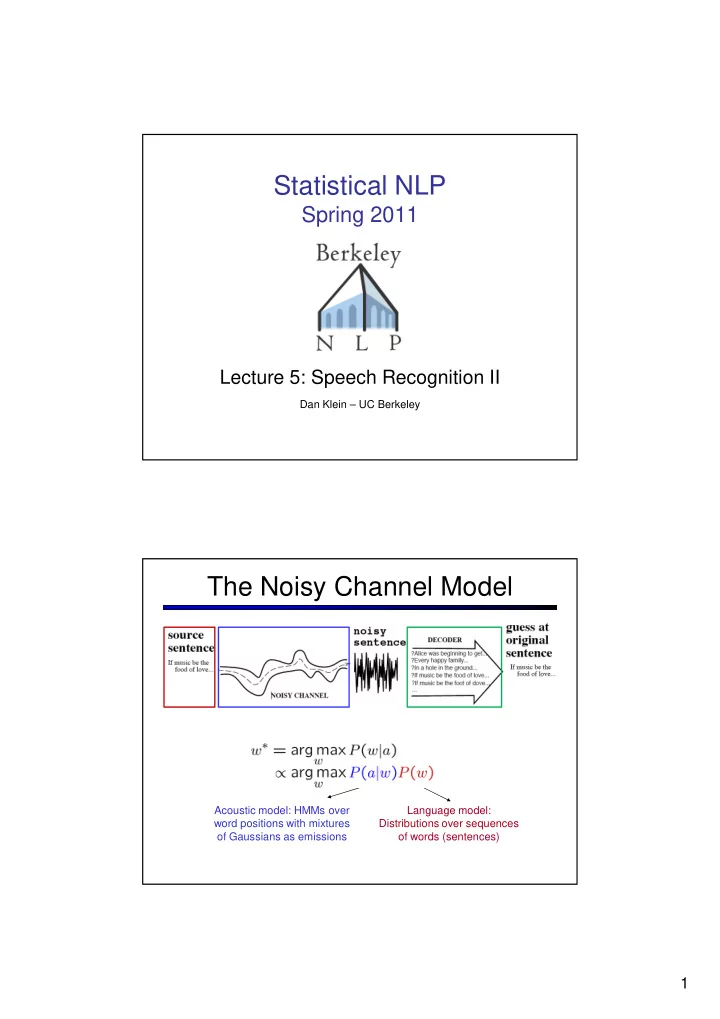
Statistical NLP Spring 2011 Lecture 5: Speech Recognition II Dan Klein UC Berkeley The Noisy Channel Model Acoustic model: HMMs over Language model: word positions with mixtures Distributions over sequences of Gaussians as emissions of


slide-1
SLIDE 1

1

Statistical NLP

Spring 2011

Lecture 5: Speech Recognition II

Dan Klein – UC Berkeley

The Noisy Channel Model

Acoustic model: HMMs over word positions with mixtures

  • f Gaussians as emissions

Language model: Distributions over sequences

  • f words (sentences)
slide-2
SLIDE 2

2

Speech Recognition Architecture Digitizing Speech

slide-3
SLIDE 3

3

Frame Extraction

A frame (25 ms wide) extracted every 10 ms

25 ms 10ms

. . .

a1 a2 a3

Figure from Simon Arnfield

Mel Freq. Cepstral Coefficients

  • Do FFT to get spectral information

Like the spectrogram/spectrum we saw earlier

  • Apply Mel scaling

Models human ear; more sensitivity in lower freqs Approx linear below 1kHz, log above, equal samples above and below 1kHz

  • Plus discrete cosine transform

[Graph from Wikipedia]

slide-4
SLIDE 4

4

Final Feature Vector

39 (real) features per 10 ms frame:

12 MFCC features 12 delta MFCC features 12 delta-delta MFCC features 1 (log) frame energy 1 delta (log) frame energy 1 delta-delta (log frame energy)

So each frame is represented by a 39D vector

HMMs for Continuous Observations

  • Before: discrete set of observations
  • Now: feature vectors are real-valued
  • Solution 1: discretization
  • Solution 2: continuous emissions

Gaussians Multivariate Gaussians Mixtures of multivariate Gaussians

  • A state is progressively

Context independent subphone (~3 per phone) Context dependent phone (triphones) State tying of CD phone

slide-5
SLIDE 5

5

Vector Quantization

  • Idea: discretization

Map MFCC vectors

  • nto discrete symbols

Compute probabilities just by counting

  • This is called vector

quantization or VQ

  • Not used for ASR any

more; too simple

  • But: useful to consider

as a starting point

Gaussian Emissions

  • VQ is insufficient for real

ASR

  • Hard to cover high-

dimensional space with codebook

  • Moves too much

ambiguity from the model to the preprocessing?

  • Instead: assume the

possible values of the

  • bservation vectors are

normally distributed.

  • Represent the
  • bservation likelihood

function as a Gaussian? From bartus.org/akustyk

slide-6
SLIDE 6

6

Gaussians for Acoustic Modeling

P(x):

P(x) x P(o) is highest here at mean P(o) is low here, far from mean

A Gaussian is parameterized by a mean and a variance:

Multivariate Gaussians

Instead of a single mean µ and variance σ2: Vector of means µ and covariance matrix Σ Usually assume diagonal covariance (!)

This isn’t very true for FFT features, but is often OK for MFCC features

slide-7
SLIDE 7

7

Gaussians: Size of Σ

µ = [0 0] µ = [0 0] µ = [0 0] Σ = I Σ = 0.6I Σ = 2I As Σ becomes larger, Gaussian becomes more spread out; as Σ becomes smaller, Gaussian more compressed

Text and figures from Andrew Ng

Gaussians: Shape of Σ

As we increase the off diagonal entries, more correlation between value of x and value of y

Text and figures from Andrew Ng

slide-8
SLIDE 8

8

But we’re not there yet

Single Gaussians may do a bad job of modeling a complex distribution in any dimension Even worse for diagonal covariances Solution: mixtures of Gaussians

From openlearn.open.ac.uk

Mixtures of Gaussians

M mixtures of Gaussians:

From robots.ox.ac.uk http://www.itee.uq.edu.au/~comp4702

slide-9
SLIDE 9

9

GMMs

Summary: each state has an emission distribution P(x|s) (likelihood function) parameterized by:

M mixture weights M mean vectors of dimensionality D Either M covariance matrices of DxD or M Dx1 diagonal variance vectors

HMMs for Speech

slide-10
SLIDE 10

10

Phones Aren’t Homogeneous

Time (s) 0.48152 0.937203 5000 Frequency (Hz) ay k

Need to Use Subphones

slide-11
SLIDE 11

11

A Word with Subphones Modeling phonetic context

w iy r iy m iy n iy

slide-12
SLIDE 12

12

“Need” with triphone models ASR Lexicon: Markov Models

slide-13
SLIDE 13

13

Markov Process with Bigrams

Figure from Huang et al page 618

Training Mixture Models

Input: wav files with unaligned transcriptions Forced alignment

Computing the “Viterbi path” over the training data (where the transcription is known) is called “forced alignment” We know which word string to assign to each observation sequence. We just don’t know the state sequence. So we constrain the path to go through the correct words (by using a special example-specific language model) And otherwise run the Viterbi algorithm

Result: aligned state sequence

slide-14
SLIDE 14

14

Lots of Triphones

Possible triphones: 50x50x50=125,000 How many triphone types actually occur? 20K word WSJ Task (from Bryan Pellom)

Word internal models: need 14,300 triphones Cross word models: need 54,400 triphones

Need to generalize models, tie triphones

State Tying / Clustering

[Young, Odell, Woodland 1994] How do we decide which triphones to cluster together? Use phonetic features (or ‘broad phonetic classes’)

Stop Nasal Fricative Sibilant Vowel lateral

slide-15
SLIDE 15

15

State Tying

Creating CD phones:

Start with monophone, do EM training Clone Gaussians into triphones Build decision tree and cluster Gaussians Clone and train mixtures (GMMs)

General idea:

Introduce complexity gradually Interleave constraint with flexibility

Standard subphone/mixture HMM

Temporal Structure Gaussian Mixtures

Model

Error rate

HMM Baseline 25.1%

slide-16
SLIDE 16

16

An Induced Model

Standard Model

Single Gaussians Fully Connected

[Petrov, Pauls, and Klein, 07]

Hierarchical Split Training with EM

32.1% 28.7% 25.6%

HMM Baseline 25.1% 5 Split rounds 21.4%

23.9%

slide-17
SLIDE 17

17

Refinement of the /ih/-phone Refinement of the /ih/-phone

slide-18
SLIDE 18

18

Refinement of the /ih/-phone

  • ae

ao ay eh er ey ih f r s sil aa ah ix iy z cl k sh n vcl

  • w

l m t v uw aw ax ch w th el dh uh p en

  • y

hh jh ng y b d dx g zh epi

HMM states per phone

slide-19
SLIDE 19

19

Inference

State sequence:

d1-d6-d6-d4-ae5-ae2-ae3-ae0-d2-d2-d3-d7-d5

Phone sequence:

d - d - d -d -ae - ae - ae - ae - d - d -d - d - d

Transcription

d - ae - d

Viterbi Variational ???