Statements of Functional Expenses for Non-Profits Best Practices for - - PowerPoint PPT Presentation

statements of functional expenses for non profits
SMART_READER_LITE
LIVE PREVIEW

Statements of Functional Expenses for Non-Profits Best Practices for - - PowerPoint PPT Presentation

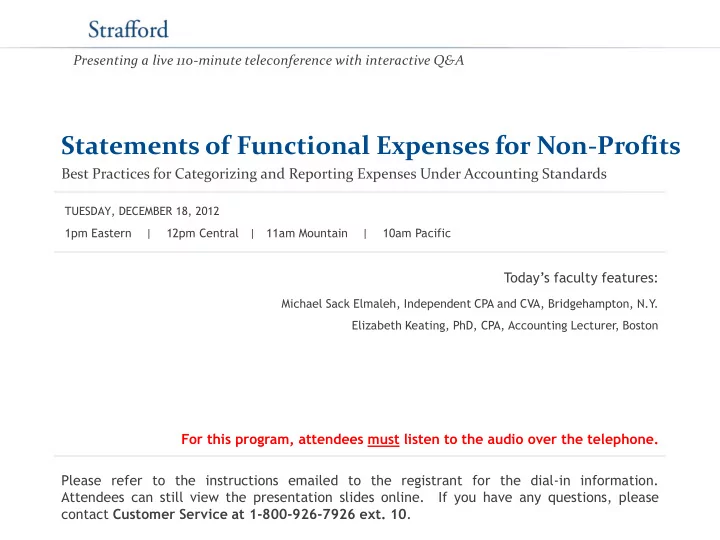
Presenting a live 110-minute teleconference with interactive Q&A Statements of Functional Expenses for Non-Profits Best Practices for Categorizing and Reporting Expenses Under Accounting Standards TUESDAY, DECEMBER 18, 2012 1pm Eastern |


slide-1
SLIDE 1

Statements of Functional Expenses for Non-Profits

Best Practices for Categorizing and Reporting Expenses Under Accounting Standards

Today’s faculty features:

1pm Eastern | 12pm Central | 11am Mountain | 10am Pacific

Please refer to the instructions emailed to the registrant for the dial-in information. Attendees can still view the presentation slides online. If you have any questions, please contact Customer Service at 1-800-926-7926 ext. 10.

TUESDAY, DECEMBER 18, 2012

Presenting a live 110-minute teleconference with interactive Q&A

Michael Sack Elmaleh, Independent CPA and CVA, Bridgehampton, N.Y . Elizabeth Keating, PhD, CPA, Accounting Lecturer, Boston

For this program, attendees must listen to the audio over the telephone.

slide-2
SLIDE 2

Tips for Optimal Quality

Sound Quality Call in on the telephone by dialing 1-866-869-6667, and enter your PIN when prompted. If you have any difficulties during the call, press *0 for assistance. You may also send us a chat or e-mail sound@straffordpub.com immediately so we can address the problem. Viewing Quality To maximize your screen, press the F11 key on your keyboard. To exit full screen, press the F11 key again.

slide-3
SLIDE 3

Continuing Education Credits

Attendees must stay on the line throughout the program, including the Q & A session, in order to qualify for a full continuing education credits. Strafford is required to monitor attendance. Please refer to the instructions emailed to the registrant for additional

  • information. If you have any questions, please contact Customer Service

at 1-800-926-7926 ext. 10.

FOR LIVE EVENT ONLY

slide-4
SLIDE 4

Program Materials

If you have not printed the conference materials for this program, please complete the following steps:

  • Click on the + sign next to “Conference Materials” in the middle of the left-

hand column on your screen.

  • Click on the tab labeled “Handouts” that appears, and there you will see a

PDF of the slides and the Official Record of Attendance for today's program.

  • Double-click on the PDF and a separate page will open.
  • Print the slides by clicking on the printer icon.
slide-5
SLIDE 5

Statements of Functional Expenses for Non-Profits Seminar

Michael Sack Elmaleh, CPA, CVA mselmaleh@gmail.com

  • Dec. 18, 2012

Elizabeth Keating, PhD, CPA liz-keating@comcast.net

slide-6
SLIDE 6

Today’s Program

Trends Of Note With SFEs [Elizabeth Keating] Standards Governing Preparation Of An SFE [Michael Sack Elmaleh] Fundamental Problems of Functional Allocation [Michael Sack Elmaleh] Slide 8 – Slide 16 Slide 17 – Slide 25 Slide 26 – Slide 30

slide-7
SLIDE 7

Notice

ANY TAX ADVICE IN THIS COMMUNICATION IS NOT INTENDED OR WRITTEN BY THE SPEAKERS’ FIRMS TO BE USED, AND CANNOT BE USED, BY A CLIENT OR ANY OTHER PERSON OR ENTITY FOR THE PURPOSE OF (i) AVOIDING PENALTIES THAT MAY BE IMPOSED ON ANY TAXPAYER OR (ii) PROMOTING, MARKETING OR RECOMMENDING TO ANOTHER PARTY ANY MATTERS ADDRESSED HEREIN.

You (and your employees, representatives, or agents) may disclose to any and all persons, without limitation, the tax treatment or tax structure, or both, of any transaction described in the associated materials we provide to you, including, but not limited to, any tax opinions, memoranda, or other tax analyses contained in those materials. The information contained herein is of a general nature and based on authorities that are subject to change. Applicability of the information to specific situations should be determined through consultation with your tax adviser.

slide-8
SLIDE 8

TRENDS OF NOTE WITH SFEs

Elizabeth Keating, PhD, CPA

slide-9
SLIDE 9

Statement Of Functional Expenses

  • Relied upon to assess

management quality and financial management

  • Detailed breakdown of

expenses

  • Expenses as defined by the

IRS (not GAAP)

  • Three functional expense

categories  Program service  Management and general  Fundraising

  • 23 natural categories (and
  • ther)

9

slide-10
SLIDE 10

Spotlight On Functional Expense Mix

  • Watchdog agencies, such as

Guidestar and Charity Navigator, focus users attention on a mix of functional expenses.

  • Research has shown:

 Donors do rely on this information to make decisions.  Firms benefit from higher program service ratios.

Red Cross

Functional expense mix

Program 92.2% Administration 4.0% Fundraising 3.7%

Source: Charity Navigator

10

slide-11
SLIDE 11

Extent Of Misreporting

Urban Institute’s Nonprofit Overhead Cost Study While this study is from the early 2000s, research suggests these poor reporting practices persist.

  • 37% percent of non-profits with at least $50,000 in contributions report zero

fundraising costs.

  • 25% of non-profits reporting $1 to $5 million in contributions report zero

fundraising costs.

  • 13% of non-profits report zero management and general expenses.
  • 7% percent charged all accounting fees to program.
  • 20% split them across more than one category, even though Form 990

instructions give accounting fees as an example of what is meant by management.

11

slide-12
SLIDE 12

Errors Or Intentional Manipulation?

  • High-profile cases of excessive compensation, inappropriate

related-party transactions, telemarketers that keep 100% of funds raised

  • Pervasive view majority of misreporting is intentional;

however,

  • Recent research suggests problems observed in small
  • rganizations may largely be errors due to a lack of education

and skills. ― Keating et al., “Misreporting Fundraising: How Do Nonprofit Organizations Account for Telemarketing Campaigns?”

12

slide-13
SLIDE 13

Incorrect Accounting Practices: Mis-Assigning Costs Using Direct Identification

Examples:

  • Record all or most accounting, legal, depreciation, insurance

lobbying in program expenses.

  • Classify certain development costs as educational (hence, a

program cost) Result:

  • Program expenses overstated
  • Fundraising and/or administrative expenses understated

13

slide-14
SLIDE 14

Incorrect Accounting Practices: Misallocating Joint Costs

Examples:

  • Allocate executive director salary and benefits based on

“perceived” time expenditure

  • Selection allocation method after first determining which one

favors program over fundraising and administrative costs Result:

  • Program expenses overstated
  • Fundraising and/or administrative expenses understated

14

slide-15
SLIDE 15

Incorrect Accounting Practices: Mis-Categorizing Cost To Another Natural Type

Examples:

  • Record professional fundraising services as advertising and

promotion or management fees Result:

  • Selected “high profile” rows are understated.
  • Others are overstated.

15

slide-16
SLIDE 16

Incorrect Accounting Practices: Misclassifying Expense As A Contra-Revenue

Examples:

  • Record fundraising expenses as deduction to a special event

Result:

  • Fundraising or administrative expenses understated
  • Total expenses understated
  • Revenues understated

16

slide-17
SLIDE 17

STANDARDS GOVERNING PREPARATION OF AN SFE

Michael Sack Elmaleh, CPA, CVA

slide-18
SLIDE 18

The SFE: In Search Of An Efficiency Measure

The income statement of a for-profit enterprise provides a basic, albeit sometimes crude and approximate, measure of efficiency. If the statement shows a profit, a certain degree of efficiency can be inferred. This is not the case for most non-profits, for which the goal is not to earn a profit but rather to provide charitable goods or services. The SFE was developed to provide an approximate measure of efficiency for non-profits, by dividing expenses into three major categories:

  • Program
  • Administrative
  • Fund Raising

18

slide-19
SLIDE 19

GAAP – SFAS No. 117

I. FASB as GAAP standard-setter

  • II. Enforecability of GAAP standards: The attest function
  • III. Required financial statements
  • A. Statement of financial position
  • B. Statement of activities
  • C. Statement of cash flow
  • IV. Voluntary health and welfare entities are required to report

expenses by function as well as by natural classification. This requirement gives rise to the SFE.

  • V. Natural vs. functional expense

19

slide-20
SLIDE 20

Basic GAAP Definitions

  • Program dervices: Activities that result in goods and services

distributed to beneficiaries, customers or members that fulfill the organizations mission

  • Management and general: Activities included oversight,

management, recordkeeping, budgeting, financing and related administration

  • Fundraising: Activities include publicizing and conducting

fundraising campaigns

20

slide-21
SLIDE 21

IRS Form 990

  • Form 990: Open to the public
  • SFE incorporated into the form
  • Basic categories consistent with FAS 117, with clarifications
  • Published magazine with advertising is a program expense.
  • Costs to secure grants are deemed program expenses.
  • Management expenses include board of director costs, legal and

accounting, liability insurance, office management, auditing and human resources.

  • Fundraising expenses: Employees working in programs and fundraising

must reasonably allocate compensation-related expenses.

  • Instructions provide detailed natural classification account

descriptions.

21

slide-22
SLIDE 22

Joint Costs, SOP 98-2

  • Joint activity involves a multiple-purpose expense, usually combining

program and fundraising purposes. Example: Issuing a mailer with a petition and fundraising appeal

  • The SOP is designed to determine guidelines as to when it is

appropriate to allocate the costs of such activities other than to fundraising.

  • The “default” assumption is that if an activity involves fundraising,

then all the expenses should be allocated to fundraising.

  • To overcome this default assumption, three tests have to be met:

Purpose, audience and content.

  • The purpose test states that the activity is seeking to accomplish

something other than fundraising. Three sub-tests must be met to pass the purpose criterion. The compensation test states that if any

  • f the compensation paid on that activity is tied to the amount of

funds raised, then the entire activity is deemed fundraising.

22

slide-23
SLIDE 23

Joint Costs, SOP 98-2 (Cont.)

  • A second sub-test in applying the purpose criterion is the similar-

function/similar-scale/same medium test. This test states that the

  • rganization must have been willing to use essentially the same

medium at the same scale, without a fundraising component. As this test involves a counter-factual analysis of management intent, it is functionally useless.

  • A third sub-test involves other evidence, which again is of little help.
  • A second criterion is the audience test. The question to be answered:

Was the target audience chosen primarily for their potential as donors, or because they were needed for some program purpose? Again, because applying this criterion entails having to consider management judgment or intent, it is not a barrier to abuse.

  • The third criterion is the content test. The activity meets this

criterion if the content supports program functions. The key element that must be present is a call to action, such as signing a petition or calling for volunteers.

23

slide-24
SLIDE 24

Joint Costs, SOP 98-2 (Cont.)

  • It should be apparent that these criteria are difficult to apply,

and the only sure way to disqualify an activity is to hire professional fundraisers who get paid on commission. Short of that, it is very easy for an organization to add a petition or call for some other action to what is essentially a fundraising campaign, and qualify to classify some of the costs as program and not fundraising.

  • The SOP does not specify any particular method of allocating

joint costs, other than indicating that they should be rational and systematic.

24

slide-25
SLIDE 25

Joint Cost: Fundraising Example

Example: Onandon is a charitable group devoted to assisting traumatized victims of over-talking. In addition to providing support and treatment groups, the organization supports legislation to combat

  • ver-talking in the society at large. They annually send a 10,000-

piece direct mailing that cost them $25,000. In the mailing, along with a request for funds, they include a newsletter and an appeal to supporters to contact their congressperson to vote for a reform law that would limit the length of election campaigns to three weeks. They expect to collect $40,000 from the mailing. So, after costs, they net only $15,000 on the mailing. If the cost of the mailing is fully allocated to fundraising expense, it would appear that only 38% of raised funds go to program purposes ($15,000/40,000). On the other hand, if they divide the cost of the mailing equally between fundraising and program expense, then the ratio looks much better. Now it would appear that 75% of the funds raised go to program purposes ($15,000/$20,000).

25

slide-26
SLIDE 26

FUNDAMENTAL PROBLEMS OF FUNCTIONAL ALLOCATION

Michael Sack Elmaleh, CPA, CVA

slide-27
SLIDE 27

Allocating Personnel Costs

  • Most smaller local non-profits do not engage in the kinds of

large-scale fundraising activities that SOP 98-2 addresses. Nonetheless, even these smaller non-profits face allocation questions, due to the fact that staff perform multiple

  • functions. For example, executive directors are likely to

perform management, fundraising and program tasks. Even lower-level program staff will engage in a mix of functional activities.

  • Clearly, the most rational way to allocate compensation cost of

staff performing multiple functions is based on time. Accurate allocation will therefore depend on accurate time-tracking. Obviously, the accuracy and sophistication of time-tracking will vary considerably from organization to organization.

27

slide-28
SLIDE 28

Key Ratios Based On SFE

  • Program efficiency ratio: Program expenses/total expenses
  • Fundraising efficiency ratio: Contributions/fundraising

expenses

  • GIGO applies: The ratios are meaningful only to the extent

that the SFE reflects accurate allocations between the functional categories

28

slide-29
SLIDE 29

Accurate SFE Allocations Are Self-Enforcing

  • As pointed out earlier, even audited SFEs contain unreliable
  • allocations. The primary focus of auditing is still the statement
  • f position.
  • IRS 990 audits are not a priority, and on those audits that do
  • ccur, the major concern is not the accuracy of the SFE.
  • The guidance on allocation such as SOP 98-2 is not all that

stringent.

  • Conclusion: Accuracy of SFEs depends on the integrity and

competence of non-profit management.

29

slide-30
SLIDE 30

Non-SFE Indications Of Too Much Fundraising Expense

As a donor, you can catch on fairly quickly as to whether your favorite charity is spending too much on fundraising. Here are some indicators:

  • Do you have a 200-year supply of address labels provided by the charity?
  • Do you receive three times as many phone calls from your charity asking

for funds as you do calls from your friends and relatives?

  • Does your charity request annual membership renewals two months after

you paid your annual dues?

  • Has your charity sold your name and address to 100 other non-profits, so

now you receive four times as many direct mail solicitations as personal mail?

  • Do you have to increase your anti-anxiety meds every time you receive a

new “call to action” from your favorite advocacy group, warning you that if you do not give them more money civilization as we know it will come to an end?

30