State Tax Incentives: Structuring Activities to Take Advantage of - - PowerPoint PPT Presentation

state tax incentives structuring activities to take
SMART_READER_LITE
LIVE PREVIEW

State Tax Incentives: Structuring Activities to Take Advantage of - - PowerPoint PPT Presentation

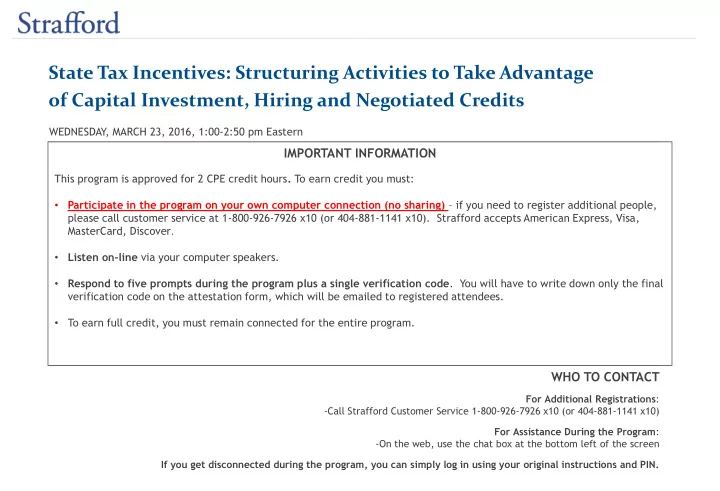
State Tax Incentives: Structuring Activities to Take Advantage of Capital Investment, Hiring and Negotiated Credits WEDNESDAY , MARCH 23, 2016, 1:00-2:50 pm Eastern IMPORTANT INFORMATION This program is approved for 2 CPE credit hours . To earn


slide-1
SLIDE 1

WHO TO CONTACT

For Additional Registrations:

  • Call Strafford Customer Service 1-800-926-7926 x10 (or 404-881-1141 x10)

For Assistance During the Program:

  • On the web, use the chat box at the bottom left of the screen

If you get disconnected during the program, you can simply log in using your original instructions and PIN.

IMPORTANT INFORMATION

This program is approved for 2 CPE credit hours. To earn credit you must:

  • Participate in the program on your own computer connection (no sharing) – if you need to register additional people,

please call customer service at 1-800-926-7926 x10 (or 404-881-1141 x10). Strafford accepts American Express, Visa, MasterCard, Discover.

  • Listen on-line via your computer speakers.
  • Respond to five prompts during the program plus a single verification code. You will have to write down only the final

verification code on the attestation form, which will be emailed to registered attendees.

  • To earn full credit, you must remain connected for the entire program.

State Tax Incentives: Structuring Activities to Take Advantage

  • f Capital Investment, Hiring and Negotiated Credits

WEDNESDAY , MARCH 23, 2016, 1:00-2:50 pm Eastern

slide-2
SLIDE 2

Tips for Optimal Quality

Sound Quality When listening via your computer speakers, please note that the quality

  • f your sound will vary depending on the speed and quality of your internet connection.

If the sound quality is not satisfactory, please e-mail sound@straffordpub.com immediately so we can address the problem. Viewing Quality To maximize your screen, press the F11 key on your keyboard. To exit full screen, press the F11 key again.

FOR LIVE EVENT ONLY

slide-3
SLIDE 3

March 23, 2016

State Tax Incentives

Zach Kimball, Managing Director, Business Development DevelopmentAdvisors z.kimball@dai-locates.com Patric S. Zimmer , President DevelopmentAdvisors pzimmer@dai-locates.com Jennifer A. Zimmerman, Attorney Horwood Marcus & Berk Chartered jzimmerman@hmblaw.com

slide-4
SLIDE 4

Notice

ANY TAX ADVICE IN THIS COMMUNICATION IS NOT INTENDED OR WRITTEN BY THE SPEAKERS’ FIRMS TO BE USED, AND CANNOT BE USED, BY A CLIENT OR ANY OTHER PERSON OR ENTITY FOR THE PURPOSE OF (i) AVOIDING PENALTIES THAT MAY BE IMPOSED ON ANY TAXPAYER OR (ii) PROMOTING, MARKETING OR RECOMMENDING TO ANOTHER PARTY ANY MATTERS ADDRESSED HEREIN.

You (and your employees, representatives, or agents) may disclose to any and all persons, without limitation, the tax treatment or tax structure, or both, of any transaction described in the associated materials we provide to you, including, but not limited to, any tax opinions, memoranda, or other tax analyses contained in those materials. The information contained herein is of a general nature and based on authorities that are subject to change. Applicability of the information to specific situations should be determined through consultation with your tax adviser.

slide-5
SLIDE 5

DAI Development Advisors: Incentive Overview and Value add for Your Clients

slide-6
SLIDE 6

DevelopmentAdvisors (DAI)

Agenda:

1) Incentive Overview 2) Types of Incentives 3) The Process/Common Mistakes 4) Case Studies 5) States for Incentive Focus

Location Analysis & Selection Incentive Analysis & Negotiations Real Estate Advisory

6

slide-7
SLIDE 7

His istory ry of f Tax Cr Credit its

  • 1ST state tax credit:
  • In 1791 when New Jersey offered Alexander Hamilton a tax abatement to locate

his manufacturing plant in New Jersey.

  • Since this early incentive, states have often used credits and other incentives to

attract businesses.

  • Presently, 46 states offer some type of corporate income tax credit or incentive .

7

slide-8
SLIDE 8

In Incentive Negotiation Overview

Granting Entities

  • Federal, State, Local, Public and Private

Triggering Events

  • Market Entry
  • Expansion
  • Routine Capex
  • Relocations/Consolidation
  • Mergers and Acquisition

Incentive Packages/Capital Investment

  • DAI typically secures and incentive

package of at least 10% - 20% of Capital Investment

  • DAI routinely negotiates packages that

are 2 to 3 times client expectations

Negotiation Process:

  • 1. Package the project
  • 2. Present the project to all entities with

funds to support the project

  • 3. Maximize incentives through

negotiations

  • 4. Secure government approvals and

negotiate performance agreements

  • 5. Announce the project with

government officials

  • 6. Document compliance requirements

to ensure incentives are received

8

slide-9
SLIDE 9

Types of f In Incentives

Statutory – “By Right”

  • Incentives provided to companies by

matter of law

  • Typically provided via state income tax

credits

Statutory – “Negotiated”

  • Incentive programs which are provided

by statute, however, the value is negotiated on a case-by-case basis

  • Examples:
  • Training Grants
  • Property Tax Reductions
  • Payroll Tax Reimbursements

Discretionary Incentives

  • Incentives that are only offered

when negotiated in conjunction with a competitive project

  • Examples:
  • Land/Property Donations
  • Cash Grants
  • Site Preparation Grants
  • Utility Rate Reductions
  • Infrastructure Upgrades
  • Railway Extensions
  • Port Fee Reductions
  • Fee Waivers

9

slide-10
SLIDE 10

Types of f In Incentives: Statutory By Right

These are incentives that are provided by matter of law and are typically in the form of tax credits including:

  • Income Tax Credit
  • Jobs Tax Credit
  • Renewable Energy Tax Credit
  • Research and Development Tax

Credit

  • Film Production Tax Credit (MD)
  • Corporate Business Tax Credit

(Conn)

  • Technology Commercialization

Tax Credit (LA)

10

slide-11
SLIDE 11

Statutory ry By Right Example

An Example of Statutory By Right tax credits in the form of Corporate Business would be: 1) A tax credit for financial institutions hiring new employees, equal to up to 50% of the financial services tax for up to 10 years 2) 5% credit for fixed capital investment in tangible personal property 3) 5% credit for investments in employee training, childcare, facilities and donation to higher education for advancement in technology; 4) 10% credit for increased investment in machinery and equipment for companies with 250 or fewer full-time permanent Connecticut employees

11

slide-12
SLIDE 12

In Investment In Incentiv ives

  • Pre-Requisites
  • Capital Investment, Job Creation or Both
  • Eligibility
  • Location
  • State-Wide Offering
  • Enterprise Zones
  • Activity or Industry
  • Manufacturing credits
  • Headquarter credits
  • Special Purpose Zones
  • Job Creation

12

slide-13
SLIDE 13

In Investment In Incentiv ives

13 13

slide-14
SLIDE 14

Poin int of f Hir ire In Incentiv ives

  • Offered on federal and state level
  • Includes incentives for hiring persons that live and/or work in designated areas as

well as for hiring targeted demographics

  • Temporary Assistance- Needy Families Recipients
  • Veterans
  • Ex-felons
  • Individuals receiving SNAP
  • Individuals working or living in same zone

14

slide-15
SLIDE 15

Rese search and Develo lopment Cr Credit its

  • Offered on federal level- on which most states model their programs.
  • Federal credit is for wages and supply costs paid in connection with qualifying

research expenditures (QRE).

  • Typically, the credit equals a percentage of qualified R&D expenditures in excess of a

base amount.

  • Documentation is critical- highly audited.

15

slide-16
SLIDE 16

Jo Job and R&D In Incentiv ives

16 16

slide-17
SLIDE 17

Train inin ing Cr Credit its

  • Typically allow business to take a credit for certain % of total annual training costs for each

eligible employee

  • While most are claimed against income, some are refundable or are claimed against

withholding tax.

  • Qualified expenditures- instructor costs, instructional materials, supplies, manuals, media

and dedicated equipment.

17

slide-18
SLIDE 18

Envir ironmental l In Incentiv ives

  • State programs are very specific and can differ widely, but they can be broke down

into 2 categories:

  • Renewables- use of energy from natural resources
  • Energy Efficiency- reduce one’s “carbon footprint”
  • State tax breaks usually come in four main types:
  • Sales tax exemptions
  • Ex. Many states specifically exempt purchases of energy efficient products
  • r renewable energy equipment- CA, WA
  • Income tax credits or deductions
  • Ex. OR Business Energy Tax Credit, AZ Non-Residential Solar and Non-

Wind Tax Credit, UT Renewable Energy Systems Credit

  • Property tax rebates or exemptions
  • Grants in lieu of the tax credit

18

slide-19
SLIDE 19

Envir ironmental l In Incentiv ives- Renewable les

  • Various renewable technologies (solar, biomass, fuel cells, groundsource,

geothermal, combined heat and power, etc.) are subsidized by federal tax code and can be deployed in a distributed manner.

  • Companies can either:
  • Own the equipment and get the tax benefits;
  • Lease the equipment (no tax benefits, but fixed cost negotiated through

lease); or

  • Buy the power generated by the project (no tax benefits, variable

payment based on power used- usually at reduced price).

19

slide-20
SLIDE 20

Envir ironmental l In Incentiv ives- Su Sustain inabil ilit ity

  • Federal Tax Deduction- 176D deduction of $0.30 to $1.80 a square foot of the building

up to the total basis of the following energy-efficient property placed in service:

  • Light fixtures and controls, not light bulbs
  • New or replacement HVAC systems and controls
  • New buildings or replacements windows, roofs and doors
  • 27 states offer at least some form of LEED incentives which can be at state, county or

city level.

20

slide-21
SLIDE 21

Envir ironmental l In Incentiv ives- Admin inis istratio ion

  • Many state tax credits, especially those for green construction, require that you apply

for the credit, rebate, or exemption before you begin the project.

  • Some tax incentives have a specific budget cap and once that is met, no more credits

are given out.

  • Applying early especially important.

21

slide-22
SLIDE 22

St Statutory ry Non-In Income Tax In Incentiv ives

  • Why focus on these type of incentives?
  • Can provide significant “above the line” benefits.
  • Can be low-risk and may not have clawback provisions.
  • Often overlooked because no processes in place to capture benefits.

22

slide-23
SLIDE 23

Types of f St Statutory ry Non-Income Tax In Incentiv ives

  • Sales tax rebates and exemptions on purchasing specific items (e.g. manufacturing,

building materials, etc.)

  • Real and personal property tax incentives (e.g. pollution control exemptions, rebates

and abatements)

  • Withholding tax rebates and exemptions
  • Utility-incentives offered by government controlled or privately-held utility companies

23

slide-24
SLIDE 24

Misce iscell llaneous St Statutory ry Cr Credit its

  • Employee retention credits
  • Commuting and Transportation Credits
  • Film Production
  • Available in approx. 30 states
  • Child Care Credits
  • Available in approx. 20 states
  • Historic Preservation Credits
  • LEED Tax Credits

24

slide-25
SLIDE 25

Meth thods to Moneti tize

  • Monetization of tax credits allows companies to realize the full or discounted value

even when it does not have tax liability.

  • Methods to Monetize:
  • Refundable credits
  • Transferrable/assignable credits
  • Partnership structure

25

slide-26
SLIDE 26

Types of f In Incentives: Statutory Negotiated

Statutory – “Negotiated”

These Incentive programs which are provided by statute, however, the value is negotiated on a case-by-case basis

  • Reduce the costs associated with opening a new facility, or the expansion of an

existing location

  • Lower overall operating expenses
  • Reduce federal and state tax liability
  • Minimize risk from claw-backs
  • Subsidized job training and training grants
  • Secure favorable financing
  • Minimize property tax
  • Lower the costs associated with infrastructure
  • Streamline all licensing requirements and procedures
  • Property tax reductions

26

slide-27
SLIDE 27

Statutory ry Negotiated Example

Statutory – “Negotiated”

Average Wage Issue:

  • States offer incentives based on average wage of the project but do not disclose what

each job is worth in incentives

  • In the case where a job wage is too low for incentives, you can eliminate those jobs

from the overall package therefore increasing the average wage on a project basis

  • If a total project is $12M with 150 jobs created it can be packaged to show
  • $12M in Capital and 125 jobs (that meet the avg. wage requirement)
  • This would secure in this case $2.5M in wage reimbursements to the company

for satisfying the average wage requirement

  • If the 150 jobs were used in total, the $2.5M incentives would not have been

triggered

27

slide-28
SLIDE 28

Types of f In Incentives: Discretionary ry

Discretionary Incentives

  • Incentives that are only offered when negotiated in conjunction with a

competitive project

  • Examples:
  • Land/Property Donations
  • Cash Grants
  • Site Preparation Grants
  • Utility Rate Reductions
  • Infrastructure Upgrades
  • Railway Extensions
  • Port Fee Reductions
  • Fee Waivers

28

slide-29
SLIDE 29

Discretionary ry In Incentives Example

Discretionary Incentives

  • A company has a $5M line item in capital budget for land in a

greenfield project

  • Negotiations with the state and local economic offices to secure 100

acres of free land for the project

  • Negotiate to have all utilities extended to site for free
  • Negotiate to have the site rough graded at no cost to the company
  • Client is ready for construction with no capital spent on the project

29

slide-30
SLIDE 30

Where Experience Matters

Common Mistakes:

  • 1. Failure to utilize qualifying investment

in negotiations

  • 2. Failure to identify incentive programs

that can directly offset project costs (Discretionary Incentives)

  • 3. Announcing early
  • 4. Improper valuation of incentive

programs

  • 5. Disclosing too much information
  • 6. Companies think they “have it

covered”

$0 $1,000,000 $2,000,000 $3,000,000 $4,000,000 $5,000,000 $6,000,000 Automotive Supplier ($12 Million Investment / 150 Jobs) Textile Facility Expansion ($33 Million / 45 Jobs) Injection Molding Facility Expansion ($10 Million Investment / 33 Jobs) Energy Services ($3.5 Million / 59 Jobs)

DAI Value Added

Client Expectation Incentive Package Secured

30

slide-31
SLIDE 31

10 Problem lems = 10 So Solut lutio ions

 Tenuous grasp of big picture facts  Necessary stakeholders excluded from inputs  Non recognition of technical aspects  Commitments not clearly defined  Don’t know what is reasonable or important to target  Nonexistent Planning /project management  Loose lips and inconsistent messaging  Lack of transparency –opaque and arcane processes  Misplaced trust in others  Compliance falls between the cracks

  • 1. Understand the Project Drivers
  • 2. Identify Stakeholders
  • 3. Pay Attention to Details
  • 4. Establish official commitments
  • 5. Define Success/Priorities
  • 6. Project Manage
  • 7. Control Messaging
  • 8. Demand/Force Transparency
  • 9. Identify Public Sector Participants

10. Set and Monitor Ongoing Responsibility

31

slide-32
SLIDE 32

1: : Understand Key Projec ject t Driv rivers

Problem: Don’t know what to offer because of a tenuous grasp of big-picture facts Solution: Understand Key Project Drivers

Ask: What is creating the need from a business perspective? What are the tactical issues from a real estate perspective? Do: Crosscheck to distill fact from opinion (best case from worst case) Establish ranges, likelihoods of outcomes

32

slide-33
SLIDE 33

2: : Id Identify ify & Engage St Stakehold lders

Problem: Don’t know what to offer because necessary stakeholders excluded Solution: Identify & Engage Stakeholders

  • Beneficiaries
  • Decisions makers
  • Influencers
  • Collateral

33

slide-34
SLIDE 34

3: : Pay Attentio ion to Detail ils

Problem: Don’t execute well because of a non-recognition of technical aspects Solution: Pay Attention to Details

  • Technical requirements for programs and

commitments

34

slide-35
SLIDE 35

Common Examples:

  • Local contractor requirement
  • Prevailing wage requirement
  • Definitions of “jobs”
  • Definition of investment (e.g. book v. tax, capitalized v. expense, lease v. own)
  • Multi-party agreements
  • Audit requirements
  • Public meetings, FOIA requests
  • Recapture, benefit reduction
  • Contingencies

3: : Pay Attentio ion to Detail ils

35

slide-36
SLIDE 36

4: : Establi lish Offic ficia ial l Offer/ r/Commit itments

Problem: Don’t know what to offer because commitments not clearly defined Solution: Establish Official Commitments

  • Quality, quantity, timeframe, ranges, but-for
  • Jobs, investment, training, needs, wages

36

slide-37
SLIDE 37

5: : Defin fine Su Success/P /Prio iorit itie ies

Problem: Don’t know what to ask for because don’t know what is reasonable or important to target Solution: Define Success/Priorities

  • Is it tax reduction, financing, training?
  • What is important to organization, what is not?

37

slide-38
SLIDE 38

6: : Projec ject t Manage

Problem: Don’t execute well because non-existent planning or project management Solution: Project Management

  • Understand roles
  • Understand timing / sequencing
  • Establish ownership on both sides of table

38

slide-39
SLIDE 39

7: : Co Contr trol l Messa ssagin ing

Problem: Don’t execute well because of loose lips and inconsistent messaging Solution: Control Messaging

  • Identify potential inflammatory people,

messages

  • Impose need-to-know and “gag” protocol –

including agents or other ancillary parties

39

slide-40
SLIDE 40

8: : Demand/Force Transparency

Problem: Don’t execute well because of a lack of transparency – opaque and arcane processes Solution: Demand/Force Transparency

  • Require explanation of process, timing, approvals
  • Ask about compliance, unique, odd, or problematic aspects
  • Understand who calls the shots

40

slide-41
SLIDE 41

9: 9: Id

Identify ify Public lic Se Sector r Part rtic icip ipants

Problem: Don’t execute well because of misplaced trust in others Solution: Identify Public Sector Participants

  • Assess stake and ownership of public sectors participants
  • Differentiate between Marketer, Facilitator, Decision Maker, Influencer, Validator

41

slide-42
SLIDE 42

10 10: : Se

Set t and Monit itor Ongoin ing Resp sponsib ibilit ility

Problem: Don’t execute well because compliance falls between the cracks Solution: Set and Monitor Ongoing Responsibility

  • Identify and outline responsibilities
  • Set up controls, procedures
  • Calendars
  • Spot check

42

slide-43
SLIDE 43

Be Best Practi tices for r Im Implem lementatio ion

  • Implementation aspects may include:

Reporting obligations Disbursement requests Tax credit claims Relationship maintenance

  • Who will own implementation requirements?

Tax department Project team / operations Compliance Legal

  • How to identify problems proactively?

43

slide-44
SLIDE 44

Process with the Client

Goal : To maximize incentives associated with Client

investment, and develop an incentive strategy for future growth

Steps:

  • Initial Call or Meeting to Understand Client Opportunity
  • Introduction to Client
  • Incentive Overview
  • Capital Projects/Budget Review
  • Agreement signed with Client to Perform Incentives
  • Incentives Negotiated- 60 to 120 Days
  • Incentives Finalized and Accepted by Client- 30 Days

44

slide-45
SLIDE 45

Case Study: : Routine Capex

Project Scope:

  • $164 Million
  • 430 Jobs

Challenges:

  • 30 day negotiation

timeline

  • Client historically

negotiated their own incentives

  • Renegotiation of

Utility Rates Required

Results:

  • Over $31 million in

negotiated incentives secured

  • $16 million in discretionary

incentives not previously received by client

  • 18.9% of capital investment
  • ffset through negotiated

incentives

DAI

45

slide-46
SLIDE 46

States of f Focus for In Incentives

Areas with aggressive incentive packages are typically found in the Southeastern US as well as Mid-Atlantic, Mid-West and Texas. States with strong incentive programs are:

  • South Carolina
  • Georgia
  • Virginia
  • Kentucky
  • Alabama
  • Arkansas
  • Kansas
  • Texas
  • Tennessee
  • Florida
  • Oklahoma

46

DAI

slide-47
SLIDE 47

Trends and Happenin ings

  • Statutory Tax Credits/Incentives Pre-Applications
  • Incentive Review
  • Incentive Reporting
  • Incentive restrictions based on prior actions or inactions
  • Political landscape affects on incentives

47

slide-48
SLIDE 48

Location Analysis & Selection Incentive Analysis & Negotiations Real Estate Advisory

DevelopmentAdvisors

Zach Kimball z.kimball@dai-locates.com (704) 521-5240 6525 Morrison Blvd., Suite 402 Charlotte, NC 28211

48

slide-49
SLIDE 49

Questions? Questions?

Contact: Jennifer A. Zimmerman Horwood Marcus & Berk Chartered 500 W. Madison, Suite 3700 Chicago, IL 60661 jzimmerman@hmblaw.com www.hmblaw.com (312) 606-3247

49