Stakeholders in the Nuclear Value Chain @ Nuclear Engineering - - PowerPoint PPT Presentation

stakeholders in the nuclear value chain
SMART_READER_LITE
LIVE PREVIEW

Stakeholders in the Nuclear Value Chain @ Nuclear Engineering - - PowerPoint PPT Presentation

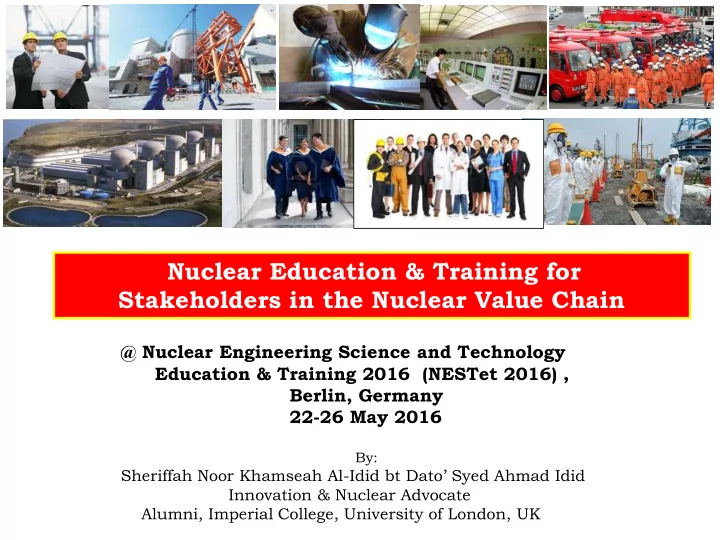
Nuclear Education & Training for Stakeholders in the Nuclear Value Chain @ Nuclear Engineering Science and Technology Education & Training 2016 (NESTet 2016) , Berlin, Germany 22-26 May 2016 By: Sheriffah Noor Khamseah Al-Idid bt Dato


slide-1
SLIDE 1

@ Nuclear Engineering Science and Technology Education & Training 2016 (NESTet 2016) , Berlin, Germany 22-26 May 2016

By:

Sheriffah Noor Khamseah Al-Idid bt Dato’ Syed Ahmad Idid Innovation & Nuclear Advocate Alumni, Imperial College, University of London, UK

Nuclear Education & Training for Stakeholders in the Nuclear Value Chain

slide-2
SLIDE 2

Global Scenario

The Future of Nuclear Power Stakeholders in a Nuclear Power Programme ( NPP) Human Resource to Support a Nuclear Power Programme Coordination Framework for Nuclear HCD Milestones for Implementation of NPP- The HR Perspective Nuclear Fuel Cycle Milestones in the Development of a National Infrastructure for Nuclear Power Elements of a New Nuclear Build Integrating the Development of a National Infrastructure for Nuclear Power and Elements of Nuclear New Build Supply Chain to identify suitable Nuclear E&T

1 2 3 6 7 8 10 5 4

Contents

9

slide-3
SLIDE 3

Stakeholders & Human Resources to support NPP Stakeholders and Nuclear E&T Nuclear Education and Training for Politicians- Cabinet Ministers and Opposition Party Members – The IAEA Program Nuclear Education and Training for High Level and Senior Government Officials, Policy and Decision Makers Nuclear Education and Training for Professionals with Potential for Promotion to be Nuclear Leaders Nuclear HRD Needs by selected countries – The Case of South Korea and Brazil Nuclear Education & Training for Students & Working Professionals – The UK Experience Nuclear Education & Training- The Korean Experience (NTC KAERI) Recommendations

14 15 17 16

Contents

18 19 13 12 11

slide-4
SLIDE 4
  • 1a. Global Nuclear Power Expansion
slide-5
SLIDE 5

1b.Operational Nuclear Power Reactors as of 15 June 2015 by IAEA

58 43 34 27 99 24

As of June 01, 2015 , 438 nuclear power reactors in 31 countries with an installed electric net capacity of about 379 GW are in operation and 67 plants with an installed capacity of 65 GW are in 16 countries under construction

slide-6
SLIDE 6
  • 1c. Location of Operational nuclear power reactors in the World

source: Nuclear power plants around the world, posted 4 July 2014

slide-7
SLIDE 7

source: Nuclear New Construction Market Map 2014 by Nuclear Energy Insider- edited 16 June 2015

1d

67

24

1 2 4

9

3

slide-8
SLIDE 8
  • 1e. Nuclear Power Reactors under Construction, Planned and Proposed

1 2 3

source: Nuclear New Construction Market Map 2014 – Nuclear Energy Insider ,2014

slide-9
SLIDE 9

source: Prospects and challenges for a global expansion of Nuclear Energy by Siegfried S Hecker, Stanford University

  • 2. Future of Global Nuclear Power
slide-10
SLIDE 10

Government Private Sector

R&D Institutes Government Industry

  • 3. Stakeholders in a Nuclear Power Programme
slide-11
SLIDE 11

Source: Managing Human Resources in the Field of Nuclear Energy – IAEA Nuclear Energy Series NG-G-2.1 International Atomic Energy Agency ( IAEA ), 2009

Nuclear Planning, Policy, Governance Nuclear Law & Regulation Operations & Maintenance Nuclear Technology Development Nuclear Business, Construction & manufacturing Nuclear Consultancy & Technical Support Services Nuclear Policy, Law, Governance, Negotiations Nuclear Education & Training Radiation Protection Nuclear Planning, Management, Financing

Media Agencies Financial Institutions

4

slide-12
SLIDE 12

Nuclear Society (NS eg ENS) Radioisotope Associations

  • 5. Coordination Framework for Nuclear HCD
slide-13
SLIDE 13
  • 6a. Milestones for the Implementation of NPP
  • The HRD Perspective, IAEA
slide-14
SLIDE 14
  • 6b. Milestones for the Implementation of NPP
  • The HRD Perspective, IAEA (TBC)
slide-15
SLIDE 15
  • 6c. Milestones for the Implementation of NPP
  • The HRD Perspective, IAEA (TBC)
slide-16
SLIDE 16
  • 6d. Milestones for the Implementation of NPP
  • The HRD Perspective, IAEA (TBC)
slide-17
SLIDE 17
  • 6e. Milestones for the Implementation of NPP
  • The HRD Perspective, IAEA (TBC)
slide-18
SLIDE 18

Nuclear Fuel Cycle includes, 1) Font-end fuel markets (i.e. uranium mining through fuel fabrication)., 2) The overall nuclear reactor sector ( nuclear reactor planning, construction ,

  • perations and maintenance and decommissioning ) , as well as the

3)Back-end of the fuel cycle.( fuel treatment /reprocessing, storage and disposal )

  • 7. Nuclear Fuel Cycle

Front – end Fuel Market Back– end Fuel Cycle Nuclear Reactor Sector

slide-19
SLIDE 19

8 Milestones in the Development of a National Infrastructure for Nuclear Power

slide-20
SLIDE 20

9

slide-21
SLIDE 21

10 Integrating the Development of a National Infrastructure for Nuclear Power and Elements of Nuclear New Build Supply Chain to identify suitable Nuclear E&T

Operation

slide-22
SLIDE 22

Final Investment Decision Contracting Construction Commissioning Operation & Maintenance(O&M) Decommissioning

Considerations before a decision to launch a Nuclear Power Program (NPP) is taken0 Preparatory Work For the contracting and construction of a nuclear power plant after a policy decision has been taken Activities to Implement a first Nuclear power plant

PHASE 4 PHASE 5 MILESTONE 4

Ready to decommission the nuclear power plant

Key Stakeholders Nuclear E&T & Awareness

  • 1. Government -Cabinet Ministers & Opposition Parties
  • 2. Senior and other Policy makers
  • 3. Professionals with Potential to be Nuclear Leaders

4.Other Professionals

  • 5. Students
  • 6. Public
  • 7. Media

What are the currently available Nuclear E&T as well as other recommended courses ?

source : Milestone Approach template by IAEA Phase 4 & Phase 5 and Nuclear E&T Recommendation by author Ms Sheriffah Noor Khamseah Al-Idid

  • 11a. Stakeholders
slide-23
SLIDE 23

Technicians

  • 11b. HUMAN RESOURCES to Support NPP

POLITICIANS, POLICY MAKERS, PROFESSIONALS, PRESS & PUBLIC

  • Policy & Decision Makers

Management of Nuclear Power Plants Management of Nuclear R&D

Nuclear Leadership

Politicians

Professionals with Potential to be Nuclear Leaders Other Working Professionals College Students University Students Media/ Press General Public

slide-24
SLIDE 24

Nuclear Power Programme ( NPP ) Needs Workforce

ENGINEERS

Entry-level Experienced Mechanical Engineer Electrical Engineer Electronics Engineer

PROFESSIONALS ( P )

Normal Minimum Degree: BSc

SCIENTISTS OTHERS

Source : IAEA Guidebook on Manpower Development for Nuclear Power , 1980

Nuclear Engineer Chemical Engineer Physicists Civil Engineer Computer Engineer I&C Engineer Chemists Biologists Economist Business Admin Commerce Accounting Finance Law Metallurgists Geologists Geophysicists Mining Engineer Power Plant Engineer

  • 11c. NUCLEAR HUMAN RESOURCES

PROFESSIONALS, TECHNICIANS & CRAFTSMEN

Journalism/PR

slide-25
SLIDE 25

Technicians

  • 11d. HUMAN RESOURCES to Support NPP

BUSINESS LEADERS, INDUSTRY REPRESENTATIVES ,TECHNICIANS & CRAFTSMEN,

Welders Pipefitters Concrete workers

Business Leaders ( Financial, Construction, Manufacturing Services ) Technicians Craftsmen

slide-26
SLIDE 26

Technicians Fig 8. HUMAN RESOURCES to Support NPP POLITICIANS, POLICY MAKERS, PROFESSIONALS, TECHNICIANS & CRAFTSMEN, PRESS & PUBLIC

Welders Pipefitters Concrete workers

Business Leaders ( Financial, Construction, Manufacturing Services ) Technicians Craftsmen

slide-27
SLIDE 27

Nuclear Power Programme ( NPP ) Needs Workforce

ENGINEERS TECHNICIANS ( T )

  • Sub-professional level personnel

Entry-level Engineer Experienced Engineer Mechanical Technician Electrical Technician Instrumentation & Control (I&C) Technician Radiation Protection Technician Chemistry Technician Electronics Technician Radiochemistry Technician QA/QC Technician

PROFESSIONALS ( P )

Normal Minimum Degree: BSc

CRAFTSMEN ( C )

  • Skilled through apprenticeship

SCIENTISTS OTHERS

Painters Sheet-metal workers Welders Miscellaneous eg truck drivers Boilermakers Carpenters Concrete Workers Electricians Insulators Iron Workers Millwrights Operators Heavy Equipt Pipe Fitters Asbestos Workers Bricklayers Cement Finishers

Source : IAEA Guidebook on Manpower Development for Nuclear Power , 1980

Nuclear Reactor Technician

  • 11e. NUCLEAR HUMAN RESOURCES

PROFESSIONALS, TECHNICIANS & CRAFTSMEN

slide-28
SLIDE 28

Final Investment Decision Contracting Construction Commissioning Operation & Maintenance(O&M) Decommissioning

Considerations before a decision to launch a Nuclear Power Program (NPP) is taken0 Preparatory Work For the contracting and construction of a nuclear power plant after a policy decision has been taken Activities to Implement a first Nuclear power plant

PHASE 4 PHASE 5 MILESTONE 4

Ready to decommission the nuclear power plant

Key Stakeholders Nuclear E&T & Awareness

  • 1. Government -Cabinet Ministers

2.Opposition Parties

  • 3. Policy makers
  • 4. Professionals
  • 5. Students
  • 6. Public
  • 7. Media

1.Nuclear Energy Conference for Government (IAEA & Countries) for Cabinet Ministers & Opposition Parties

  • 2a. Nuclear Leadership Education Program and 2b Nuclear Energy Management Course for Policy makers & Potential Senior Nuclear Leaders
  • 3. Nuclear Courses for Potential Nuclear Leaders ( for Young Professionals with Potential for Promotion to Leadership Positions )
  • 4. Nuclear CPD courses for Working Professionals including industry representatives ( Construction, Manufacturing and Services ets)
  • 5. Science, Engineering & Other related courses for Students at College & University Level
  • 6. Specialized training for Technicians and Craftsmen

7.General Introduction to Nuclear Energy to General Public and Media

  • 8. Specially arranged Visits to Countries with NPP for Politicians, Policy makers and Media Representatives

source : Milestone Approach template by IAEA Phase 4 & Phase 5 and Nuclear E&T Recommendation by author Ms Sheriffah Noor Khamseah Al-Idid

  • 12. Stakeholders

and Nuclear E&T

slide-29
SLIDE 29

Technicians

  • 13. Nuclear Education & Training Programme for

Politicians – Cabinet Ministers & Opposition Parties Members The IAEA Programme

  • - Cabinet Ministers -

Opposition Party Members

Politicians

slide-30
SLIDE 30
  • 13a. INTERESTS & ISSUES/CONCERNS regarding Nuclear Power for Specific Stakeholders
  • 1a. Government – Making a Decision to invest in Nuclear Power - ( Part 1 )

Politicians Interest Issues/ Concerns

  • 1. Getting elected with strong

public support

  • 2. Enhancing national

economies – Increasing GDP i) Increasing products offered ii) Increasing jobs iii) Increasing number of domestic & international trade & commerce iv) Increasing FDI’s

  • 3. Ensuring energy security
  • 1. Facing strong

public opposition

  • 2. National economy

impacted negatively

  • 3. Energy Security

threatened

  • 4. Ensuring public money spent

has a return on investments ( RoI)

  • 4. Allay public fear of

Government spending public money aimlessly

  • 5. Be updated on various financing

sources & models for investing in Nuclear Power

  • 5. Building Nuclear

Power Plants is too expensive. i) fear of no ROI’s ii) Concerned about appropriate sources & models of financing nuclear power

  • 6. Ensuring sustainability of

Environment – international

  • bligation ( Kyoto Protocol)
slide-31
SLIDE 31

International Ministerial Conference on Nuclear Power

1st Conference

  • March 2005

2nd Conference

  • April 2009

3rd Conference

  • 27-29 June 2013

13b Training / Conferences for Politicians / Ministers by the IAEA

Politicians

  • - Cabinet Ministers
  • Opposition Party

Members

slide-32
SLIDE 32

Nos/Year Venue Conference Title & Main Topics of Discussions

Attendees

Impact/Outcome

  • Tangible/Intangible

1st Conference 21-22 March 2005 Paris, France International Ministerial Conference on Nuclear Energy in the 21st Century: 1) The World Energy resources and needs 2) The Environmental challenges of the 21st Century 3) Driving factors for nuclear industry strategies & choices 4) Governance ( Role of Government, Social acceptance, Non proliferation, physical protection )

Participants are expected to be Ministers and senior level advisors, or representatives of

  • rganisations that

can make or influence energy related decisions.

2nd Conference 20-21 April 2009 Beijing, China International Ministerial Conference on Nuclear Energy in the 21st Century: 1) Energy Resources and the Environment 2) What technology is available & expected to be available in the future 3) Infrastructure development & support for countries considering introducing NP 4) Reliable fuel supply, spent fuel & waste management

Among the 400 Participants expected to participate are Ministers and senior level advisors, or representatives of

  • rganisations that

can make or influence energy related decisions.

3rd Conference : 27-29 June 2013 Saint Petersburg, Russian Federation International Ministerial Conference on Nuclear Power in the 21st Century: 1) Energy and Environment 2) Nuclear Safety and Reliability through International Cooperation 3) Infrastructure, Technology & Institutional Development-The Way Forward ( HR, new financing models etc) 4) Drivers for deployment of Sustainable and Innovative Technology

All persons wishing to participate in the conference are requested to register online in advance. & participation form is transmitted through Government of Member State.

13c International Ministerial Conference on Nuclear Power
slide-33
SLIDE 33

13d Ministers with portfolio involving Nuclear Power Minister of Economics Minister of Energy Minister of Education Minister of Science Minister of Environment Minister of Finance Economic Portfolio Energy Portfolio Education & Training Portfolio Technology Portfolio Minister of Information Minister of Trade & Commerce Environment Portfolio Finance Portfolio Information Portfolio Trade Portfolio Topics of Discussions deliberated Energy Resources & Needs Environmental Challenges Technology Development Nuclear HRD New Financing Models Role of Media International Nuclear Supply Chain & potential business opportunities Economic Impact & benefits of investing in Nuclear Power

slide-34
SLIDE 34
  • 13e. Recommendations for Conferences for Politicians / Ministers by the IAEA

1. Decrease the cycle for this International Ministerial Conference from every 4 year to every 1-2 years- in view that new issues , challenges & Opportunities can be shared with the Ministers 2. IAEA could consider restructuring the International Ministerial Conference to not only focus on energy issues but also accord priority on matters relating to i) Economics ii) Finance iii) Media & Information

  • 3. In view that most countries policy is to send only Minister of one portfolio ( usually Minister of Energy

) to attend the conference, IAEA may need to discuss & identify strategy to engage more Ministers to participate at these Conferences including Minister of Economics, Minister of Finance, Minister of Information etc a) IAEA could consider having parallel sessions on these specific topics after the general

  • verview & status of NPP on first day for all Ministers
  • r

b) IAEA could consider separating the International Ministerial Conference on Nuclear Power to be held annually but with alternate focus. i) Year 1 – focus on Energy & Environment – with participation from Minister of Energy and Minister of Environment ii) Year 2 – focus on Human resource Development- with participation from Minister of Education iii) Year 3- Focus on Financing & Business Opportunities- with participation from Minister of Finance and Minister of Trade & Industry

slide-35
SLIDE 35

Technicians

  • 14. Nuclear Education & Training Programe for

High Level/ Senior Government Officials, Policy & Decision Makers

  • - Politicians / Ministers
  • Policy & Decision Makers

Management of Nuclear Power Plants Management of Nuclear R&D Institutes

Nuclear Leadership

INLEP, provide leadership education in the governance structure, business strategies,

  • perational practices and technologies needed

to develop successful, safe and secure nuclear energy programme for:

  • High level Government Officials
  • Senior Executives of nuclear operating

companies

  • Senior Regulators
  • Participation is by invitation only. Each class

will consist of about 20 participants, drawn from several countries. The instructors include faculty from MIT and other universities as well as an group of prominent experts and practitioners from industry and government.

  • Comprise two modules ( each module 9-10

day duration ) and site visits First Course offering in 2013, continued in 2014 and 2015 One week programme – This format of the IAEA Nuclear Energy Management School is a short and condensed version of the School and puts stronger emphasis on strategic and policy issues which need to be understood by those in key leadership roles in nuclear organizations. It also emphasizes issues at the national and international level in the nuclear context and provides a broad overview of important nuclear issues and policy. This curriculum is well suited for nuclear

  • rganization leaders, newly appointed senior

managers, managers who may be new to nuclear organizations, or senior nuclear government policy makers and decision makers.

slide-36
SLIDE 36

Technicians 15a . Nuclear Education & Training for Nuclear Leaders ( Professionals with Potential to be Leaders )

  • - Politicians / Ministers
  • Policy & Decision Makers

Management of Nuclear Power Plants Management of Nuclear R&D Institutes

Nuclear Leadership

International Nuclear Management Academy (INMA) is a framework facilitated by the IAEA, through its Nuclear Knowledge Management (NKM) Section in the Department of Nuclear Energy in collaboration with nuclear engineering and business faculties at universities and with nuclear employers around the world. Its goal is to support participating universities in the implementation of high quality master's level management programmes for the nuclear sector NMA aims to make high quality management education that is tailored to the specific needs and challenges of the nuclear sector both more available and more accessible to :

  • working nuclear managers or
  • nuclear professionals with potential to move into management.

INMA programmes are intended for students in both developed and developing countries. INMA Member Universities are encouraged to offer courses in the form of online and distance learning, and also in short-format courses and on a part-time basis. This is intended to give working nuclear professionals more flexibility and options to successfully complete programmes. Several participating universities have started work on introducing INMA Nuclear Technology Management (NTM) master’s level programmes, with the first already commence in the fall of 2015 and others being introduced over the next one to three years. The Manchester University in the United Kingdom has recently introduced the first Nuclear Technology Management Programme. This programme is expected to be endorsed by IAEA as the first successfully peer reviewed INMA programme by the fall of 2015 . National Research Nuclear University (MEPhI) in the Russian Federation is expected to be the next university to introduce a Nuclear Technology Management Programme, and is targeting to start-up and be fully endorsed by the fall of 2016

National Research Nuclear University (Moscow Engineering Physics Institute)

slide-37
SLIDE 37

Technicians

  • 15b. Nuclear Education & Training for Nuclear Leaders

( Professionals with Potential to be Leaders )

  • - Politicians / Ministers
  • Policy & Decision Makers

Management of Nuclear Power Plants Management of Nuclear R&D Institutes

Nuclear Leadership

CERTIFICATE COURSE Participants of each IAEA NEM School interact and learn from some of the best specialists in the global nuclear industry and from the IAEA. The IAEA NEM School is offered in several programme and curriculum formats that can be tailored to specific needs on request and can be conducted in three different formats, based on a member state’s particular needs: One week programme – This format of the IAEA Nuclear Energy Management School is a short and condensed version of the School and puts stronger emphasis on strategic and policy issues which need to be understood by those in key leadership roles in nuclear organizations. It also emphasizes issues at the national and international level in the nuclear context and provides a broad overview of important nuclear issues and policy. This curriculum is well suited for nuclear organization leaders, newly appointed senior managers, managers who may be new to nuclear organizations, or senior nuclear government policy makers and decision makers. Two week programme – This format of the IAEA Nuclear Energy Management School is well suited for first level or middle level managers in nuclear facilities or organizations. It will provide them with essential knowledge to better understand their role in the broader organizational and industry context and prepare them to work at a higher level in their organizations. A broad overview of nuclear energy challenges and policy issues is provided, with an emphasis being placed on facility management perspectives, and participant experience sharing, case study team work. Three week programme - This format of the IAEA Nuclear Energy Management School is well suited for young professionals working in nuclear organizations who show some managerial interest and potential.

slide-38
SLIDE 38

Technicians

  • 15b. Contd Nuclear Education & Training for Nuclear Leaders

( Professionals with Potential to be Leaders )

  • - Politicians / Ministers
  • Policy & Decision Makers

Management of Nuclear Power Plants Management of Nuclear R&D Institutes

Nuclear Leadership

slide-39
SLIDE 39

Technicians

  • 15c. Nuclear Education & Training for Nuclear Leaders

( Professionals with Potential to be Leaders )

  • - Politicians / Ministers
  • Policy & Decision Makers

Management of Nuclear Power Plants Management of Nuclear R&D Institutes

Nuclear Leadership

The Abdus Salam International Centre for Theoretical Physics (ICTP, Trieste, Italy) in co-operation with the International Atomic Energy Agency (IAEA, Vienna, Austria) is jointly organizing the School of Nuclear Energy Management, The purpose of this school is to provide a unique international educational experience aimed at building future leadership in managing nuclear energy programmes from among promising young professionals, particularly from newcomer countries that seek to develop nuclear power or other nuclear applications, who show promise as future leaders of the nuclear industry, academia and public sector entities. It will enable the transfer of IAEA specific knowledge to Member States towards their capacity building efforts. The prospect of a continuing worldwide use of nuclear technologies – for electricity generation and electricity and applications in medicine, agriculture and industry, as well as the ageing cadres in the field points to the need for new cadre of nuclear professionals. A highly competent management is vital to the success at all stages of nuclear

  • programmes. The school will train young professionals from developing and developed countries with managerial

potential on aspects of the industry to ensure their broad understanding of the current issues that need to be tackled in their countries. The School will consist of a series of keynote presentations by leading IAEA specialists on topics relevant to managing nuclear energy programmes followed by practical sessions. All participants will be expected to be actively involved in discussions, assigned projects, panel reviews and other activities. The following topics will be covered:

  • World Energy Balance, Geopolitics and Climate Issues;
  • Energy Planning, Energy Economics and Nuclear Power Economics and Finance;
  • Nuclear Power - Technology and Life Cycle;
  • Nuclear Safety and Security;
  • Nuclear Law, International Conventions and Relevant Mechanisms;
  • Nuclear Non-Proliferation and Safeguards;
  • Human Resource Development and Knowledge Management;
  • Nuclear Leadership, Management and Sociology;
  • Emergency Planning and Preparedness
  • Radioactive Waste Management and Decommissioning
  • Communicating Radiation Risks to the Public
  • IAEA Support for Nuclear Power Development.

3-14 October 2016

slide-40
SLIDE 40

Technicians

  • 15d. Nuclear Education & Training for Nuclear Leaders

( Professionals with Potential to be Leaders )

  • - Politicians / Ministers
  • Policy & Decision Makers

Management of Nuclear Power Plants Management of Nuclear R&D Institutes

Nuclear Leadership

This School will be organized by the Japan Nuclear Human Resource Network ( JN-HRD.net), Japan Atomic Energy Agency (JAEA), University of Tokyo , Japan Atomic Industrial Forum (JAIF) and JAIF International Cooperation Centre (JICC) in Cooperation with the International Atomic Energy Agency (IAEA) The purpose of the Japan-IAEA Joint Nuclear Energy Management School is to provide a unique international educational experience aimed at building future leadership to manage nuclear energy programmes, to nourish a wide range of knowledge on issues related to the peaceful use of nuclear technology and to broaden individual networking with people interested in nuclear energy from all over the world. The Session topics will be covered:

  • Energy Policy Making and the Role of Nuclear Power
  • Management of New Nuclear Power Projects
  • Nuclear Material Control;
  • Protecting People and the Environment;
  • Developing National Capacity for Nuclear Energy

Participants Qualification: Young Professionals ( preferrably less than 40 years old ) with managerial potential who have worked in the nuclear field for at least 3 years and shall make good use of the fruits

  • f the Management School for their current and/or future jobs

Suitable for : Employees of NPPs, R&D Organizations, Utilities, Regulators, Suppliers, Executive Authorities Education & Training Organizations

11-27 July 2016

slide-41
SLIDE 41

Technicians

  • 15e. Nuclear Education & Training for Nuclear Leaders

( Professionals with Potential to be Leaders )

  • - Politicians / Ministers
  • Policy & Decision Makers

Management of Nuclear Power Plants Management of Nuclear R&D Institutes

Nuclear Leadership

Project title and number : The Nuclear Energy Management School, organized by the International Atomic Energy Agency (IAEA) in cooperation with the Khalifa University (KU), the Federal Authority for Nuclear Regulation (FANR), Emirates Nuclear Energy Corporation (ENEC) and the Critical Infrastructure and Coastal Protection Authority (CICPA), will be held from 17 to 28 May 2015 in Abu Dhabi, United Arab Emirates. The purpose of the Joint UAE-IAEA Nuclear Energy Management School is to provide a unique, international educational experience aimed at building future leadership to manage nuclear energy programmes, to promote and foster knowledge

  • f a wide range of issues related to the peaceful use of nuclear technology, and to provide a unique worldwide

networking opportunity for future managers in the area of nuclear energy.

  • Energy Policy Making and the Role of Nuclear Power
  • Management of New Nuclear Power Projects
  • Nuclear Material Control;
  • Protecting People and the Environment;
  • Developing National Capacity for Nuclear Energy

Participants Qualification: Young Professionals ( preferrably between 25 and 40 years old ) with managerial potential from developing countries with plans to newly introduce nuclear power and from countries with an established nuclear programme Suitable for : Employees of NPPs, R&D Organizations, Utilities, Regulators, Suppliers, Education & Training Organizations The school is open to approximately 35 participants of which 15 are foreign participants from participating Member States of TC Project RAS/2/2015 and Member states in Asia and the Pacific embarking or considering embarking on NPP. Their participation to this NEM School should be supported through their respective National TC project

Joint UAE-IAEA Nuclear Energy Management School 17 - 28 May 2015, Abu Dhabi, UAE

slide-42
SLIDE 42

16 16. . Nuc uclear lear Po Power er Pr Prog

  • gramme

ramme (NPP) PP) : HR R Req equi uirements ements by by Sel elec ected ted Cou

  • unt

ntries ries

  • Kor
  • rea

ea an and B d Braz azil il

slide-43
SLIDE 43

       

Industry R&D Institute Univer sities

  • Case for Korea
slide-44
SLIDE 44

Nuclear Education & Training for Students & Working Professionals

  • The United Kingdom’s Experience
  • The Nuclear New Build Supply Chain Perspective

17a

slide-45
SLIDE 45

Nuclear New Build Supply-Chain

Source: The Supply Chain for a UK Nuclear New Build Programme by Dr. Stephen A Court National Metals Technology Centre ( NAMTEC ) , February 2009

Project Management

slide-46
SLIDE 46

Undergraduate Nuclear Engineering

Masters of Law (LLM) International and Comparative Nuclear Law and Policy

MEng with Nuclear Power Engineering & Sustainable Energy

MPhil Nuclear Energy which combines nuclear technology with nuclear policy and business MSc Nuclear Safety ,Security and Safeguards Dalton Nuclear Institute Planning, Policy, Legal & Regulatory ( Nuclear Law ) , Safety & Security Engineering, Design MA Degree in N uclear Regulation Note : A group of universities in Austria, Germany, the Netherlands, Norway and the United Kingdom will launch the first comprehensive Master's Degree Programme in Nuclear Security in the first quarter of 2013, using the material produced by International Nuclear Security Education Network (INSEN )

slide-47
SLIDE 47
slide-48
SLIDE 48

MPhil Nuclear Energy which combines nuclear technology with nuclear policy and business Certificate of Nuclear Professionalism is developed in partnership with employers and the Open University and was introduced in 2011 focus on nuclear principles, safety, behavioural, commercial and project management skills Certificate of Nuclear Professionalism ( CoNP)

Certificate , introduced in 2011 Covers 7 Modules Safety, Environmental and Security Management Technical Leadership Communications Commercial Awareness Project Management Nuclear Principles, Protections & Frameworks Safety Case Production and Evaluation. i) Aston University ii) 20/20 Business Insight iii) UCLAN University iv) Open University

  • Project Management
slide-49
SLIDE 49

1 2 3 4

  • Building & Construction (1)

5 6

slide-50
SLIDE 50

Nuclear Island

Programme launched in 15 June 2011 for engineering students to have hands-on experience in designing and constructing a scaled down nuclear power plant in Constructionarium facility at Bircham Newton in Norfolk . Students will be assessed on radiation protection, site licensing, budgetary control and project management.

1 2 3 4

The Engineering Construction Industry Training Board (ECITB) is the statutory organisation, national training provider and awarding body with responsibility for the training and development of the UK’s engineering construction

  • Building & Construction (1)
slide-51
SLIDE 51

???

Nuclear Island

Programme launched in 15 June 2011 for engineering students to have hands-on experience in designing and constructing a scaled down nuclear power plant. Students will be assessed on radiation protection, site licensing, budgetary control and project management The Nuclear Island has been developed by a partnership of :

  • Imperial College London,
  • Constructionarium,
  • Cogent Sector Skills Council,
  • Engineering Construction Industry Training Board

(ECITB) and

  • Construction Skills.

The partnership received funding to develop the project from the National Higher Education Science, Technology, Engineering and Mathematics (HE STEM) Programme and the Royal Academy of Engineers.

Photo source: Clive Smith Strategy Director Nuclear COGENT SSC:

slide-52
SLIDE 52

The Dalton CPD Centre design short courses for specific business needs covering the nuclear landscape, governance, policy, supply chain and material Dalton Nuclear Institute 22- 24 Mac 2012 Nuclear leadership and governance for senior managers facing nuclear industry change. 1 day Introduction to Nuclear Energy is particularly suited to employees of companies thinking about entering the nuclear supply chain

CONSTRUCTION: NUCLEAR LEADERSHIP & GOVERNANCE

PGCert Governance of the UK Civil Nuclear Industry (e-Learning)

slide-53
SLIDE 53

1 2

New Nuclear Build and Manufacturing (NNUMAN) programme has been awarded £4m funding by the Engineering and Physical Sciences Research Council (EPSRC) to research for new, innovative and efficient manufacturing technologies to enable UK manufacturing companies to learn the benefits of the new methods and apply them to new nuclear power plants

Nuclear Advance Manufacturing Research Centre

The most improved manufacturing processes developed in NNUMAN will be taken forward to prototype by Nuclear AMRC to enable UK manufacturing companies to learn the benefits

  • f the new methods and use them to enable consortium members to become the suppliers
  • f choice to the global nuclear industry

3

National Skills Academy Nuclear – Manufacturing; a tri-partite collaboration between : A one stop shop for skills for nuclear manufacturing & further development of key training courses and qualifications to support the up-skilling of manufacturers

NUCLEAR MANUFACTURING & FABRICATION – Part One

slide-54
SLIDE 54

NUCLEAR MANUFACTURING & FABRICATION – Part Two

The National Skills Academy Nuclear - Manufacturing is a collaboration between the National Skills Academy for Nuclear, Semta (Sector Skills Council for the Advanced Manufacturing and Engineering sectors) and the NAMRC. The collaboration will work together to provide: A one stop shop for skills for nuclear manufacturing. High Quality Provider Network Innovative support tools Further development of key training courses and qualifications to support the up-skilling of manufacturers.

slide-55
SLIDE 55

Gen II established in June 2000 by five partner companies – Sellafield Ltd, Tata Steel Europe (formerly Corus), Amec, Iggesund Paperboard and Innovia Films. offers: Advanced manufacturing short courses i) Instrumentation system, control & testing ii) Process Plant pumping & piping system iii) Technology of Fluid Flow in Pipelines Nuclear Worker Apprenticeship i)Electrical Apprenticeship-12 month course ii)Pipefitting Apprenticeship- 12-18 months iii)Welding, Fabrication and Pipefitting Apprenticeship – 12-18 months iv)Fabrication (Fabrication is the term use to cover a wide range of occupations including: Welders, Platers, Sheet Metal Workers, Pipe Fitters ) Apprenticeship – 15 months v)Mechanical Apprenticeship – 15 months vi)Nuclear Worker Apprenticeship – 24 months vii)Process Apprenticeship – 12 months

NUCLEAR MANUFACTURING & FABRICATION – Part Three

  • ffers
slide-56
SLIDE 56

Operations & Maintenance MEng Mechanical and Nuclear Engineering MEng Chemical and Nuclear Engineering MPhil Nuclear Engineering MEng Mechanical and Nuclear Engineering MEng Material Science and Nuclear Engineering MEng Chemical and Nuclear Engineering MEng Mechanical and Nuclear Engineering

  • Part I
slide-57
SLIDE 57

Operations & Maintenance

BSc Nuclear Science and Materials MSc Physics and Advanced Materials MEng Nuclear Engineering

  • Part 2

Certificate of Professional Development in Radiation Protection

slide-58
SLIDE 58

Decommissioning

slide-59
SLIDE 59

Nuclear Education offered by Consortium of Institutions in the United Kingdom i) NUTEC ii) National Skills Academy for Nuclear (NSAN)

17b

slide-60
SLIDE 60

A consortium of UK universities and other institutions providing postgraduate education in Nuclear Science & Technology

Imperial College London Centre for Nuclear Engineering

The University of Manchester Dalton Nuclear Institute

Bristol Leeds Sheffield National Nuclear Laboratory UCLan Lancaster Surrey Birmingham Oxford Strathclyde HMS Sultan Liverpool City University & UCL Cambridge

The University of Manchester Dalton Cumbrian Facility

Defence Academy of the United Kingdom UHI Millenium Institute Open University Cardiff Loughborough University

NTEC KNOO Nuclear EngD Diamond Nuclear First Nuclear AMRC Nuclear Champion

Collaboration: academia

slide-61
SLIDE 61

Continuing Professional Development (CPD)

Individual subjects are presented in ‘short course’ modules for engineers and managers in full-time employment who wish to advance their skill and knowledge base. The core of each module is one week of direct teaching at the relevant institution, minimising the time away from the workplace for an employee whilst maximising its effectiveness. i) part-time basis over a period of 3 years as well as ii) full-time in 1 year Master's degree in Nuclear Science and Technology provided by a consortium of UK universities Course Structure The qualifications offered are available on a full-time or part-time basis. I) Full-time MSc taken over 1 year: 4 core and 4 elective modules are taken over a period of approximately 9 months. The project and dissertation then follows. II) Part-time MSc taken over 3 years: Year 1 : 4 Core modules (Successful completion attains Postgraduate Certificate= PG Cert) Year 2 : 4 Elective modules (Successful completion attains Postgraduate Diploma= PG Dip) Year 3 : Project & Dissertation

NTEC MSc is accredited by i) Institution of Engineering and Technology ii) Institution of Mechanical Engineers iii) the Energy Institute iv) Institute of Materials, Minerals and Mining

slide-62
SLIDE 62

The modules which make up the Certificate of Nuclear Professionalism are;

Modules Module Titles Institutions offering the courses Module 1 Safety, Environmental and Security Management UCLan Module 2 Technical Leadership Aston Business School Module 3 Communications Business Insight 20|20 Module 4 * Commercial Awareness Aston Business School Module 5 Project Management Aston Business School Module 6 Nuclear Principles Protections & Frameworks UCLan Note: Open University offer module 6 as e-learning. Module 7 Safety Case Production and Evaluation UCLan

The modules are available through a number of providers of the Skills Academy

Certificate of Nuclear Professionalism

slide-63
SLIDE 63

UK’s Nuclear Education & Training Directory

17c

slide-64
SLIDE 64

UK’S Nuclear Education, Skills & Training Directory

Directory is Accessible via National Skills Academy for Nuclear (NSAN website http:www.nuclear.nsacademy.co.uk

slide-65
SLIDE 65
slide-66
SLIDE 66
slide-67
SLIDE 67

Nuclear Education & Training - The Korean Perspective : NTC KAERI The IAEA Milestone Approach

18

slide-68
SLIDE 68
slide-69
SLIDE 69
slide-70
SLIDE 70

Recommendations

19

slide-71
SLIDE 71

Recommendations - Part One 1.Set up a Task Force on Nuclear Education & Training , could be chaired by Minister of Education with membership of all Nuclear HRD stakeholders Invite Universities, Industry, Government Agencies & Others to sit & talk TOGETHER on the way forward for Nuclear Education &Training Partnership or Consortium may be established for offering Degree courses , Continuing Professional Development May refer to UK & French Best Practices

  • Avoid Duplication & Competition ( resources wasted-people, time &

money!!! )

  • 2. Identify Nuclear Education & Training Needs for stakeholders:

eg a)Government – Planning/ Policy/Governance/ Risk/ Export Control b) Industry – Business opportunities: manufacturing, construction engineering etc c) Regulatory body- Law & Regulations d) Academia & R&D Agencies – Nuclear S&T, R&D

slide-72
SLIDE 72

Recommendations - Part Two

  • 3. Critical to remember – Manpower trained is NOT JUST to work in

a nuclear power plant or station but in other organizations in the nuclear power sector value-chain eg Government, Industry and | Businesses, Media, Finance etc

  • 4. Prepare Nuclear HRD Roadmap to outlining areas/fields/|

number of personnel/ timeframe/funds required

  • 5. . It may not be strategic for a number of universities to be
  • ffering same or similar courses on nuclear engineering

It may be more relevant for each university to identify its strengths and then offer the selected courses to support nuclear power eg University A offers Nuclear Engineering University B offers Nuclear Safety and Security University C offers Nuclear Law and Policy University D offers Nuclear Energy incorporating Business

slide-73
SLIDE 73

Recommendations - Part Three

  • 6. For institutions currently offering only Nuclear Engineering courses it

may be relevant to introduce other related courses- independently or as part of an existing module covering Nuclear Energy, Law, Governance , Risk , Business, Finance, Economics etc

  • 7. Apart from the offer of Nuclear Engineering courses for

undergraduates/ graduates, institutions of Higher Education as well as private E&T Centres could consider also offering courses to: a) Working professionals b) Technicians c) Craftsmen

slide-74
SLIDE 74

Recommendations - Part Four

  • 8. In view of the great importance of public opinion and the significant role of

the media must be given due recognition

  • Open/ Introduce & offer Nuclear Education & Training to

Media representatives i) Develop specialized topics/curriculum to encourage media participation and ii) consider inviting foreign media to share their views and experiences

  • n nuclear power with local media and the general public
  • 9. As Financing is amongst the critical factors for Nuclear Power Projects

to be realistically implemented,

  • Open/ Introduce & offer Nuclear Education & Training to

representatives from the Banking & Financial Sector i) Develop specialized topics/curriculum for financiers and ii) consider foreign investors in NPP to share their views & experiences

slide-75
SLIDE 75

Recommendations - Part Five

  • 10. As Nuclear Leadership is fundamental to ensure the safe, secure and

profitable operations of nuclear power plants ( to the NP plant owners as well as national economy ) relevant Nuclear E&T Agencies/

  • rganizations ( including the IAEA/WNA/WNU NEA/OECD and others

including ENS ) could consider introducing a) Nuclear Training Programmes ( short courses ) for Nuclear Leaders covering : i) Politicians ii) Policy and Decision Makers iii) Senior Management of Nuclear Power Plants iv) CEOs of Nuclear Businesses in place of ENEL which had just closed down. [ Note: As the World Nuclear University (WNU) ‘s 6 weeks summer course targets young professionals up to the age of 40 years the Nuclear Leadership course could cover Politicians, Policy & decision makers as well as Professionals above 40 years who are given leadership roles in Nuclear related initiatives/organizations] b) also for Financial & banking sector Officials as well as c) Media Representatives

slide-76
SLIDE 76

Recommendations - Part Six

  • 11. European Nuclear Society (ENS) in partnership with ENEN can take the

initiative and lead to prepare a softcopy and hardcopy Directory of Nuclear Education and Training offered by EU Member States covering all stakeholders including: i) Politicians ii) Policy and Decision Makers iii) Professionals with Potential to be Nuclear Leaders iv) Other Working Professionals v) Business Leaders and Industry Representatives vi) Students vii) Technicians viii) Craftsmen ix) Public and x) Media Representatives And I would be happy to offer my support and ideas to the ENS and ENEN for this initiative

slide-77
SLIDE 77
slide-78
SLIDE 78

University of Natural Resources and Applied Sciences, Vienna List of Projects of Institute of Risk Research Vienna University

  • f Technology

Bachelor of Physics University of Vienna Masters in Nuclear and Isotope Physics FH campus Wien

  • 1. Bachelor of

Radiology Technology &

  • 2. Master of

Radiology Technology University of Graz 1.Bachelor of Technical Physics &

  • 2. Master of Technical

Physics University of Salzburg Research Projects of Radiology University of Innsbruck Master of Chemistry

Proposed First Page for each EU Member States outlining Nuclear courses offered

slide-79
SLIDE 79

Technicians HUMAN RESOURCES to Support NPP POLITICIANS, POLICY MAKERS, PROFESSIONALS, PRESS & PUBLIC

  • Policy & Decision Makers

Management of Nuclear Power Plants Management of Nuclear R&D

Nuclear Leadership

Politicians

Professionals with Potential to be Nuclear Leaders Other Working Professionals College Students University Students Media/ Press General Public

ENS Current Focus

slide-80
SLIDE 80

Technicians HUMAN RESOURCES to Support NPP BUSINESS LEADERS, INDUSTRY REPRESENTATIVES ,TECHNICIANS & CRAFTSMEN,

Welders Pipefitters Concrete workers

Business Leaders ( Financial, Construction, Manufacturing Services ) Technicians Craftsmen

slide-81
SLIDE 81

Published by Nuclear Energy Agency (NEA), OECD & European Nuclear Society (ENS) (TBC) 2017

slide-82
SLIDE 82
slide-83
SLIDE 83

Recommendations - Part Seven

  • 12. The International Atomic Energy Agency ( IAEA) either via its Human Resource

Department or Knowledge Management (KM) Department can take the initiative and lead to prepare a softcopy and hardcopy Directory of Nuclear Education and Training offered by IAEA Member States covering all stakeholders including: i) Politicians ii) Policy and Decision Makers iii) Professionals with Potential to be Nuclear Leaders iv) Other Working Professionals v) Business Leaders and Industry Representatives vi) Students vii) Technicians viii) Craftsmen ix) Public and x) Media Representatives And I would be happy to offer my support and ideas to the IAEA for this initiative

slide-84
SLIDE 84

sheriffahnai@gmail.com Mobile: 00 6017 6853075