STACL: Simultaneous Translation with Integrated Anticipation & - - PowerPoint PPT Presentation

stacl simultaneous translation with integrated
SMART_READER_LITE
LIVE PREVIEW

STACL: Simultaneous Translation with Integrated Anticipation & - - PowerPoint PPT Presentation

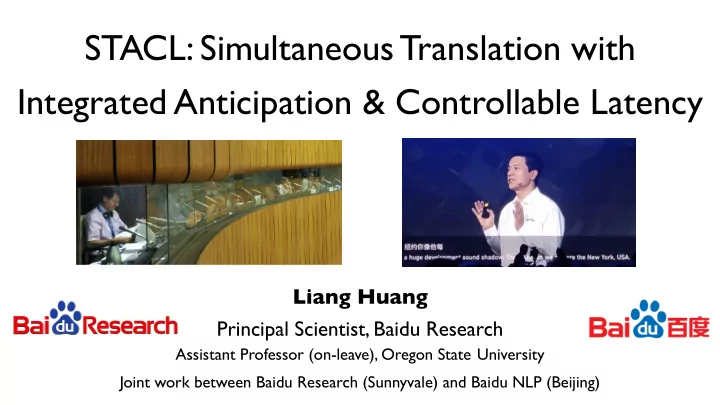
STACL: Simultaneous Translation with Integrated Anticipation & Controllable Latency Liang Huang Principal Scientist, Baidu Research Assistant Professor (on-leave), Oregon State University Joint work between Baidu Research (Sunnyvale) and


slide-1
SLIDE 1

STACL: Simultaneous Translation with Integrated Anticipation & Controllable Latency

Liang Huang

Principal Scientist, Baidu Research

Assistant Professor (on-leave), Oregon State University Joint work between Baidu Research (Sunnyvale) and Baidu NLP (Beijing)

slide-2
SLIDE 2

Breakthrough in Simultaneous Translation

2

Baidu World Conference, November 2017 Baidu World Conference, November 2018

STACL

full-sentence (non-simultaneous) translation simultaneous translation, latency ~3 secs

slide-3
SLIDE 3

Breakthrough in Simultaneous Translation

2

Baidu World Conference, November 2017 Baidu World Conference, November 2018

STACL

full-sentence (non-simultaneous) translation simultaneous translation, latency ~3 secs

slide-4
SLIDE 4

Breakthrough in Simultaneous Translation

2

Baidu World Conference, November 2017 Baidu World Conference, November 2018

STACL

full-sentence (non-simultaneous) translation simultaneous translation, latency ~3 secs

slide-5
SLIDE 5

Background: Consecutive vs. Simultaneous

consecutive interpretation
 multiplicative latency (x2) simultaneous interpretation
 additive latency (+3 secs)

slide-6
SLIDE 6

Background: Consecutive vs. Simultaneous

consecutive interpretation
 multiplicative latency (x2) simultaneous interpretation
 additive latency (+3 secs)

simultaneous interpretation is extremely difficult

  • nly ~3,000 qualified simultaneous

interpreters world-wide each interpreter can only sustain for 
 at most 10-30 minutes the best interpreters can only cover 
 ~60% of the source material

slide-7
SLIDE 7

Tradeoff between Latency and Quality

4

high latency low latency low quality high quality machine
 translation word-by-word
 translation simultaneous interpreters ~3 seconds

  • ur


goal consecutive 
 interpreters 1 sentence

slide-8
SLIDE 8

Industrial Work in Simultaneous Translation

  • almost all existing “real-time” translation systems use conventional full-

sentence translation techniques, causing at least one-sentence delay

  • some systems repeatedly retranslate, but constantly changing translations is

annoying to the user and can’t be used for speech-to-speech translation

5

Baidu, Nov. 2017 (~12 seconds delay) Sougou, Oct. 2018 (~12 seconds delay)

slide-9
SLIDE 9

Industrial Work in Simultaneous Translation

  • almost all existing “real-time” translation systems use conventional full-

sentence translation techniques, causing at least one-sentence delay

  • some systems repeatedly retranslate, but constantly changing translations is

annoying to the user and can’t be used for speech-to-speech translation

5

Baidu, Nov. 2017 (~12 seconds delay) Sougou, Oct. 2018 (~12 seconds delay)

slide-10
SLIDE 10

Industrial Work in Simultaneous Translation

  • almost all existing “real-time” translation systems use conventional full-

sentence translation techniques, causing at least one-sentence delay

  • some systems repeatedly retranslate, but constantly changing translations is

annoying to the user and can’t be used for speech-to-speech translation

5

Baidu, Nov. 2017 (~12 seconds delay) Sougou, Oct. 2018 (~12 seconds delay)

slide-11
SLIDE 11

Academic Work in Simultaneous Translation

  • prediction of German verb (Grissom et al, 2014)
  • reinforcement learning (Grissom et al, 2014; Gu et al, 2017)
  • learning Read/Write sequences on top of a pretained NMT model
  • “encourages” latency requirements, but can’t force them in testing
  • complicated, and slow to train

6

Grissom et al, 2014

slide-12
SLIDE 12

Challenge: Word Order Difference

  • e.g. translate from SOV language (Japanese, German) to SVO (English)
  • German is underlyingly SOV, and Chinese is a mix of SVO and SOV
  • human simultaneous interpreters routinely “anticipate” (e.g., predicting German verb)

Grissom et al, 2014

slide-13
SLIDE 13

Challenge: Word Order Difference

  • e.g. translate from SOV language (Japanese, German) to SVO (English)
  • German is underlyingly SOV, and Chinese is a mix of SVO and SOV
  • human simultaneous interpreters routinely “anticipate” (e.g., predicting German verb)

Grissom et al, 2014

President Bush meets with Russian President Putin in Moscow

slide-14
SLIDE 14

Challenge: Word Order Difference

  • e.g. translate from SOV language (Japanese, German) to SVO (English)
  • German is underlyingly SOV, and Chinese is a mix of SVO and SOV
  • human simultaneous interpreters routinely “anticipate” (e.g., predicting German verb)

Grissom et al, 2014

non-anticipative: President Bush (…… waiting ……) meets with Russian … President Bush meets with Russian President Putin in Moscow

slide-15
SLIDE 15

Challenge: Word Order Difference

  • e.g. translate from SOV language (Japanese, German) to SVO (English)
  • German is underlyingly SOV, and Chinese is a mix of SVO and SOV
  • human simultaneous interpreters routinely “anticipate” (e.g., predicting German verb)

Grissom et al, 2014

non-anticipative: President Bush (…… waiting ……) meets with Russian … President Bush meets with Russian President Putin in Moscow anticipative: President Bush meets with Russian President Putin in Moscow

slide-16
SLIDE 16

Our Solution: Prefix-to-Prefix

… wait whole source sentence …

1 2

source: target:

4 1 2 3 5

seq-to-seq

4 1 2 3

wait k words

1 2

source: target:

5

prefix-to-prefix
 (wait-k)

  • seq-to-seq is only suitable for

conventional full-sentence MT

  • we propose prefix-to-prefix, tailed to

simultaneous MT

  • special case: wait-k policy: translation is

always k words behind source sentence

  • training in this way enables anticipation
slide-17
SLIDE 17

Our Solution: Prefix-to-Prefix

… wait whole source sentence …

1 2

source: target:

4 1 2 3 5

seq-to-seq

4 1 2 3

wait k words

1 2

source: target:

5

prefix-to-prefix
 (wait-k)

  • seq-to-seq is only suitable for

conventional full-sentence MT

  • we propose prefix-to-prefix, tailed to

simultaneous MT

  • special case: wait-k policy: translation is

always k words behind source sentence

  • training in this way enables anticipation

President

Bùshí

布什茶

Bush zǒngtǒng

总统

President

slide-18
SLIDE 18

Our Solution: Prefix-to-Prefix

… wait whole source sentence …

1 2

source: target:

4 1 2 3 5

seq-to-seq

4 1 2 3

wait k words

1 2

source: target:

5

prefix-to-prefix
 (wait-k)

  • seq-to-seq is only suitable for

conventional full-sentence MT

  • we propose prefix-to-prefix, tailed to

simultaneous MT

  • special case: wait-k policy: translation is

always k words behind source sentence

  • training in this way enables anticipation

President Bush

Bùshí

布什茶

Bush zǒngtǒng

总统

President zài

in

slide-19
SLIDE 19

Our Solution: Prefix-to-Prefix

… wait whole source sentence …

1 2

source: target:

4 1 2 3 5

seq-to-seq

4 1 2 3

wait k words

1 2

source: target:

5

prefix-to-prefix
 (wait-k)

  • seq-to-seq is only suitable for

conventional full-sentence MT

  • we propose prefix-to-prefix, tailed to

simultaneous MT

  • special case: wait-k policy: translation is

always k words behind source sentence

  • training in this way enables anticipation

President Bush meets

Bùshí

布什茶

Bush zǒngtǒng

总统

President zài

in Mòsīkē

莫斯科

Moscow

slide-20
SLIDE 20

Our Solution: Prefix-to-Prefix

… wait whole source sentence …

1 2

source: target:

4 1 2 3 5

seq-to-seq

4 1 2 3

wait k words

1 2

source: target:

5

prefix-to-prefix
 (wait-k)

  • seq-to-seq is only suitable for

conventional full-sentence MT

  • we propose prefix-to-prefix, tailed to

simultaneous MT

  • special case: wait-k policy: translation is

always k words behind source sentence

  • training in this way enables anticipation

President Bush meets with

Bùshí

布什茶

Bush zǒngtǒng

总统

President zài

in Mòsīkē

莫斯科

Moscow yǔ

with

slide-21
SLIDE 21

Our Solution: Prefix-to-Prefix

… wait whole source sentence …

1 2

source: target:

4 1 2 3 5

seq-to-seq

4 1 2 3

wait k words

1 2

source: target:

5

prefix-to-prefix
 (wait-k)

  • seq-to-seq is only suitable for

conventional full-sentence MT

  • we propose prefix-to-prefix, tailed to

simultaneous MT

  • special case: wait-k policy: translation is

always k words behind source sentence

  • training in this way enables anticipation

President Bush meets with Russian

Bùshí

布什茶

Bush zǒngtǒng

总统

President zài

in Mòsīkē

莫斯科

Moscow yǔ

with Éluósī

俄罗斯

Russian

slide-22
SLIDE 22

Our Solution: Prefix-to-Prefix

… wait whole source sentence …

1 2

source: target:

4 1 2 3 5

seq-to-seq

4 1 2 3

wait k words

1 2

source: target:

5

prefix-to-prefix
 (wait-k)

  • seq-to-seq is only suitable for

conventional full-sentence MT

  • we propose prefix-to-prefix, tailed to

simultaneous MT

  • special case: wait-k policy: translation is

always k words behind source sentence

  • training in this way enables anticipation

President Bush meets with Russian President

Bùshí

布什茶

Bush zǒngtǒng

总统

President zài

in Mòsīkē

莫斯科

Moscow yǔ

with zǒngtǒng

总统

President Éluósī

俄罗斯

Russian

slide-23
SLIDE 23

Our Solution: Prefix-to-Prefix

… wait whole source sentence …

1 2

source: target:

4 1 2 3 5

seq-to-seq

4 1 2 3

wait k words

1 2

source: target:

5

prefix-to-prefix
 (wait-k)

  • seq-to-seq is only suitable for

conventional full-sentence MT

  • we propose prefix-to-prefix, tailed to

simultaneous MT

  • special case: wait-k policy: translation is

always k words behind source sentence

  • training in this way enables anticipation

President Bush meets with Russian President

Bùshí

布什茶

Bush zǒngtǒng

总统

President zài

in Mòsīkē

莫斯科

Moscow yǔ

with zǒngtǒng

总统

President Éluósī

俄罗斯

Russian Pǔjīng

普京

Putin

Putin

slide-24
SLIDE 24

Our Solution: Prefix-to-Prefix

… wait whole source sentence …

1 2

source: target:

4 1 2 3 5

seq-to-seq

4 1 2 3

wait k words

1 2

source: target:

5

prefix-to-prefix
 (wait-k)

  • seq-to-seq is only suitable for

conventional full-sentence MT

  • we propose prefix-to-prefix, tailed to

simultaneous MT

  • special case: wait-k policy: translation is

always k words behind source sentence

  • training in this way enables anticipation

President Bush meets with Russian President

Bùshí

布什茶

Bush zǒngtǒng

总统

President zài

in Mòsīkē

莫斯科

Moscow yǔ

with zǒngtǒng

总统

President Éluósī

俄罗斯

Russian Pǔjīng

普京

Putin

Putin in Moscow

huìwù

会晤

meet

slide-25
SLIDE 25

More General Prefix-to-Prefix

  • prefix-to-prefix (given source prefix)


p(yt | x1 … xg(t) , y1… yt-1)


g(⋅) is a monotonic non-decreasing function


g(t): num. of source words used to predict yt

  • seq-to-seq (given full source sent)


p(yt | x1 … xn , y1… yt-1)

Pres. at Moscow with Putin meet

President Bush meets with Putin in Moscow 布什茶 总统 在 莫斯科 与 普京 会晤

Bush

t=3

g(3) = 4

slide-26
SLIDE 26

Demo 1 (Research)

10

This is just our research demo. Our production system is better (shorter ASR latency).

slide-27
SLIDE 27

Demo 1 (Research)

10

This is just our research demo. Our production system is better (shorter ASR latency).

slide-28
SLIDE 28

Demo 1 (Research)

10

This is just our research demo. Our production system is better (shorter ASR latency).

slide-29
SLIDE 29

Demo 1 (Research)

10

This is just our research demo. Our production system is better (shorter ASR latency).

江 泽⺠氒 对 法国 总统 的 来华 访问 表示 感谢 。

jiāng zé mín d u ì fǎ guó zǒng tǒng d e l á i huá fǎng wèn biǎo shì gǎn xiè

jiang zemin to French President ’s to-China visit express gratitude

jiang zemin expressed his appreciation for the visit by french president .

slide-30
SLIDE 30

Demo 2 (Latency-Accuracy Tradeoff)

11

slide-31
SLIDE 31

Demo 2 (Latency-Accuracy Tradeoff)

11

slide-32
SLIDE 32

Demo 3 (Deployment)

12

This is live recording from the Baidu World Conference on Nov 1, 2018.

slide-33
SLIDE 33

Demo 3 (Deployment)

12

This is live recording from the Baidu World Conference on Nov 1, 2018.

slide-34
SLIDE 34

German => English Example

13

German source: doch während man sich im kongress nicht auf ein vorgehen einigen kann , warten mehrere bundesstaaten nicht länger . English translation (simultaneous wait 3 — training not converged yet): but , while congress does not agree on a course of action , several states no longer wait . English translation (full-sentence beam search): but , while congressional action can not be agreed , several states are no longer waiting .

slide-35
SLIDE 35

Refinements: Wait-k with Catchup

  • English translation length is often ~1.25x of the Chinese input length
  • in a more or less “synchronized” policy like wait-k, the English translation will be

lagging behind more and more severely

  • catchup: decode two English words in 1 out of 4 steps

14

slide-36
SLIDE 36

New Latency Metric: Average Lagging

  • previous latency metrics: CW (consecutive wait) and AP (average proportion)
  • they’re good metrics but do not directly measure the level of “lagging behind”
  • our metric, Average Lagging (AL), measures on average how many (source)

words is the translation lagging behind; ideally, AL (wait-k with catchup) ≈ k

15

slide-37
SLIDE 37

Experiments: German<=>English

16

  • trained on 4.5M sentence pairs (WMT 15); comparing with Gu et al 2017
slide-38
SLIDE 38

Experiments: German<=>English

17

  • trained on 4.5M sentence pairs (WMT 15); comparing with Gu et al 2017
slide-39
SLIDE 39

Experiments: German<=>English

17

  • trained on 4.5M sentence pairs (WMT 15); comparing with Gu et al 2017
slide-40
SLIDE 40

Experiments: Chinese<=>English

18

  • trained on 2M sentence pairs; evaluated on NIST 06 / 08; 1-ref and 4-ref BLEU
slide-41
SLIDE 41

Chinese=>English Examples From Recent News

19

slide-42
SLIDE 42

Chinese=>English Examples From Recent News

19

slide-43
SLIDE 43

Media Reports

20

slide-44
SLIDE 44

Media Reports

20

This is another new development that has made foreign technology media so excited since the release of Baidu Deep Speech 2 in 2016. — QbitAI (量勵⼦孑位)

slide-45
SLIDE 45

Conclusions

  • first simultaneous translation system with seamlessly integrated anticipation
  • human simultaneous interpreters also anticipate all the time
  • some previous works predict source language verbs
  • we don’t have a separate “anticipation” step, and only predict target side words
  • first simultaneous translation system with arbitrary controllable latency
  • some previous works use reinforcement learning with latency as part of the

reward, but can’t impose a hard constraint on latency at test time

  • very easy to train and scalable — minor changes to any neural MT codebase

21

slide-46
SLIDE 46

Conclusions

  • first simultaneous translation system with seamlessly integrated anticipation
  • human simultaneous interpreters also anticipate all the time
  • some previous works predict source language verbs
  • we don’t have a separate “anticipation” step, and only predict target side words
  • first simultaneous translation system with arbitrary controllable latency
  • some previous works use reinforcement learning with latency as part of the

reward, but can’t impose a hard constraint on latency at test time

  • very easy to train and scalable — minor changes to any neural MT codebase

21

slide-47
SLIDE 47
slide-48
SLIDE 48

⾮靟常 感谢 您 来 听 我 的 演讲

Thank you very much for listening to my speech

slide-49
SLIDE 49

Side Project: Translation with Noisy Input from ASR

  • neural MT is fragile, and automatic speech recognition output is noisy
  • Hairong Liu’s work (on arXiv): Robust Neural MT using phonetic information

23

有


yǒu

have

⼜叉


yòu

again