St George's Barracks Manton Residents Draft Discussion Document 31 - - PowerPoint PPT Presentation

st george s barracks
SMART_READER_LITE
LIVE PREVIEW

St George's Barracks Manton Residents Draft Discussion Document 31 - - PowerPoint PPT Presentation

St George's Barracks Manton Residents Draft Discussion Document 31 July 2018 St Georges Barracks Proposal: 300 hectare site 70 houses on Officers Mess Site 3,000 houses on the western development plot 500 houses in the Future


slide-1
SLIDE 1

St George's Barracks

Manton Residents Draft Discussion Document 31 July 2018

slide-2
SLIDE 2

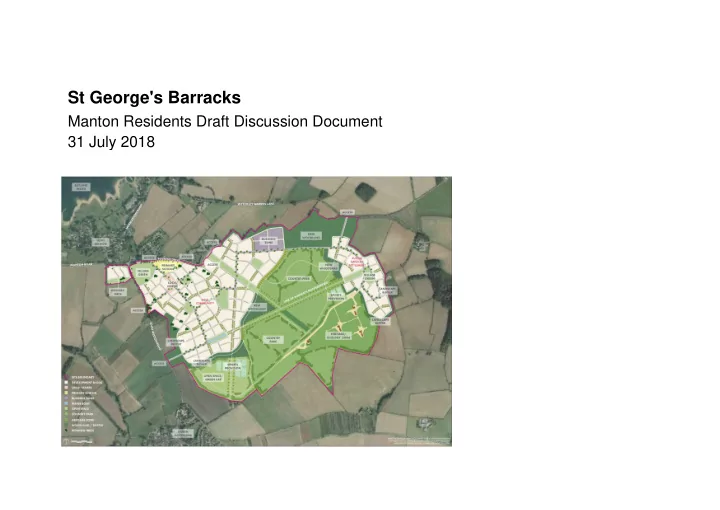
St Georges Barracks Proposal:

  • 300 hectare site
  • 70 houses on Officers Mess Site
  • 3,000 houses on the western development plot
  • 500 houses in the Future Satellite Settlement
  • 14 hectares of employment
  • New Primary School
  • Local Centre
  • 180 hectares (60%) green space
slide-3
SLIDE 3

Scale: (urban mass)

  • Oakham

346 hectares

  • Uppingham

111 hectares

  • St Georges

113 hectares (excludes satellite village)

  • Manton

15 hectares

slide-4
SLIDE 4

Main Issues

  • Whilst there is an overall issue regarding the

scale of development, it's character and the need for such a development, the visual impact will not be significant for Manton.

  • The key issue and impact on the village will

be traffic, noise and air quality.

  • This would apply to construction traffic,

quarrying? and traffic generation from the development itself.

  • The main visual impact would be a new

roundabout on the A6003. This may be a positive for the village.

slide-5
SLIDE 5

Housing Need

  • The Strategic Housing Market Assessment (SHMA) update 2017 established a need in the County for

3,200 new dwellings from 2011 to 2036 based on a delivery rate of 160 dwellings per annum.

  • Whilst St Georges Barracks could deliver 3,570 homes in total an assumption has been made in the Draft

Local Plan that only 1,200 dwellings will be delivered in the plan period (up to 2036). This is based on a delivery rate of 100 units per annum from 2024 to 2036. The balance will be delivered beyond the current plan period.

Table 1: Proposed Spatial Distribution across the County 2. Table 2: Comparison of the Revised Housing Requirement proposed in this paper and the Consultation Draft Plan (2017) requirements

  • This effectively means that there will be a reduction in development elsewhere in the County as indicated in

the table below which could be seen as a positive factor.

slide-6
SLIDE 6

Employment Baseline

  • The Rutland County Council Employment Land Assessment Update - Final Report Jan 2016 assesses the

supply, need and demand for employment land in Rutland up 2036.

  • The report suggests that an additional 29.09 HA of employment land is required up to 2036.
  • St Georges could supply 14 hectares of this.
  • The proposed mix (in the Transport Assessment) at St Georges is:

B1 (offices) 25% B2 (Light Industrial) 40% B8 (Distribution) 35%

slide-7
SLIDE 7

Masterplan Analysis

slide-8
SLIDE 8

Use Area Required Actual Area Notes Overall Site Area 300 HA 300 HA Includes Officers Mess Site 60% Public Open Space 180 HA (only 160 HA achievable if Eastern Area delivered) 195.8 HA The 195.8 HA is based on the drawn masterplan which has a shortfall in housing and employment of 37 HA. If this is corrected to take up the shortfall and omitting the eastern housing 180 acres are achieved. Officers mess site 2.4 HA 2.4 HA Delivers 70 houses at 2.9/HA Western Area 3,000 homes at 29 dwellings/hectare (excluding officers mess) 103.5 HA 73HA This is a shortfall of 28 HA which, at 29/HA, accommodates only 2,117 dwellings (To achieve 3,000 homes a density of 41/HA would be needed). Eastern Area 500 homes at 29 dwellings/hectare 17.2 HA 20 HA Adequate provision for 500 homes Employment Zone 14 HA 5.0 HA A shortfall of 9 HA. At standard development densities (17,500sqft/ac) this equates to a shortfall in employment floorspace of 390,000 sq ft. School 2.3 HA 2.3 HA Local Centre 1.5 HA 1.5 HA SUDS (Sustainable Urban Drainage) None None 4.5 ha of land will be required to achieve greenfield run-off rates based on 15m3/dwelling.

slide-9
SLIDE 9

Quantum of Development - Housing

  • The High-Level Masterplan sets out a target of 3,570 homes on the St Georges Barracks Site. 70 on the

former Officers Mess, 3,000 on the western site and an additional future 500 on the eastern satellite village.

  • To achieve 3,000 dwellings at 29 dwellings per hectare 103.5 hectares of development land will be
  • required. Only 73 hectares are shown on the masterplan. This would provide 2,190 dwellings. The

difference between actual and required land (30.5 hectares - or an area larger than Edith Weston) is shown

  • n the overlay below.
slide-10
SLIDE 10

Quantum of Development - Employment

  • The High-Level Masterplan refers to employment as a key element of the scheme to ensure that the

development is sustainable.

  • The Masterplan states an area of 14 hectares (34.5 acres) should be provided. At average commercial

densities (and based on the Traffic Assessment) this would give 61,200m2 (650,000 sq ft) of commercial development.

  • The masterplan states the aspiration to create one job per household. A total of 3,570 new jobs.
  • As illustrated below only 5 hectares of employment space is shown on the masterplan. A shortfall of 9
  • hectares. At average commercial densities this would equate to a shortfall of 39,342 m2 (423,000 sq ft).
slide-11
SLIDE 11

Drainage

  • To comply with current government guidance on flood prevention new developments must attenuate

surface water runoff so that the discharge matches a standard greenfield discharge. This prevents rapid fluctuations in surface water flow through a greater discharge from hard surfaces such as roads and roofs. As a rule of thumb an allowance of 15m3 per house should be allowed which is an area of 4.5 hectares.

  • As the site is a former airfield it is likely that the high point of the site is the centre of the runways so

effectively the centre of the site. As attenuation ponds need to be located at the low points these may impact on the location of the housing. No information on drainage strategy (foul and storm) seems to be contained within the documentation. Transport

  • A Transport Assessment (TA) was prepared for St Georges in April 2018 and contains an assessment of

the existing traffic situation, the assumptions on trip generation from the new development, distribution of traffic and predicted traffic generation post development.

  • Traffic will be one of the key factors impacting on Manton and its impact needs to be fully understood. The

TA needs to be reviewed in detail and assessed to understand the impact on the existing highway network, the rural character of the roads and tourism (cycling etc). Affordable housing

  • Whilst affordable housing is mentioned there does not appear to be a percentage established in the

available documentation. Establishing a minimum should be a key consideration.

slide-12
SLIDE 12

Next Steps

  • Develop a coherent plan and a consistent message to enable the group to respond to the consultation

timescales.

  • It seems that there are three key options available:
  • 1. Fight for no development at all (unlikely to succeed)
  • 2. Accept the scale of development but ensure safeguards are in place to control development and ensure

that the infrastructure, affordable housing, employment targets etc are met.

  • 3. Push for a development of a scale which compliments, and does not have an adverse impact on, the

County (this seems to be the favoured approach from Edith Weston and North Luffenham) If a smaller 500 unit scheme were proposed it would be of a scale which complimented rather than

  • vershadowed Edith Weston as

illustrated below.

slide-13
SLIDE 13
  • The St George's proposals have been through a range of public consultations, including a recent public

exhibition in Manton. At the same time RCC are bringing forward an updated Local Development Plan (LDP) extending the plan period to 2036. This is now working its way through the consultation process. The new LDP will incorporate the St George's Development into it. The timescale is broadly set out below.

Anticipated Date Process 31st July cabinet Report Consultation opens 13th August closes 24th sept RCC are carrying out an additional non-statutory consultation to consider the implications of including St George's Barracks into the LDP. Consultation Period 6 weeks Nov / Dec 2018 LDP Published. The LDP will be available for a minimum of 6 weeks for public comment Early 2019 If the plan is considered sound RCC can submit to the Planning Inspectorate. 2019/2020 The plan is examined by an independent planning Inspector, normally at a public hearing. 2020 If the Inspector finds the plan to be sound it can be adopted by the local Authority. 2020/2021 Following adoption of the plan it is likely that the developer will submit an

  • utline planning application to establish the principles and quantum of

development. 2020/2021 Once the outline application is determined individual development plots / phases will be submitted as reserved matters applications.

  • The first key milestone is to prepare representations to the non-statutory consultation by the 24th

September.

slide-14
SLIDE 14

Action Items (initial thoughts)

Item Action Status

REPRESENTATIONS / LOBBYING Attend 31st July Cabinet Meeting to gauge the mood of councillors and the level of support for the proposal Should local residents be canvassed to get their views and understand what the main concerns and issues are to create a consistent message and evidence base? What are the key concerns of villagers, are there other issues? Contact other resident groups / parishes to see if resources can be pooled and potentially agree a statement of common ground. Confirm timescales and monitor progress of the LDP (Parish Council?). Establish a mechanism and process for making representations and objections Review the policies set out in the Local Plan and draft initial thoughts / actions / responses. Prepare representations for August/Sept non-statutory consultation Prepare representations for Nov/Dec non-statutory consultation REVIEW OF POLICIES / BACKGROUND INFORMATION Review the Housing Need in more detail. Does this only meet Rutland needs or picking up a shortfall in other areas? Review the Employment Land Assessment Update in more detail. Does 14HA of B1/B2 and B8 at St Georges comply. For example, the assessment refers to relevant employment policies in the Neighbourhood Plans and for Edith Weston Commercial or Industrial

slide-15
SLIDE 15

development should only be permitted if: There is no increase in HGV's travelling through the village. Review the proposals against National and Local planning policies to highlight any areas

  • f non-compliance and conflict.

Investigate Garden Village requirements to ensure that St Georges adheres to these. Review available documentation on affordable housing to see what policies / percentages of affordable housing are relevant. TRAFFIC & TRANSPORTATION Review the Transport Assessment to understand the impacts of construction traffic, quarry traffic and future development traffic. Carry out independent surveys to confirm the baseline figures used in the TA (junction queues etc) Carry out a character analysis of the existing rural roads - photographs at peak times, conflicts of cycle / pedestrians and cars DRAINAGE Check the documentation and EA flood map to see if any information is available on drainage strategy and flood. Review site contours and locations of watercourses to see what a likely drainage strategy would be. ECOLOGY See if any representations have been made from Natural England / wildlife groups etc.

slide-16
SLIDE 16

MASTERPLAN Check standard B1/B2/B8 employment densities to see if one job per household is achievable

slide-17
SLIDE 17

Proposed Local Plan Policy for St. George’s

6.1 In order to take account of the above, a new policy is proposed with specific reference to the potential development of the St. George’s site. Comments are invited on this proposed policy as set out below. 6.2 It is important that the new development on this site delivers a high-quality design, and an appropriate mixed and balanced community through the provision of community facilities and infrastructure, local employment opportunities and a wide choice of high quality market and affordable homes to meet the needs of different groups as well as those wishing to build their own homes. 6.3 The policy below supports the development of new “garden village” of between 1,500 and 3,000 dwellings, appropriate employment land together with associated education, health and community facilities alongside extensive areas of open space. The concept of the new settlement is based on the principles for garden communities set out by the Town and Country Planning Association (Link?). These principles have been analysed to set out the framework for the design, development and delivery through the long-term stewardship of the proposed new community at St. George’s as follows:

  • Ensure that the potential development funds the delivery of appropriate services and facilities to support and benefit the wellbeing of both the new

and existing, neighbouring community.

  • RCC commits to ensuring the best possible outcome for the County from the redevelopment of the site through a MoU setting out a clear vision for

the development of the new community and to establish and facilitate a programme of community engagement from the beginning.

  • Establishment of a Community Trust (which will be transferred to the new community with residents/Parish Councils as Trustees) to ensure the

creation of a flourishing and vibrant community, making it a place where people want to live and work in the future.

  • Provide a genuinely mixed community with new homes of various types and tenures which meet the needs of residents in terms of size,

affordability and choice of ownership, including appropriate provision for local people to enter onto the housing market.

  • Provide a range of work choices to allow residents to choose to live and work at home, within the new community and the County, and act as a

focal point for new enterprise.

  • Ensure that the new settlement is developed within a set of high quality design principles concerning the use of appropriate styles and materials

which ensures that the development respects both its immediate context and reflects its location within Rutland.

slide-18
SLIDE 18
  • Protect and where possible enhance the natural environment within the site through the creation of significant areas of public open space, a

network of green corridors and the creation of new habitat to support an overall increase in biodiversity across the whole site and its relationship to the wider County

  • Promote the incorporation of sustainably designed “future proof” homes and workplaces.
  • As part of the first phase, develop a new local centre which will become the heart of the new community and the potential primary focus for

cultural, recreational, education, health, shopping and leisure activities.

  • Ensure that the layout of the development looks to facilitate extensive safe routes for walking and cycling, particularly to the local centre, the

related employment areas and provide linkages to the existing neighbouring community.

  • Ensure that as far as possible public transport opportunities are established and enhanced in order to provide convenient and accessible choices

to the new community.

6.4 Proposals for the development of the site will need to consider all infrastructure requirement and any necessary matters of avoiding, mitigating or compensating for environmental impacts. This will include consideration of how proposals will contribute to the wider network of settlements, provide a focus for sustainable services and facilities within the new settlement as well as connect to and support services and facilities in the nearby settlements. 6.5 Proposals will need to be accompanied by a delivery strategy to indicate how and when development will be implemented, the design codes and development standards that are proposed, together will a comprehensive assessment of required infrastructure and its phasing for delivery. The development of St. George’s will result in an increase in the demand for travel. To alleviate this, it will be necessary to make appropriate access arrangement, consider any required improvements to transport infrastructure as well as encourage the use of other forms of travel away from the private car. The provision of superfast broadband through fibre to the premise (FTTP) for residents and businesses will be expected to be delivered as a minimum 6.6 The St. George’s site offers the opportunity to provide for appropriate employment, not only to meet the needs arising from the residents of the new

  • community. At least 14 hectares of employment land is expected to be provided on this site on the basis of 9 hectares being required to support the

new community and 5 hectares to contribute as part of the overall employment land provision in Rutland as set out in the Local Plan employment land review.

slide-19
SLIDE 19

Policy RLPxx – St George’s Garden Village

Planning permission will be granted for the creation of a new garden village of between 1,500 and 3,000 dwellings at St George’s. The new community must be developed as a comprehensive mixed use scheme in accordance with a finalised masterplan prepared for the whole site and to be agreed by the Council. The finalised and agreed masterplan must demonstrate how it will deliver a sustainable new community based on the following Rutland garden village principles: 1. Ensures the potential development funds the delivery of appropriate services and facilities to support and benefit the wellbeing of both the new and existing, neighbouring community. 2. Sets out a clear vision for the development of the new community and facilitates a programme of community engagement throughout the master- planning process. 3. Establishes a Community Trust (which will be transferred to the new community with residents/Parish Councils as Trustees) to ensure the creation of a flourishing and vibrant community, making it a place where people want to live and work in the future. 4. Provides a genuinely mixed community with new homes of various types and tenures which meet the needs of residents in terms of size, affordability and choice of ownership, including appropriate provision for local people to enter onto the housing market. 5. Provides a range of work choices to allow residents to choose to live and work at home, within the new community and the County, and act as a focal point for new enterprise. 6. Ensures that the new settlement is developed within a set of high quality design principles concerning the use of appropriate styles and materials which ensures that the development respects both its immediate context and reflects its location within Rutland 7. Design and development that protects and where possible enhances the natural environment within the site through the creation of significant areas

  • f public open space, a network of green corridors and the creation of new habitat to support an overall increase in biodiversity across the whole site

and its relationship to the wider County. 8. Promotes the incorporation of sustainably designed “future proof” homes and workplaces. 9. As part of the first phase, ensures the develop a new local centre which will become the heart of the new community and the potential primary focus for cultural, recreational, education, health shopping and leisure activities

slide-20
SLIDE 20

10. Ensure that that layout of the development looks to facilitate extensive safe routes for walking and cycling, particularly to the local centre, the related employment areas providing linkages to the existing neighbouring community. 11. Ensure that as far as possible public transport opportunities are established and enhanced in order to provide convenient and accessible choices to the new community. These principles should be embedded into the planning, development, delivery and ongoing lifetime of the community. Community infrastructure will be provided for the first phase of development to ensure new community can develop from the very start. The proposed development will comprise a garden village development of new homes together with employment, local services, retail and community uses, as well as extensive open space provision. The development must ensure that the following key elements are provided:

  • residential development of between 1,500 and 3,000 dwellings, with 1,200 expected to be built in the plan period to 2036; and
  • a new employment cluster providing at least 14 hectares of serviced employment land; and
  • implementation of necessary new and improved highway infrastructure to access the site and to ensure impact on the existing highway network is

minimised; and

  • a mixed use village core with local neighbourhood shops to serve the everyday needs of residents and develop a community destination and

support a sense of community; and

  • provision of new (or expanded and relocated) primary school; and
  • appropriate community infrastructure to support the scale of development included on the site including a multifunctional community centre and a

new health and wellbeing centre; and

  • a broad mix of housing types affordability and tenures to meet the housing needs in Rutland including opportunities for self-build; and
  • networks of multifunctional green spaces, a country park and high quality open spaces with green access routes linking to nearby settlements and

the wider countryside; and

  • safeguarding of land for mineral extraction and the development of landscape buffers and structure planting to screen future mineral workings

within the site; and

  • a broad ‘green gap’ between the site, North Luffenham and Edith Weston and the surrounding countryside.
slide-21
SLIDE 21

Proposals will need to demonstrate how they will avoid, minimise and where necessary mitigate or compensate any adverse environmental impacts and how they will meet all of the following criteria: a). the creation of a model of sustainable living with exemplary standards of design, construction and community facilities; and b). the development of a bespoke energy strategy for the site with appropriate provision of heat and electricity from renewable and local carbon sources where possible; and c). the installation of super-fast broadband (through fibre to the premise) for all businesses, community facilities and dwellings; and d). the preparation of a comprehensive Travel Plan to maximise integrated transport choice and connections to services and facilities in neighbouring settlements, including: appropriate access arrangements, road links, junction improvements, network of dedicated pedestrian and cycle links throughout the new settlement with direct and clearly defined connections to neighbouring settlements; appropriate infrastructure to facilitate the use of electric vehicles; and e). provision of appropriate means to deal with waste water that meets the requirements of the Water Framework Directive and to secure improvements in water quality and surface water management; and f). enhancement of landscape and green infrastructure to support biodiversity, prevent coalescence with neighbouring villages and provide accessible

  • pportunities for recreation through: the provision of open space, allotments and private gardens, provision of significant areas of new open space

and woodland, and the creation of an extensive walking, cycling and riding network with areas of new green infrastructure; and g). the establishment of appropriate liaison and governance solutions by identifying the ways in which inclusive and continuous engagement, joint working and long term stewardships can be secured to deliver this unique and exceptional garden village development.