Spreading Scriptural Holiness: Spreading Scriptural Holiness: - - PDF document

spreading scriptural holiness spreading scriptural
SMART_READER_LITE
LIVE PREVIEW

Spreading Scriptural Holiness: Spreading Scriptural Holiness: - - PDF document

A Prayer of John Wesley A Prayer of John Wesley Eternal God our sovereign Lord, we Spreading Scriptural Holiness: Spreading Scriptural Holiness: acknowledge that all we are, all we have, is Then and Now Then and Now yours. O give us such a


slide-1
SLIDE 1

Spreading Scriptural Holiness: Then and Now Spreading Scriptural Holiness: Then and Now

Laceye Warner A Prayer of John Wesley A Prayer of John Wesley

Eternal God our sovereign Lord, we acknowledge that all we are, all we have, is

  • yours. O give us such a sense of your infinite

goodness, that we may return to you all possible love and obedience. O may we always delight to praise your holy Name, and, above all your benefits, love you, our great Benefactor. Amen

  • Mr. Wesley
  • Mr. Wesley

Why study Wesley?

“tradition” as a noun, adjective, etc. traditio “to tradition” “For I handed on to you as of first importance

what I in tern had received: that Christ died for

  • ur sins in accordance with the scriptures.”

(I Cor 15.1-11)

Why study Wesley? “Traditionalism is the dead faith of the living, but tradition is the living faith of the dead.”

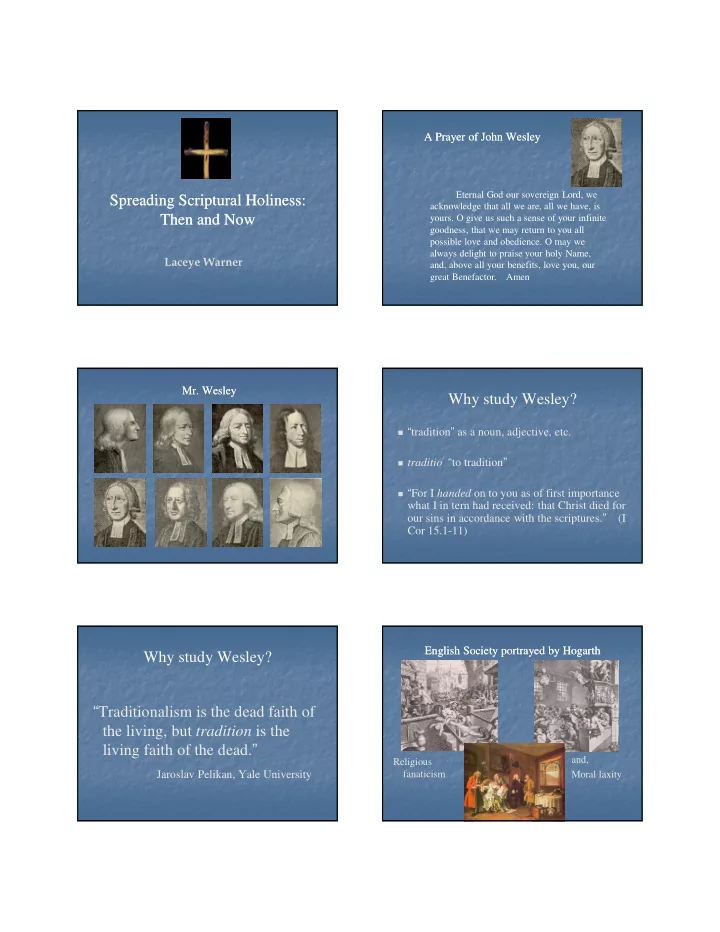
Jaroslav Pelikan, Yale University English Society portrayed by Hogarth English Society portrayed by Hogarth

Religious fanaticism and, Moral laxity

slide-2
SLIDE 2

The Early Methodist Movement

“What may we

reasonably believe to be God’s design in raising up the People Called Methodist?

  • A. To reform the nation

and, in particular, the Church; to spread scriptural holiness over the land.”

  • “Large” Minutes

Difficulties of Contemporary Language

Where are we?...

And how did we get here?

A bifurcation… Etymological threads

Reclaiming Language

Greek root--euangelion Old Testament usage

“to proclaim good tidings”

angelos “messenger” angelo “to announce”

Announcement of God’s salvific activity (Isaiah)

Reclaiming Language

New Testament/Post-Easter

usage

to proclaim the message of

salvation in word and deed (Klaiber)

With Intentional Practices…

Evangelism is- that set of loving, intentional activities governed by the goal of initiating persons into Christian discipleship in response to the reign of God

(Scott Jones, The Evangelistic Love of God and Neighbor, 18)

Who practices evangelism?

…all Christians We are commissioned to

evangelistic ministry by

  • ur baptisms

“…to proclaim the good

news and live according to the example of Jesus Christ.”

(See the UM Hymnal pages 35 and 40)

slide-3
SLIDE 3

Mission of the UMC

“The mission of the Church is

to make disciples of Jesus Christ”—for the transformation of the world

The Book of Discipline, UMC,

1996 and 2008

Discussion….

What opportunities and obstacles to

practicing ministry and evangelism do you and your congregation perceive in your context?

Obstacles Then and Now

Lack of capacity and/or

confidence to understand and live our beliefs

Preoccupation with rapid

numerical growth

Disinterest in sustained

Christian practices

Reluctance to share wealth Lack of capacity to move

beyond relief efforts to facilitate sustainability

Spreading Scriptural Holiness

Obstacle Lack of capacity and/or confidence to understand and live our beliefs Resource The Wesley’s encouraged a deep simple faith that shaped Christian living

Spreading Scriptural Holiness

Obstacle Preoccupation with rapid numerical growth Resource ‘Growth’: steady intense growth in numbers, but also in grace

Spreading Scriptural Holiness

Obstacle Disinterest in sustained Christian practices Resource Practices and organization emerged from doctrine for intentional growth

slide-4
SLIDE 4

Spreading Scriptural Holiness

Obstacle Reluctance to share wealth Resource Wealth-sharing and outreach are significant components of personal and communal faith

Spreading Scriptural Holiness

Obstacle Beyond Relief Resource Long term practices such as education, medical care, and no/low interest loans facilitate sustainability

A Prayer of John Wesley A Prayer of John Wesley

Teach us, Ruler of the universe, to see people by the light of the faith we profess, that we may check in ourselves all ungenerous judgments, all presumptuous claims, that, recognizing the needs and rightful claims of others we may remove old hatreds and rivalries and hasten new understandings, that we may bring our tributes of excellence to the treasury of our common humanity; through Jesus Christ our Lord. Amen.

Spreading Scriptural Holiness

Living Faith Immersion in doctrine through the sermons and hymns alongside practices was intended to nurture individuals in the Christian faith.

Spreading Scriptural Holiness: Living Faith

A steady decline in theological aptitude has occurred in the last two centuries among those practicing ministry. John Wesley (with Jonathan Edwards) is among the last serious scholars and Christian practitioners.

See William Abraham, Logic of Evangelism

Spreading Scriptural Holiness: Living Faith Spreading Scriptural Holiness: Living Faith

A Plain Account of the People Called Methodists, to preach and “to convince those who would hear what true Christianity was and to persuade them to embrace it.” Wesley named the following as important resources for the early Methodists: “following only common sense and Scripture; though they generally found, in looking back, something in Christian antiquity

slide-5
SLIDE 5

Spreading Scriptural Holiness: Living Faith

In his The Character of a

Methodist, John answered the questions, “who is a Methodist?” and “what is the mark?” with this response:

“A Methodist is one who has the

love of God shed abroad in [one’s] heart.

Spreading Scriptural Holiness: Doctrine

In his sermon, Causes of the Inefficacies of Christianity, Wesley outlined three aspects that Christians often lacked:

(1) a sufficient understanding of

doctrine,

(2)

adequate discipline, and/or

(3)

self-denial.

Living Faith: Charles’ Hymnody and Christian Formation Living Faith: Charles’ Hymnody and Christian Formation

Hymns more than

anything else formed early Methodists

Yet, did not receive

doctrinal status with the Sermons and Notes on the NT in the 1784 Deed

  • f Declaration

Doctrine: Charles’ Hymnody and Christian Formation

“These hymns lead one back to basic themes and emotions of the formative faith: the soteriological center, the emphasis on God’s grace and human appropriation, the challenge for growth and missional responsibility.”

Thomas Langford

John Wesley’s Theology

“Scripture Way of

Salvation” (1765)

Most often preached

sermon, and

Most mature

representation of Wesley’s theology

Sanctification as event

and process

John Wesley’s Theology: ‘Via Salutis’ John Wesley’s Theology: ‘Via Salutis’

Original

righteousness and sin

  • “One thing needful”—the

renewal of the image of God Prevenient grace

Precedes human

action

Analogous to

conscience

Given to all

Repentance Justification

See next slide

Sanctification

See next slide

Assurance Regeneration

slide-6
SLIDE 6

John Wesley’s Theology: ‘Via Salutis’ John Wesley’s Theology: ‘Via Salutis’

Justification Pardon God does for us Work of Christ Accounted as righteous Relative change Forensic Imputation Saved from guilt of sin Sanctification Holiness God does in us Work of Holy Spirit Becoming righteous Real change Therapeutic Impartation Saved from power of sin

John Wesley’s Theology: ‘Via Salutis’ John Wesley’s Theology: ‘Via Salutis’

Christian perfection (entire sanctification)

Perfect love (purity of heart) Is not absolute perfection, but freedom from sin (a conscious, voluntary breaking of a known law of God) “Having the mind of Christ and walking as he walked” The root or remains of sin still not destroyed Backsliding still possible A process or instant? gradual or instantaneous?

John Wesley’s Theology: ‘Via Salutis’ John Wesley’s Theology: ‘Via Salutis’

  • Possible Problems with Perfection…

Antinomianism--being above the law Perfectionism--being without error “Sinless perfection”--a problem term Claims of perfection--Bell and Maxfield “Second Blessing”?--Fletcher’s terminology (Checks against Antinomianism) A roadblock for participation of many Anglican clergy in the Methodist movement

John Wesley

Theological Integration

Knowledge and vital piety Sacramentalism and

evengelism

Faith and good works Justification and

sanctification

Sola fide and sola gratia Piety and mercy Personal holiness and social

holiness Not a new theology--Synthesis

From: Richard Heitzenrater, The Poor and the People Called Methodists

Living Faith Living Faith

Wesley and the Moravians Peter Bohler presses him on “sola fide” No degrees of faith “Preach faith til you have it, and then, because you have it, you will preach faith.” Bohler forms Fetter Lane Society May 1, 1738, at Hutton’s house

Living Faith

John Wesley’s experience of assurance May 24, 1738 “He had taken away my sins, even mine, and saved me…”

slide-7
SLIDE 7

Discussion….

How do you and your congregation

understand Christian faith?

What direct and indirect practices contribute

to formation in faith in your congregation?

What would you like your congregation to

learn from the Wesley’s? A prayer of John Wesley

All-sufficient God of heaven and earth, who art above all, and through all, and in all; from whom, by whom, and in whom are all things; in whom we live, move, and have our being; may

  • ur wills be as entirely and continually derived

from yours, as our being and happiness are. Help us with your grace, that whatever we do or suffer this day may tend to your glory. Amen

Spreading Scriptural Holiness

Growth

While much of contemporary ‘evangelism’ is quantified by the rapid increase of local church attendance, the early Methodist movement acknowledged a relatively slow, but steady, intense process of Christian formation resulting in changed lives.

Counting Conversions

Growth: (1) Numerical, and (2) Growth in Grace

Numerical Growth

Bristol, 1739 The revival begins with

field preaching and ‘society’ meetings

1745 experiment

Early Methodist Strategies

Beginnings of field preaching

A “new period” in Wesley’s life, Following George Whitefield’s example Started in Bristol at the brickyard (Kingswood)

  • Preaching outside church

buildings not illegal but highly irregular

  • George Whitfield
slide-8
SLIDE 8

Spreading Scriptural Holiness: Organization and Practices

“I was so

tenacious of every point relating to decency and

  • rder that I

should have thought the saving of souls almost a sin if it had not been done in a church.” JW

Wesley preaching at the Sandgate, Newcastle

Early Methodist Strategies Early Methodist Strategies

Formation of the “United Societies”

Starts in Bristol, combined Nicholas Street and Baldwin Street societies

Acquisition of “preaching houses”

Building of the New Room, Bristol Leasing of the Old Foundery, London

Numerical Growth

By 1750, London societies’

membership 2000

100 circuits total, served

by 3 dozen preachers

Numerical Growth

By 1760, Societies’ membership

20,000

Growth rate:

approximately 1000 members per year

Numerical Growth

By 1770, Methodism growing

steadily in America

Growth rate in England:

approximately 1600 members per year

1775 Leeds membership

2000

London, still 2500 after

twenty years

slide-9
SLIDE 9

Numerical Growth

In 1781, 178 preachers, one for

every 250 members, a constant ratio since 1767

63 circuits in England Only a dozen with 1000

members

Spreading Scriptural Holiness: Organization and Practices

The movement spread North and West, initially mostly among youth and women of modest background, eventually forming a triangle—London, Bristol, Newcastle

Numerical Growth Discussion….

What is lost when growth in numbers are

prioritized above grace? Or numbers and growth are dis-integrated (separated)?

Where do you see the integrated growth of

numbers and grace in the United Methodist Church?

Discussion….

How can we develop measures of growth—

  • r what measures of growth are faithful

assessments of ministry?

Discuss goals, evidence/artifacts,

direct/indirect measurers.

A prayer of John Wesley A prayer of John Wesley

O God who dwells in the Light which no one can approach, in whose presence there is no night, in the light of whose countenance there is perpetual day; we your servants, whom you have preserved by your power this day, bless and glorify you and humbly pray that this, and all our days, may be wholly devoted to your service. Send your Holy Spirit to be the guide of all our ways and the sanctifier of our souls and bodies. Amen

slide-10
SLIDE 10

Spreading Scriptural Holiness

Practices The intentionality of the early Methodist movement’s

  • rganization and practices

(e.g. field preaching, lay preachers, classes and bands) emerged directly from doctrinal frames facilitating intentional and meaningful growth.

Spreading Scriptural Holiness: Organization and Practices

John consistently urged that authentic spiritual formation could not take place “without society, without living and conversing with [others].” Bristol “New Period”--Bristol “New Period”--Bristol

“To Watch Over One Another in Love” “To Watch Over One Another in Love”

Society structure: divided into small groups

Classes: 10-12 by geography (subdivision) Captain Foy’s suggestion First used to pay debt at New Room Leader responsible for full amount Everyone assigned to a class Later developed into meetings

Bands: 6-8 people, by age, sex, marital status

Voluntary, homogenous, nurturing Not everyone belonged to a band

Band lists--Penitents and Select Society

slide-11
SLIDE 11

Spreading Scriptural Holiness: Organization and Practices Spreading Scriptural Holiness: Organization and Practices

Lay leadership positions in

society Helper--preacher Class and band leaders Trustees--oversee property Steward--manage funds Visitors of the Sick

Circuits formed of societies in a

region located primarily in rural areas led by Assistants--head preacher on circuit

Spreading Scriptural Holiness: Organization and Practices Spreading Scriptural Holiness: Organization and Practices

Discipline in the societies

Class tickets--examined, renewed quarterly Required for attendance at some meetings General Rules-- One requirement to join Three conditions in order to continue:

  • do good,
  • avoid evil,
  • attend to the ordinances of God

Means of Grace

Piety: [Instituted] prayer, searching

Scripture, Lord’s Supper, fasting, conferencing

Mercy: [Prudential] feeding the

hungry, clothing the naked, visiting sick, imprisoned or variously afflicted, almsgiving, awakening the sinner...

The Old Foundery, London

London

Early Methodist Organization

Strategies: Field Preaching, Lay People Small Groups Organization: Classes/Bands Tickets, General Rules Conference Itineracy/Circuits Examination Doctrinal Standards

slide-12
SLIDE 12

Oxford Methodism Oxford Methodism

Wesley’s Diaries

Wesley’s reading

Jeremy Taylor, Holy Living and Holy

Dying

Thomas a’Kempis, The Imitation of

Christ

William Beveridge, Private Thoughts

upon Religion

Robert Nelson, The Practice of True

Devotion

Christ Church, Oxford Christ Church, Oxford

Bocardo Gaol

Wesley’s Diaries Wesley’s Diaries

slide-13
SLIDE 13

Ingham and Wesley Diaries Ingham and Wesley Diaries

Oxford Methodism Oxford Methodism

Wesley’s diaries

Care of time (see Taylor’s Holy Living) Family tradition (see Susanna, Samuel) Private account (compare with Journal) Written in code/cipher for secrecy, economy of space and time Record of details: reading, traveling, writing, conversations, prayer, resolutions, self-examination, etc.

General Questions

Have I prayed with fervor, by myself and at Chapel? Have I used the Collects at 9, 12, and 3? Grace? Have I after every pleasure immediately given

thanks?

Did I in the morning plan the business of the day? Have I been zealous in undertaking and active in

doing what good I could?

Has good will been and appeared the spring of all my

actions toward others?

Discussion….

At what point do practices and organizational

structures become ‘works righteousness’ or as Parker Palmer describes, ‘functional atheism’?

How can we anchor ourselves in faithful

practices that provide a foundation for Christian belief and practice, particularly justification and sanctification?

A prayer of John Wesley Eternal God, we give you humble thanks for all the blessing spiritual and temporal which in the riches

  • f your mercy you have poured down upon us…. O

thou Saviour of all who trust in you, do with us what seems best in your own eyes…. Pour into us the whole spirit of humility, and make it the constant, ruling habit

  • f our minds, that all our other tempers may arise from

it. Amen

Spreading Scriptural Holiness

Wealth-sharing Consideration of economics and its implications for personal and communal faith, specifically wealth- sharing among and by participants, was a significant discipline required of early Methodists contributing significantly to changed lives.

slide-14
SLIDE 14

John Wesley

Wesley’s Social Context

Not a preferential option for the poor,

rather a commitment to living into the image of Christ

18th Cent. Tremendous Social Transition:

Capitalism & Enlightenment

Vast majority of Methodists, like the

majority of society, were poor

John Wesley’s Economic Ethic

1.

The source of all things is God and so all things belong to God

2.

Earthly wealth has been placed in human hands to be stewarded on God’s behalf

3.

God expects that we use what we are given to provide for our own necessities and then for the necessities of others

4.

To spend our God-given resources on luxuries while others are in need of necessities is to misuse what God has given us

Randy Maddox, The Poor and the People Called Methodists

Biblical Foundations

The Bible Offers:

500 verses on prayer Less than 500 on faith Over 2,000 on money and

possessions

10% of the gospels (288 verses)

focus on the use of money

16 of Jesus’ 38 parables are about

the use of money

(James S. Hewitt, Adult Bible Studies Teacher, Nashville: Tyndale House Publishers, 1988)

Biblical Foundations

Old Testament Themes

1.

Wealth as Occasion for Idolatry 2. Wealth as Fruit of Injustice 3. Wealth as the Blessing on the Faithful

4.

Wealth as the Reward of Labor From: Sandra Wheeler, Wealth

New Testament Themes

1.

Wealth as a Competing Object of Devotion

2.

Wealth as a Stumbling Block

3.

Wealth as a Symptom of Injustice

4.

Wealth as a Resource for Human Needs as peril and Obligation

Church History

Teaching from Early Church

Didache, Apostolic Constitutions, Barnabas, Hermas, Justine Martyr Justin Martyr: “The wealthy among us help the needy. . . Those who are prosperous, and willing, give what each thinks fit. And what is collected is deposited with the president, who gives aid to the orphans and widows.”

Church Fathers

Irenaeus: “Whatever we acquired from unrighteousness when we were unbelievers, we proved righteous when we have become believers, by applying it to the Lord’s advantage.”

Church Fathers

Cyprian: “Life is redeemed from Dangers

by almsgiving. Souls are delivered from death by almsgiving.” “Make Christ a partner with you in your earthly possessions, that He also may make you a fellow heir with Him in His heavenly kingdom.” “You are wealthy and rich. Do you think that you can celebrate the Lord’s Supper, not at all considering the offering? Can you come to the Lord’s supper without sacrifice and yet take part of the sacrifice that the poor man has offered?”
slide-15
SLIDE 15

Spreading Scriptural Holiness

“Gain all you can,

without hurting either yourself or your neighbor…

Save all you can, by

cutting off every expense which serves

  • nly to indulge foolish

desire…

Give all you can, or in

  • ther words give all you

have to God.”

Spreading Scriptural Holiness

“Do you not know that God has entrusted you with that money (all above what buys necessaries for your families) to feed the hungry, to clothe the naked, to help the stranger, the widow, the fatherless; and indeed, as far as it will go, to relieve the wants of all [hu]mankind. How can you, how dare you, defraud your Lord by applying it to any other purpose!”

John Wesley, The Dangers of Increasing Riches

John Wesley’s Letter to Miss March

“visit the poor, the widow, the sick, the fatherless in their affliction; and this, although they should have nothing to recommend them but that they are bought with the blood of Christ. It is true that this is not pleasing to flesh and

  • blood. There are a thousand

circumstances usually attending it which shock the delicacy of our nature, or rather of our education. But yet the blessing which follows this labour of love will more than balance the cross” (JWL, 6:208-9)

Miss March

“Yet I find time to visit the sick and the poor; and I must do it, if I believe the Bible, if I believe these are the marks whereby the Shepherd of Israel will know and judge His sheep at the great day. . . . . .I am concerned for you; I am sorry you should be content with lower degrees of usefulness and holiness than you are called to.” (Letter to Miss March,

10 Dec. 1777)

Spreading Scriptural Holiness

“But first supplying thy own reasonable wants [necessities], together with those of thy family; then restoring the remainder to me [God], through the poor, whom I had appointed to receive it…leaving the right of being supplied first, and the blessedness of giving rather than receiving?”

John Wesley, The Good Steward

Charles Wesley

“How many collections think you has my brother made between Thursday evening and Sunday? No fewer than

  • seven. Five this one day

from the same poor exhausted people. He has no mercy on them, on the GIVING poor I mean; as if he was in haste to reduce them to the number of the RECEIVING poor.”

XIII.2 Works, 9:277

slide-16
SLIDE 16

From Wesley to My Church:

Ronsvalle Study: 29 Protestant Denominations in the US from 1968-1995

As American wealth has increased, giving as a

percentage of total income has declined

Decline of 35% in benevolence giving (if

“Congregational finance” is separated from “benevolences”

Contemporary Situation

“Many pastors loathe stewardship sermons, since they feel an inherent conflict between their sincere personal ministry to parishioners and the necessity to ask the same people for Money” (Dean Hoge, Money Matter)

83% of pastors feel their congregants do not want the

pastor to know how much they give (John & Sylvia Ronsvalle, Rediscoverng Accountability) Many church members view money given to the congregation as paying for a service, like dues paid to a social organization

Contemporary Situation

Seeker Church Movement: Postponement of

Ethical Awareness (from mid-80s)

Highly individualistic and consumeristic—

self-sacrifice and community responsibility unpopular; need for community eroded

In this culture all self-sacrifice—especially

that involving personal wealth—is highly unpopular The Spirituality of Fund-Raising by Henri Nouwen

“As a form of ministry, fund-raising is as spiritual as giving a sermon, entering a time of prayer, visiting the sick, or feeding the hungry.” “Asking people for money is giving them the opportunity to put their resources at the disposal of the Kingdom. Whether they have much or little is not as important as the possibility

  • f making their money available to God.”

“When fund-raising as ministry calls people together in communion with God and with one another, it must hold out the real possibility of friendship and community.”

For Discussion

Where, in your congregation, do you anticipate points of tension when speaking

  • f wealth sharing?

What are the reasons behind the anticipated tensions? What can you do to resolve these?

Spreading Scriptural Holiness

Obstacle Beyond Relief Resource Long term practices such as education, medical care, and no/low interest loans facilitate sustainability

slide-17
SLIDE 17

Spreading Scriptural Holiness

Wesley sought to treat symptoms and systems

  • f poverty to empower

numerous Methodists not merely to survive but to live sustainably and flourish.

London

Class meetings & Bands Class Leaders Connectional Collection Individual Solicitation Lending Program Soup Kitchen Orphanage (Newcastle) Dispensary School (Kingswood) Preaching Houses

Beyond Relief

A number of

experiments including:

A lending stock Medical dispensary Poor houses As well as schools and

care for vulnerable and abandoned children

Beyond Relief: Lending Stock

Wesley had hoped the

Methodist movement would eventually “have all things in common”

However, that became

difficult as the movement grew.

In 1746 Wesley

experimented with a micro-loan program funded by collections among Wesley’s more affluent friends in London.

20 shillings paid in 3

months

Beyond Relief: Medicine

Wesley published

Primitive Physick, 1747

He was skeptical of

physicians, but also moved by those too poor to seek medical care.

In 1746 he engaged a

surgeon and apothecary at the Foundery to dispense medicine and

  • ffer advice each Friday

100 visitors monthly at

a cost of 120 pounds

Women in Early Methodism

John Wesley is among

the earliest to encourage women’s participation and leadership

Mary Bosanquet

Fletcher (1739-1815)

Most likely wrote first

defense of women’s preaching in Methodism

slide-18
SLIDE 18

Women in Early Methodism

“Can I do more for the

souls or bodies of those about me?”

Mary Bosanquet

Fletcher

Women in Early Methodism

Christopher’s Alley Methodist Society Sarah Crosby (1729-1804) Sarah Ryan (1724-1768)

Women in Early Methodism

Bosanquet, Crosby and

Ryan composed a family rule, welcoming orphans and the sick poor.

Bosanquet intentionally

chose to form 35 women and children over years, rather than take all preaching invitations

Obstacles Then and Now

Lack of capacity and/or

confidence to live our beliefs

Preoccupation with rapid

numerical growth

Disinterest in sustained

Christian practices

Reluctance to share wealth Lack of capacity to move

beyond relief efforts to facilitate sustainability

Spreading Scriptural Holiness

Obstacle Lack of capacity and/or confidence to understand and live our beliefs Resource The Wesley’s encouraged a deep simple faith that shaped Christian living

Spreading Scriptural Holiness

Obstacle Preoccupation with rapid numerical growth Resource ‘Growth’: steady intense growth in numbers, but also in grace

slide-19
SLIDE 19

Spreading Scriptural Holiness

Obstacle Disinterest in sustained Christian practices Resource Practices and organization emerged from doctrine for intentional growth

Spreading Scriptural Holiness

Obstacle Reluctance to share wealth Resource Wealth-sharing and outreach brings implications for personal and communal faith

Spreading Scriptural Holiness

Obstacle Beyond Relief Resource Long term practices such as education, medical care, and no/low interest loans facilitate sustainability

Next Steps

Where is the Holy Spirit calling you? Your

congregation(s)?

Next Steps

What are the next steps? What do you need to take those steps? Prayer

Luke 13. 10-17

What binds us as

individuals?

slide-20
SLIDE 20

Luke 13. 10-17

What binds us as the

body of Christ?

Luke 13. 10-17

What transforms us

as individuals?

Luke 13. 10-17

What transforms us

as the body of Christ? I am no longer my own, but thine. Put me to what thou wilt, rank me with whom thou wilt. Put me to doing, put me to suffering. Let me be employed by thee or laid aside for thee, exalted for thee or brought low for thee. Let me be full, let me be empty. Let me have all things, let me have nothing…

John Wesley’s Covenant Prayer

We freely and heartily yield all things to thy pleasure and disposal. And now, O glorious and blessed God, Father, Son, and Holy Spirit, thou art ours, and we are thine. So be it. And the covenant which we have made on earth, let it be ratified in heaven. Amen.

Let us pray as communities:

In Closing…

Goodness is stronger than evil; Love is stronger than hate; Light is stronger than darkness; Life is stronger than death; Victory is ours through Him who loved us.

Desmond Tutu, South Africa (John 1.5)