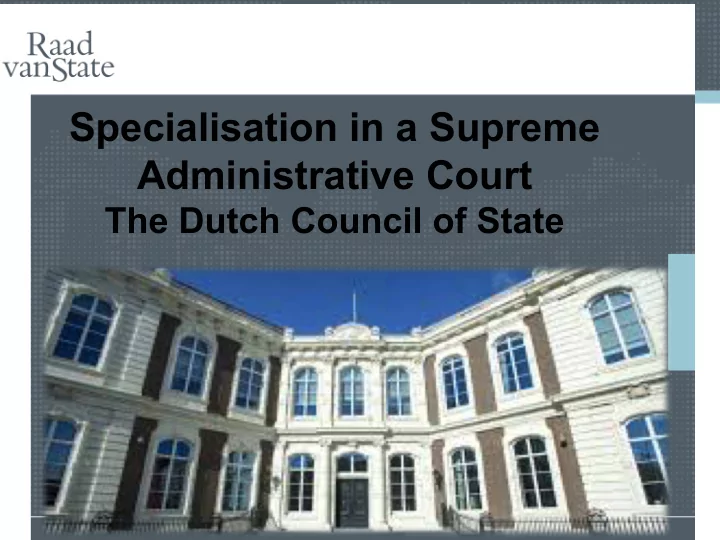
Specialisation in a Supreme Administrative Court The Dutch Council - - PowerPoint PPT Presentation

specialisation in a supreme
SMART_READER_LITE
LIVE PREVIEW

Specialisation in a Supreme Administrative Court The Dutch Council - - PowerPoint PPT Presentation

Specialisation in a Supreme Administrative Court The Dutch Council of State Dutch Council of State Advisary Division Administrative Jurisdiction Division: Three Chambers : 1. Spatial Planning Chamber 2. Immigration Chamber (regular and


slide-1
SLIDE 1

Specialisation in a Supreme Administrative Court

The Dutch Council of State

slide-2
SLIDE 2

Dutch Council of State

  • Advisary Division
  • Administrative Jurisdiction Division:

– Three Chambers:

  • 1. Spatial Planning Chamber
  • 2. Immigration Chamber (regular and asylum residence permits,

detention)

  • 3. General Chamber
slide-3
SLIDE 3

Environmental cases

  • Spatial Planning Chamber:
  • Spatial Planning, Transport Infrastructure, Aviation, Nature Conservation.
  • General Chamber (appeal):
  • Building, Environmental licenses for enterprises

Future (2020?): Environmental Chamber

slide-4
SLIDE 4

Specialisation of judges

Each judge works in two chambers (50%-50%): The effect is: About half of the judges does no environmental cases; the

  • ther half does environmental cases often.

Within the Spatial planning chamber:

  • Groups of specialist for specific cases, f.i. cases about

nature conservation/ cases about windmills.

slide-5
SLIDE 5

Allocation of cases to judges

  • 1. At random within the chambers
  • 2. For specific (environmental) cases: 2 out of 3 judges

from a list of specialists

  • Because of the required expertise or experience or for efficiency

reasons

  • These list are on the website of the Council of state

(transparancy!).

slide-6
SLIDE 6

No specialisation in environmental law at the Dutch administrative courts

  • System of rotation (administrative, penal and civil law)
  • At some courts: special chambers for certain cases (not

in the field of environmental law) Reasons given: As a matter of principal: to avoid a tunnel vision Practical: the number of environmental cases at the courts are too small (to obtain and retain experience).

slide-7
SLIDE 7

(Dis)advantages of specialisation

For:

  • Specific knowledge on a technical and complex field of law

can lead tot better and faster decisions Against:

  • Specialisation can lead to a situation where few judges

determine the main lines of the case law/Risk of tunnel vision Conclusion(?): specialisation of judges in environmental law should be persued in courts where there are enough environmental cases (and judges).

slide-8
SLIDE 8

How is the knowledge aquired?

Training:

  • External (organised by the organisation/council for the

judiciary)

  • Internal: (organised within the Council of State, mostly about

new (international) case law Obtained in previous functions:

  • other courts
  • science
  • legal professions
  • public authorities
slide-9
SLIDE 9

Recruitment of judges for the Council of State

Depending on the needs, candidates are asked to apply with specific knowledge in the field of environmental law or

  • ther fields of law.