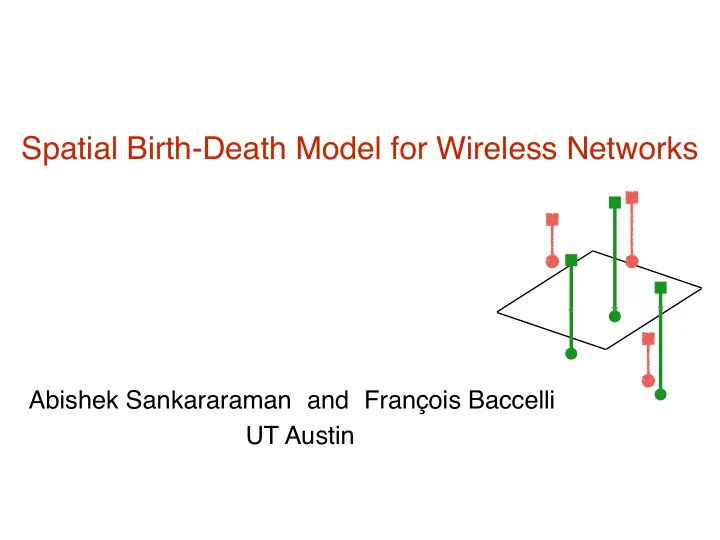
SLIDE 1
Spatial Birth-Death Model for Wireless Networks
Abishek Sankararaman François Baccelli and UT Austin
SLIDE 2 Outline
- Motivation and Background.
- Math Model - Interacting Particle System.
- Summary of Results.
- Further Questions.
SLIDE 3 Background and Motivation
- Model for a wireless network that captures precisely
- Interactions in Space
(Interference)
SLIDE 4 Background and Motivation
- Model for a wireless network that captures precisely
- Interactions in Space
(Interference)
- Interactions in Time due to randomness in traffic.
SLIDE 5 Background - Ad-Hoc Wireless Networks
- We study a simplified dynamical model for ad-hoc wireless networks.
SLIDE 6 Background - Ad-Hoc Wireless Networks
- We study a simplified dynamical model for ad-hoc wireless networks.
- Main engineering application - Overlaid D2D networks.
- Increasing popularity of D2D as means to offload some cellular traffic.
[Dhillon, 15], [Lee, Lin, Andrews, Heath 15], [Lu, DeVeciana 15]
SLIDE 7
- Ad-hoc networks have been studied in detail for a long time !
Background - Ad-Hoc Wireless Networks
SLIDE 8
- However, little is understood on the spatio-temporal interactions in ad-hoc
wireless network. [Blaszczyszyn, Jovanovic, Karray `13]
- 1. Static spatial setting [Baccelli, et.al 03], [FlashLinQ 13]
(Does not precisely capture interactions through traffic arrivals)
- 2. Flow-based queuing models (for ex. [Bonald,Proutiere 06])
( Does not capture precisely, the information-theoretic interactions)
- Ad-hoc networks have been studied in detail for a long time !
Background - Ad-Hoc Wireless Networks
SLIDE 9
- However, little is understood on the spatio-temporal interactions in ad-hoc
wireless network. [Blaszczyszyn, Jovanovic, Karray `13]
- 1. Static spatial setting [Baccelli, et.al 03], [FlashLinQ 13]
(Does not precisely capture interactions through traffic arrivals)
- 2. Flow-based queuing models (for ex. [Bonald,Proutiere 06])
( Does not capture precisely, the information-theoretic interactions)
- Ad-hoc networks have been studied in detail for a long time !
A caricature framework that captures the interactions over space and time.
Background - Ad-Hoc Wireless Networks
SLIDE 10
Stochastic Network Model - Preliminaries
SLIDE 11
- continuum space for the network.
S = [−Q, Q] × [−Q, Q] The edges wrapped around to form a torus
- Links (Tx-Rx pairs) are line segments of length .
T
Stochastic Network Model - Preliminaries
SLIDE 12 Probability of a point arriving in space and time is λdxdt
dx
dt
- Links arrive as a PPP on with intensity
R × S
λ
- continuum space for the network.
S = [−Q, Q] × [−Q, Q] The edges wrapped around to form a torus
- Links (Tx-Rx pairs) are line segments of length .
T
Stochastic Network Model - Preliminaries
SLIDE 13
- Each Tx has an iid file size of mean bits to transmit to its Rx
L
Probability of a point arriving in space and time is λdxdt
dx
dt
- Links arrive as a PPP on with intensity
R × S
λ
- continuum space for the network.
S = [−Q, Q] × [−Q, Q] The edges wrapped around to form a torus
- Links (Tx-Rx pairs) are line segments of length .
T
Stochastic Network Model - Preliminaries
SLIDE 14
- A link exits the network after the Tx finishes transmitting its file.
- Each Tx has an iid file size of mean bits to transmit to its Rx
L
Probability of a point arriving in space and time is λdxdt
dx
dt
- Links arrive as a PPP on with intensity
R × S
λ
- continuum space for the network.
S = [−Q, Q] × [−Q, Q]
- Links (Tx-Rx pairs) are line segments of length .
The edges wrapped around to form a torus
T
Stochastic Network Model - Preliminaries
SLIDE 15
- : The configuration of links present in the system at time
φt
t
(Configuration at time t).
Stochastic Network Model - Preliminaries
- A link exits the network after the Tx finishes transmitting its file.
- Each Tx has an iid file size of mean bits to transmit to its Rx
L
Probability of a point arriving in space and time is λdxdt
dx
dt
- Links arrive as a PPP on with intensity
R × S
λ
- continuum space for the network.
S = [−Q, Q] × [−Q, Q] The edges wrapped around to form a torus
φt = {(x1, y1), (x2, y2), · · · , (xNt, yNt)}
- Links (Tx-Rx pairs) are line segments of length .
T
SLIDE 16
Line Segment - Arrival Departure Schematic
Spatial Domain S
The red lines represent space-time position of links that are either dead by time t or not yet born at time t.
Increasing Time (Time = t)
The “ “ appear as a Poisson Process
φt
The green represent
SLIDE 17 (Configuration at time t).
φt = {(x1, y1), (x2, y2), · · · , (xNt, yNt)}
- : The configuration of links present in the system at time
φt
t
φRx
t
= {x1, x2, · · · , xNt} φT x
t
= {y1, y2, · · · , yNt}
The set of receivers at time t The set of transmitters at time t
Basic Notation
||xi − yi|| = T ∀i
Note - is a random variable depending on the dynamics
Nt
Tx(xi) = yi
SLIDE 18
- Each Tx has an iid exponential file size of mean bits to transmit to
its Rx
- Links arrive in the network as a PPP on with intensity
- A point exits the network after the Tx finishes transmitting its file.
Speed of file transfer ?
R × S
λ L
Stochastic Network Model - Dynamics
(Configuration at time t).
φt = {(x1, y1), (x2, y2), · · · , (xNt, yNt)}
SLIDE 19 Given by the instantaneous Shannon Rate seen at each point.
(Configuration at time t).
φt = {(x1, y1), (x2, y2), · · · , (xNt, yNt)}
- Each Tx has an iid exponential file size of mean bits to transmit to
its Rx
- Links arrive in the network as a PPP on with intensity
- A point exits the network after the Tx finishes transmitting its file.
Speed of file transfer ?
R × S
λ L
Stochastic Network Model - Dynamics
SLIDE 20
- Interference seen at point due to configuration
x
φ
(distance measured on the torus).
l(·) : R+ → R+
called the ‘path-loss function’.
φ = {(x, Tx(x)), (x1, y1), (x2, y2), (x3, y3), (x4, y4)}
x y1 y2 y3 y4
I(x, φ) = X
y∈φT x\T x(x)
l(||y − x||)
Stochastic Network Model - Dynamics
SLIDE 21
- Speed of file-transfer to point in configuration
x
φ
A deterministic function of the configuration
bits per second
- Interference seen at point due to configuration
x
φ
(distance measured on the torus).
l(·) : R+ → R+
called the ‘path-loss function’.
R(x, φ) = C log2 ✓ 1 + l(T) N0 + I(x, φ) ◆
I(x, φ) = X
y∈φT x\T x(x)
l(||y − x||) φ = {(x, Tx(x)), (x1, y1), (x2, y2), (x3, y3), (x4, y4)}
x y1 y2 y3 y4
Stochastic Network Model - Dynamics
SLIDE 22
- The speed of file transfer by link at location in configuration φ
x R(x, φ1) ≥ R(x, φ2)
bits per second
x y1 y2 y3 y4 x y1 y2 y3
R(x, φ) = C log2 ✓ 1 + l(T) N0 + I(x, φ) ◆
Stochastic Network Model - Dynamics
φ1 = {(x, Tx(x)), (y1, Tx(y1)), (y2, Tx(y2)), (y3, Tx(y3)), (y4, Tx(y4))}
φ1 = {(x, Tx(x)), (y1, Tx(y1)), (y2, Tx(y2)), (y3, Tx(y3))}
SLIDE 23 Spatial Birth-Death Process since -
- Arrivals from the Poisson Rain
- Departures happen after file transfer
The Problem Statement
- A link ‘born’ at location and time with file-size leaves the system
(‘dies’) at time
xp
Lp
bp
dp = inf ( u ≥ bp : Z u
t=bp
R(xp, φt)dt ≥ Lp )
where and is the set of links “alive” at time .
φt t
R(x, φ) = C log2 ✓ 1 + l(T) N0 + I(x, φ) ◆
SLIDE 24
Spatial Birth-Death (SBD) Model
Spatial Domain S
The red lines represent space-time position of links that are either dead by time t or not yet born at time t.
Increasing Time (Time = t)
The “ “ appear as a Poisson Process
φt
The green represent
SLIDE 25
SBD Model - Interacting Particle System
φ = {(x, Tx(x)), (x1, y1), (x2, y2), (x3, y3), (x4, y4)}
x y1 y2 y3 y4
A caricature framework that accounts for spatio-temporal interactions. The rest of the talk - present results on this model Conclude with questions on how to enrich the framework to cover different aspects and applications.
SLIDE 26 The statistical assumptions imply that is a Markov Process on the set of marked simple counting measures on the set
φt
S
Stochastic Network Model - Details
- Needed to avoid the corner case of when interference is 0.
N0 > 0
S = [−Q, Q] × [−Q, Q]
Want rate to be non-zero. Model Assumptions.
φ = {(x, Tx(x)), (x1, y1), (x2, y2), (x3, y3), (x4, y4)}
x y1 y2 y3 y4
SLIDE 27 Some Comments on the Model
- Continuum space-time stochastic system.
SLIDE 28
- There is no effect of fading considered in the model.
However, one can think of a model with ‘fast fading’ and study it.
Some Comments on the Model
- Continuum space-time stochastic system.
R(x, φ) = CEh " log2 1 + h0l(T) N0 + P
y∈φT x\{T (x)} hyl((||y − x||)
!#
SLIDE 29
- We study the simplest scheduling (bandwidth-allocation) i.e. ALOHA.
- We do not consider the interaction of links through intelligent MAC
layer scheduling in addition to physical layer interference.
For example, each point measures the interference, and decides to be active
- nly when the interference is below a threshold.
Some Comments on the Model
- There is no effect of fading considered in the model.
However, one can think of a model with ‘fast fading’ and study it.
- Continuum space-time stochastic system.
R(x, φ) = CEh " log2 1 + h0l(T) N0 + P
y∈φT x\{T (x)} hyl((||y − x||)
!#
SLIDE 30 SBD Model - Special Case
Case when T=0. ( The case when link lengths are very small compared to network size.)
(Configuration at time t).
φt = {x1, · · · , xNt} , xi ∈ S
The wireless dynamics is evolution of points. The qualitative features (mathematically) are retained.
R(x, φ) = C log2 1 + 1 N0 + P
y∈φt\{x} l(||y − x||)
!
The rate function
SLIDE 31
SBD Model - Special Case
Spatial Domain S Increasing Time (Time = t)
The red lines represent space-time position of points that are either dead by time t or not yet born at time t. The “ “ appear as a PPP on S × R The green represent φt
SLIDE 32
- When is Ergodic ? (i.e. admit an unique stationary regime)
This has design implications for example in determining how much traffic to off-load from cellular to D2D.
Natural Questions to ask on the Model
φt
In particular, is a phase-transition for finite mean delay.
SLIDE 33
- When is ergodic, can one say something about the
steady-state point process ? Formulas for mean delay and intensity in steady state.
- When is Ergodic ? (i.e. admit an unique stationary regime)
Natural Questions to ask on the Model
φt φt
In particular, is a phase-transition for finite mean delay. This has design implications for example in determining how much traffic to off-load from cellular to D2D.
SLIDE 34 Main Result - Ergodicity Criterion
admits no stationary regime. admits an unique stationary regime. Under further assumptions that is bounded and monotone,
r → l(r)
λ > λc = ⇒ φt λ < λc = ⇒ φt
(1) (2)
Denote by . Then,
Theorem -
λc = Cl(T) ln(2)L R
x∈S l(||x||)dx
(a.k.a. stable)
SLIDE 35 Corollary:
- is always unstable for the popular power law path-loss function
for all since
l(r) = r−α
α > 2
φt
Z
x∈S
||x||−αdx = ∞
Main Result - Ergodicity Criterion
admits no stationary regime. admits an unique stationary regime. Under further assumptions that is bounded and monotone,
r → l(r)
λ > λc = ⇒ φt λ < λc = ⇒ φt
(1) (2)
Denote by . Then,
Theorem -
λc = Cl(T) ln(2)L R
x∈S l(||x||)dx
(a.k.a. stable)
SLIDE 36 Rate-Conservation - “On average, what comes in is what goes out”
Total speed at which bits depart. Total speed at which bits arrive
Assume is the steady-state point process on with intensity for the dynamics to guess the phase-transition point.
φ0
β S
Using the definition of Spatial Palm probability, the above simplifies to λ|S|L = E 2 4 X
x∈φ0
R(x, φ0) 3 5
Intuition for Phase Transition
λL = βCE0
φ0
log2 ✓ 1 + l(T) N0 + I(0, φ0) ◆
SLIDE 37
“On average, speed of arrival of bits equals speed of departure of bits.”
φ0
β → ∞
Assume, that as , i.e. at the brink of instability - is Poisson !
(1)
Intuition for Phase Transition
λL = βCE0
φ0
log2 ✓ 1 + l(T) N0 + I(0, φ0) ◆
SLIDE 38 “On average, speed of arrival of bits equals speed of departure of bits.”
Thus (1) simplifies to give
Under the assumption, concentration of interference holds, i.e.
φ0
X
y∈φ0
l(||y||) ≈ E[ X
y∈φ0
l(||y||)] = β Z
y∈S
l(||x||)dx
β → ∞
Assume, that as , i.e. at the brink of instability - is Poisson !
(1)
Intuition for Phase Transition
λL = βCE0
φ0
log2 ✓ 1 + l(T) N0 + I(0, φ0) ◆
λL = βC log2 1 + l(T) N0 + β R
x∈S l(||x||)dx
! = f(β)
SLIDE 39 φ0
β → ∞
Assume, that as , i.e. at the brink of instability - is Poisson !
The rate-conservation can be simplified to the following.
10 20 30 0.5 1 1.5
The function f() Assymptote c
λL = f(β)
We need for the equation to hold.
λ < λc
Intuition for Phase Transition
λL = βC log2 1 + l(T) N0 + β R
x∈S l(||x||)dx
! = f(β)
SLIDE 40 B(·) : R+ → R+
Let be any non-increasing function. Then Theorem :
Clustering in Steady State
E0
φ0
2 4 X
y∈φT x \{T x(0)}
B(||y||) 3 5 ≥ E 2 4 X
y∈φT x
B(||y||) 3 5
SLIDE 41 “The average interference measured at any typical point of space is smaller than at measured at any typical receiver”.
B(·) : R+ → R+
Let be any non-increasing function. Then Theorem :
Clustering in Steady State
E0
φ0
2 4 X
y∈φT x \{T x(0)}
B(||y||) 3 5 ≥ E 2 4 X
y∈φT x
B(||y||) 3 5
SLIDE 42 5 10 15 5 10 15
B(·) : R+ → R+
Let be any non-increasing function. Then Theorem :
This clustering invalidates the Poisson assumption, but indicates, the Poisson approximation can be a bound.
Clustering in Steady State
E0
φ0
2 4 X
y∈φT x \{T x(0)}
B(||y||) 3 5 ≥ E 2 4 X
y∈φT x
B(||y||) 3 5
“The average interference measured at any typical point of space is smaller than at measured at any typical receiver”.
SLIDE 43
A point in a crowded region of space is slowed down and in turn slows down others near it. Intuitively, expect some form of clustering in steady state which the theorem formalizes.
An Understanding of Clustering
R(x, φ1) ≥ R(x, φ2)
x y1 y2 y3 y4 x y1 y2 y3
φ1 = {(x, Tx(x)), (y1, Tx(y1)), (y2, Tx(y2)), (y3, Tx(y3)), (y4, Tx(y4))}
φ1 = {(x, Tx(x)), (y1, Tx(y1)), (y2, Tx(y2)), (y3, Tx(y3))}
SLIDE 44
Formulas for Mean number of links
(Configuration at time t).
φt = {(x1, y1), (x2, y2), · · · , (xNt, yNt)}
SLIDE 45 The Poisson approximation gives a simple heuristic for computing β λL = βE " log2 1 + 1 N0 + P
y∈φ0 l(||y||)
!# = βf ln(2) Z ∞
z=0
e−N0z(1 − e−z) z e−βf
R
x∈S(1−e−zl(||x||))dxdz
The largest solution to the above fixed point equation gives a heuristic formula
0.4 0.6 0.8 1 5 10 15 20 25 / c
Simulation
,
Steady State Formulas - Poisson Heuristic
SLIDE 46 The Poisson approximation gives a simple heuristic for computing β λL = βE " log2 1 + 1 N0 + P
y∈φ0 l(||y||)
!# = βf ln(2) Z ∞
z=0
e−N0z(1 − e−z) z e−βf
R
x∈S(1−e−zl(||x||))dxdz
The largest solution to the above fixed point equation gives a heuristic formula
0.4 0.6 0.8 1 5 10 15 20 25 / c
Simulation
As expected, performs poorly. However, we conjecture that
,
Steady State Formulas - Poisson Heuristic
SLIDE 47 A heuristic that accounts for correlation i.e. clustering
The Approximation
ˆ I
- 1. Any single tagged particle interacts with a static non-random environment
- 2. Pairs of points are not independent
βs = λL C log2 ⇣ 1 +
1 N0+ˆ I
⌘ (Similar to the Poisson Approximation)
(Accounting for the Clustering)
Steady State Formulas - Second Order Heuristic
SLIDE 48 A heuristic that accounts for correlation i.e. clustering
The Approximation
ˆ I
- 1. Any single tagged particle interacts with a static non-random environment
- 2. Pairs of points are not independent
βs = λL C log2 ⇣ 1 +
1 N0+ˆ I
⌘ (Similar to the Poisson Approximation)
(Accounting for the Clustering)
Steady State Formulas - Second Order Heuristic
Conditional on two points at and , they each “see” an interference of
x y
ˆ I + l(||x − y||)
SLIDE 49 A heuristic that accounts for correlation i.e. clustering
The Approximation
Conditional on two points at and , they each “see” an interference of
x y
ˆ I + l(||x − y||)
ˆ I
- 1. Any single tagged particle interacts with a static non-random environment
- 2. Pairs of points are not independent
βs = λL C log2 ⇣ 1 +
1 N0+ˆ I
⌘ (Similar to the Poisson Approximation)
(Accounting for the Clustering)
Steady State Formulas - Second Order Heuristic
Pairs of particles interact with a environment. and with each other
SLIDE 50 0.4 0.5 0.6 0.7 0.8 0.9 1 10 20 30 40 λ / λc β Simulations Second Order Heuristic Poisson Heuristic
βs = λL C log2 ⇣ 1 +
1 N0+Is
⌘ Is = λL Z
x∈S
l(||x||) C log2 ⇣ 1 +
1 N0+Is+l(||x||)
⌘dx
where is the smallest solution to the fixed point equation Is The second-order heuristic performs much better than the Poisson heuristic as it accounts for clustering.
Steady State Formulas - Second Order Heuristic
SLIDE 51
Proof sketch for Stability Phase Transition
SLIDE 52 Assume stability and write down ‘Rate Conservation Equations’. Then find a contradiction.
N Y (t)
Both process are stationary
Y (t) = Y (0) + Z t
s=0
D(s)ds + Z t
s=0
(Y (s) − Y (s−))N(ds)
Implies If
E[D(0)] + λNE0
N[Y (0) − Y (0−)] = 0
Proof Idea - Necessary Condition
SLIDE 53 φt(S)
Red - Epochs of Death Black - Epochs of Arrivals RCL implies Total bits left in the network i.e. remaining ‘workload’ RCL implies
λ|S| = λd
λ|S|L = E 2 4 X
x∈φ0
R(x, φ0) 3 5
Proof Idea - Necessary Condition
(1) (2)
SLIDE 54 Sum of interference seen at all points
Y (t) = X
x∈φt
I(x, φt)
Red - Epochs of Death with Palm measure
- Black - Epochs of Arrivals with Palm measure E0
b
E0
d
Proof Idea - Necessary Condition
SLIDE 55 Sum of interference seen at all points
Y (t) = X
x∈φt
I(x, φt)
E0
b[I] = E0 D[D]
Red - Epochs of Death with Palm measure
- Black - Epochs of Arrivals with Palm measure E0
b
E0
d
I = Y (0+) − Y (0) D = Y (0) − Y (0+)
Proof Idea - Necessary Condition
RCL for implies
Y (t)
SLIDE 56 Sum of interference seen at all points
Y (t) = X
x∈φt
I(x, φt)
E0
b[I] = E0 D[D]
Red - Epochs of Death with Palm measure
- Black - Epochs of Arrivals with Palm measure E0
b
E0
d
I = Y (0+) − Y (0) D = Y (0) − Y (0+)
E[I] = 2E[φ0(S)] |S| Z
x∈S
l(||x||)dx
Linearity of Expectation Handle this measure through Papangelou’s Theorem
Proof Idea - Necessary Condition
RCL for implies
Y (t)
SLIDE 57 The Death Point process admits as stochastic intensity -
Rt = X
x∈φt
R(x, φt)
with respect to the filtration Ft = σ(φs : s ≤ t) Papangelou’s theorem implies
dP0
d
dP
= R0 E[R0]
Proof Idea - Necessary Condition
We have the following 3 rate conservation equations λ|S| = λd
λ|S|L = E 2 4 X
x∈φ0
R(x, φ0) 3 5
E0
b[I] = E0 D[D]
(Structure in the Dynamics) (1) (2) (3)
SLIDE 58 The Death Point process admits as stochastic intensity -
Rt = X
x∈φt
R(x, φt)
with respect to the filtration Ft = σ(φs : s ≤ t) Papangelou’s theorem implies
dP0
d
dP
= R0 E[R0]
Proof Idea - Necessary Condition
We have the following 3 rate conservation equations λ|S| = λd
λ|S|L = E 2 4 X
x∈φ0
R(x, φ0) 3 5
E0
b[I] = E0 D[D]
(Structure in the Dynamics)
- On simplifying, can see that equations (1), (2), (3) and the relation
can’t hold simultaneously.
(1) (2) (3)
λ > λc
SLIDE 59 The Death Point process admits as stochastic intensity -
Rt = X
x∈φt
R(x, φt)
with respect to the filtration Ft = σ(φs : s ≤ t) Papangelou’s theorem implies
dP0
d
dP
= R0 E[R0]
Proof Idea - Necessary Condition
We have the following 3 rate conservation equations λ|S| = λd
λ|S|L = E 2 4 X
x∈φ0
R(x, φ0) 3 5
E0
b[I] = E0 D[D]
(Structure in the Dynamics)
- On simplifying, can see that equations (1), (2), (3) and the relation
can’t hold simultaneously.
λ > λc = ⇒ φt
admits no stationary regime. Thus
(1) (2) (3)
λ > λc
SLIDE 60 Proof Idea - Clustering
Sum of interference seen at all points
Y (t) = X
x∈φt
I(x, φt)
I = Y (0+) − Y (0) D = Y (0) − Y (0+)
E0
b[I] = E0 D[D]
Red - Epochs of Death with Palm measure
- Black - Epochs of Arrivals with Palm measure E0
b
E0
d
SLIDE 61 Proof Idea - Clustering
Sum of interference seen at all points
Y (t) = X
x∈φt
I(x, φt)
I = Y (0+) − Y (0) D = Y (0) − Y (0+)
E0
b[I] = E0 D[D]
Red - Epochs of Death with Palm measure
- Black - Epochs of Arrivals with Palm measure E0
b
E0
d
E[I(0, φ0)] = β λLE0
φ0[R(0, φ0)I(0, φ0)]
≤ E0
φ0[R(0, φ0)]E0 φ0[I(0, φ0)]
Since is a deterministic non-increasing function of R(0, φ0)
I(0, φ0)
Rearranging the terms further gives the result.
SLIDE 62
The dynamics has this inherent ‘subset’ monotonicity. Thus, can study a certain approximation such that
✏
R✏(x, φ) ≤ R(x, φ)
Proof Idea - Sufficient Condition
R(x, φ1) ≥ R(x, φ2)
x y1 y2 y3 y4 x y1 y2 y3
φ1 = {(x, Tx(x)), (y1, Tx(y1)), (y2, Tx(y2)), (y3, Tx(y3)), (y4, Tx(y4))}
φ1 = {(x, Tx(x)), (y1, Tx(y1)), (y2, Tx(y2)), (y3, Tx(y3))}
SLIDE 63 The dynamics has this inherent ‘subset’ monotonicity. We construct a discrete upper bound dynamics by tessellating the space S
Denote by as the configuration at time in this approximate system
φ✏
t
t ✏
Let where . X(t) ∈ NN✏
Xi(t) = φ✏
t(Ai)
as a Markov Chain on NN✏ Want and want to work out a natural coupling with φt
X(t)
✏ ✏ Ai
aj
Proof Idea - Sufficient Condition
SLIDE 64 ✏ ✏ Ai
aj
Let where X(t) ∈ NN✏
Xi(t) = φ✏
t(Ai)
as a Markov Chain on NN✏ Want and want to work out a natural coupling with φt
X(t)
,
- 1. Arrivals - PPP on with intensity
- 2. IID Exponential File Sizes of mean .
3. R × S
λ
L
l✏(x, y) - The path-loss function is such that
l✏(x, y) = l(ai, aj) for all x ∈ Ai y ∈ Aj
is a Markov Chain
X(t)
= ⇒
Proof Idea - Sufficient Condition
SLIDE 65 ✏ ✏ Ai
aj
Let where X(t) ∈ NN✏
Xi(t) = φ✏
t(Ai)
- 1. Arrivals - PPP on with intensity
- 2. IID Exponential File Sizes of mean .
3. R × S
λ
L
l✏(x, y) - The path-loss function is such that
l✏(x, y) = l(ai, aj) for all x ∈ Ai y ∈ Aj
is a Markov Chain
X(t)
= ⇒
l✏(x, y) ≥ l(x, y)∀x, y ∈ S
Subset Monotonicity further gives that if then,
X(t) < (φt(Ai))N✏
i=1
P[ lim
t→∞ ||X(t)||1 < ∞] ≤ P[ lim t→∞ φt(S) < ∞]
. Furthermore,
Proof Idea - Sufficient Condition
SLIDE 66 ✏ ✏ Ai
aj
Let where X(t) ∈ NN✏
Xi(t) = φ✏
t(Ai)
Need to define a path-loss function so that
- for all
- l✏(x, y) = l(ai, aj)
x ∈ Ai y ∈ Aj
l✏(x, y) ≥ l(x, y)∀x, y ∈ S
l✏(ai, aj) = sup{l(||bi − bj|| : ||ai − bi||, ||aj − bj|| ∈ {0, ✏}}
Defines a discrete upper bound dynamics such that
X(t) φt
stable =
⇒
has an unique stationary regime
P[ lim
t→∞ ||X(t)||1 < ∞] ≤ P[ lim t→∞ φt(S) < ∞]
Proof Idea - Sufficient Condition
SLIDE 67 Xi → Xi + 1 Xi → Xi − 1
The Evolution at rate at rate ✏2
1 LCXi log2 ✓ 1 + 1 N0 + I✏
i (X)
◆
I✏
i (X) = N✏
X
j=1
(Xj − 1(j = i))l✏(ai, aj)
Proof Idea - Sufficient Condition
SLIDE 68 Proof Idea - Sufficient Condition
Xi → Xi + 1 Xi → Xi − 1
The Evolution at rate at rate ✏2
1 LCXi log2 ✓ 1 + 1 N0 + I✏
i (X)
◆
I✏
i (X) = N✏
X
j=1
(Xj − 1(j = i))l✏(ai, aj)
Fluid Scale Evolution.
dxi dt = ✏2 − Cxi(t) L ln(2) P
j xj(t)l✏(ai, aj)
Analyze this evolution through Fluid Limit techniques of [Dai 95] [Massoulié, 07].
SLIDE 69 Can show that if λ < C ln(2)L R
x∈S l✏(x, 0)dx =
⇒ X(t) is stable.
Proof Idea - Sufficient Condition
Xi → Xi + 1 Xi → Xi − 1
The Evolution at rate at rate ✏2
1 LCXi log2 ✓ 1 + 1 N0 + I✏
i (X)
◆
I✏
i (X) = N✏
X
j=1
(Xj − 1(j = i))l✏(ai, aj)
Fluid Scale Evolution.
dxi dt = ✏2 − Cxi(t) L ln(2) P
j xj(t)l✏(ai, aj)
Analyze this evolution through Fluid Limit techniques of [Dai 95] [Massoulié, 07].
SLIDE 70 Proof Idea - Sufficient Condition
By letting , we can conclude that admits an unique stationary regime.
λ < λc = ⇒ φt
✏ → 0
Xi → Xi + 1 Xi → Xi − 1
The Evolution at rate at rate ✏2
1 LCXi log2 ✓ 1 + 1 N0 + I✏
i (X)
◆
I✏
i (X) = N✏
X
j=1
(Xj − 1(j = i))l✏(ai, aj)
Fluid Scale Evolution.
dxi dt = ✏2 − Cxi(t) L ln(2) P
j xj(t)l✏(ai, aj)
Can show that if λ < C ln(2)L R
x∈S l✏(x, 0)dx =
⇒ X(t) is stable.
Analyze this evolution through Fluid Limit techniques of [Dai 95] [Massoulié, 07].
SLIDE 71 Conclusions and Future Questions
- Framework to account for spatial-temporal interactions in a
wireless network.
- Stability Criterion
- Heuristic formulas for mean delay.
SLIDE 72
- Enriching the model to allow for MAC layer scheduling of points and
interference cancellation at the Physical layer ?
- Framework to account for spatial-temporal interactions in a
wireless network.
- Stability Criterion
- Heuristic formulas for mean delay.
Dynamic Capacity - Maximal Arrival rate over all scheduling ?
Conclusions and Future Questions
SLIDE 73
- Enriching the model to allow for MAC layer scheduling of points and
interference cancellation at the Physical layer ?
- Framework to account for spatial-temporal interactions in a
wireless network.
- Stability Criterion
- Heuristic formulas for mean delay.
Dynamic Capacity - Maximal Arrival rate over all scheduling ?
- Proof techniques for the infinite plane system ?
We believe the phase-transition value is the same, but no proof.
Conclusions and Future Questions
SLIDE 74
Thank You very much for your time.