South Carolina House Ways and Means Healthcare Subcommittee - - PowerPoint PPT Presentation

south carolina house ways and means healthcare
SMART_READER_LITE
LIVE PREVIEW

South Carolina House Ways and Means Healthcare Subcommittee - - PowerPoint PPT Presentation

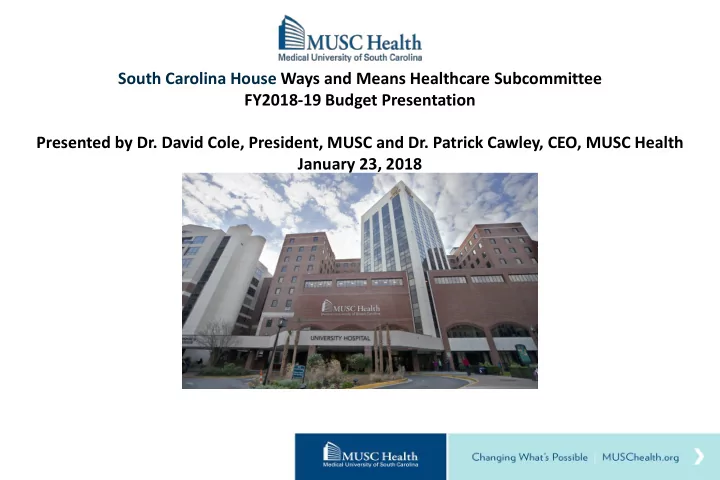
South Carolina House Ways and Means Healthcare Subcommittee FY2018-19 Budget Presentation Presented by Dr. David Cole, President, MUSC and Dr. Patrick Cawley, CEO, MUSC Health January 23, 2018 MUSC Health Leading Health Innovation for the


slide-1
SLIDE 1

South Carolina House Ways and Means Healthcare Subcommittee FY2018-19 Budget Presentation Presented by Dr. David Cole, President, MUSC and Dr. Patrick Cawley, CEO, MUSC Health January 23, 2018

slide-2
SLIDE 2

MUSC Health “ Leading Health Innovation for the Lives We Touch”

  • More than one million patient visits per year
  • U.S. News & World Report again ranked MUSC #1 hospital in S.C.; 6 of our pediatric

specialties in the top 50 programs across the nation

  • 10 nationally-ranked programs in U.S. News and World Report (top 1% of similar U.S.

hospitals)

  • Graduate and professional programs in every dimension of health care (3,000 students)
  • Created Lowcountry Stroke Collaborative in partnership with Roper St. Francis
  • Leading South Carolina with a record $260 million in research funding

2

slide-3
SLIDE 3

MUSC’s Economic Impact

  • One of the largest employers in South Carolina with approximately 13,500 employees
  • Annual $3.8 billion economic impact in the Charleston Metro Area

3

slide-4
SLIDE 4

Update on the Investment in the South Carolina Telehealth Alliance

4

Update on the Statewide Health Innovations

slide-5
SLIDE 5

What is the South Carolina Telehealth Alliance (SCTA)?

Mission: Improve the health of all South Carolinians through telehealth

SCTA Advisory Council Membership

› MUSC Health › Palmetto Care Connections › SC General Assembly Members (2) › Greenville Health System › Palmetto Health › McLeod Health › SC DMH › SC DHHS › SCETV › Rural Health Provider › Community Hospital

SCTA Service Providers

› SC DMH › MUSC Health › Palmetto Health › PH - USC Medical Group › Greenville Health System › McLeod Health › Roper St. Francis › Spartanburg Regional Healthcare System › Palmetto Care Connections › SC AHEC

5

slide-6
SLIDE 6

Children’s & Women’s Health

  • Infant

Mortality

Mental & Behavioral Health

  • Addiction

Chronic Disease

  • Diabetes
  • Heart

Disease

  • Obesity

Cancer

  • Preventive

care

  • Screenings

Principles

Collaboration Alignment Metric-Driven Ability to have meaningful Impact Aligns with our strengths

Plug and Play Resources

Telehealth Public Health Screening Vans Clinical Research Students Ag Extensions

What is the Statewide Health Innovations program?

Mission: Improve the health of all South Carolinians through rapid deployment of innovative programs focused on the primary health concerns of the state

Health Care Issues

6

slide-7
SLIDE 7

Telehealth Highlights

  • School-based telehealth increases access to care for underserved children (more than

doubled consult volume in each of the last 3 years; early evidence of cost-savings for high-needs children)

  • With the statewide telestroke program, EVERY citizen in South Carolina is now less

than an hour from expert stroke care

  • October 2017 provided a record number of telestroke and teleneurology consultations

(572), yet stroke transfers to MUSC are at an all-time low (~10%, compared to 24% 3 years ago), keeping more patients in their home communities

  • 40% increase in telehealth consultations supporting primary care clinics (compared to

2016)

  • Tele-ICU has potentially saved 109 lives in the first three quarters of 2017 (actual vs.

predicted mortality statistics)

7

slide-8
SLIDE 8

Virtual Care Into Patients’ Homes

The 2018 SCTA Strategic Plan includes an acceleration of the deployment of virtual care innovations that connect directly with patients and primary care providers. This will be deployed through: 1) Contracts with the SCTA Regional Hub partners to serve their communities (i.e., Palmetto Health, GHS, McLeod Health) 2) MUSC taking a lead role in ensuring smaller communities and health systems will benefit from these innovations

8

slide-9
SLIDE 9

School-based Telehealth Network

  • MUSC has partnered with Palmetto Health to

lead the SCTA school-based telehealth workgroup and school-based telehealth expansion.

  • One of the fastest growing school-based

telehealth networks in the country!

  • Reduced ED visits
  • Reduced Missed Days
  • f School
  • Reduce Cost to

System

  • Control Chronic

Disease (e.g. asthma)

9

slide-10
SLIDE 10

Expanded Partnership with SCDMH

The SCTA agreement with the South Carolina Department of Mental Health (SCDMH) will provide funding to support statewide expansion of their successful telepsychiatry programs, such as:

  • Emergency Department Telepsychiatry Consultation Program
  • Community Telepsychiatry Program
  • Deaf Services Telepsychiatry
  • EMS Telepsychiatry Program
  • Averaging over 1,700 comprehensive

telepsychiatry services per month

  • 38% of telepsych patients received

30-day follow-up care (vs. 13% in control group)

  • $2,300 saved per emergency

department visit

  • Over 70,000 DMH telepsych services

provided since program inception

10

slide-11
SLIDE 11

South Carolina Telestroke Care

  • Statewide coverage of expert stroke care
  • Some of the best stroke response and

treatment metrics in the country

11

slide-12
SLIDE 12

Exciting News!

MUSC was named one of two national Telehealth Center of Excellence and awarded a grant from the U.S. Department of Health and Human Services. Without the State’s investment, this prestigious award would have not been possible.

12

slide-13
SLIDE 13

Update on the Statewide Health Innovations

13

slide-14
SLIDE 14

Statewide Health Innovations

($7.5 million recurring funds)

Cancer - Mobile Health Unit

  • Initial 12 months mapped out, and we started executing the plan in December with visits to Bamberg, Barnwell,

and Allendale. Follow-up visits to these counties are scheduled for the end of this month. Next month, we are visiting Sumter, Orangeburg, and Williamsburg Counties.

  • Over the next 3 years (FY18-21),the Hollings Cancer Center (with Clemson) mobile van would like to expand

breast and cervical cancer screenings plus cardiovascular disease risk factor screenings to 12 critical needs counties: Williamsburg, Orangeburg, Aiken, Edgefield, Saluda, Bamberg, Barnwell, Allendale, Sumter, Marion, Dillon, and Anderson. This will be an initial visit and/or follow-up and this expansion will enhance and compliment this arena with other state agencies. Children’s Health - #1 - Mother’s Milk Bank of South Carolina (MMBSC)

  • Non-profit service to South Carolina hospitals established and based at MUSC in 2015 whose mission is to

provide safe, pasteurized donor milk to infants.

  • Currently screens and approves potential milk donors; collects milk at 20 milk depot partners across the state;

processes and pasteurizes donor milk; and distributes donor human milk to 11 hospitals in South Carolina.

  • Over the next 3 years (FY18-21), MUSC would like to expand this service to all counties and all hospitals in S.C.

14

slide-15
SLIDE 15

Statewide Health Innovations - Continued ($7.5 million recurring funds)

Children’s Health - #2 – MUSC/Boeing Center for Children’s Wellness

  • Works to prevent and reduce childhood obesity from birth to adolescence by creating healthier school and childcare environments.
  • Collaborates with numerous organizations across the state, including SCDE, SCDHEC, SCDHHS, SCMA, College of Charleston,

Clemson University, SC Eat Smart Move More, Alliance for a Healthier Generation, SC Farm to School, and both Palmetto Health and McLeod Children’s Hospitals impacting 13 school districts, 229 schools, 162,000 students, and 50+ childcare centers.

  • Over the next 3 years (FY18-21), MUSC would like to expand this service to all counties and all schools in S.C..

Public Health Collaborations – Working with Clemson and USC

  • In the process of recruiting and hiring Clemson Health Extension Agents, Horticulture Agents, and Lifestyle Educators for Anderson,

Barnwell, and Williamsburg Counties.

  • These agents and educators will collaborate closely with MUSC partners to implement, support, and expand both of the Pain and

Cancer Screening Programs as well as two additional collaborative programs: MUSC Boeing Center for Children’s Wellness Docs Adopt School Health Initiative (DASHI) and Clemson University’s Farm-to-school Program. Both of these programs will be ready to launch once agents and education hiring is completed this March.

  • MUSC met with leaders from the USC School of Medicine to develop collaboration on the Rural Health Initiatives involving

residencies as well as telehealth statewide coverage.

15

slide-16
SLIDE 16

Statewide Health Innovations - Continued ($7.5 million recurring funds)

Mental Health - Opioid Epidemic – Project #1

  • MUSC has established the Intensive Program for Pain and Opioid Rehabilitation, which prevents opioid

addiction through opioid de-prescribing and improving access to safe treatment options for chronic pain.

  • 3-week program enables patients who are on chronic opioid pain medications to taper completely off pain

medications while optimizing non-opioid methods to manage chronic pain.

  • First group of patients was seen this month, including patients from the Barnwell County area who were

recruited in conjunction with Clemson University. Currently, recruiting efforts are underway targeting 3 critical needs counties: Anderson, Barnwell, and Williamsburg.

  • Over the next 3 years (FY18-21), we would like to expand access statewide through rehabilitation tools to

target critical needs counties: Aiken, Clarendon, Dillon, Florence, Greenville, Horry, Lancaster, Richland, and Sumter.

16

slide-17
SLIDE 17

Statewide Health Innovations - Continued

($7.5 million recurring funds)

Mental Health - Opioid Epidemic – Project #2

  • In December 2017, MUSC, in partnership with DAODAS and HHS, launched an exciting initiative to expand

access to Medication-Assisted Treatment (MAT) for opioid addiction in South Carolina. This innovative program, launched in emergency departments (EDs) in Charleston and Horry Counties, starts medication in the ED and links patients to “fast track providers” in the local community for follow-up.

  • In the first month of the project, half of all patients who screened positive for substance abuse in the ED were

primary opioid abusers. 100% of eligible patients were started on MAT in the ED, and all of those patients attended their follow-up appointment.

  • Leveraging remaining DAODAS federal funds, plans are in place to immediately start statewide expansion

efforts by building SBIRT infrastructure in EDs around the state.

  • In the next 3 years would like to expand this initiative statewide. We will work with DAODAS this year to

establish longer term implementation plan.

17