South African Childrens Reading Literacy Achievement PIRLS and - - PowerPoint PPT Presentation

south african children s reading literacy achievement
SMART_READER_LITE
LIVE PREVIEW

South African Childrens Reading Literacy Achievement PIRLS and - - PowerPoint PPT Presentation

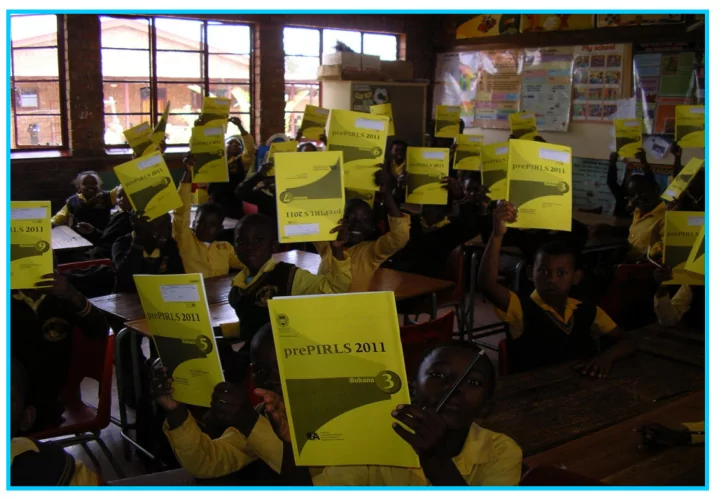
South African Childrens Reading Literacy Achievement PIRLS and prePIRLS 2011 Summary of the key results Prof. Sarah Howie and Dr Surette van Staden National Research Coordinators Centre for Evaluation and Assessment, University of Pretoria


slide-1
SLIDE 1
slide-2
SLIDE 2

South African Children’s Reading Literacy Achievement

PIRLS and prePIRLS 2011

Summary of the key results

  • Prof. Sarah Howie and Dr Surette van Staden

National Research Coordinators Centre for Evaluation and Assessment, University of Pretoria Joint Media Briefing 11 December 2012

slide-3
SLIDE 3

Overview

  • Background to PIRLS 2011
  • Achievement results
  • Benchmark results
  • Some significant factors
  • Conclusions
slide-4
SLIDE 4

BACKGROUND TO PIRLS 2011

slide-5
SLIDE 5

What is PIRLS?

  • An international comparative study in reading

literacy

  • Measures trends across years
  • Monitors policy implementation over time
  • Provides a global context for achievement
slide-6
SLIDE 6

What is PIRLS?

  • Progress in International Reading Literacy Study

(2001 to 2011)

  • Assess reading literacy at Grade 4 level at three

points in time: 2001, 2006 and 2011

  • Move from “learning to read” to “reading to learn”
slide-7
SLIDE 7

Why the introduction of prePIRLS in 2011?

PIRLS 2006 revealed that children at Grade 4 level, in many countries, are still developing fundamental reading skills.

slide-8
SLIDE 8

Why the introduction of prePIRLS in 2011?

50 100 150 200 250 300 350 400 450 500 550

PIRLS 2006 Grade 5 Results by Test Language

slide-9
SLIDE 9

Why the introduction of prePIRLS in 2011?

The IEA has: introduced prePIRLS to bridge PIRLS at Grade 4:

  • A less difficult assessment, intended to measure the

reading comprehension skills of students who are still in the process of learning how to read extended PIRLS at Grades 5 & 6:

  • Participation is encouraged as it could provide valuable

information about learners’ strengths and weaknesses in reading

slide-10
SLIDE 10

A comparison of the PIRLS and prePIRLS tests

AIM GOAL use of a wide range of text types within each purpose for reading, with an equal proportion of material assessing each reading purpose to create an authentic reading experience PIRLS prePIRLS 800 words per text 400 words per text shorter, easier vocabulary and simpler syntax

slide-11
SLIDE 11

prePIRLS 2011 Grade 4

Afrikaans English isiNdebele isiXhosa isiZulu Sepedi Sesotho Setswana siSwati Tshivenda Xitsonga

PIRLS 2011 Grade 5

Afrikaans English

slide-12
SLIDE 12

PIRLS 2011 Participating Countries

Main study participants PIRLS benchmarking participants

Australia Italy Alberta, Canada Austria Kuwait Ontario, Canada Azerbaijan Lithuania Quebec, Canada Belgium (French) Malta Maltese-Malta Botswana Morocco English/Afrikaans –South Africa Bulgaria Netherlands Andalusia, Spain Canada New Zealand Abu Dhabi, UAE Chinese Taipei Northern Ireland Dubai, UAE Colombia Norway Florida, USA Croatia Oman Czech Republic Poland

prePIRLS participants

Denmark Portugal Botswana England Qatar Colombia Finland Romania South Africa France Russian Federation Georgia Saudi Arabia

Note: Bahrain, Egypt, Kuwait, Libya and Qatar were countries that withdrew from prePIRLS 2011

Germany Singapore Honduras Slovak Republic

Grade 6 participants

Hong Kong SAR Slovenia Hungary Spain Indonesia Sweden Iran, Islamic Rep of Trinidad and Tobago Ireland United Arab Emirates Israel United States

slide-13
SLIDE 13

PIRLS South Africa 2006

Grade 4 11 Languages Grade 5 11 Languages

PIRLS South Africa 2011

prePIRLS Grade 4 11 Languages PIRLS Grade 5 Afrikaans English

slide-14
SLIDE 14

PIRLS and prePIRLS 2011 Samples

Study Grade Attained sample No of learners prePIRLS 4 341 15 744 PIRLS 5 92 3 515 Total 433 19 259

  • Implementation in

2011

  • Reading Literacy

Assessment

  • Background

Questionnaires

slide-15
SLIDE 15

ACHIEVEMENT RESULTS

slide-16
SLIDE 16

GRADE 4

PREPIRLS 2011 RESULTS

slide-17
SLIDE 17

prePIRLS 2011 Overall Results

576 500 463 461 100 200 300 400 500 600 700 Colombia International Centre point Botswana South Africa Average scale score

slide-18
SLIDE 18

prePIRLS 2011 Performance by Gender

500 461 446 475

100 200 300 400 500 600

Intenational Centre point South Africa Gr 4 Boys Gr 4 Girls

Average scale score

slide-19
SLIDE 19

prePIRLS 2011 Performance by Test Language

International Centre point

550 525 531 436 429 443 388 425 428 452 395 407

100 200 300 400 500 600 International Centre point

slide-20
SLIDE 20

prePIRLS 2011: % of Learners Writing Test in their Home

Language by Test Language

10 20 30 40 50 60 70 80 90 100 Afrikaans English isiNdebele isiXhosa isiZulu Sepedi Sesotho Setswana siSwati Tshivenda Xitsonga Percentage of Grade 4 Learners Gr 4 Same Gr 4 Different

slide-21
SLIDE 21

prePIRLS 2011: Performance for Learners Writing in the Same or

Different Language to their Home Language

590 449 458 511 365 100 200 300 400 500 600 700 Same Different

slide-22
SLIDE 22

GRADE 5

PIRLS 2011 RESULTS

slide-23
SLIDE 23

PIRLS 2011 Overall Results

569 552 548 538 515 476 457 450 424 424 421 419 419

100 200 300 400 500 600

slide-24
SLIDE 24

PIRLS 2011 Performance compared to Reference Countries

571 568 568 567 558 556 552 531 527 450 448 439 430 428 425 421 419 391 310

100 200 300 400 500 600

slide-25
SLIDE 25

PIRLS 2011 Performance by Test Language

Test Language and Home Language Performance by Test Language 43% 58%

0% 10% 20% 30% 40% 50% 60% 70%

Same as Language of the Test Different from Language of the Test

Percentage of learners

500 421 427 431 397 418 523 389 100 200 300 400 500 600

slide-26
SLIDE 26

PIRLS 2011 Performance compared to PIRLS 2006

421 427 419 403 416 398

50 100 150 200 250 300 350 400

South Africa Afrikaans English 2011 2006

slide-27
SLIDE 27

BENCHMARK RESULTS

slide-28
SLIDE 28

GRADE 4

PREPIRLS 2011 OVERALL BENCHMARK PERFORMANCE

slide-29
SLIDE 29

prePIRLS 2011 Overall Benchmark Performance

% Achieving Benchmarks

29 71 Percentage of learners Not Attained Low

30 23 12 6

Low Intermediate High Advanced

Of 71%

slide-30
SLIDE 30

prePIRLS 2011 Benchmark Performance by Gender

22 35

78 65 48 36 21 16 7 5

Girl Boy Not reached Low International Benchmark Intermediate International Benchmark High International Benchmark Advanced International Benchmark

slide-31
SLIDE 31

prePIRLS 2011 Benchmark Performance by Test Language

29 12 10 31 38 29 57 36 34 24 53 47 71 88 90 69 62 71 43 64 66 76 47 53

6 15 19 0.2 0.4 0.8 0.1 0.1 0.25

South Africa Afrikaans English isiNdebele isiXhosa isiZulu Sepedi Sesotho Setswana siSwati Tshivenda Xitsonga

Did not reach Low International benchmark Intemediate International Benchmark High International Benchmark Advanced International benchmark

slide-32
SLIDE 32

GRADE 5

PIRLS 2011 OVERALL BENCHMARK PERFORMANCE

slide-33
SLIDE 33

PIRLS 2011 Benchmark Performance

5 43 39 45 95 57 61 55 80 34 33 34 44 14 11 15

8 4 2 5

International median South Africa Afrikaans English Did not reach Low International Benchmark Intemediate International Benchmark High International Benchmark Advanced International Benchmark

slide-34
SLIDE 34

PIRLS 2011 Benchmark comparisons with Selected International Participants

57% 66% 72% 100% 95% 99% 97% 99% 97% 34% 28% 38% 90% 80% 92% 87% 92% 87% 14% 4% 10% 48% 44% 63% 62% 63% 58% 4% 1% 7% 8% 18% 24% 19% 19%

SA Gr 5 Afr and Eng Indonesia Colombia Netherlands International Median Finland Singapore Russian Federation Northern Ireland

Low International Benchmark High International Benchmark Intermediate International Benchmark Advanced International Benchmark

slide-35
SLIDE 35

PIRLS 2011 Performance by Gender

38% 48% 62% 52% 38% 31% 14% 13% 5% 3%

Girls Boys Not attained Low International Benchmark Intermediate International Benchmark High International Benchmark Advanced International Benchmark

slide-36
SLIDE 36

PIRLS Grade 5 Benchmarks by Location

19 81 16 84 72 28 36 64 45 55 74 26 10 20 30 40 50 60 70 80 90 Not reached Low Not reached Low Not reached Low Not reached Low Not reached Low Not reached Low Urban Suburban Township Medium city

  • r town

small town

  • r village

Remote rural

slide-37
SLIDE 37

Trends in Benchmarks reached: PIRLS 2006 to PIRLS 2011

47 43 53 57 36 34 17 14 5 4 2006 2011

Did not reach Low International benchmark Intemediate International Benchmark High International Benchmark Advanced International benchmark

slide-38
SLIDE 38

SOME SIGNIFICANT FACTORS

slide-39
SLIDE 39

Location of the School and Grade 4 Achievement

530 531 448 516 441 428

100 200 300 400 500 600

Urban Suburban Township Medium size city Small town Remote rural

Grade 4 Score

102 pts

slide-40
SLIDE 40

Teacher Qualifications and Grade 4 Achievement

427 442 504 484 468 457

50 100 150 200 250 300 350 400 450 500 550 600 No Teacher Qualification Certificate in Education/Pre-Service Diploma 4-Year Diploma in Education Bachelors Degree Postgraduate Diploma Postgraduate In-Service Diploma or Certificate

prePIRLS 2011 Teacher Qualifications

Series1

slide-41
SLIDE 41

Grade 4 Class Size by Test Language

Grade 4 Class Size by Test Language National Average 40

Afrikaans 34 English 36 isiNdebele 47 isiXhosa 45 isiZulu 41 Sepedi 43 Sesotho 45 Setswana 43 siSwati 53 Tshivenda 44 Xitsonga 46

Grade 5 Class Size 2006-2011

36 35 37 38 35 39 5 10 15 20 25 30 35 40 45 South Africa Afrikaans English

PIRLS Class Sizes

2011 2006

slide-42
SLIDE 42

School Libraries and Achievement

Libraries at Schools Grade 4 Achievement

585 514 445 430 100 200 300 400 500 600 700 School Library 5000+ School Library 501-5000 School Library 500 Books or less No school Library

155 pts

6 15 20

59

School library with more than 5 000 books School library with 500-5 000 books School library with 500 books or less No school library

slide-43
SLIDE 43

Resources at Home and Achievement

652 484 448

100 200 300 400 500 600 700 Afrikaans English isiNdebele siSwati Tshivenda Xitsonga South Africa Many resources Some resources Few resources

204 pts

slide-44
SLIDE 44

School Safety and Achievement

Safe and Orderly Schools Grade 4 Achievement

467 518 463 505 433 486 100 200 300 400 500 600 South Africa International average Safe and orderly Somewhat safe and orderly Not safe and orderly 24 10 6 14 8 26 22 12 13 8 14 4 20 40 60 80 100 120 Afrikaans English isiNdebele isiXhosa isiZulu Sepedi Sesotho Setswana siSwati Tshivenda Xitsonga South Africa International average Safe and orderly Somewhat safe and orderly Not safe and orderly

slide-45
SLIDE 45

Bullying and Achievement

Frequency of Bullying Grade 4 Achievement

17 47 28 33

55 20

50 100

South Africa International average Almost never Sometimes Often

511 483 447 523 513 489

100 200 300 400 500 600

Almost never Sometimes Often South Africa International average

slide-46
SLIDE 46

CONCLUSIONS

slide-47
SLIDE 47

Conclusions for Grade 4 Achievement

  • Overall performance is low and comparable to

Botswana

  • 1/3 learners at risk educationally and cannot read at

fundamental level needed, even in their home language

  • Significant language differences (100 pts)
  • Learners tested in English are the strongest readers
  • Languages most at risk - Sepedi and Tshivenda
  • African learners at English LOLT schools 50pts more
  • Girls read significantly better than boys
  • 1/3 of boys at risk
slide-48
SLIDE 48

Conclusions for Grade 5 Achievement

  • Overall Grade 5 performance in Afrikaans and

English is still low internationally

  • Performance is comparable to some emerging

economies (e.g. Indonesia)

  • Girls achieve higher scores than boys
  • 50% of boys at risk educationally
  • 74% of remote rural learners at risk
  • No overall difference since 2006, however, more

learners reaching international benchmarks

  • Concern that top achievers have dropped
  • Biggest improvement amongst Afrikaans group
slide-49
SLIDE 49

Factors Making a Difference

  • Top readers demonstrate ability to interpret,

integrate and evaluate information – not just retrieve

  • Supportive home environment develops early literacy
  • Successful schools are adequately to well resourced,

emphasise academic success and are safe and

  • rderly
  • Well educated and satisfied teachers make a

difference

  • Learners who are positive towards reading do better

in terms of motivation, self-concept and enjoyment

  • f reading
slide-50
SLIDE 50

Emerging Negative Factors

  • Location of school
  • LoLT vs Home Language
  • Overcrowding and class size
  • Dilapidated infrastructure and shortage of

resources

  • Age, experience and qualification of teachers
  • Too much teaching time lost
  • Bullying and school climate
slide-51
SLIDE 51

Thank you for your attention.