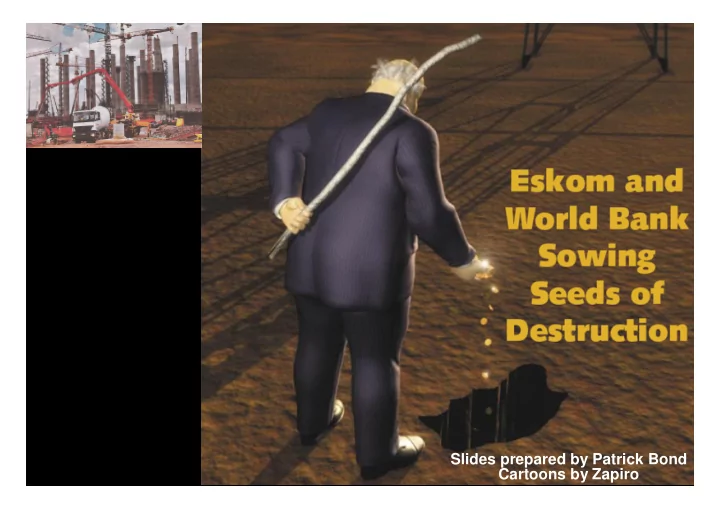
SLIDE 1 South Africa seeks a $3.75 bn loan from the World Bank to finance Eskom’s coal-fired power. Can we block it?
Slides prepared by Patrick Bond Cartoons by Zapiro
SLIDE 2
SLIDE 3
Medupi is in Limpopo Province, the second poorest, near Lephalale The largest electricity consumers are smelters in Richards Bay and the Vaal
SLIDE 4
- climate destruction
- local ecologies, health
- no participation in
(belated) WB process
excessive prices
strife and oppression
ultra-cheap power
- profit outflow to MNCs
- increased foreign debt
- privatisation
- ANC corruption
- WB's apartheid (and
post-apartheid) history
Ten reasons to block Medupi, world’s 4th biggest coal-fired power plant:
SLIDE 5 Ten reasons to reject Medupi
- climate destruction
- local ecologies, health
- no participation in (belated) WB process
- poor people pay excessive prices
- disconnections, social strife and oppression
- multinational corps. get ultra-cheap power
- profit outflow to MNCs
- increased foreign debt
- privatisation
- ANC corruption
- WB's apartheid (and post-apartheid) history
- climate destruction: Medupi alone
will emit 25 mn CO2 tonnes/year, more than 115 countries; SA emits vast quantities of GHG/capita/GDP
SLIDE 6
For energy-related emissions, SA is 20 times higher than even the US per unit of per capita GDP
SLIDE 7
SA ‘Long-Term Mitigation Scenario’ is not serious about making CO2 cuts
… no surprise that Jacob Zuma signed the Copenhagen Accord on Dec 18 2009 – Pretoria has no intent to make emissions cuts until after 2030, and then only gradually
SLIDE 8 Ten reasons to reject Medupi
- climate destruction
- local ecologies, health
- no participation in (belated) WB process
- poor people pay excessive prices
- disconnections, social strife and oppression
- multinational corps. get ultra-cheap power
- profit outflow to MNCs
- increased foreign debt
- privatisation
- ANC corruption
- WB's apartheid (and post-apartheid) history
- local ecologies: Medupi has no scrubbers
due to ‘relative lack of pollution’ nearby… yet ambient SO2 standards are already exceeded, the area is dry, 40 new mines will open, and mining areas suffer extreme water degradation
SLIDE 9 Ten reasons to reject Medupi
- climate destruction
- local ecologies, health
- no participation in (belated) WB process
- poor people pay excessive prices
- disconnections, social strife and oppression
- multinational corps. get ultra-cheap power
- profit outflow to MNCs
- increased foreign debt
- privatisation
- ANC corruption
- WB's apartheid (and post-apartheid) history
- no civic participation in (belated) WB process:
12/09 consultation had no attendees from affected areas; WB procurement rules were clearly violated due to in-progress financing; the borrower, Eskom, has huge governance crises, including extreme leadership turmoil
SLIDE 10 Ten reasons to reject Medupi
- climate destruction
- local ecologies, health
- no participation in (belated) WB process
- poor people pay excessive prices
- disconnections, social strife and oppression
- multinational corps. get ultra-cheap power
- profit outflow to MNCs
- increased foreign debt
- privatisation
- ANC corruption
- WB's apartheid (and post-apartheid) history
- price increases: 25%/year price rise
for next three years; in real terms, 127% increase from 2008-12; widespread opposition including promised national labour strike
SLIDE 11
SLIDE 12 Consumption for poor/ working people? SA is world’s most unequal large country
Source: I nternational Monetary Fund Article 4 Consultation, Staff Report, September 2009
SLIDE 13 Ten reasons to reject Medupi
- climate destruction
- local ecologies, health
- no participation in (belated) WB process
- poor people pay excessive prices
- disconnections, social strife and oppression
- multinational corps. get ultra-cheap power
- profit outflow to MNCs
- increased foreign debt
- privatisation
- ANC corruption
- WB's apartheid (and post-apartheid) history
- disconnections: approximately 1/3
- f Eskom’s four million customers
record zero consumption – as they were disconnected and hence many have illegally reconnected
SLIDE 14
SLIDE 15
Upsurge of protest against electricity disconnections, price increases, WB loan
SLIDE 16
SLIDE 17
SLIDE 18 Ten reasons to reject Medupi
- climate destruction
- local ecologies, health
- no participation in (belated) WB process
- poor people pay excessive prices
- disconnections, social strife and oppression
- multinational corps. get ultra-cheap power
- profit outflow to MNCs
- increased foreign debt
- privatisation
- ANC corruption
- WB's apartheid (and post-apartheid) history
- multinational corp sweetheart deals: multi-decade
‘Special Pricing Agreements’ made during late apartheid give BHP Billiton and Anglo American $0.01/kWh electricity, seven times cheaper than households pay; Eskom’s R9.7 billion ($1.3 bn) loss in 2009 was due to these deals, which got sweeter when aluminium prices fell
SLIDE 19
Eskom's residential customers cannot afford higher-priced electricity and poor people are disconnected by the millions each year
SA offers world’s cheapest electricity, but mainly to a few metals/ mining houses
SLIDE 20 Ten reasons to reject Medupi
- climate destruction
- local ecologies, health
- no participation in (belated) WB process
- poor people pay excessive prices
- disconnections, social strife and oppression
- multinational corps. get ultra-cheap power
- profit outflow to MNCs
- increased foreign debt
- privatisation
- ANC corruption
- WB's apartheid (and post-apartheid) history
- profit outflow: BHP Billiton, Anglo,
Arcelor Mittal, Xstrata and most other beneficiaries of Eskom largesse are headquartered abroad, hence putting extreme pressure on current account
SLIDE 21
Profit outflow to corporate hq’s (London, Melbourne): Current account deficit has grown dangerously large
SLIDE 22
The Economist, 25 Feb 2009
World’s most risky emerging market
SLIDE 23 Ten reasons to reject Medupi
- climate destruction
- local ecologies, health
- no participation in (belated) WB process
- poor people pay excessive prices
- disconnections, social strife and oppression
- multinational corps. get ultra-cheap power
- profit outflow to MNCs
- increased foreign debt
- privatisation
- ANC corruption
- WB's apartheid (and post-apartheid) history
- foreign debt: already at dangerous
levels, with very high repayment costs on Medupi loan, when R/$ rate falls (borrowing should be localised)
SLIDE 24
Since early 2000s, rapid rise in SA foreign debt, to the point of severe debt/GDP danger levels
SLIDE 25
SLIDE 26
Five currency crashes, 1996-2008
when Rand falls 15%+, then repaying World Bank’s US$ debt is much more expensive
SLIDE 27 Ten reasons to reject Medupi
- climate destruction
- local ecologies, health
- no participation in (belated) WB process
- poor people pay excessive prices
- disconnections, social strife and oppression
- multinational corps. get ultra-cheap power
- profit outflow to MNCs
- increased foreign debt
- privatisation
- ANC corruption
- WB's apartheid (and post-apartheid) history
- privatisation of electricity generation is
underway with this loan, especially renewable component – to be increased for next plant (Kusile) to up to 49% private ownership; unions will fight hard to maintain full public supply
SLIDE 28
SLIDE 29 Ten reasons to reject Medupi
- climate destruction
- local ecologies, health
- no participation in (belated) WB process
- poor people pay excessive prices
- disconnections, social strife and oppression
- multinational corps. get ultra-cheap power
- profit outflow to MNCs
- increased foreign debt
- privatisation
- ANC corruption
- WB's apartheid (and post-apartheid) history
- ANC corruption: the ruling party
investment arm, Chancellor House, will earn R1 bn ($135 mn) pure profit from Eskom contracts in a conflict-of-interest tender deemed ‘improper’ by a state agency in March 2010
SLIDE 30 Ten reasons to reject Medupi
- climate destruction
- local ecologies, health
- no participation in (belated) WB process
- poor people pay excessive prices
- disconnections, social strife and oppression
- multinational corps. get ultra-cheap power
- profit outflow to MNCs
- increased foreign debt
- privatisation
- ANC corruption
- WB’s apartheid (and post-apartheid) history
- from 1951 (3 years after apartheid
began) to 1966 (when SA became ‘upper-middle income’), loans to Eskom of $100 mn gave no electricity to black townships or rural areas
SLIDE 31 South African apartheid generously funded by WB/ I MF
Source:
SLIDE 32 South African apartheid (1948-94) generously funded by WB/IMF
- World Bank's $100 million in loans to Eskom for coal-fired power
generation from 1951-66 gave only corporations and white people electric power, but all South Africans repaid the loans;
- WB point-blank refused to heed United Nations General
Assembly instruction in 1966 not to lend to apartheid SA;
- I MF apartheid-supporting loans of more than $2 billion between
the Soweto uprising in 1976 and 1983, when US Congress finally prohibited lending to Pretoria;
- World Bank loan for Lesotho dams in 1986 was widely
acknowledged to ` sanctions-bust' apartheid via London trust;
- I MF advice to Pretoria in 1991 to impose a regressive Value
Added Tax, in opposition to which 3,5 million people went on a two-day national strike;
- 1993 I MF $850 mn loan locked in post-apartheid neoliberal
macroeconomic policies plus public sector wage freeze, and I MF was responsible for Mandela’s retention of apartheid finance minister and central bank governor in May 1994
SLIDE 33 South African class apartheid supported by WB/IMF, post-1994
- World Bank promotion of ` market-oriented' land reform
in 1993-94, based on willing-seller, willing-buyer, so that instead of 30% land redistribution as promised in 1994, less than 1% of good land was redistributed;
- World Bank endorsement of bank-centred housing policy
in August 1994, with recommendations for smaller housing subsidies;
- World Bank design of infrastructure policy in November
1994, which provided rural and urban poor with only pit latrines, no electricity connections, inadequate roads, and communal taps instead of house or yard taps;
- World Bank's conservative role in welfare commission in
1996, which recommended a 44% cut in the monthly grant to impoverished, dependent children from R135 per month to R75;
SLIDE 34 South African class apartheid supported by WB/IMF (continued)
- World Bank's participation in failed (neoliberal) Growth,
Employment and Redistribution policy in June 1996, contributing two staff economists and economic model;
- World Bank and I MF's consistent message to South African
workers that wages are too high, and that unemployment can only be cured through ` labour flexibility';
- World Bank's repeated commitments to invest, through its
subsidiary the I nternational Finance Corporation, in privatised infrastructure, housing securities for high- income families, for-profit ` managed healthcare' schemes, and the now-bankrupt, US-owned Dominos Pizza franchise;
- consistent failure of Bank and I MF ` structural adjustment
programmes' in Southern Africa since the 1980s; and
- stubborn refusal by the Bank and I MF to cancel debt owed
by our impoverished neighbours since the mid-1990s, except in tiny amounts and with brutal conditionality.
SLIDE 35
What does WB say it should do in SA?
SLIDE 36
What does WB say it should do in SA?
Only mention of Eskom: downplays state aid
SLIDE 37
Pravin Gordhan claims: Medupi is ‘SA’s first loan’ Actually, 15 WB Group loans to SA since 1994
SLIDE 38
WB’s International Finance Corporation: 11 loans of $286 million, 1996-2007
SLIDE 39
Even WB admits ‘push for lending’, ‘failure to develop appropriate products’
SLIDE 40
Opposition to Medupi, Eskom pricing and privatisation, and World Bank loan
Conservation plus electricity-as-a-right? (So 2002 Joburg WSSD does not repeat)
SLIDE 41
Sign-on opposition to Medupi, Eskom pricing and privatisation, and World Bank loan (Feb-March 2010)
SLIDE 42 What does civil society want?
1) Redirect power from smelters to households: more ‘Free Basic Electricity’
(50kWh/ household/ month is tokenistic)
- ‘African National Congress-led local government
will provide all residents with a free basic amount of water, electricity and other municipal services, so as to help the poor. Those who use more than the basic amounts will pay for the extra they use.’ (ANC campaign promise, 2000 municipal elections)
- 100 kWh/ person/ month should be free for all SA
residents, paid for with cross-subsidies, in order to promote gender equity, respiratory disease prevention, education, local enterprises, services- desegregation and other ‘merit goods’
- block tariff implemented with credit meters
(impossible to implement rising block tariff with prepaids)
SLIDE 43
What does civil society want?
2) No new coal/ nuke energy; instead, a coherent transformation strategy – for solar, wind and wave power, and new extraction, production, transport, consumption, disposal (zero-waste) and economic systems
3) ‘Just Transition’ and green jobs for metalworkers and mineworkers who suffer job losses
(e.g. solar hot water heaters)
SLIDE 44
What does civil society want? Jubilee SA demands:
4) An end to neoliberal advice, World Bank ‘knowledge banking’ and sector/ project loans 5) Reparations for apartheid interest received by the World Bank, and for failed advice on structural adjustment programming (1996 Growth, Employment and Redistribution)
SLIDE 45
New SA elites (Trevor Manuel and Jeff Radebe) dance to neoliberal WB/IMF music
SLIDE 46 Do Third World countries need World Bank and I MF loans?
- Grants needed, not loans (which are costly
to repay when currency value declines);
- hard- currency (US$) component of
I nternational Financial I nstitution (I FI ) lending is inappropriate for basic needs goods that are most desperately needed;
- to repay $ loans means more intense
export orientation (cash crops instead of food);
- elites use hard currency for luxury
imports;
- local-currency financing should be
arranged instead.
SLIDE 47 Jubilee South’s Pan- African Declaration on PRSPs, May 2001, Kampala.
- We reject… any further role or
interference of the World Bank
- r IMF in our countries.
- We as African civil society
- rganisations need to… mobilise
- ur people to challenge and
change the global economic system through campaigns and actions to shut down the World Bank and IMF.
Voices for I MF/ WB closure: Jubilee South
SLIDE 48 Voices for I MF/ WB closure:
Archbishop of Cape Town
Njongonkulu Ndungane
- [If] we must release ourselves from debt
peonage - by demanding the repudiation and cancellation of debt - we will campaign to that end. And if the World Bank and IMF continue to stand in the way of social progress, movements like Jubilee South Africa will have no regrets about calling for their abolition. To that end, the World Bank Bonds Boycott movement is gaining even great momentum. Even a money centre city like San Francisco decided to redict funds away from Bank bonds into other investments, on the moral grounds that taking profits from World Bank operations contributes to poverty, misery and ecological
- degradation. More and more investors are realising that profiting
from poverty through World Bank bonds is not only immoral, but will not make good financial sense as the market shrinks.
Ndungane, N. (2003), A World with a Human Face: A Voice from Africa, Cape Town, David Philip, p.31.
SLIDE 49
- During South African apartheid, we asked this question:
who reaps economic benefits of oppression?;
- Jubilee SA, Brazil’s Movement of the Landless and many
- thers asked same question in 2000: at a time of
worsening global apartheid, is it morally acceptable to earn profits from World Bank bonds?
- same ? for climate, poverty, privatization, corruption
- ‘World Bank Bonds Boycott’ began in April 2000 with
commitments not to purchase another Bank bond
- the Bank gets 80% of its funding by issuing bonds;
- when enough investors endorse the campaign, the
Bank’s bond rating will decline, so it will be fiduciarily irresponsible to invest in Bank bonds -- a real threat...
- Between 2000-05, scores of major investors joined,
including municipalities, pensions, universities, churches, socially-responsible funds and individuals
What solidarity do we need?
Should the North invest in the World Bank?
SLIDE 50 I t’s time to revive the WB Bonds Boycott
against climate destruction, poverty, privatization, corruption
PARTI AL LI ST
TI AA-CREF (world’s largest
pension) sold its WB bonds
Univ. of New Mexico Unitarian Church Global Greengrants Fund Ben and Jerry’s Foundation
Calvert Group
Progressive Assets Management Trillium Assets Management PLUS many US cities (e.g., San Francisco, Boulder, Milwaukee, Oakland, Berkeley, Cambridge, Richmond, CA) Major union pension/investment funds
(e.g., Teamsters, Postal Workers,
Service Employees I nternational, American Federation of Government Employees, Longshoremen, Communication Workers of America, United Electrical Workers)
JOI N US!
SLIDE 51
Otherwise, institutions with World Bank bonds profit from global apartheid and climate chaos