Source, Lund, Sweden Rdiger Schmidt With material from Mats - - PowerPoint PPT Presentation

source lund sweden
SMART_READER_LITE
LIVE PREVIEW

Source, Lund, Sweden Rdiger Schmidt With material from Mats - - PowerPoint PPT Presentation

CERN Nine months at the European Spallation Source, Lund, Sweden Rdiger Schmidt With material from Mats Lindroos Rdiger Schmidt Nine months at ESS page 1 Why ESS? CERN Why neutron scattering ? Neutron scattering


slide-1
SLIDE 1

CERN

Rüdiger Schmidt Nine months at ESS page 1

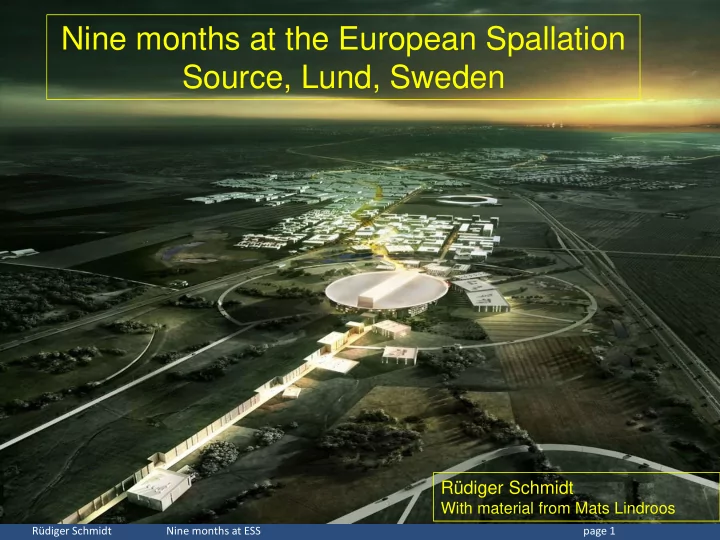
Nine months at the European Spallation Source, Lund, Sweden

Rüdiger Schmidt

With material from Mats Lindroos
slide-2
SLIDE 2

CERN

Rüdiger Schmidt Nine months at ESS page 2

Why ESS? Why neutron scattering ?

  • Neutron scattering can be applied to a range of scientific

questions, in physics, chemistry, geology, biology, engineering and medicine.

  • With a neutron tool kit, we can probe the structure and dynamics
  • f materials over a wide range of length- and time-scales
  • life science,
  • soft condensed matter research,
  • chemistry of materials,
  • energy research,
  • magnetic and electronic phenomena,
  • engineering materials and geosciences,
  • archaeology and heritage conservation,
  • fundamental and particle physics.
slide-3
SLIDE 3

CERN

Rüdiger Schmidt Nine months at ESS page 3

Example of using neutrons for archaeology

2012-amphore-photo Proto-Corinthian ceramic vase dated to about 700–600 B.C. 2012-amphore X-rays Radiography: ANTARES@ FRM II Neutron Tomography: PGAA @ FRM II

slide-4
SLIDE 4

CERN

Rüdiger Schmidt Nine months at ESS page 4

Neutrons are good for ……

slide-5
SLIDE 5

CERN

Rüdiger Schmidt Nine months at ESS page 5

ESS has a long history……

slide-6
SLIDE 6

CERN

Rüdiger Schmidt Nine months at ESS page 6

….and requires very slow neutrons

slide-7
SLIDE 7

CERN

Rüdiger Schmidt Nine months at ESS page 7

5 MW seems to be a natural constant

slide-8
SLIDE 8

CERN

Rüdiger Schmidt Nine months at ESS page 8

Berkeley 37-inch cyclotron 350 mCi Ra-Be source Chadwick

1930 1970 1980 1990 2000 2010 2020

105 1010 1015 1020

1

ISIS

Pulsed Sources

ZINP-P ZINP-P/ KENS WNR IPNS ILL X-10 CP-2

Steady State Sources

HFBR HFIR NRU MTR NRX CP-1

1940 1950 1960

Effective thermal neutron flux n/cm2-s

(Updated from Neutron Scattering, K. Skold and D. L. Price, eds., Academic Press, 1986)

FRM-II SINQ SNS ESS J- PARC

ESS - Bridging the neutron gap

slide-9
SLIDE 9

CERN

Rüdiger Schmidt Nine months at ESS page 9

ESS at Lund

slide-10
SLIDE 10

CERN

Rüdiger Schmidt Nine months at ESS page 10

ESS at Lund

2 h from Geneva 35 min from Kastrup

slide-11
SLIDE 11

CERN

Rüdiger Schmidt Nine months at ESS page 11

If you do not like rain, go to Lund….

slide-12
SLIDE 12

CERN

Rüdiger Schmidt Nine months at ESS page 12

Moving around in Lund

slide-13
SLIDE 13

CERN

Rüdiger Schmidt Nine months at ESS page 13

Moving around in Lund

slide-14
SLIDE 14

CERN

Rüdiger Schmidt Nine months at ESS page 14

Recipe for a Spallation Source

  • Accelerate many many many protons to 1 – 2 GeV
  • Proton beam power of several MW, 1.5 * 1016 protons / second
  • Send the protons to a metal (tungsten) target
  • 1 GeV proton => about 20 Neutrons
  • Slow the neutrons down to thermal energies
  • Watch out – do not mix meV and MeV
  • Send them through (curved) guides to the experiments
  • Have an experiment (instrument) to use the neutrons

Single-Crystal Diffractometer (TOPAZ)

slide-15
SLIDE 15

CERN

Rüdiger Schmidt Nine months at ESS page 15

ESS Linac

Energy (MeV)

  • No. of Modules
  • No. of Cavities

βg Temp (K) Cryo Length (m)

Source

0.075 1 – ~300 –

LEBT

0.075 – – ~300 –

RFQ

3.6 1 1 – ~300 –

MEBT

3.6 – 3 – ~300 –

DTL

90 5 5 – ~300 –

Spoke

220 13 2 (2S) × 13 0.5 βopt ~2 4.14

Medium β

570 9 4 (6C) × 9 0.67 ~2 8.28

High β

2000 21 4 (5C) × 21 0.86 ~2 8.28

HEBT

2000 – – ~300 –

Spokes Medium β High β DTL MEBT RFQ LEBT Source

HEBT & Contingency

Target

2.4 m 4.5 m 3.6 m 40 m 54 m 75 m 174 m

75 keV 3.6 MeV 90 MeV 220 MeV 570 MeV 2000 MeV

352.21 MHz 704.42 MHz

slide-16
SLIDE 16

CERN

Rüdiger Schmidt Nine months at ESS page 16

Site Plan

~600 m

slide-17
SLIDE 17

CERN

Rüdiger Schmidt Nine months at ESS page 17

slide-18
SLIDE 18

CERN

Rüdiger Schmidt Nine months at ESS page 18

Science village Scandina via

A research center for Europe

slide-19
SLIDE 19

CERN

Rüdiger Schmidt Nine months at ESS page 19

ESS office buildings

slide-20
SLIDE 20

CERN

Rüdiger Schmidt Nine months at ESS page 20

ESS site ….today

slide-21
SLIDE 21

CERN

Rüdiger Schmidt Nine months at ESS page 21

Artist view of ESS and MAX IV ….tomorrow

ESS linac ESS Target building ESS Instruments Science village MAX IV

slide-22
SLIDE 22

CERN

Rüdiger Schmidt Nine months at ESS page 22

Example of a (small) target: ISIS target hall

slide-23
SLIDE 23

CERN

Rüdiger Schmidt Nine months at ESS page 23

ESSS: some numbers

  • Staff number at ESS: today about 200, expected to increase to

450-500 when operating

  • Start of operation (first protons on target) planned for 2019
  • Projected lifetime: 40 years
  • Operation budget per year: 140 M€
  • The construction budget for ESS is 1843 M€
  • Accelerator:

510 M€

  • Target station:

150 M€

  • Infrastructure:

520 M€

  • Controls etc.:

70 M€

  • N Instruments:

350 M€

  • Others: administration, licencing, energy, …

Not a typo

slide-24
SLIDE 24

CERN

Rüdiger Schmidt Nine months at ESS page 24

ESS specific

  • ESS is an emerging research laboratory with (still) very limited

capacity in-house

  • Collaborative projects: Work in a collaboration where the scope
  • f the project can be set by the total capacity (distributed) of the

partners

  • The accelerator part of the project well suited for this as this

community has a strong tradition of open collaboration (XFEL, FAIR, CERN, e.g.LINAC4, European commission framework programs such as EUCARD and TIARA, EURISOL,...)

  • To keep cost down and to optimize schedule this requires that

investments in required infrastructure is done at the partner with best capacity to deliver

slide-25
SLIDE 25

CERN

Rüdiger Schmidt Nine months at ESS page 25

Sebastien Bousson Pierre Bosland Santo Gammino Søren Pape Møller Roger Ruber Ibon Bustinduy CERN The National Center for Nuclear Research, Swierk Anders J Johansson Roger Barlow

Prototyping the ESS accelerator

slide-26
SLIDE 26

CERN

Rüdiger Schmidt Nine months at ESS page 26

Transition from construction to operation

ESS Operations can be divided into three distinct phases:

  • Initial Operations Phase (2019 – 2022, 4 years) – Includes one

year of activities to produce first neutrons (2019) and three years of activities to improve accelerator performance and to commission instruments (experiments by friendly users);

  • Initial User Program Operations (2023 – 2025, 3 years) –

Includes support necessary for reliable operations with public users and provides the basis for future cost sharing; and,

  • User Program Operations (Beginning in 2026 – ) – Routine
  • perations including the completion and commissioning of

the final 22 public instruments.

slide-27
SLIDE 27

CERN

Rüdiger Schmidt Nine months at ESS page 27

Scope contingency for 5 MW accelerator

  • We plan for delivering a 5 MW accelerator
  • The scope contingency for the accelerator is beam power.

The purchasing of power supplies and RF sources necessary to go from 2.5 to 5 MW will be scheduled discretely. These purchases will be authorized after the financial requirements for delivering 2.5 MW of beam power are secure.

  • Each 7 M€ reduction decrease energy by 70 MeV (=175 kW at

62.5 mA)

Spokes Medium β High β DTL MEBT RFQ LEBT Source

HEBT & Contingency

Target

2.4 m 4.5 m 3.6 m 40 m 54 m 75 m 174 m

75 keV 3.6 MeV 90 MeV 220 MeV 570 MeV 2000 MeV

352.21 MHz 704.42 MHz

Scope conting ency 100 M€ CM and RF sources

slide-28
SLIDE 28

CERN

Rüdiger Schmidt Nine months at ESS page 28

INFRASTRUCTURE DIRECTORATE Ö. Larsson (I) DIRECTOR PERSONAL ASSISTANT

  • I. Persson

ENVIRONMENT, SAFETY & HEALTH (ESH) DIVISION

  • P. Jacobsson

HEAD OF DIVISION

  • U. Agnvik (C)
  • T. Hansson
  • F. Jörud
  • G. Myhré (C)
  • D. Skölde (C)

ENERGY DIVISION

  • T. Parker

HEAD OF DIVISION

  • E. Lindström
  • F. Indebetou (C)

MACHINE DIRECTORATE

  • F. MEZEI (I)

DIRECTOR DEPUTY DIRECTOR

  • J. Lehander

PERSONAL ASSISTANT

  • E. Lagrelius (L), M. Lindberg (A)

PROJECT SUPPORT & ADMINISTRATION DIRECT

  • M. Tiirakari

DIRECTOR DEPUTY DIRECTOR

  • T. Welander (L), A. W

SENIOR ADVISOR – INNOVATION J.T SENIOR EXECUTIVE ASSISTANT Hélène ADMIN ASSISTANT STEERING COMMITTEE SECRETARY

Ås dré

LEGAL DI

  • O. Graber-

HEAD OF

  • S. Backm
  • A. Iriondo
  • J. Långbe
  • C. Ramb

PARTNERS & INDUSTRY GROUP

  • U. Gunsenheimer

(A)(C) GROUP LEADER

  • R. Larrea Basterra (C)
  • O. Rey Orozco (C)
  • A. Schmidli

COMMUNICATIONS AND EXTERNAL RELATIONS DIVISION

  • A. Weeks

HEAD OF DIVISION M-L. Ainalem

  • M. Ekdahl
  • M. Nilsson
  • A. Simoes (C)

HUMAN RESOURCES DIVISION

  • L. Petersson

HEAD OF DIVISION

  • A. Carlekrantz

Å. Carlenhag (C)

  • S. Havelius
  • T. Nilsson

MEDIA COORDINATION GROUP

Vacant GROUP LEADER

  • T. Lindqvist (C)
  • K. McFaul
  • K. Myram (C)
  • R. Eriksson (C)

CONVENTIONAL FACILITIES DIVISION

  • K. Hedin

HEAD OF DIVISION

  • L. Lavesson (C)
  • A. Thonäng
  • U. Hammarlund (C)

TEAM ASSISTANT

CONSTRUCTION GROUP

  • M. Eneroth

GROUP LEADER

  • M. Åberg
  • L. Hedenklo
  • M. Jakobsson
  • J. Mattsson
  • F. Österberg
  • L. Persson
  • E. Segerstedt
  • K. Sjöstrand
  • K. Wennerholm

SCIENTIFIC PROJECTS DIVISION

  • R. Connatser

HEAD OF DIVISION

  • A. Larsson (C)

NEUTRON INSTRUMENTS DIVISION

  • K. Andersen

HEAD OF DIVISION

  • M. Strobl

DEPUTY HEAD OF DIVISION

  • P. P. Deen
  • P. Henry
  • A. Jackson
  • R. Lechner (C)
  • E. Oksanen
  • W. Schweika
  • M. Sharp
  • N. Tsapatsaris
  • H. Wacklin

SCIENTIFIC ACTIVITIES DIVISION

  • A. Hiess

HEAD OF DIVISION

  • B. Linnenberg

TEAM ASSISTANT

  • H. Bordallo (C)
  • M. Everett
  • S. Hall (C)
  • P. Schurtenberger (C)
  • C. Theroine

SCIENCE DIRECTORATE

  • D. Argyriou

DIRECTOR DEPUTY DIRECTOR

  • O. Kirstein

SENIOR ADVISOR S. Petersson Årsköld PERSONAL ASSISTANT E. Lagrelius (L), M. Lindberg (A) INTEGRATED CONTROL SYSTEM DIVISION

  • G. Trahern

HEAD OF DIVISION

  • M. Rescic (C)

SYSTEM ENGINEER ä öm Åsva

CS HW & IS GROUP

  • D. Piso Fernandez (I)

GROUP LEADER

CS SW & SVCs GROUP

  • S. Gysin (I)

GROUP LEADER

  • E. Laface
  • K. Rathsman

EUROPEAN SPALLATION SOURCE, AB BOARD

  • S. Landelius, CHAIR
  • B. Smith, VICE-CHAIR

EUROPEAN SPALLATION SOURCE (ESS)

  • J. Yeck

DIRECTOR GENERAL AND CHIEF EXECUTIVE OFFICER (CEO) SENIOR EXECUTIVE ASSISTANT

  • K. Hélène

ADMIN ASSISTANT M. Herbst ASSOCIATE DIRECTOR FOR OPERATIONS, ES&H and QA P. Carlsson QUALITY ASSURANCE MANAGER

  • L. Berdén

QUALITY ASSURANCE CONSULTANT

  • G. Svensson (C)

SENIOR ADVISOR

  • C. Vettier (C)

In-Kind Review Committee

  • M. Marazzi, Chair

Administration & Finance Committee

  • M. Scharff, Chair

EUROPEAN SPALLATION SOURCE STEERING COMMITTEE

  • L. Börjesson, CHAIR

HOST COUNTRIES: SWEDEN AND DENMARK DESIGN GROUP

  • J. Molander (C)

GROUP LEADER

  • F. Bergstedt (C)
  • B. Hedén
  • J. Lundgren
  • R. Sjöholm
  • K. Svedin

DATA MANAGEMENT CS

INFRASTRUCTURE GROUP

  • L. Fernandez (I)

GROUP LEADER

PROTECTION SYSTEMS GROUP

  • A. Nordt

GROUP LEADER

SYSTEMS

egår ö

TARGET PHYSICS GROUP

  • E. Pitcher (A)

GROUP LEADER

  • D. Ene
  • C. Kharoua (C)
  • J. Moberg

J-P Sievers (C) öhr

TARGET CONTROLS GROUP

  • L. Coney

GROUP LEADER

  • A. Sadeghzadeh

MATERIALS TARGET DIVISION

  • J. Haines

HEAD OF DIVISION

  • E. Pitcher

DEPUTY HEAD OF DIVISION

  • F. Plewinski
  • T. McManamy (C)
  • C. Blixt

ADMINISTRATIVE ASSISTANT

CHOPPERS GROUP

  • I. Sutton

GROUP LEADER

  • E. Nilsson

DETECTOR GROUP

  • R. Hall-Wilton

GROUP LEADER

  • C. Höglund
  • K. Kanaki
  • A. Khaplanov
  • T. Kittelmann
  • S. Kolya
  • D. Pfeiffer

ö

SAMPLE ENVIRONMENT GROUP

  • M. Meissner (C)(I)

GROUP LEADER

NEUTRON TECHNOLOGIES DIVISION

  • O. Kirstein

HEAD OF DIVISION

  • R. Hall-Wilton

DEPUTY HEAD OF DIVISION

  • M. Dell Anno Boulton

TEAM ASSISTANT Böhm

BEAM PHYSICS GROUP

  • H. Danared

GROUP LEADER

  • R. de Prisco

Köttig

ACCELERATOR DIVISION

  • M. Lindroos

HEAD OF DIVISION

  • H. Danared

DEPUTY HEAD OF DIVISION

  • J. Weisend II

DEPUTY HEAD OF ACCELERATOR PROJECTS

  • D. McGinnis

CHIEF ENGINEER

  • I. Aviles Santillana (C)
  • R. Bonomi (C)
  • M. Conlon (C)
  • S. Peggs (C)
  • N. Valverde Alonso (C)
  • A. Jansson

SAFETY & RELIABILITY MANAGER

  • C. Prabert

PERSONAL ASSISTANT

  • G. Jacobsson

TEAM ASSISTANT å Hå Gå

  • P. Rå

SUPP PROCUREME LOGISTICS

  • A. Week

HEAD OF

  • M. De
  • T. Had

B.O. Per

IN-KIND

  • G. Né

GROUP

PROJECT S DIVISIO

  • J. Bris

HEAD OF

  • I. Per

PERSONAL

  • J. And
  • M. Jako
  • K. Jons
  • J. Nilsso
  • S. Osso
  • M. Pa
  • A. Stenber
  • H. Szent
  • M. Klein-Ve
  • J. Wo

Bjö Å. Bejr

Conventional Facilities Advisory Committee TBD, Chair Science Advisory Committee

  • A. Matic, Chair

Technical Advisory Committee

  • R. Garoby, Chair
slide-29
SLIDE 29

CERN

Rüdiger Schmidt Nine months at ESS page 29

My involvement

  • Learning about sc

high intensity proton linacs

  • Machine Protection

(..organised a PLC workshop)

  • Planning
  • Controls systems
  • … and many activities

not related to ESS

1. Introduction........................................................................................................................ 3 2. Architecture of the Machine Protection System ................................................................ 5 I. Main Objectives ............................................................................................................... 5 II. Response Time for MPS to Stop Beam Operation ......................................................... 6 III. Principles of the Beam Interlock System ...................................................................... 8 IV. Partitioning of the Beam Interlock System ................................................................... 8 3. Interlocking of ESS Systems Related to MPS ...................................................................... 9 I. Warm LINAC .................................................................................................................. 10 Proton Source .................................................................................................................. 10 Low Energy Beam Transport (LEBT) ................................................................................. 10 Medium Energy Beam Transport (MEBT) ........................................................................ 11 Drift Tube LINAC (DTL) ..................................................................................................... 13 II. Superconducting LINAC................................................................................................ 14 III. RF System ................................................................................................................... 14 IV. Beam Instrumentation ................................................................................................ 16 Beam Loss Monitoring System ......................................................................................... 17 Beam Current Monitoring System ................................................................................... 17 Faraday Cups .................................................................................................................... 19 Wire Scanners .................................................................................................................. 19 V. Vacuum System ............................................................................................................ 19 VI. Cryo Modules .............................................................................................................. 20 Frequency tuning ............................................................................................................. 20 Interlocking ...................................................................................................................... 20 VII. Target Station Systems .............................................................................................. 21 VIII. Magnets and Power Supplies ................................................................................... 22

slide-30
SLIDE 30

CERN

Rüdiger Schmidt Nine months at ESS page 30

Some of my impressions

  • Exciting new project in the accelerator world
  • Together, ESS and MAXlab will become one of the major accelerator research

centres in Europe

  • Working methods very different from CERN
  • Very formal definition of requirements…..
  • Structure of technical discussions not obvious…
  • Very little collaboration between the two labs
  • Surprisingly little activities related to protection of personnel yet….
  • Many challenges
  • Building up a lab from scratch on a green field
  • Working with outside partners to deliver most systems
  • Building up a base with qualified personnel
  • Collaboration in some areas can be of interest for both labs, ESS and CERN
  • Interlock and protection systems
  • Superconducting RF
  • Others (beam losses, BLMs, diamond detectors, ….)
slide-31
SLIDE 31

CERN

Rüdiger Schmidt Nine months at ESS page 31

Slide from Mats Lindroos

slide-32
SLIDE 32

CERN

Rüdiger Schmidt Nine months at ESS page 32

  • The first ESS annual review took place at LUND the 12th-14th November 2013
  • Present : ESS project team, 33 members of the review team organized in 7

subcommittees and 7 observers (see next slide for details)

First impressions:

  • The review committee congratulates the ESS team and its management for the

quality of the material and presentations submitted to the reviewers

  • The ESS is now a real project from all points of view, well shaped and well
  • rganized. ESS is now managing to the established baseline.
  • A big effort was made in the last 10 months to build up an organization

structure with names and clear responsibilities attached to it

  • The management of the project is strong, well determined, motivated and

success oriented. The ESS overall schedule foresees first protons on target in December 2019. The cost cap has been fixed to 1.843 B€ (year 2013).

  • ESS will start real construction work in June 2014 (ground break)

Project Review November 2013

slide-33
SLIDE 33

CERN

Rüdiger Schmidt Nine months at ESS page 33

  • Schedule Priority – Facility construction complete at the end of 2022

with 5 MW capability installed;

  • Operations Linked to Construction Progress – Initial operations in

2019 (production of 1st neutrons) and facility operations in 2023 (instruments available for the user program);

  • Scope Contingency - Explicit scope contingency integrated into the

accelerator plans (scope that can be delayed if necessary);

  • Instrument Program – Technically limited schedule, leverage

construction investment, plan for additional investment;

  • Conventional facilities costs above the cost report value covered
  • utside the cap by the host countries or new partners;

Plan A and other plans…