Sophomore Accelerated English A Separate Peace Vocabulary - - PowerPoint PPT Presentation

sophomore accelerated english a separate peace vocabulary
SMART_READER_LITE
LIVE PREVIEW

Sophomore Accelerated English A Separate Peace Vocabulary - - PowerPoint PPT Presentation

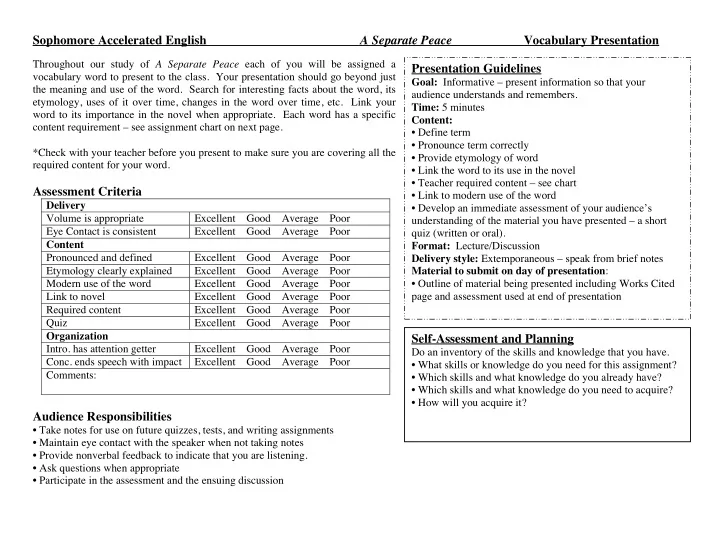
Sophomore Accelerated English A Separate Peace Vocabulary Presentation Throughout our study of A Separate Peace each of you will be assigned a Presentation Guidelines vocabulary word to present to the class. Your presentation should go beyond


slide-1
SLIDE 1

Presentation Guidelines

Goal: Informative – present information so that your audience understands and remembers. Time: 5 minutes Content:

  • Define term
  • Pronounce term correctly
  • Provide etymology of word
  • Link the word to its use in the novel
  • Teacher required content – see chart
  • Link to modern use of the word
  • Develop an immediate assessment of your audience’s

understanding of the material you have presented – a short quiz (written or oral). Format: Lecture/Discussion Delivery style: Extemporaneous – speak from brief notes Material to submit on day of presentation:

  • Outline of material being presented including Works Cited

page and assessment used at end of presentation

Self-Assessment and Planning

Do an inventory of the skills and knowledge that you have.

  • What skills or knowledge do you need for this assignment?
  • Which skills and what knowledge do you already have?
  • Which skills and what knowledge do you need to acquire?
  • How will you acquire it?

Sophomore Accelerated English A Separate Peace Vocabulary Presentation

Throughout our study of A Separate Peace each of you will be assigned a vocabulary word to present to the class. Your presentation should go beyond just the meaning and use of the word. Search for interesting facts about the word, its etymology, uses of it over time, changes in the word over time, etc. Link your word to its importance in the novel when appropriate. Each word has a specific content requirement – see assignment chart on next page. *Check with your teacher before you present to make sure you are covering all the required content for your word.

Assessment Criteria Audience Responsibilities

  • Take notes for use on future quizzes, tests, and writing assignments
  • Maintain eye contact with the speaker when not taking notes
  • Provide nonverbal feedback to indicate that you are listening.
  • Ask questions when appropriate
  • Participate in the assessment and the ensuing discussion

Delivery Volume is appropriate Excellent Good Average Poor Eye Contact is consistent Excellent Good Average Poor Content Pronounced and defined Excellent Good Average Poor Etymology clearly explained Excellent Good Average Poor Modern use of the word Excellent Good Average Poor Link to novel Excellent Good Average Poor Required content Excellent Good Average Poor Quiz Excellent Good Average Poor Organization

  • Intro. has attention getter

Excellent Good Average Poor

  • Conc. ends speech with impact

Excellent Good Average Poor Comments:

slide-2
SLIDE 2

Hour 4 Word Chapter, Page # Required Content

  • 1. Mrs. Wathen

specter Chapter 1 12 Root

  • 2. Carrie Allen

rhetorically Chapter 1 16 Use of language

  • 3. Alex Braun

counterattack Chapter 1 19 Prefix (counter-, contra-)

  • 4. Janay Briggs-Wragg

chronic Chapter 2 23 Root

  • 5. Conor Byrne

emblem Chapter 2 25 Difference between emblem and symbol

  • 6. Eli Cohen

hypnotism Chapter 2 25 Meaning

  • 7. Dylan Compton

infinity Chapter 2 30 Root

  • 8. Brett Conard

abstractedly Chapter 3 33 Use of language

  • 9. Daryan Fisher

catacombed Chapter 3 33 Meaning

  • 10. Daniel Gaudynski

blitzkrieg Chapter 3 34 Principle of language

  • 11. Libby Geboy

decalogue Chapter 5 66 Prefix

  • 12. Samme Gorman

idiosyncratic Chapter 6 74 Root and Prefix

  • 13. Cam Goudreau

automaton Chapter 6 78 Prefix

  • 14. Amanda Her

emissaries Chapter 6 74 Root

  • 15. Ali Johannes

catapulted Chapter 6 87 Meaning

  • 16. Aliyah Kirby

fratricide Chapter 7 89 Suffix

  • 17. Matt Levy

dexterity Chapter 7 100 Root

  • 18. Brittany Lyons

virtuoso Chapter 7 100 Principle of language

  • 19. Sofia Nicolet

aphorism Chapter 8 113 Meaning

  • 20. Jacob Nikolay

hypocritical Chapter 8 117 Prefix

  • 21. Melissa Rosenfeld

patriarchal Chapter 8 119 Root (include other “arch” words)

  • 22. Ben Silverstein

cacophony Chapter 9 132 Root

  • 23. Tim Sperl

choreography Chapter 9 136 Root

  • 24. Desmond Steward

foreboding Chapter 10 141 Prefix (include other “fore” words)

  • 25. Libby Suing

incongruity Chapter 12 179 Prefix – include all “not” prefixes

  • 26. Ian Webb

bellicose Chapter 13 196 Root

  • 27. Alyson Zimmerman

Maginot Line Chapter 13 209 Allusion See Sample Presentation on the last page

slide-3
SLIDE 3

Hour 5 Word Chapter, Page # Required Content

  • 1. Mrs. Wathen

specter Chapter 1 12 Root

  • 2. Naomi Arenzon

cinch Chapter 1 14 Slang

  • 3. Sidney Brod

rhetorically Chapter 1 16 Use of language

  • 4. Carley Bruckner

counterattack Chapter 1 19 Prefix (counter-, contra-)

  • 5. Brionne Candie

chronic Chapter 2 23 Root

  • 6. Dima Chichelnitskiy

emblem Chapter 2 25 Difference between emblem and symbol

  • 7. Sam Choice

hypnotism Chapter 2 25 Meaning

  • 8. Atiyana Evelyn

infinity Chapter 2 30 Root

  • 9. Ethan Fellows

abstractedly Chapter 3 33 Use of language

  • 10. Nolan Grant

catacombed Chapter 3 33 Meaning

  • 11. Riley Grossman

blitzkrieg Chapter 3 34 Principle of language

  • 12. Rachel Grove

decalogue Chapter 5 66 Prefix

  • 13. Alex Jensen

idiosyncratic Chapter 6 74 Root and Prefix

  • 14. Ricky Kerns

automaton Chapter 6 78 Prefix

  • 15. Jailyn King

emissaries Chapter 6 74 Root

  • 16. Sam Kirk

catapulted Chapter 6 87 Meaning

  • 17. Carolin Kuerfgen

fratricide Chapter 7 89 Suffix

  • 18. Brandon Levy

dexterity Chapter 7 100 Root

  • 19. Amina Maamouri

virtuoso Chapter 7 100 Principle of language

  • 20. Clare McCullough

aphorism Chapter 8 113 Meaning

  • 21. Cassie Meyers

hypocritical Chapter 8 117 Prefix

  • 22. Ian O’Connor

patriarchal Chapter 8 119 Root (include other “arch” words)

  • 23. Claire Olig

cacophony Chapter 9 132 Root

  • 24. Miles Randolph

choreography Chapter 9 136 Root

  • 25. Cameron Rigby

foreboding Chapter 10 141 Prefix (include other “fore” words)

  • 26. Jeremy Rosengarten

incongruity Chapter 12 179 Prefix – include all “not” prefixes

  • 27. Quaid Simpson

bellicose Chapter 13 196 Root

  • 28. Simone Tekavec

Maginot Line Chapter 13 209 Allusion

slide-4
SLIDE 4

Hour 7 Word Chapter, Page # Required Content

  • 1. Mrs. Wathen

specter Chapter 1 12 Root

  • 2. Brian Aronica

cinch Chapter 1 14

  • 3. Talia Brooks

rhetorically Chapter 1 16 Use of language

  • 4. Josh Chianelli

counterattack Chapter 1 19 Prefix (counter-, contra-)

  • 5. Mina Fedderly

chronic Chapter 2 23 Root

  • 6. Shante Fosse

emblem Chapter 2 25 Difference between emblem and symbol

  • 7. Sophia Geho

hypnotism Chapter 2 25 Meaning

  • 8. Nina Gerard

infinity Chapter 2 30 Root

  • 9. Taylor Hansen

abstractedly Chapter 3 33 Use of language

  • 10. Katie Harris

catacombed Chapter 3 33 Meaning

  • 11. Sheila Johnson

blitzkrieg Chapter 3 34 Principle of language

  • 12. Aaron Kauer

decalogue Chapter 5 66 Prefix

  • 13. Hannah Keckeisen

idiosyncratic Chapter 6 74 Root and Prefix

  • 14. Dmitriy Kravtsov

automaton Chapter 6 78 Prefix

  • 15. Cormac Mahalick

emissaries Chapter 6 74 Root

  • 16. Allie Marcus

catapulted Chapter 6 87 Meaning

  • 17. Michael Mills

fratricide Chapter 7 89 Suffix

  • 18. Nellie Murphy

dexterity Chapter 7 100 Root

  • 19. Rachel Reisner

virtuoso Chapter 7 100 Principle of language

  • 20. Georgie Schmidt

aphorism Chapter 8 113 Meaning

  • 21. Jacob Teper

hypocritical Chapter 8 117 Prefix

  • 22. Ellie Weidner

patriarchal Chapter 8 119 Root (include other “arch” words)

  • 23. Emani Williams

cacophony Chapter 9 132 Root

  • 24. Daniel Zenge

choreography Chapter 9 136 Root 25. foreboding Chapter 10 141 Prefix (include other “fore” words) 26. incongruity Chapter 12 179 Prefix – include all “not” prefixes 27. bellicose Chapter 13 196 Root 28. Maginot Line Chapter 13 209 Allusion

slide-5
SLIDE 5

Sample Presentation

Specter – Noun – 1) a ghost, 2) something widely feared as a possible unpleasant or dangerous occurrence: the specter of a nuclear holocaust 3) a mental representation of some haunting experience (Example: "It aroused specters from his past") Etymology

  • Early 17th century from French spectre or Latin spectrum
  • 1605, from Fr. spectre "an image, figure, ghost" (16c.), from L. spectrum "appearance, vision, apparition" (see spectrum). Spectral is attested from

1815 in the sense of "ghostly" (first recorded in Shelley); 1832 in sense of "of or pertaining to a spectrum."

  • bug - from an Old Welsh word meaning 'specter' or 'ghost.' It later became another word for "beetle," some of which resemble a frightful specter

Connection to novel “I had more money and success and ‘security’ than in the days when specters seemed to go up and down them with me.” This use of the word corresponds to the meaning of “ghost.” Gene the narrator has the perspective to see the youth of his past as ghosts, whereas Gene the character would never have used this word to describe his acquaintances and friends. This word appropriately captures the feelings of Gene about his past and their hold or lack of hold on him. Language Characteristics of language relevant to this word: (Language is symbolic, systematic, conventional, learned, changeable; kinds of language)

  • connotation – usually negative or neutral.
  • not changed in meaning that much over time

Required content – Root spec-, spic-, spect-, spectat-, spectro- -spectr, -spectful, -spection, -spective – from the Latin: see, look; sight, appear; behold, examine Other words – aspect, inspect, perspective, Modern use of the word

  • People

Senator Arlan Specter – Republican Senator from Pennsylvania Music Producer Phil Specter

  • The English language badly needs a new word: "Specterism." The word derives its origin from "Bushism," a word coined by Slate's Jacob

Weisberg, which means an incoherent statement by the most powerful man in the world. What is a "Specterism"? Here's the proposed dictionary entry: Specterism n. A threat to stand up to Bush that is never meant to be acted upon and withdrawn at the very first opportunity. Sources: http://www.onelook.com/ http://democrats.com/specterism http://www.dynamicphonics.com/page18.html